
ᐅ Lighting Design for a Multi-Story Apartment with LED Indirect Lighting
Created on: 21 Feb 2025 12:35
G
goldfisch138
Hello everyone,
we have finalized the floor plan for our new build and are currently working on the final lighting design.
All lighting and electrical systems will be connected via KNX.
[IMG width="726px"]https://st.hzcdn.com/fimgs/7192e74307b114bb_8432-w500-h328-b0-p0--.jpg[/IMG]
Here is how I planned the lighting:
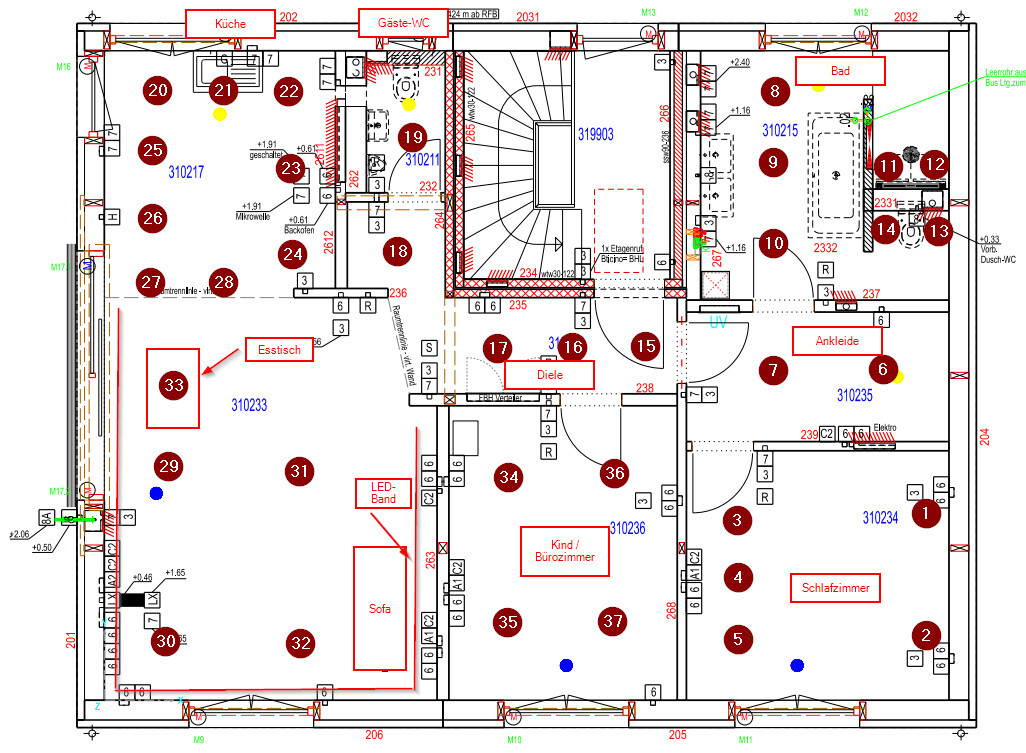
I will mainly use recessed ceiling spots, with changes only in the bedrooms and living/dining area.
Lamps 1 to 5 will be warm white fixtures. In the hallway, I planned three ceiling spotlights, but I’m still unsure whether to add an LED strip about 30cm (12 inches) above the finished floor as indirect lighting. The lighting transition from the hallway to the living/dining area is also still unclear to me. The dining table will be the focal point of the living/dining area and is currently planned to be illuminated by a ceiling light.
In the kitchen, I will place the spots in an L-shape over the work surface. I think a central placement is not ideal, as it tends to create shadows on the countertop. Regarding spots 23 and 24, I’m uncertain about their placement since that is where the appliance wall is.
Additionally, there will be an LED strip in the living room that can be adjusted between warm white and cool white depending on the atmosphere. Another LED strip will serve as backlighting behind the TV. The sofa has now been rotated compared to the plan above and is positioned against the wall facing the balcony.
I would appreciate it if you could share your experiences and also offer honest, even harsh, criticism. I have put a lot of thought into this and would now like to finalize the lighting design but want to gather your opinions and expertise beforehand.
Thanks in advance.
we have finalized the floor plan for our new build and are currently working on the final lighting design.
All lighting and electrical systems will be connected via KNX.
[IMG width="726px"]https://st.hzcdn.com/fimgs/7192e74307b114bb_8432-w500-h328-b0-p0--.jpg[/IMG]
Here is how I planned the lighting:
I will mainly use recessed ceiling spots, with changes only in the bedrooms and living/dining area.
Lamps 1 to 5 will be warm white fixtures. In the hallway, I planned three ceiling spotlights, but I’m still unsure whether to add an LED strip about 30cm (12 inches) above the finished floor as indirect lighting. The lighting transition from the hallway to the living/dining area is also still unclear to me. The dining table will be the focal point of the living/dining area and is currently planned to be illuminated by a ceiling light.
In the kitchen, I will place the spots in an L-shape over the work surface. I think a central placement is not ideal, as it tends to create shadows on the countertop. Regarding spots 23 and 24, I’m uncertain about their placement since that is where the appliance wall is.
Additionally, there will be an LED strip in the living room that can be adjusted between warm white and cool white depending on the atmosphere. Another LED strip will serve as backlighting behind the TV. The sofa has now been rotated compared to the plan above and is positioned against the wall facing the balcony.
I would appreciate it if you could share your experiences and also offer honest, even harsh, criticism. I have put a lot of thought into this and would now like to finalize the lighting design but want to gather your opinions and expertise beforehand.
Thanks in advance.
 Malle Zwabber22 Feb 2025 10:17
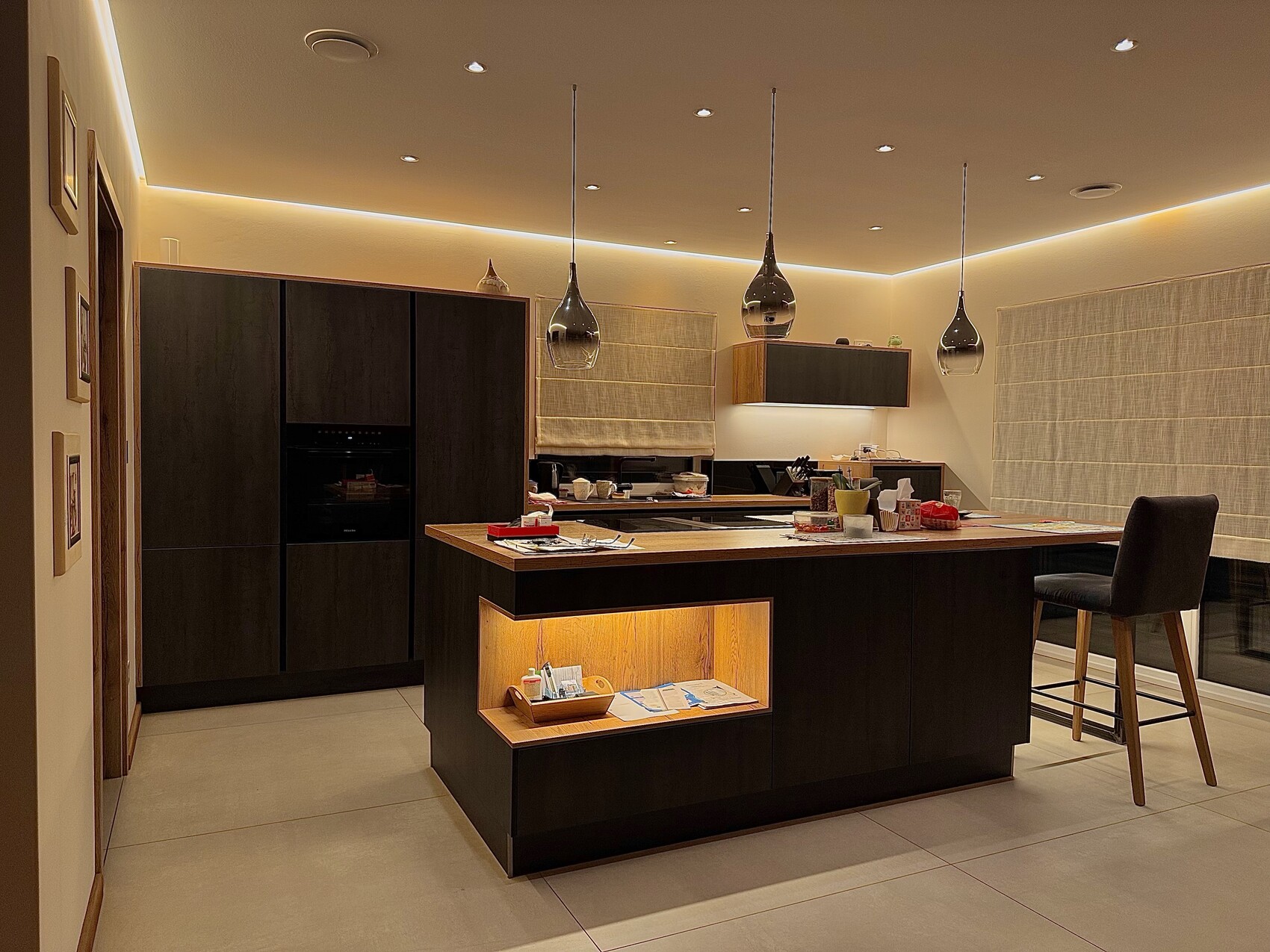
I have worked with all types of lighting in my house. I mainly use spotlights for the kitchen, pendant lights for the dining area, and indirect lighting for a cozy atmosphere. All of them are also dimmable.
W
wiltshire22 Feb 2025 10:21Molybdean schrieb:
I consider my eyesight good, but I can’t manage to see flickering from PWM in reasonably up-to-date technology. If you have good eyesight, you just need to know how to recognize PWM. Take an elongated object like a pen—or even better, something longer—in your hand and swing it quickly. If you see a stroboscopic effect, meaning the object appears to move in a jerky or stepped way, then you’ve made the PWM visible.
Besides the sensitivity some people have to PWM (and it’s not only people with epilepsy), there is a noticeable connection between PWM and headaches, for example in offices or exhibition booths. As a pet owner, I am especially cautious in this regard. I don’t have any solid findings on this, but I acknowledge that animals’ eyes perceive a different range of frequencies than humans do, so I take precautions more or less as a preventive measure without really knowing the details or having scientific evidence.
M
Molybdean22 Feb 2025 10:49The visible range is around ~100 Hz, sensitive eyes can perceive up to ~400 Hz.
The stroboscopic effect is especially problematic with rotating machines.
At the 1 kHz+ frequencies I use here, I have not been able to detect any stroboscopic effect, neither by waving nor with a cordless drill.
However, I acknowledge that animals might react differently (especially due to possible coil noises that are above the human hearing threshold). So far, I have not observed any reaction to the dimming from the neighbor’s cat.
The stroboscopic effect is especially problematic with rotating machines.
At the 1 kHz+ frequencies I use here, I have not been able to detect any stroboscopic effect, neither by waving nor with a cordless drill.
However, I acknowledge that animals might react differently (especially due to possible coil noises that are above the human hearing threshold). So far, I have not observed any reaction to the dimming from the neighbor’s cat.
W
wiltshire22 Feb 2025 10:54Molybdean schrieb:
So far, I haven’t seen any reaction to the dimming from the neighbor’s cat.I haven’t experienced that myself either. What I have experienced is that changing the light in my son’s bedroom stopped his complaints about feeling unwell.
M
Molybdean22 Feb 2025 10:59wiltshire schrieb:
I haven’t experienced that myself either.
What I have experienced is that changing the light in my son’s bedroom stopped complaints about discomfort. I would much more likely attribute that to psychological effects rather than PWM 😉 The other light will also differ in color temperature, brightness, and beam angle.
Do you know at what frequency the PWM operated? As I said, below approximately 400Hz (cycles per second) this can actually occur; above that, the human eye is simply too slow.
goldfisch138 schrieb:
Where would you place the spot light? Always in the center of the intended room. Centered above the toilet and centered above the shower.