
ᐅ Integrating Fresh Air Supply for Bora Exhaust System into Kitchen Island
Created on: 18 Feb 2025 14:00
S
Schul8erHello everyone,
we are currently planning our new build and are now considering the supply and exhaust air system for our Bora system. It’s not yet 100% decided that it will be the Bora system. The InductionAir Plus system from Siemens is also said to be very good – especially attractive in terms of price.
The concept will be the same:
An open-plan kitchen with an island that has an integrated exhaust system for the cooktop. In the living room area, there is a wood-burning stove – possibly with its own fresh air supply. In winter, the exhaust system naturally has the disadvantage that warm indoor air is extracted and cold outside air enters when windows are open.
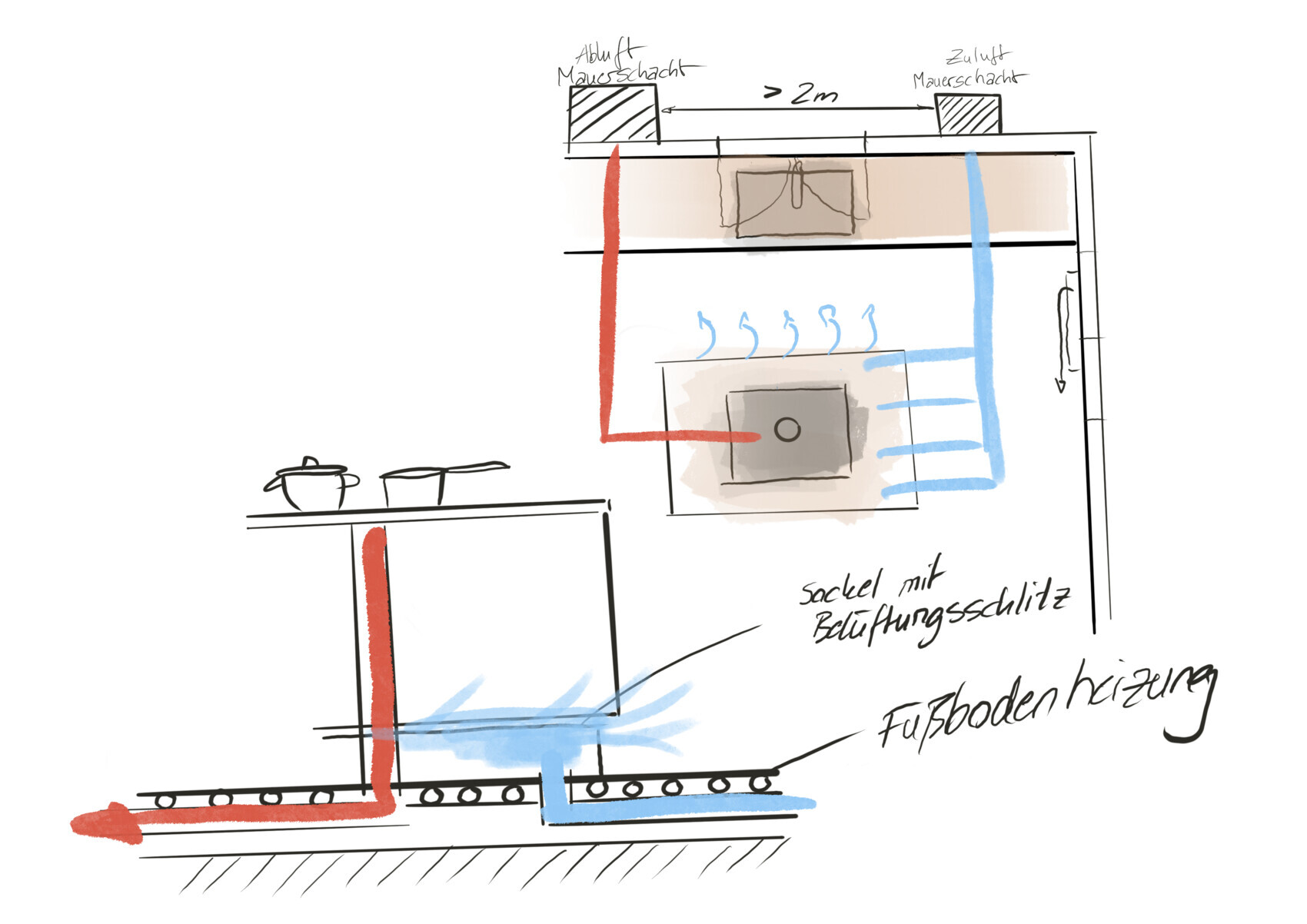
I’ve read that it can be useful to channel the supply air for the exhaust system into the plinth area of the kitchen cabinets. The surrounding air can be slightly preheated by the underfloor heating, and the cold air is already at floor level. In the worst case, you just have cold feet. I have sketched the concept once. I would lead the supply air into the plinth of the island and create a gap to the cabinet carcass so that fresh air can flow into the room at this point. Supply and exhaust air vents are spatially separated on the exterior wall and situated at floor level (possibly through a wall box or light well) to avoid condensation forming on rising ducts. Check valves would probably need to be installed.
Does anyone have experience with this kind of solution? What distance should supply and exhaust vents have, both in the kitchen and on the exterior wall? What else should be considered? Does the exhaust system still need a “fresh air contact” or pressure sensor if there is a wood stove with its own fresh air supply?
I appreciate all experiences and advice.
Regards
we are currently planning our new build and are now considering the supply and exhaust air system for our Bora system. It’s not yet 100% decided that it will be the Bora system. The InductionAir Plus system from Siemens is also said to be very good – especially attractive in terms of price.
The concept will be the same:
An open-plan kitchen with an island that has an integrated exhaust system for the cooktop. In the living room area, there is a wood-burning stove – possibly with its own fresh air supply. In winter, the exhaust system naturally has the disadvantage that warm indoor air is extracted and cold outside air enters when windows are open.
I’ve read that it can be useful to channel the supply air for the exhaust system into the plinth area of the kitchen cabinets. The surrounding air can be slightly preheated by the underfloor heating, and the cold air is already at floor level. In the worst case, you just have cold feet. I have sketched the concept once. I would lead the supply air into the plinth of the island and create a gap to the cabinet carcass so that fresh air can flow into the room at this point. Supply and exhaust air vents are spatially separated on the exterior wall and situated at floor level (possibly through a wall box or light well) to avoid condensation forming on rising ducts. Check valves would probably need to be installed.
Does anyone have experience with this kind of solution? What distance should supply and exhaust vents have, both in the kitchen and on the exterior wall? What else should be considered? Does the exhaust system still need a “fresh air contact” or pressure sensor if there is a wood stove with its own fresh air supply?
I appreciate all experiences and advice.
Regards
D
derdietmar18 Feb 2025 14:13Hello,
no outward venting, instead an air outlet at floor level. This saves a lot of effort, potential errors, and costs. It works just as well.
Your solution would also need to be waterproof in the base area (including the ventilation ducts). I would estimate the costs for the duct installation alone to be over 2000 Euro.
Best regards
no outward venting, instead an air outlet at floor level. This saves a lot of effort, potential errors, and costs. It works just as well.
Your solution would also need to be waterproof in the base area (including the ventilation ducts). I would estimate the costs for the duct installation alone to be over 2000 Euro.
Best regards
Exhaust air is fine as it is, but it would be sufficient to let the supply air enter at the window line and then exit there. For this, a so-called shadow gap between the base and the bottom edge of the carcass is enough. I assume you are also having underfloor heating loops installed beneath that line.
Overall, I would discuss this again with the HVAC specialist.
Overall, I would discuss this again with the HVAC specialist.
J
Jesse Custer18 Feb 2025 15:52I admit: in our case, the unit simply sucks in the cooking air from above and then blows it out filtered and dried below at the base underneath the kitchen cabinet.
I wouldn’t have thought to make such a fuss about it...
I wouldn’t have thought to make such a fuss about it...
@Jesse Custer .. with this, you are a supply air user. You then ventilate moisture through the window after or during cooking, or more slowly through the controlled residential ventilation system. In contrast, there are exhaust air users who want to expel the moist air directly outside.
kbt09 schrieb:
In contrast, there are exhaust air users who want the humid air to be removed directly outside. That was the reason behind choosing exhaust air. We have friends who are completely satisfied with their recirculating air system. For them, it’s fine to open the window wide after cooking to get rid of the humid air and odors. My parents-in-law open the window during cooking with their exhaust air system. If possible, I would like to avoid this in both cases.
Installing the supply air under the cabinets by the window is certainly an option, but I thought I might lose more residual heat from the underfloor heating if I extend all the way to the island. From a cost perspective, fewer supply air ducts are probably more sensible.
How is the shadow gap technically implemented? Does the supply air duct end bluntly, with an open end in the plinth area below the cabinet carcass? Or is it somehow distributed to several outlets? Thanks in advance.
Similar topics