
ᐅ Floor plan design for 170 sqm, pitched roof, 1.5 storeys (1.5 floors)
Created on: 16 Feb 2025 20:46
H
hannes28Hello dear forum,
We have purchased a plot with an existing building (unfortunately in very poor condition) and plan to build a single-family house after demolition. In recent months, alongside preparations for the demolition, we have been working on plans for our new home, which we will soon present to several local general contractors. We are very interested in your honest opinions on whether our planning seems promising or if we are on the wrong track.
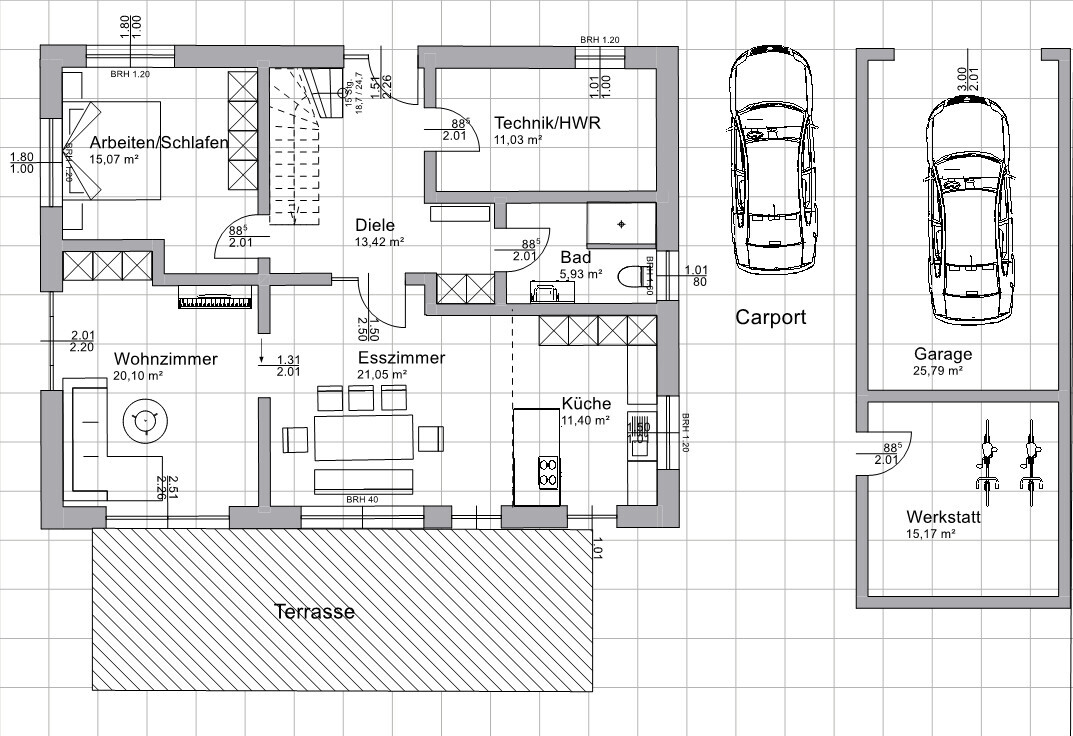
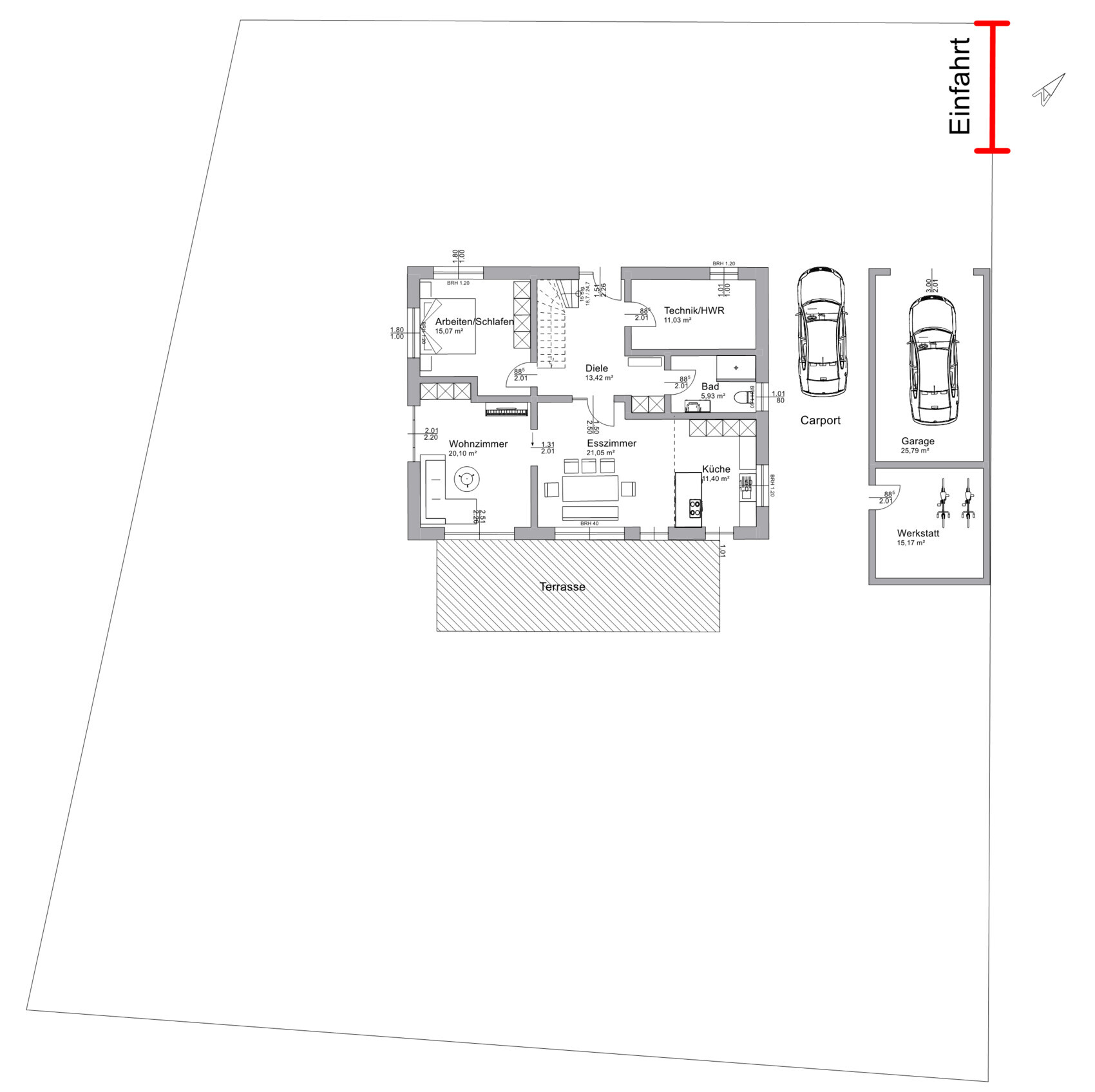
For the design, it is important to us that the ground floor allows for barrier-free living if needed in the future. In terms of layout, we want the house to open primarily towards the large, private garden. The garage of the existing house is currently located in the west corner; we would like to place it in the northeast next to the neighbor’s existing garage.
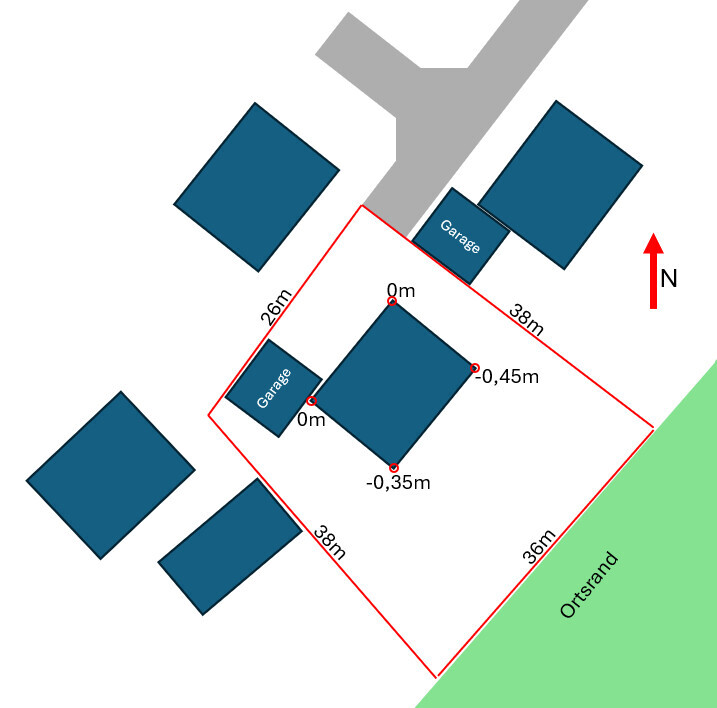
The existing house to be demolished is fully basemented, though the basement on the driveway side is only about 1.50m (5 feet) deep in the ground due to the sewer depth, and the ground floor is elevated around 1.20m (4 feet). This means there is already a foundation pit after demolition, which could support building with a basement. However, for our new single-family house, we definitely want a barrier-free, level entrance, so a basement would require a deeper pit and, due to the site conditions, a sewage lift station. We will discuss refilling the pit and the associated costs with the excavation contractor in the coming weeks, so there are no concrete figures yet. It might be possible to recycle demolition material on site for backfilling with our excavator. At the moment, we are leaning strongly towards building without a basement, as we prefer utility rooms and a workshop on ground level, and we are quite discouraged by many (including personal) experiences with damp or flooded basements.
Thank you very much for your feedback!
hannes28
-----------------------------------------------------------------------------
Development plan/restrictions: Old zoning plan from the 1960s with relatively few specifications. Only single-story buildings are officially allowed on the lot, but there is currently a house with ground floor plus attic on it, and there are many deviations in the neighborhood. Overall, the municipality is quite open to exceptions.
Plot size: 1100sqm (0.27 acres)
Slope: approximately 45cm (18 inches) downhill across the house width, see site plan
Floor area ratio: /
Gross floor area ratio: /
Building envelope, setback line, and boundary: not further southeast than neighboring developments
Edge development: /
Number of parking spaces: /
Number of stories: according to zoning plan ground floor only, but currently built with ground floor plus attic
Roof form: gable roof
Architectural style: /
Orientation: /
Maximum heights/restrictions: /
Further requirements: /
Homeowner requirements
Style, roof form, building type: traditional style, 1.5 stories, gable roof (current plan: 1m (3 feet) knee wall, 38° pitch), solid masonry construction
Basement, stories: currently tending towards no basement, 1.5 stories
Number of occupants, age: currently 2 × 30 years old, planning for 2–3 children
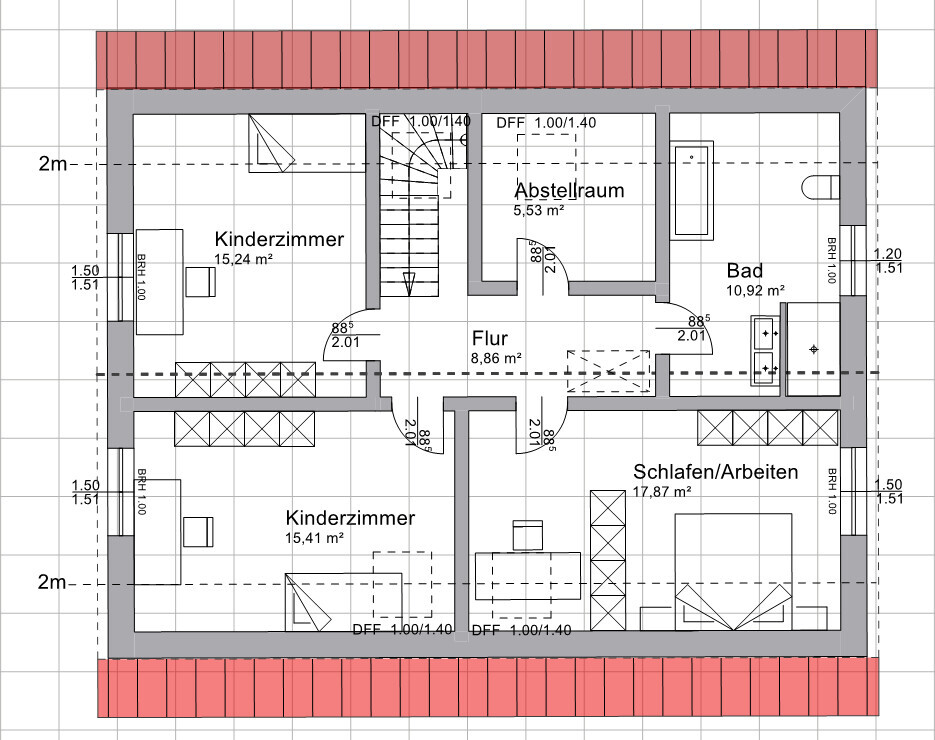
Room requirements for ground floor and upper floor: Ground floor: kitchen + dining, living room, "flexible room" (home office or barrier-free bedroom), shower bath, utility/technical room; Upper floor: master bedroom with home office corner, 2 children’s rooms, bathroom, possibly storage room
Office: Family use or home office?: 50% home office
Guest overnight stays per year: fewer than 5
Open or closed architecture: rather closed
Conservative or modern building style: rather conservative
Open kitchen, cooking island: preferably open with cooking island, but not a must
Number of dining seats: large table for 6–8 people
Fireplace: rather not
Music / stereo wall: yes for music, TV is not a priority
Balcony, roof terrace: no
Garage, carport: garage plus adjoining rooms for workshop and garden tools; possibly a carport between garage and house
Vegetable garden, greenhouse: approximately 50sqm (540 square feet) vegetable garden would be perfect
Further wishes / special features / daily routine, also reasons why something should or should not be included
- Living room as a retreat, e.g., for piano playing
- Large dining table is the central place
House design
Who created the plan:
- Do-it-yourself
What do you like particularly? Why?: separated living room (as a retreat & for music); barrier-reduced ground floor, living on one level possible in old age
What do you dislike? Why?: no possibility for a fixed staircase to the attic in case it is developed later; no pantry
Price estimate according to architect/planner: /
Personal budget for the house, including fittings: 750,000 including garage
Preferred heating technology: heat pump, preferably ground-source with underfloor collector
If you had to give up, on which details/expansions
- Could you give up: /
- Could you not give up: possibility for barrier-free living on the ground floor
Why is the design as it is now?
- many iterations of own planning
- orientation of kitchen/dining/living towards the garden
- staircase near the entrance (acoustic separation from living area, possibility to separate upper floor)
- we would like to place the garage on the northeast side, where the neighbor’s garage already stands
- layout not yet fully optimized to the last detail, e.g., exact window positions based on brick work pattern, etc.
What do you think makes it particularly good or bad?
Good:
- nice visual axis from entrance to garden
- living room as a separable retreat but still connected to the dining area
Bad:
- still unsure how to practically connect the garage/carport roofing to the house
We have purchased a plot with an existing building (unfortunately in very poor condition) and plan to build a single-family house after demolition. In recent months, alongside preparations for the demolition, we have been working on plans for our new home, which we will soon present to several local general contractors. We are very interested in your honest opinions on whether our planning seems promising or if we are on the wrong track.
For the design, it is important to us that the ground floor allows for barrier-free living if needed in the future. In terms of layout, we want the house to open primarily towards the large, private garden. The garage of the existing house is currently located in the west corner; we would like to place it in the northeast next to the neighbor’s existing garage.
The existing house to be demolished is fully basemented, though the basement on the driveway side is only about 1.50m (5 feet) deep in the ground due to the sewer depth, and the ground floor is elevated around 1.20m (4 feet). This means there is already a foundation pit after demolition, which could support building with a basement. However, for our new single-family house, we definitely want a barrier-free, level entrance, so a basement would require a deeper pit and, due to the site conditions, a sewage lift station. We will discuss refilling the pit and the associated costs with the excavation contractor in the coming weeks, so there are no concrete figures yet. It might be possible to recycle demolition material on site for backfilling with our excavator. At the moment, we are leaning strongly towards building without a basement, as we prefer utility rooms and a workshop on ground level, and we are quite discouraged by many (including personal) experiences with damp or flooded basements.
Thank you very much for your feedback!
hannes28
-----------------------------------------------------------------------------
Development plan/restrictions: Old zoning plan from the 1960s with relatively few specifications. Only single-story buildings are officially allowed on the lot, but there is currently a house with ground floor plus attic on it, and there are many deviations in the neighborhood. Overall, the municipality is quite open to exceptions.
Plot size: 1100sqm (0.27 acres)
Slope: approximately 45cm (18 inches) downhill across the house width, see site plan
Floor area ratio: /
Gross floor area ratio: /
Building envelope, setback line, and boundary: not further southeast than neighboring developments
Edge development: /
Number of parking spaces: /
Number of stories: according to zoning plan ground floor only, but currently built with ground floor plus attic
Roof form: gable roof
Architectural style: /
Orientation: /
Maximum heights/restrictions: /
Further requirements: /
Homeowner requirements
Style, roof form, building type: traditional style, 1.5 stories, gable roof (current plan: 1m (3 feet) knee wall, 38° pitch), solid masonry construction
Basement, stories: currently tending towards no basement, 1.5 stories
Number of occupants, age: currently 2 × 30 years old, planning for 2–3 children
Room requirements for ground floor and upper floor: Ground floor: kitchen + dining, living room, "flexible room" (home office or barrier-free bedroom), shower bath, utility/technical room; Upper floor: master bedroom with home office corner, 2 children’s rooms, bathroom, possibly storage room
Office: Family use or home office?: 50% home office
Guest overnight stays per year: fewer than 5
Open or closed architecture: rather closed
Conservative or modern building style: rather conservative
Open kitchen, cooking island: preferably open with cooking island, but not a must
Number of dining seats: large table for 6–8 people
Fireplace: rather not
Music / stereo wall: yes for music, TV is not a priority
Balcony, roof terrace: no
Garage, carport: garage plus adjoining rooms for workshop and garden tools; possibly a carport between garage and house
Vegetable garden, greenhouse: approximately 50sqm (540 square feet) vegetable garden would be perfect
Further wishes / special features / daily routine, also reasons why something should or should not be included
- Living room as a retreat, e.g., for piano playing
- Large dining table is the central place
House design
Who created the plan:
- Do-it-yourself
What do you like particularly? Why?: separated living room (as a retreat & for music); barrier-reduced ground floor, living on one level possible in old age
What do you dislike? Why?: no possibility for a fixed staircase to the attic in case it is developed later; no pantry
Price estimate according to architect/planner: /
Personal budget for the house, including fittings: 750,000 including garage
Preferred heating technology: heat pump, preferably ground-source with underfloor collector
If you had to give up, on which details/expansions
- Could you give up: /
- Could you not give up: possibility for barrier-free living on the ground floor
Why is the design as it is now?
- many iterations of own planning
- orientation of kitchen/dining/living towards the garden
- staircase near the entrance (acoustic separation from living area, possibility to separate upper floor)
- we would like to place the garage on the northeast side, where the neighbor’s garage already stands
- layout not yet fully optimized to the last detail, e.g., exact window positions based on brick work pattern, etc.
What do you think makes it particularly good or bad?
Good:
- nice visual axis from entrance to garden
- living room as a separable retreat but still connected to the dining area
Bad:
- still unsure how to practically connect the garage/carport roofing to the house
hannes28 schrieb:
You cannot do without: the option for barrier-free living on the ground floorThat is not possible. The bathroom is far from accessible. (The kitchen is also a dead end.)
We are facing a similar project. When we asked our home planner / energy consultant about a surface collector, he advised against it: no plants would grow there anymore. It would just become a lawn.
Our building plot is much smaller. In your case, both options might fit. Just consider in advance where the collector should be located and how the garden in that area will be used.
Also, just throwing this out there in case you’re not already familiar: the trench collector as a special form of surface collector could also be an option here.
Our building plot is much smaller. In your case, both options might fit. Just consider in advance where the collector should be located and how the garden in that area will be used.
Also, just throwing this out there in case you’re not already familiar: the trench collector as a special form of surface collector could also be an option here.
Too bad I can’t edit here, so this is a double post:
I would also consider attaching the garage to the neighbor’s garage. That’s how it looks to me in your floor plan. This way, you could possibly set the garage a bit forward so it aligns with the neighbor’s garage to the north.
The site plan probably shows the existing building?
Another point: the walls on the ground floor and upper floor seem to be quite offset from each other in places. I’m not a structural engineer, but it seems advisable to consult one before spending too much time on floor plans that might ultimately be unbuildable.
For the bathroom on the upper floor, you should consider whether there’s enough space at the sink. It could be tight, and someone standing at the mirror might get hit by the door if someone comes in.
Best regards
I would also consider attaching the garage to the neighbor’s garage. That’s how it looks to me in your floor plan. This way, you could possibly set the garage a bit forward so it aligns with the neighbor’s garage to the north.
The site plan probably shows the existing building?
Another point: the walls on the ground floor and upper floor seem to be quite offset from each other in places. I’m not a structural engineer, but it seems advisable to consult one before spending too much time on floor plans that might ultimately be unbuildable.
For the bathroom on the upper floor, you should consider whether there’s enough space at the sink. It could be tight, and someone standing at the mirror might get hit by the door if someone comes in.
Best regards
KJaneway schrieb:
I would also consider attaching the garage to the neighbor’s garage. That’s how it looks to me in your floor plan. This way, you could possibly set the garage a bit forward so that it aligns with the neighbor’s garage to the north. Since the site plan doesn’t reflect what the current plan phase proposes, moving the garage forward from the plan phase would probably make it difficult to actually enter the garage. I estimate the driveway to the property is about 4 to a maximum of 5 meters wide (13 to 16 feet).
KJaneway schrieb:
In the upstairs bathroom, you should consider whether there is enough space around the sink. It might be just tight enough for someone applying makeup in front of the mirror to get hit by the door when entering. I agree with that.
However, there is also the fundamental question of accessibility on the ground floor, which I, like @ypg, do not see as being met. So, the question to @hannes28 is: is there already an official diagnosis that will require this sooner or later, or is this “just” in case you end up spending more time in the house as you get older?
Hello everyone,
Thank you very much for your quick replies and constructive feedback!
Best regards
Hannes
Thank you very much for your quick replies and constructive feedback!
ypg schrieb:I completely agree with you about the bathroom, but it could be relatively easily extended to the left around the wardrobe area. Where do you see the problem with the kitchen?
It’s not possible. The bathroom is anything but accessible.
(The kitchen is a dead end, too)
KJaneway schrieb:That’s a good point. I think whether to choose a collector at all, and which type, ultimately depends on the house’s energy demand and the required collector surface. Then we can make a decision. For example, if the ground collector can be installed under a planned “play lawn” anyway, that wouldn’t be a problem.
We’re working on a similar project. When we asked our home designer/energy consultant about a ground collector, he advised against it: No plants will grow anymore. It just becomes lawn.
...
Just throwing this out there, in case you haven’t heard of it yet: the trench collector, a special type of ground collector, might also be suitable here.
KJaneway schrieb:Extending the garage forward will be difficult due to the driveway. The driveway width is about 4.50m (15 feet), so you definitely need enough space for maneuvering.
I would also consider placing the garage next to the neighbor’s garage. That’s how it looks in your floor plan. That way you could possibly move the garage forward a bit so it is aligned with the neighbor’s garage to the north.
KJaneway schrieb:Exactly, the site plan shows the situation before demolition.
The site plan probably shows the existing building?
KJaneway schrieb:We are aware of the issue with walls not aligning on top of each other. However, I wondered how big a problem this really is, since many standard solid-construction houses we looked at online also have walls that don’t line up exactly.
Another point: the walls on the ground floor and upper floor appear to be significantly offset from each other in some areas. I’m not a structural engineer, but I think it’s worth discussing before investing too much time in floor plans that might ultimately not be buildable.
KJaneway schrieb:Good point. Space-wise, an alternative layout should work. We will take another look at that.
In the upper floor bathroom, you should consider whether there is enough space at the sink. It could be just enough that someone applying makeup in front of the mirror might get hit by the door when it’s opened.
kbt09 schrieb:Thanks for asking. Luckily, we are currently doing well and do not need accessibility features at the moment. Our concern is about being able to stay in the house in case of (hypothetical) illness or accident, whether in old age or earlier. We have already observed many cases among family and friends where the absence of a living room or shower bathroom on the ground floor made home care impossible, but in other cases, living at home was no problem because all important functions were on one level. Perhaps that is why the term “accessible” according to the DIN standard is not quite appropriate for us, as we do not necessarily have to meet it; it is more about not blocking ourselves off or creating unnecessary barriers. If a bathroom needs to be modified after a disability occurs, that’s possible, but if I don’t have a bathroom or extra room on the ground floor at all, things look worse.
But there is still the fundamental question of accessibility on the ground floor, which I, like @ypg, do not see as given. So the question to @hannes28 ... is there currently a diagnosed condition that makes this necessary sooner or later, or is this “just” for possibly needing it as you get older?
Best regards
Hannes
Similar topics