
ᐅ Challenging Floor Plan, Plot, and Historic Building – Section 34
Created on: 11 Feb 2025 21:44
B
buttyhome
Dear Forum,
First of all, we would like to introduce ourselves. We are a family of four and have now found a nice sloped plot in NRW. We are aware that it is considered a "challenging plot" in terms of buildability, but we have fallen in love with the location and the view. It is a total of 390 m² (4200 sq ft) of building land, with green space extending behind the plot. Currently, it is occupied by two buildings, the front one of which is a listed monument requiring renovation. The rear building is in such poor condition that it must be demolished. Of course, the monument must not be significantly disturbed within its ensemble, so a modern flat roof is unfortunately not possible. However, I am hopeful that we can connect the monument with our planned new building by a joint or gap.
First, the current situation: the front house is the monument, which I intend to renovate and use as a home office/guest room.
The front house currently has two floors, but ceiling heights no longer meet our needs due to our height, so we plan, as far as possible, to remove some walls and the ceiling between floors to expose the beams.
Now to our planned new build. We are working with an architect we really trust, who has designed and renovated some truly excellent houses within our circle of friends.
Development plan / restrictions
Plot size: buildable - 390 m² (4200 sq ft), with green space behind
Slope: yes, ascending towards the rear, with an incline between 8 and 12 %, so the house will sit at the lower part of the slope. Unfortunately, the view into the valley can only be enjoyed from the upper floor due to buildings on the opposite side of the street.
§34 construction: “mixed neighborhood”, single and two-story buildings with flat and pitched roofs, some 2.5-story pitched roofs
Edge development: apparently quite common in the neighborhood. My architect is more optimistic than I am that edge development will be allowed.
Number of parking spaces: 1
Number of stories: two full floors + pitched roof
Roof type: pitched roof
Style: must integrate with the half-timbered monument for an overall harmony (please no historicism, I prefer modern architecture, perhaps with wooden cladding)
Orientation: The architect insists on building the eaves side facing the street because of window areas. I am unsure if this is possible due to boundary constraints, so I suggest a gable orientation as an alternative. I am particularly interested in your ideas here! We are still in the very first planning phase.
Maximum height / limits: 2.5 stories
Client requirements
Number of occupants: 2 adults + 2 children
Ground floor space needs: master bedroom, 2 children's bedrooms, 2 bathrooms, separate cloakroom, either at the rear (slope) or in the basement: laundry room, storage, building services
Upper floor: large open-plan kitchen and living area with garden access, fireplace, guest toilet
Office: combined with guest room
Occasional overnight guests per year
Open or closed architecture: open plan
Traditional or modern design: modern
Open kitchen with island
Minimum dining seats: 8
Fireplace: yes
Music/speaker wall: no
Balcony, roof terrace: no
Carport
House design
Not yet available, we are still assessing the basic buildability
Designer: architect versus own ideas
Personal budget for house including fittings: initially open, we want to see what is possible
Preferred heating system: heat pump
If you had to give up something, which details or features
- can you do without: -
- cannot do without: large window front facing the garden with direct garden/terrace access
Here is the architect’s first concept. She assumes basic buildability including edge development and therefore wants to place the new build with the eaves side directly adjacent to the neighbor. I would prefer a longer joint/gap, but that would make the edge building length disproportionate. I find that unfortunate as I would like the new building positioned further back in the plot to create a larger front courtyard. This is the first idea currently being checked for feasibility by the building and monument authorities:
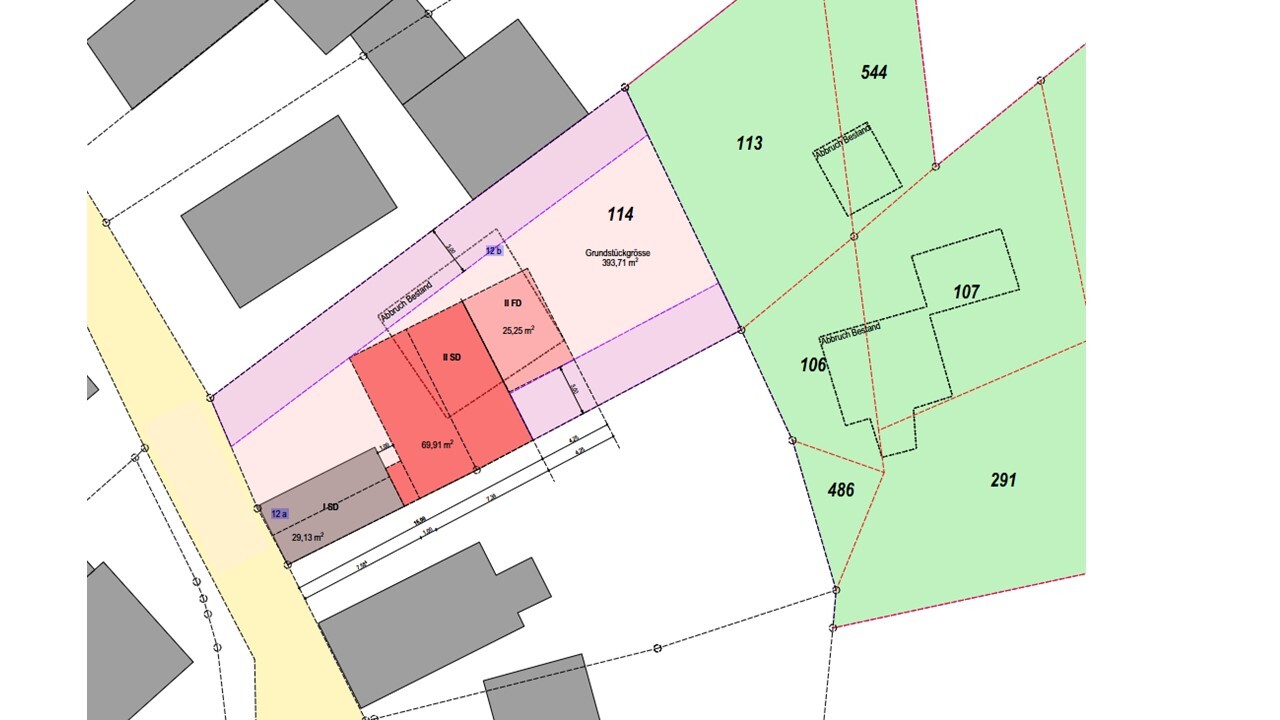
The extension toward the garden is optional and designed with a flat roof.
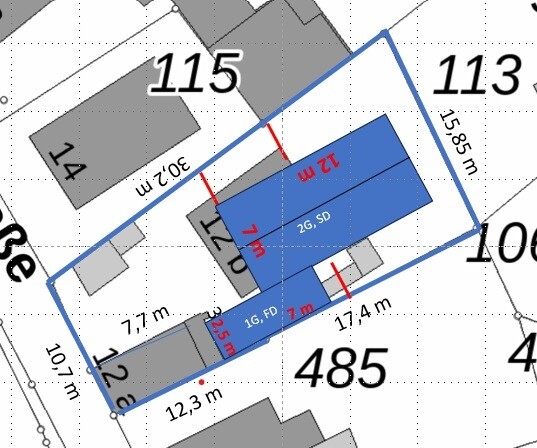
My idea would be to extend the building joint further, placing the entrance and cloakroom there, with the new building accessed above. This new building would be rotated to face with its gable. Because it would extend far into the slope, the ground floor would effectively become a basement, and the upper floor would have direct garden access at ground level. I would also need to encroach on the neighboring boundary, but I imagine this might be simpler as I am only planning a single story there. Would the house then have enough windows? You don’t want to orient large window fronts too much towards neighbors, but at least toward the garden I would like to have a large gable window area.
Thank you very much for your suggestions! What do you think is feasible? What are the pros and cons?
I am also still looking for a contour map. All the maps I find online are somewhat coarse. Is there an online resource for NRW? What options should I select in the NRW geoportal to get a good detailed representation?
First of all, we would like to introduce ourselves. We are a family of four and have now found a nice sloped plot in NRW. We are aware that it is considered a "challenging plot" in terms of buildability, but we have fallen in love with the location and the view. It is a total of 390 m² (4200 sq ft) of building land, with green space extending behind the plot. Currently, it is occupied by two buildings, the front one of which is a listed monument requiring renovation. The rear building is in such poor condition that it must be demolished. Of course, the monument must not be significantly disturbed within its ensemble, so a modern flat roof is unfortunately not possible. However, I am hopeful that we can connect the monument with our planned new building by a joint or gap.
First, the current situation: the front house is the monument, which I intend to renovate and use as a home office/guest room.
The front house currently has two floors, but ceiling heights no longer meet our needs due to our height, so we plan, as far as possible, to remove some walls and the ceiling between floors to expose the beams.
Now to our planned new build. We are working with an architect we really trust, who has designed and renovated some truly excellent houses within our circle of friends.
Development plan / restrictions
Plot size: buildable - 390 m² (4200 sq ft), with green space behind
Slope: yes, ascending towards the rear, with an incline between 8 and 12 %, so the house will sit at the lower part of the slope. Unfortunately, the view into the valley can only be enjoyed from the upper floor due to buildings on the opposite side of the street.
§34 construction: “mixed neighborhood”, single and two-story buildings with flat and pitched roofs, some 2.5-story pitched roofs
Edge development: apparently quite common in the neighborhood. My architect is more optimistic than I am that edge development will be allowed.
Number of parking spaces: 1
Number of stories: two full floors + pitched roof
Roof type: pitched roof
Style: must integrate with the half-timbered monument for an overall harmony (please no historicism, I prefer modern architecture, perhaps with wooden cladding)
Orientation: The architect insists on building the eaves side facing the street because of window areas. I am unsure if this is possible due to boundary constraints, so I suggest a gable orientation as an alternative. I am particularly interested in your ideas here! We are still in the very first planning phase.
Maximum height / limits: 2.5 stories
Client requirements
Number of occupants: 2 adults + 2 children
Ground floor space needs: master bedroom, 2 children's bedrooms, 2 bathrooms, separate cloakroom, either at the rear (slope) or in the basement: laundry room, storage, building services
Upper floor: large open-plan kitchen and living area with garden access, fireplace, guest toilet
Office: combined with guest room
Occasional overnight guests per year
Open or closed architecture: open plan
Traditional or modern design: modern
Open kitchen with island
Minimum dining seats: 8
Fireplace: yes
Music/speaker wall: no
Balcony, roof terrace: no
Carport
House design
Not yet available, we are still assessing the basic buildability
Designer: architect versus own ideas
Personal budget for house including fittings: initially open, we want to see what is possible
Preferred heating system: heat pump
If you had to give up something, which details or features
- can you do without: -
- cannot do without: large window front facing the garden with direct garden/terrace access
Here is the architect’s first concept. She assumes basic buildability including edge development and therefore wants to place the new build with the eaves side directly adjacent to the neighbor. I would prefer a longer joint/gap, but that would make the edge building length disproportionate. I find that unfortunate as I would like the new building positioned further back in the plot to create a larger front courtyard. This is the first idea currently being checked for feasibility by the building and monument authorities:
The extension toward the garden is optional and designed with a flat roof.
My idea would be to extend the building joint further, placing the entrance and cloakroom there, with the new building accessed above. This new building would be rotated to face with its gable. Because it would extend far into the slope, the ground floor would effectively become a basement, and the upper floor would have direct garden access at ground level. I would also need to encroach on the neighboring boundary, but I imagine this might be simpler as I am only planning a single story there. Would the house then have enough windows? You don’t want to orient large window fronts too much towards neighbors, but at least toward the garden I would like to have a large gable window area.
Thank you very much for your suggestions! What do you think is feasible? What are the pros and cons?
I am also still looking for a contour map. All the maps I find online are somewhat coarse. Is there an online resource for NRW? What options should I select in the NRW geoportal to get a good detailed representation?
B
buttyhome16 Feb 2025 12:15haydee schrieb:
In the end, our costs were 42,000 including disposal of everything. One factor that saved money was that we had the time.
Thanks for the tips! Demolition really takes a lot of time. Right now, we’re mainly waiting for the building authority’s decision on what can be done on the plot. We don’t want to rely on legal non-conformity protection if the building is already gone...We also have a slope. Everyone agreed not to touch the slope.
What is legally possible is up to your architect. I think his proposal is quite good.Yes, that seems to be the general consensus here. At the moment, I find it too dark behind the building. The slope rises steeply right behind the house. I had hoped to move some material to create a level area first, which would also let in more light... Or maybe a bridge into the garden instead?

buttyhome schrieb:
That will come up eventually anywayFor me, it would only be a hobby project if there is extra money available. From what I understand, you don’t actually want to live in it. Others probably feel the same, depending on demand. So how do you use it to justify a loan? Of course, it’s different if you have the cash lying around and enjoy the project. That’s why the question about the budget and how it is composed is fundamental.buttyhome schrieb:
I was hoping to move some material around to create a flat ground surface first, which would also let in more light... A slope remains a slope. The more soil you move back and forth, the more you will have to retain. I also don’t see how that would make it any brighter. But I do agree that light is one of the main issues. Am I right in assuming that the architect’s design includes no windows on the south side (= boundary wall)?
buttyhome schrieb:
I can probably forget about renovating a historic listed building by about 90 percent. Over what time frame, and are there no caps on that? You have to pay that much in taxes first to be able to write off such amounts. The whole arrangement isn’t entirely clear to me, unfortunately.
buttyhome schrieb:
I currently find it too dark behind the building. I agree, although the topographic map section is really quite limited. It would also be useful to know the full extent of the plot now, including the garden.
So the question remains: where to place the terrace? It’s quite shady on the east side. That can be nice in midsummer, but generally it’s not the most inviting spot (though that is a matter of taste). I could imagine a terrace on the west side, maybe as a courtyard with a front garden, etc. But in my opinion that depends heavily on traffic – if many cars pass by, that quickly becomes annoying.
The south and north sides are probably too close to the fence.
If it were mine, I would probably place the terrace on the east side (because I am very sensitive to traffic noise) – depending on the height perhaps on the upper floor or split-level. To avoid it feeling too dark, I would likely design the dining area as a conservatory extension. My aunt did something similar and it’s very nice (though expensive). The question of the south side of the house will be interesting. Having no windows there would not be an option for me. That’s why the architect’s suggestion would be off the table (if that’s how it actually is). Unfortunately, the information about alternatives is too vague. Somehow I can’t imagine you would be allowed to build right on the northern boundary. So it would probably be more like your proposal after all.
I would not build a bridge into the garden. The designer from a house supplier suggested such a structure. Retaining wall, 1 m (3.3 ft) of air, and then the house. The windows receive hardly any light, and the whole thing ends up as a dirty pit.
We built right up to the slope, and the slope-side wall on the ground floor is a retaining wall.
If you build without a direct connection to the historic building, there are other options and possibly windows facing south after all.
We built right up to the slope, and the slope-side wall on the ground floor is a retaining wall.
If you build without a direct connection to the historic building, there are other options and possibly windows facing south after all.
B
buttyhome16 Feb 2025 15:08Great! Now the discussion is exactly where I wanted it. Things are becoming much clearer to me!
Once there’s a deep trench behind the house and the slope rises steeply, it’s actually darker than if you fill the slope behind the house up to the first floor level, then have a flat area there, and the terrace a few meters away from the house.
Thanks for pointing that out so clearly. I overlooked this problem, and the architect initially just focused on the wish to connect the historic building.
You can depreciate 9 percent of the renovation costs each year over 10 years. If I put 200,000 into the listed building, that means 18,000 depreciation per year, a huge advantage. When renting out, I can then depreciate another 7 percent.
The whole slope faces south. So if the terrace is located above the house, you have sun all day. You just have to walk a few meters. A terrace on the west side, meaning toward the street, would only be second choice. I’d like to set up a second seating area there, but I find privacy in the garden more appealing.
Both the architect and we are equally uncertain because information here is only available via a building inquiry. That takes an enormous amount of time for such a simple question and to get ideas. With “my idea” from the first post, we would mostly have free boundaries; I could build windows facing south, and further up the slope, there are no houses to the south anymore. Then the dining area with plenty of windows facing southeast, maybe a conservatory as you suggested. In any case, it has to be the upper floor, preferably with level access.
That’s exactly how I would like to do it as well. Then I would also need earth that I remove from the slope for the ground floor and backfill behind the retaining wall. Is it really so much more expensive that it explains the general skepticism here? Such earthworks are also needed with a simple basement.
It really feels good now to think this through together. By now I’m convinced that the disadvantages outweigh the benefits. Maybe I’ll be allowed to build next to the northern neighbor after all. I don’t want windows there anyway, and then I can place the terrace to the southeast. Parking space for the car would be in front of the house.
I also wouldn’t know how it could become brighter because of that.
Once there’s a deep trench behind the house and the slope rises steeply, it’s actually darker than if you fill the slope behind the house up to the first floor level, then have a flat area there, and the terrace a few meters away from the house.
But light is also one of the main problems. Am I right in assuming that the architect’s design has no windows on the south side (= boundary development)?
Thanks for pointing that out so clearly. I overlooked this problem, and the architect initially just focused on the wish to connect the historic building.
Over what period and are there no upper limits?
You can depreciate 9 percent of the renovation costs each year over 10 years. If I put 200,000 into the listed building, that means 18,000 depreciation per year, a huge advantage. When renting out, I can then depreciate another 7 percent.
Where to put the terrace
The whole slope faces south. So if the terrace is located above the house, you have sun all day. You just have to walk a few meters. A terrace on the west side, meaning toward the street, would only be second choice. I’d like to set up a second seating area there, but I find privacy in the garden more appealing.
I still somehow can’t imagine that you would be allowed to build directly on the northern boundary. So it would probably be more like your suggestion.
Both the architect and we are equally uncertain because information here is only available via a building inquiry. That takes an enormous amount of time for such a simple question and to get ideas. With “my idea” from the first post, we would mostly have free boundaries; I could build windows facing south, and further up the slope, there are no houses to the south anymore. Then the dining area with plenty of windows facing southeast, maybe a conservatory as you suggested. In any case, it has to be the upper floor, preferably with level access.
We are right up to the slope, and the slope-side wall on the ground floor is a retaining wall.
That’s exactly how I would like to do it as well. Then I would also need earth that I remove from the slope for the ground floor and backfill behind the retaining wall. Is it really so much more expensive that it explains the general skepticism here? Such earthworks are also needed with a simple basement.
If you build without a direct connection to the listed building, there are other possibilities and maybe windows facing south after all
It really feels good now to think this through together. By now I’m convinced that the disadvantages outweigh the benefits. Maybe I’ll be allowed to build next to the northern neighbor after all. I don’t want windows there anyway, and then I can place the terrace to the southeast. Parking space for the car would be in front of the house.
B
buttyhome16 Feb 2025 15:23K a t j a schrieb:
It would also be helpful to know the exact boundaries of the entire property, including the garden.
I'm currently just using my phone and trying to get a rough impression of the property in 3D view. I hope it's not too confusing.
Similar topics