
Hello, in our guest bathroom (new solid construction), the connections for the bidet were incorrectly placed (too far apart, meant for a different model) and have now been "corrected" for the Villeroy & Boch Subway 2.0 Compact.
The situation left by the HSK installer is shown in the picture; he removed a lot of material, leaving only a small amount of calcium silicate brick and a lot of foam.
The tiler said he has encountered similar situations more often in renovations of older buildings. He applies plenty of tile adhesive, lets it set, and then tiles over it.
We find this questionable because the bidet’s bolts are barely anchored in the calcium silicate brick, and the tile that the bidet is mounted on is glued onto a substrate of 4 cm (1.5 inches) tile adhesive and 10 cm (4 inches) construction foam.
For a stable substrate for tiling, I would like to reduce the construction foam and let the wall "regenerate." Without much knowledge of masonry and concrete, I am thinking of small reinforcing rods—like bolts or threaded rods—inserted into the existing calcium silicate brick above and to the side, possibly some form of formwork (or cutting the existing foam to act as formwork or adding some additional formwork by foaming) and then concreting it.
Is this sensible/feasible? If yes, what type of concrete/mortar could I use for this? Or are there better ways to rebuild a wall that is non-elastic? At what thickness, for example, would a small Wedi board be stable enough?
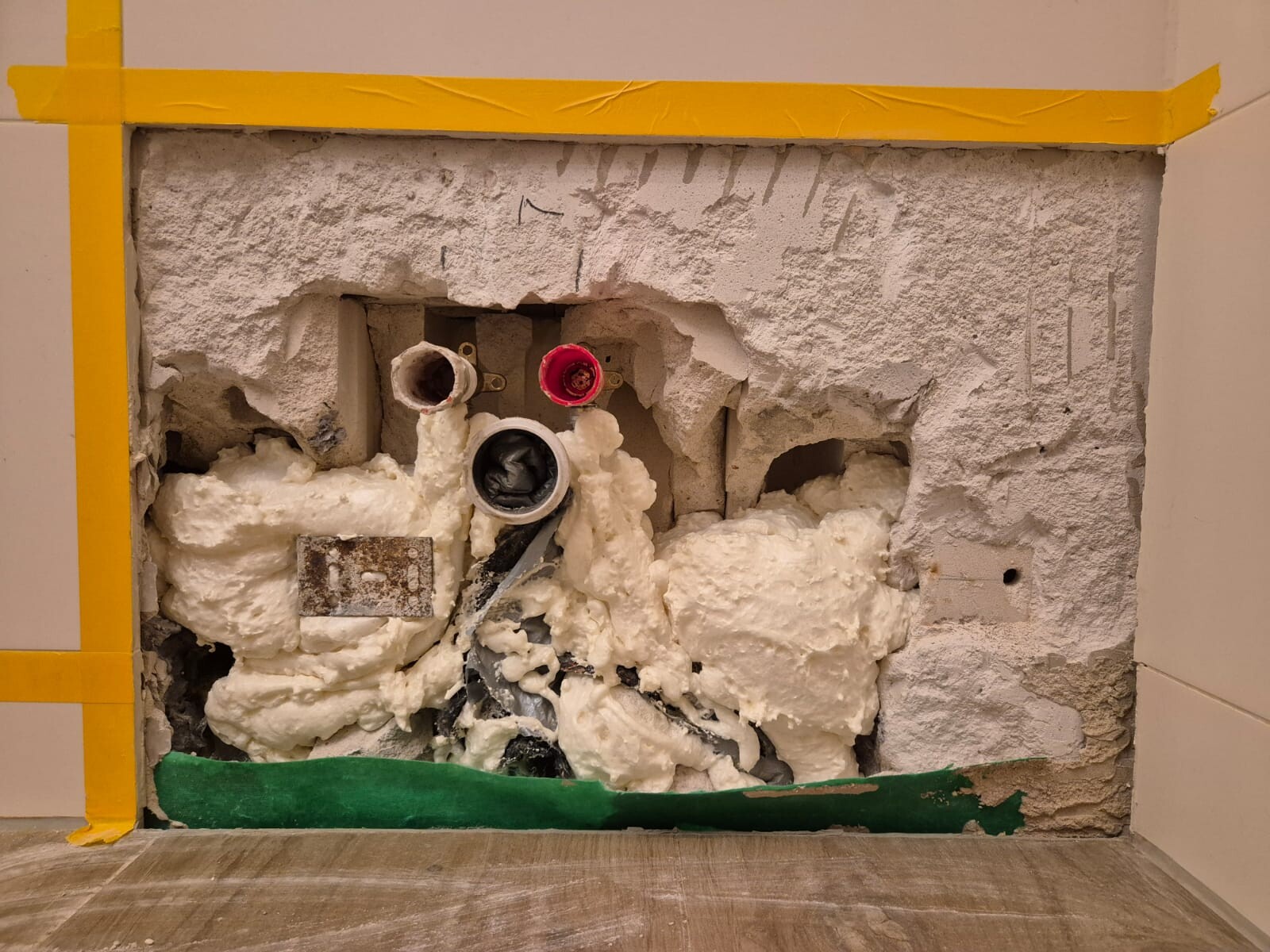
The situation left by the HSK installer is shown in the picture; he removed a lot of material, leaving only a small amount of calcium silicate brick and a lot of foam.
The tiler said he has encountered similar situations more often in renovations of older buildings. He applies plenty of tile adhesive, lets it set, and then tiles over it.
We find this questionable because the bidet’s bolts are barely anchored in the calcium silicate brick, and the tile that the bidet is mounted on is glued onto a substrate of 4 cm (1.5 inches) tile adhesive and 10 cm (4 inches) construction foam.
For a stable substrate for tiling, I would like to reduce the construction foam and let the wall "regenerate." Without much knowledge of masonry and concrete, I am thinking of small reinforcing rods—like bolts or threaded rods—inserted into the existing calcium silicate brick above and to the side, possibly some form of formwork (or cutting the existing foam to act as formwork or adding some additional formwork by foaming) and then concreting it.
Is this sensible/feasible? If yes, what type of concrete/mortar could I use for this? Or are there better ways to rebuild a wall that is non-elastic? At what thickness, for example, would a small Wedi board be stable enough?
At first glance, the color definitely resembles an archaeological find in Egypt.
The bidet will likely be mounted on a freestanding fixture and therefore practically has nothing to do with the wall. The tile adhesive bonds with the masonry and is certainly sufficient to hold the tiles in place. The tiles themselves don’t need to support anything. In that sense, I don’t see any issue with following the tiler’s approach, so your plan seems unnecessary.
The bidet will likely be mounted on a freestanding fixture and therefore practically has nothing to do with the wall. The tile adhesive bonds with the masonry and is certainly sufficient to hold the tiles in place. The tiles themselves don’t need to support anything. In that sense, I don’t see any issue with following the tiler’s approach, so your plan seems unnecessary.
No, as mentioned above – the bidet is to be fastened with 2 bolts into the calcium silicate brick (hollow brick!) visible at the top, not using any mounting element. The heating installer would use injection mortar for this. It will then hang directly on the wall or tile, so the tile must be stably and rigidly supported from behind.

On the right, I see a fixing hole drilled into the wall, and on the left, a questionable installation of a metal bracket embedded in what looks like excessive expanding foam, both located below the water supply and drain connections. The tile would essentially only connect these two anchors by acting as a common washer. In my opinion, the weak point is less the backing behind the tile and more the foundation of the metal bracket, which does not seem to be properly secured here. Reinforcing the tile underneath might protect it from breaking, but how is this measure supposed to stabilize the critical metal bracket?
https://www.instagram.com/11antgmxde/
https://www.linkedin.com/company/bauen-jetzt/
https://www.instagram.com/11antgmxde/
https://www.linkedin.com/company/bauen-jetzt/
Tim1979 schrieb:
Hello, in our guest bathroom (new solid construction), the connections for the bidet were installed incorrectly (too far apart, for a different model) and have now been "corrected" for the Villeroy & Boch Subway 2.0 Compact.
The situation left by the installer from HSK is shown in the picture; he removed a lot, leaving only a small amount of sand-lime brick and much foam. P.S.: A bidet in the guest bathroom—I’m impressed. However, in this case, I would have chosen a different bidet model rather than carry out installation-critical modifications.
https://www.instagram.com/11antgmxde/
https://www.linkedin.com/company/bauen-jetzt/
Maybe I don’t fully understand, but I find the project itself quite questionable, as the concrete block is already significantly weakened by the necessary openings for cold, hot, and wastewater pipes, even before any subsequent chiseling. There are very flat mounting elements (about 4cm (1.5 inches) thick) that sometimes don’t rest on the floor but are fixed higher up on rails attached to the wall.
In the picture, I can’t clearly see where you plan to insert the screws or threaded rods into the now damaged wall so that they would have enough grip. Even if you now add some concrete, this new block won’t properly bond with the upper concrete block and won’t gain sufficient long-term stability towards the bottom where various pipes run. The toilet next to it will likely have a front wall built up, so it might be possible to extend this to support the bidet as well. Maybe you can share other pictures. If necessary, a few tiles will have to be removed again.
I also don’t see how a threaded rod or bolt could hold securely in a layer of tile adhesive that is just slapped on.
In the picture, I can’t clearly see where you plan to insert the screws or threaded rods into the now damaged wall so that they would have enough grip. Even if you now add some concrete, this new block won’t properly bond with the upper concrete block and won’t gain sufficient long-term stability towards the bottom where various pipes run. The toilet next to it will likely have a front wall built up, so it might be possible to extend this to support the bidet as well. Maybe you can share other pictures. If necessary, a few tiles will have to be removed again.
I also don’t see how a threaded rod or bolt could hold securely in a layer of tile adhesive that is just slapped on.
Similar topics