
Hello everyone,
Two years ago, we moved into our house, including the basement.
In the basement, we created a large room, which at the moment and in the future is divided into:
One side hobby room
One side storage/pantry room
I would like to visually separate both areas. I want to do this properly and am thinking of using drywall with gypsum board panels.
Now to my questions, or rather, I would like to get some advice here:
1. Does drywall make the most sense in terms of price/performance here?
2. I would ideally like to install panels on both sides, but without insulation – does that make sense? It’s meant purely as a visual separation.
3. Regarding the door opening: Obviously, a passage is needed, but it does not have to be a hinged door – maybe a sliding option could work, or possibly just leaving it open, since the doorway area is a nice feature visually and it could also be practical to keep the passage permanently open. Of course, planning a door makes sense for the future, but maybe someone has another idea?
4. I am open to suggestions or tips to keep everything as cost-effective as possible.
Thank you very much!!
Two years ago, we moved into our house, including the basement.
In the basement, we created a large room, which at the moment and in the future is divided into:
One side hobby room
One side storage/pantry room
I would like to visually separate both areas. I want to do this properly and am thinking of using drywall with gypsum board panels.
Now to my questions, or rather, I would like to get some advice here:
1. Does drywall make the most sense in terms of price/performance here?
2. I would ideally like to install panels on both sides, but without insulation – does that make sense? It’s meant purely as a visual separation.
3. Regarding the door opening: Obviously, a passage is needed, but it does not have to be a hinged door – maybe a sliding option could work, or possibly just leaving it open, since the doorway area is a nice feature visually and it could also be practical to keep the passage permanently open. Of course, planning a door makes sense for the future, but maybe someone has another idea?
4. I am open to suggestions or tips to keep everything as cost-effective as possible.
Thank you very much!!
Harakiri schrieb:
If you use OSB and aim for standard door width/door height/door leaf dimensions, you can probably skip the UA profiles.
And yes, you can also cut one profile diagonally and fold the flaps down – but for that, you use a UW profile, not a CW profile. The special door lintel profiles have the advantage that they are usually pre-punched for standard door widths, which also helps ensure you don’t make any mistakes with the rough opening dimensions for the door. That’s right, I might still use a door lintel profile after all, since the pre-punching is definitely helpful, in my opinion. However, that doesn’t change the fact that I will also use the regular vertical profiles for the door opening, as I’m sheathing with OSB.
However, if the floor opening width is not exactly 760mm (30 inches), the pre-punched profile for 760mm (30 inches) is of no use to me... I specifically did not cut out the floor in the door opening area. This way, I have more flexibility when working without a special door lintel profile.
Update:
The frame construction is completely assembled and looks great.
The rough door width I have now is 76.2cm (30 inches) and the height is 200.5cm (79 inches).
Attached is a photo for better illustration!
Thanks again for your help!
Regarding OSB boards:
Unfortunately, due to space constraints, I only bought OSB boards measuring 165x65cm (65x26 inches) – so I will need to cut them to 125cm (49 inches) to fit the frame construction.
Both OSB boards should then be screwed onto the same frame, correct?
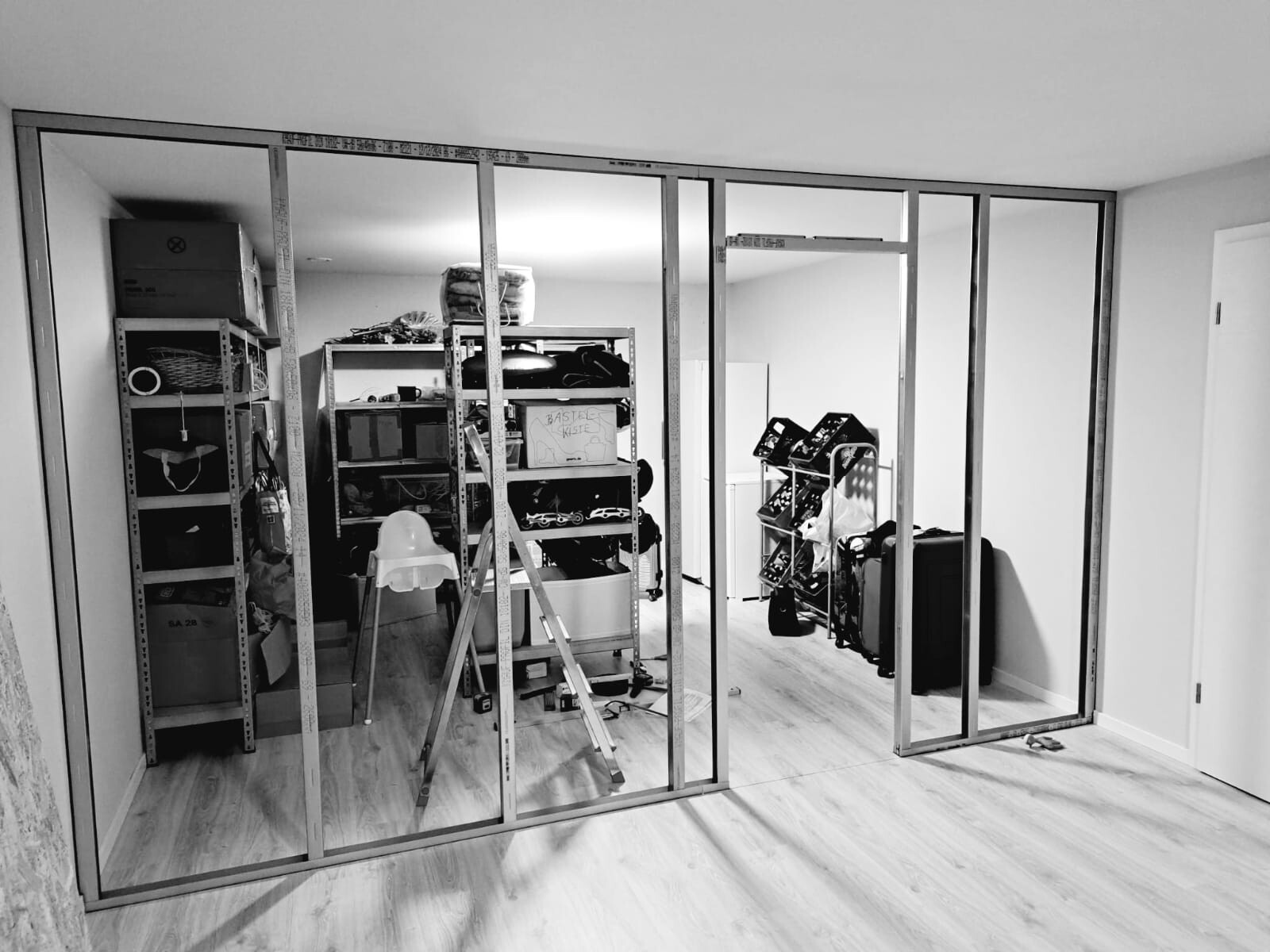
The frame construction is completely assembled and looks great.
The rough door width I have now is 76.2cm (30 inches) and the height is 200.5cm (79 inches).
Attached is a photo for better illustration!
Thanks again for your help!
Regarding OSB boards:
Unfortunately, due to space constraints, I only bought OSB boards measuring 165x65cm (65x26 inches) – so I will need to cut them to 125cm (49 inches) to fit the frame construction.
Both OSB boards should then be screwed onto the same frame, correct?
A staff member at the hardware store recommended using a drywall screw, which is actually designed for fastening gypsum board, to attach my 12mm (1/2 inch) OSB panels.
I was already skeptical on site and now, after installing the first row of sheathing, I am even more so.
The screw passes through both the OSB and the metal stud framing quite easily, but after going through the OSB panel, the screw head initially pushes away from the metal stud, then pulls it back and finally sits quite securely. However, I am unable to countersink the screw fully into the OSB panel; the screw head protrudes and spins. I believe this is due to the hardness of the material, depending on the type of wood fiber you get.
My question is: The slight protrusion of the screw head can probably be leveled out later with the gypsum board, which I don’t consider a big issue. But I am concerned about stability. The screw head should firmly press against the surface and not spin freely.
How would you proceed here? Is the stability sufficient, or should I really use different screws? If so, which ones? I’ve read quite a bit online but it seems to be a common problem. I’m just wondering if I should ignore it or not.
I was already skeptical on site and now, after installing the first row of sheathing, I am even more so.
The screw passes through both the OSB and the metal stud framing quite easily, but after going through the OSB panel, the screw head initially pushes away from the metal stud, then pulls it back and finally sits quite securely. However, I am unable to countersink the screw fully into the OSB panel; the screw head protrudes and spins. I believe this is due to the hardness of the material, depending on the type of wood fiber you get.
My question is: The slight protrusion of the screw head can probably be leveled out later with the gypsum board, which I don’t consider a big issue. But I am concerned about stability. The screw head should firmly press against the surface and not spin freely.
How would you proceed here? Is the stability sufficient, or should I really use different screws? If so, which ones? I’ve read quite a bit online but it seems to be a common problem. I’m just wondering if I should ignore it or not.
 In der Ruine30 Jan 2025 08:02
Prager91 schrieb:
The slight protrusion of the screw can certainly be “balanced out” later with the drywall panel, and I don’t find it problematic, Forget that quickly. The drywall won’t compensate for that at all. It will remain hollow and form dents if it’s pulled against the OSB somewhere else, unless the screw is countersunk into the drywall first. I pre-drilled my OSB panels using a countersink bit.
However, there are screws with better grip. Some people have reported good experiences with Fermacell screws.
In der Ruine schrieb:
Forget about that quickly. The gypsum plasterboard (GKB) won’t compensate for that. It stays hollow and dents if it’s pulled against the oriented strand board (OSB) elsewhere, unless the screw goes fully into the plasterboard first. I pre-drilled my OSB panels with a countersink.
However, there are screws with better grip. Apparently, some people have had good experiences with Fermacell screws. I have read that too – I will get some Fermacell screws and try my luck. If that doesn’t work, I’ll have to drill pilot holes.
Similar topics