
ᐅ Floor Plan Design for a Single-Family Home of Approximately 250 sqm with a Separate Granny Flat
Created on: 26 Jan 2025 21:52
C
CornforthWhite
I already feel a bit anxious writing this, anticipating the inevitable criticism of our design, but I’m posting it anyway. We struggled somewhat with the software, so much of the presentation is still quite provisional. Our main goal is to find out whether what we’ve basically planned could work. We’re primarily looking for feedback on functional planning errors. Style critique is sure to come since our design is unlikely to suit most people’s taste here—but that interests us less (we like what we like, and that probably won’t change). Although tastes vary, I’ve learned a lot from other threads recently and hope that “the usual suspects” might also take a look at our design. Thanks in advance!
Development Plan / Restrictions
Plot size: 960 m² (10,333 sq ft)
Slope: no
Floor area ratio: 0.2, maximum buildable footprint however <175 m² (1,883 sq ft)
BUT: the 1977 Building Use Ordinance applies
Floor space index: -
Building envelope, building line and boundary: 5 m (16 ft) from the road on the south and west, 3 m (10 ft) from neighbors on the north and east
Edge development: no
Number of parking spaces: 1.5 per dwelling unit
Number of storeys: 1 + attic
Roof style: no fixed style, but roof pitch regulation with 2 options
Option 1: 22–26 degrees
Option 2: 33–44 degrees
Architectural style: no specification
Orientation: flexible
Maximum heights / limits: in red the official restrictions of the development plan, in green the generously granted exceptions we are aware of (several times approved). The neighbors recently submitted a building application aiming for slightly higher eaves and knee wall heights—this will serve as a reference for us.
For roof option 1 (22–26 degrees pitch): ridge height max. 8 m (26 ft) (or 8.15 m / 27 ft), eaves height max. 4.0 m (13 ft) (or 5.20–5.30 m / 17–17.5 ft), knee wall max. 115 cm (45 in) (or 2.20–2.30 m / 7–7.5 ft)
For roof option 2 (33–44 degrees pitch): ridge height max. 10.5 m (34 ft), eaves height max. 3.5 m (11.5 ft), knee wall max. 40 cm (16 in) (exceptions probably possible but no figures known)
Definition of eaves height: Top of rough ground floor slab to intersection of exterior wall with the bottom edge of the rafters
Definition of knee wall: Top of rough attic floor slab to intersection of exterior wall with the bottom edge of the rafters
Client Requirements
Architectural style, roof shape, building type: a new build that does not look like a typical new build
Basement, floors: no basement (high groundwater level, no living space planned underground), two full stories (which are effectively possible due to generous exceptions from the development plan)
Number of people, age: my mother (70+), my husband and I (late 30s), 2 cats, 1 dog, 1 child planned
Space requirements on ground and upper floors: On the ground floor a self-contained apartment for my mother and kitchen / living / dining / utility for us;
Office: 2 offices (both approx. 50% and 80% remote work)
Guest stays per year: about 2–3 weeks
Open or closed layout: open on the ground floor
Conservative or modern building style: conservative
Open kitchen, kitchen island: yes to both
Number of dining seats: 6–8
Fireplace: yes (gas fireplace)
Music/sound system wall: no
Balcony, roof terrace: balcony would be nice
Garage, carport: spacious double garage
Utility garden, greenhouse: rather no
Other wishes / special features / daily routine, including reasons why some things are desired or not:
House Design
Who designed it: DIY
What do you like most and why?
- Style inspired by classic American Colonial architecture
- Living area centered around the fireplace
- Porch with insect protection, fireplace & privacy
- Kitchen island with plenty of workspace
- Small “secondary kitchen” to temporarily hide dirty dishes / cooking mess
What do you not like? Why?
I wouldn’t exactly say “dislike,” but we have doubts about the following points:
Personal price limit for the house, including fittings: we’re budgeting €3,000 per m² plus additional costs and landscaping, but have significant equity and thus some flexibility upwards; also plan a lot of personal work.
Preferred heating technology: heat pump with geothermal probe
If you have to give up something, which features/finishes
- Could be sacrificed: balcony
- Cannot be sacrificed: no compromises on the self-contained apartment
Why is the design like it is now?
We originally wanted to buy a house with old-style charm but found nothing suitable. Although we like modern, minimalist architecture, it’s not for us personally.
I’ll help a bit with the images.
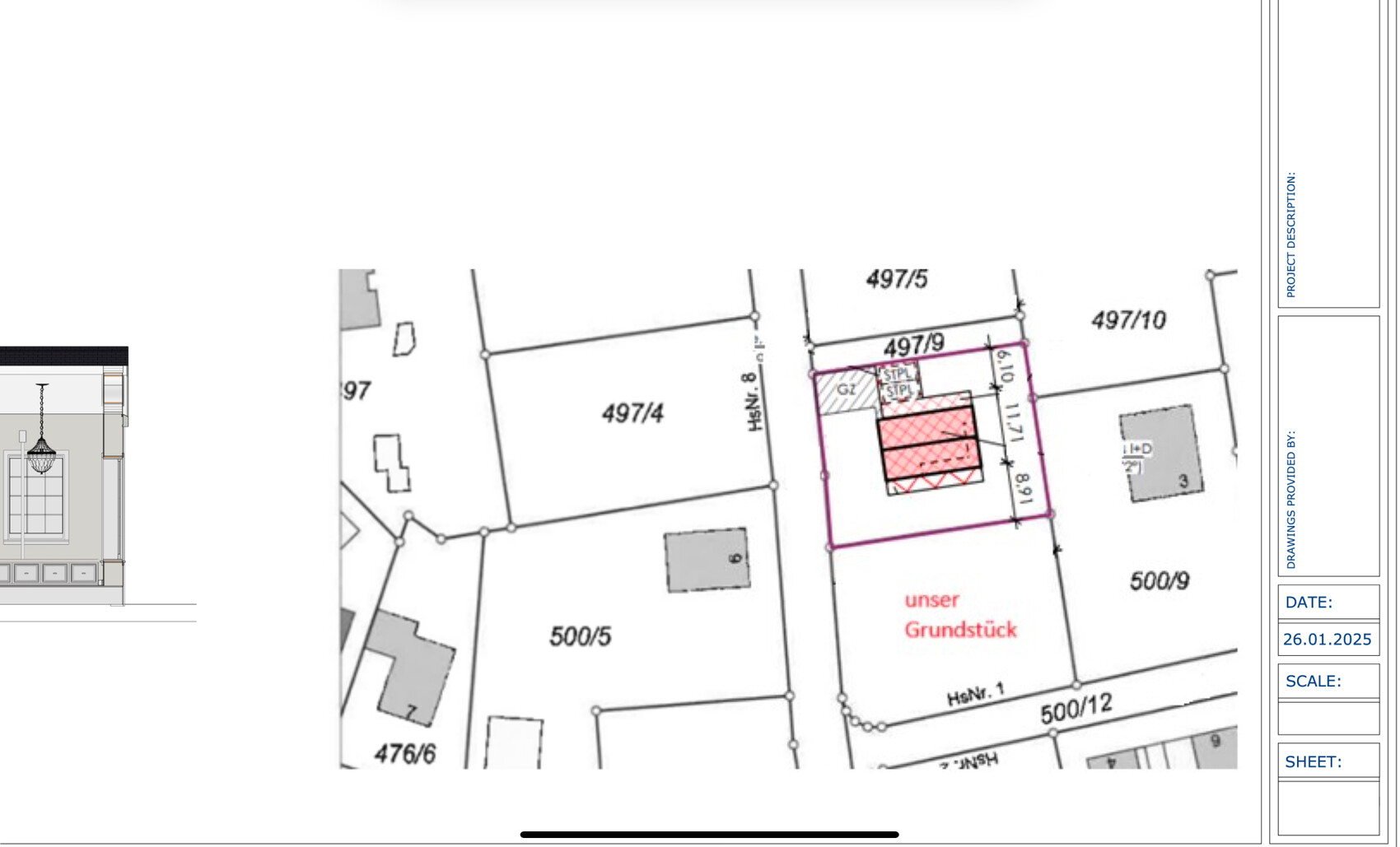
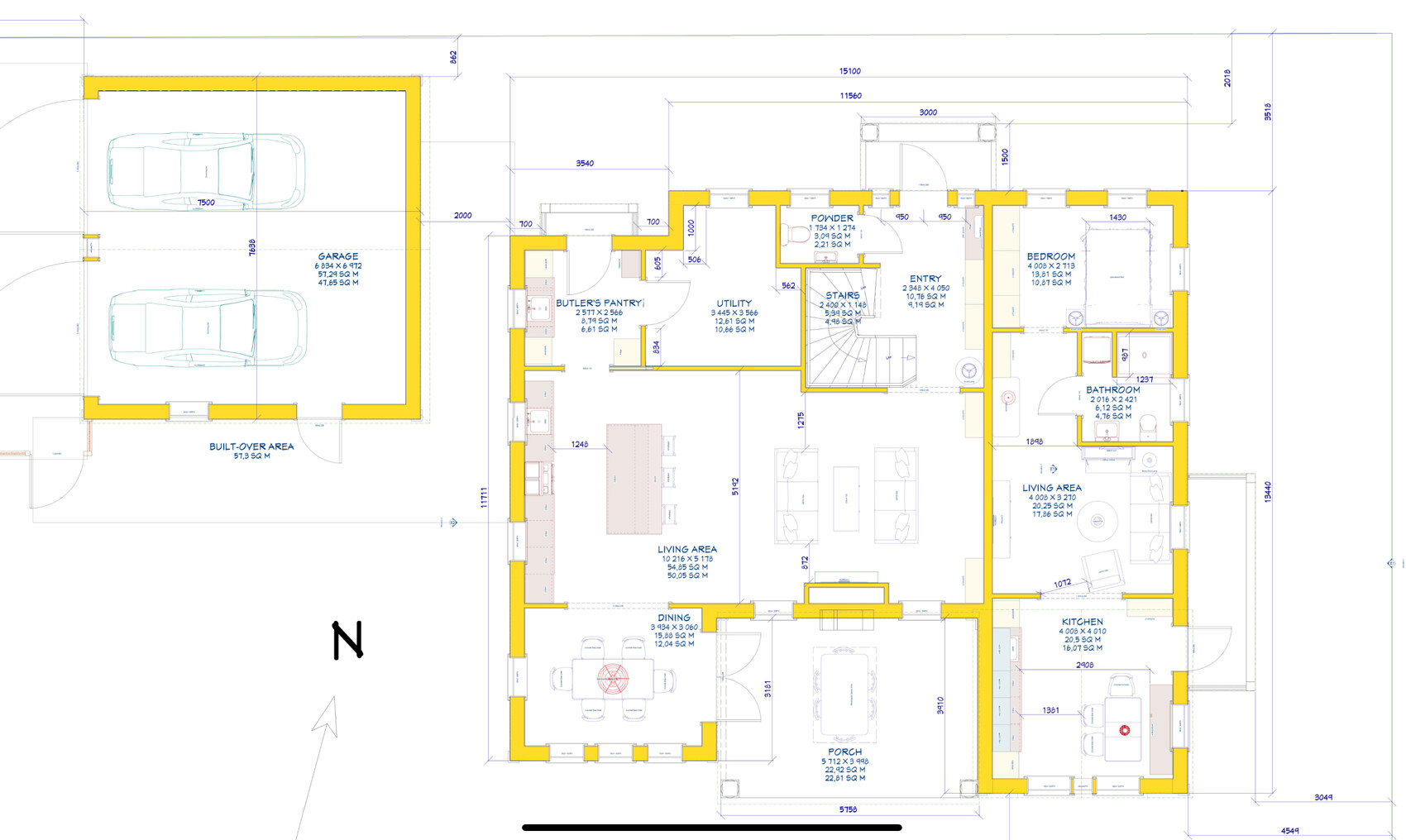
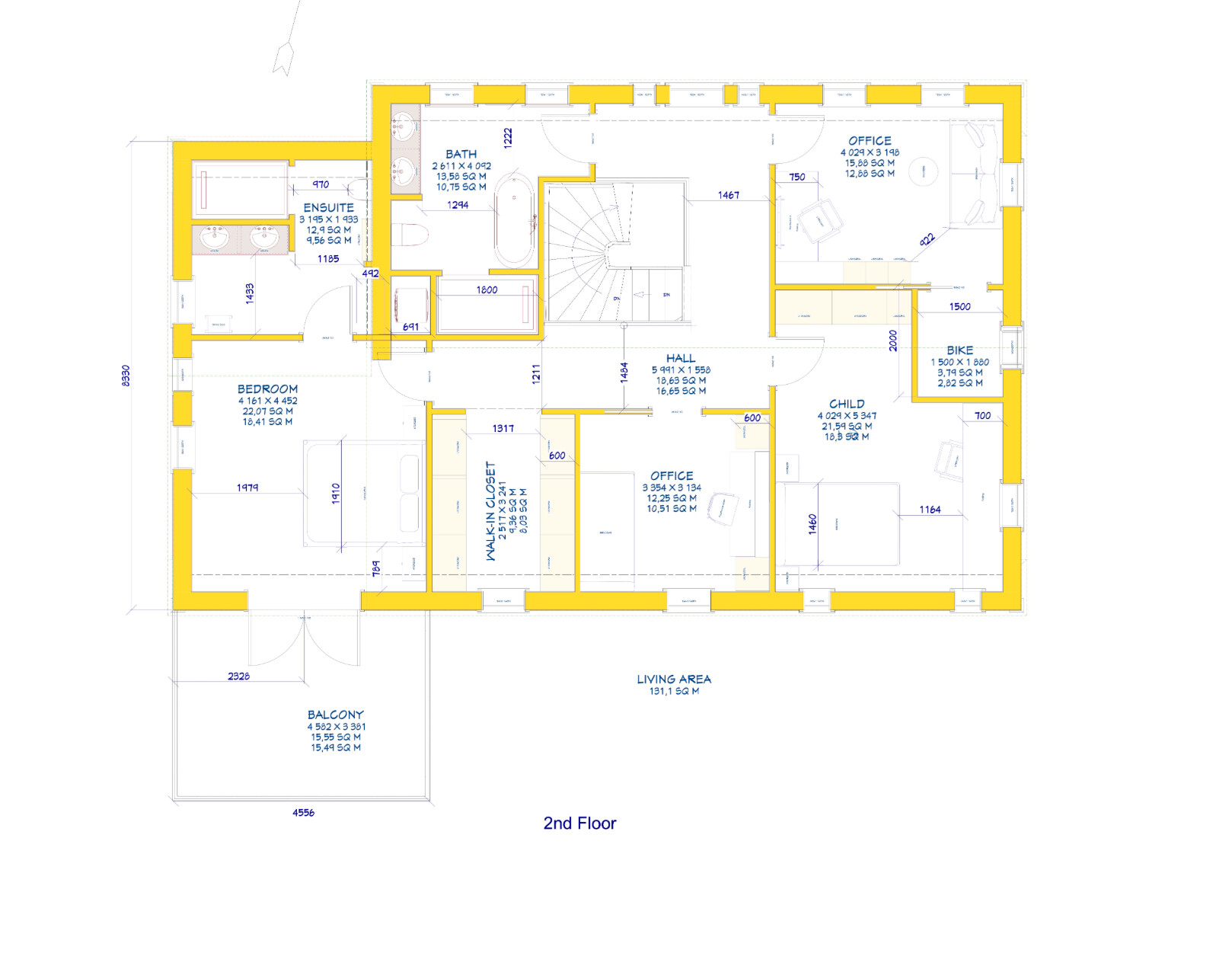
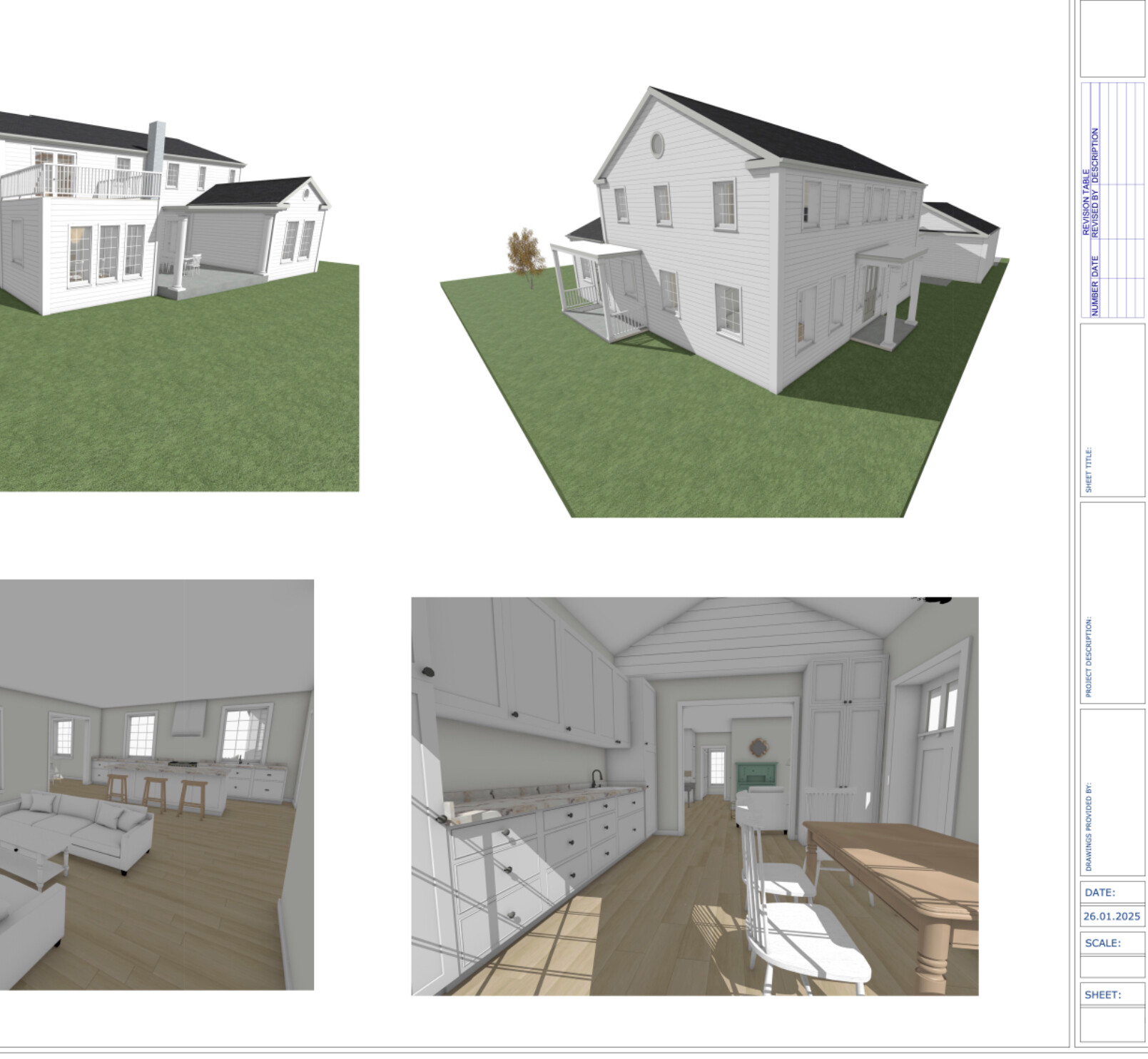
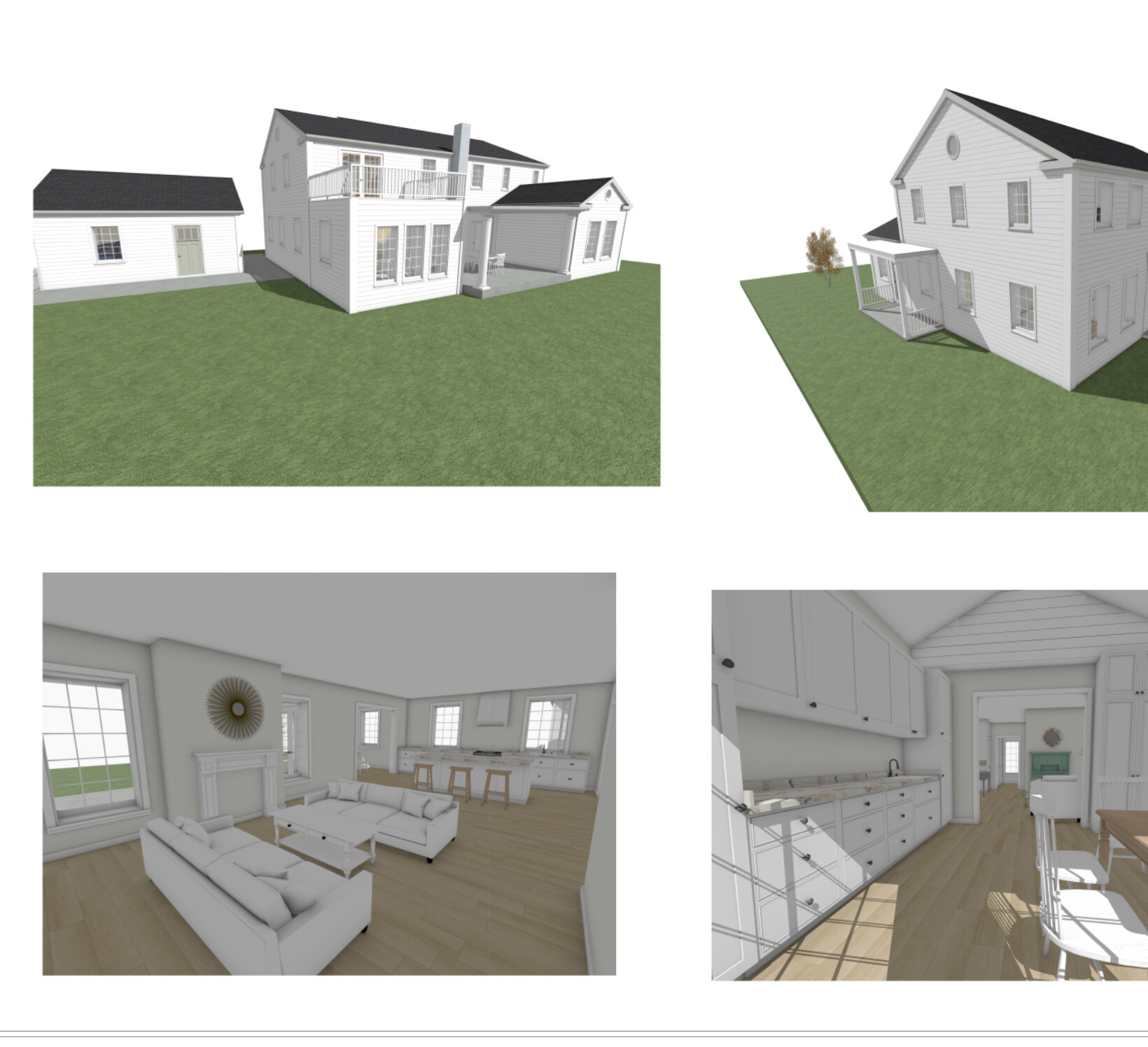
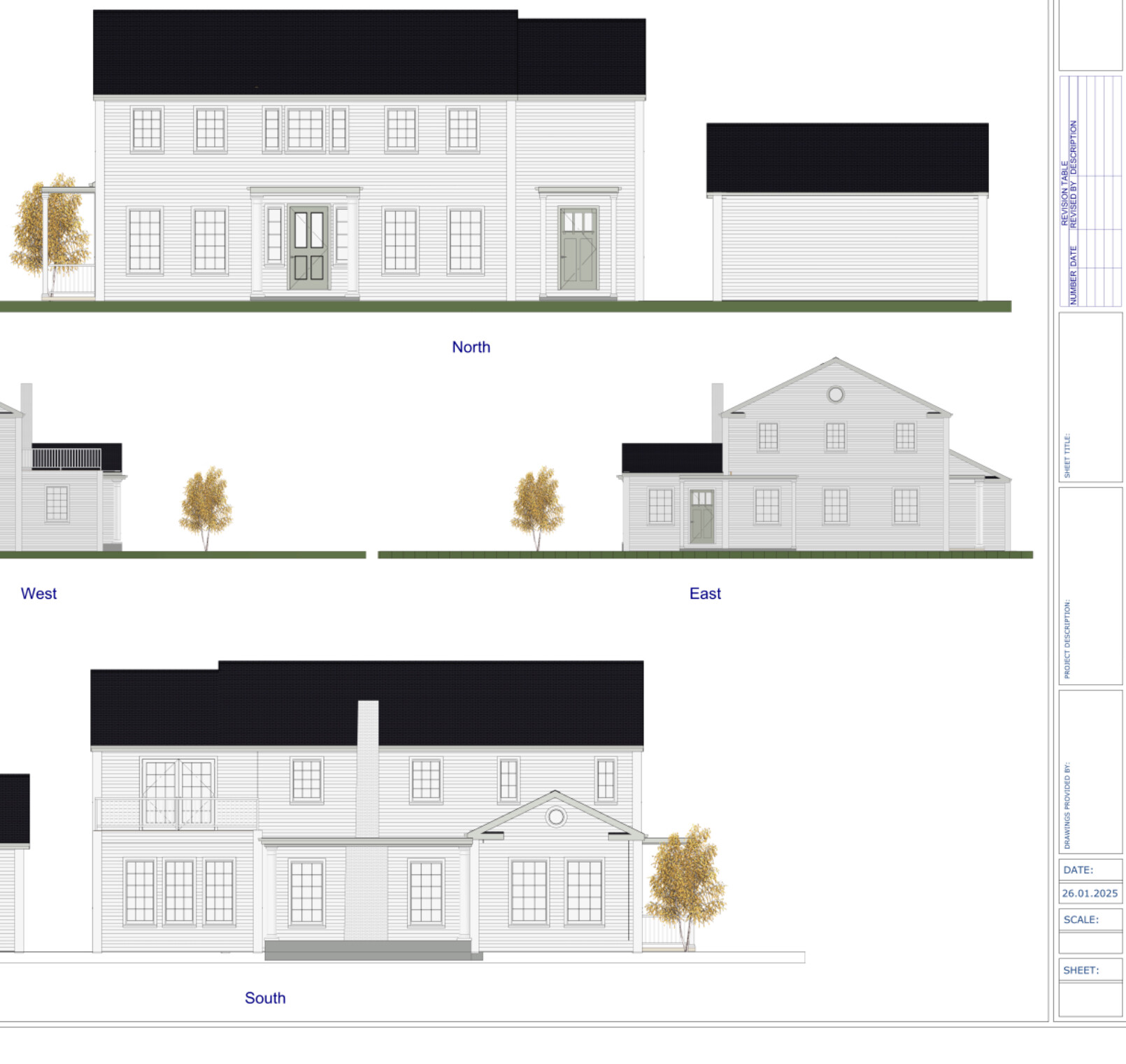
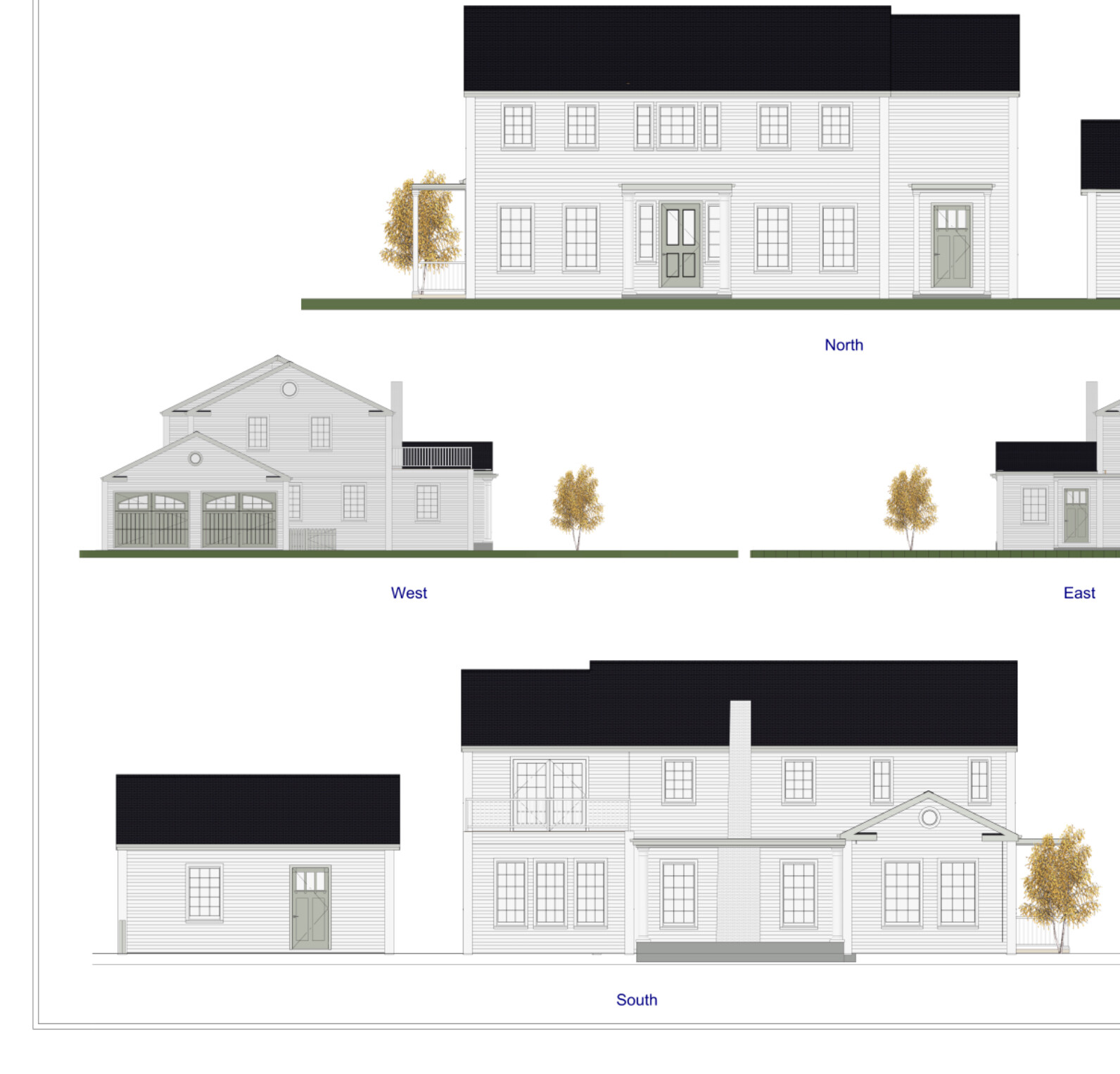
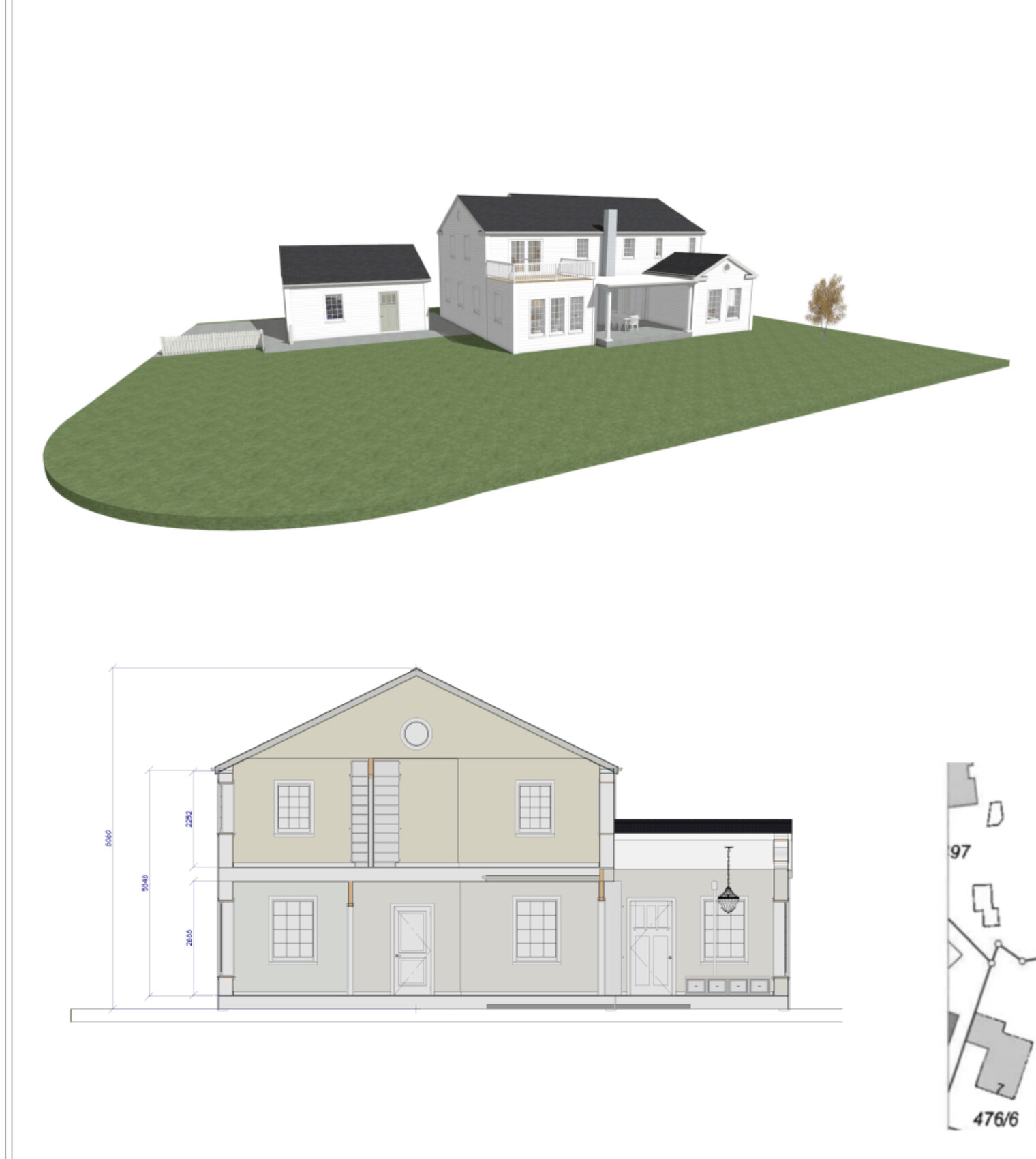
Development Plan / Restrictions
Plot size: 960 m² (10,333 sq ft)
Slope: no
Floor area ratio: 0.2, maximum buildable footprint however <175 m² (1,883 sq ft)
BUT: the 1977 Building Use Ordinance applies
- § 19 IV: Ancillary structures according to § 14 are not counted towards the allowable footprint. The same applies to balconies, loggias, terraces, and structural elements as far as they are permitted within setback areas or distance zones under regional law (here: Bavaria) (…).
- § 21a III: Covered parking spaces and garages are not to be counted towards the allowable footprint as long as they are less than 0.1 of the plot area.
Floor space index: -
Building envelope, building line and boundary: 5 m (16 ft) from the road on the south and west, 3 m (10 ft) from neighbors on the north and east
Edge development: no
Number of parking spaces: 1.5 per dwelling unit
Number of storeys: 1 + attic
Roof style: no fixed style, but roof pitch regulation with 2 options
Option 1: 22–26 degrees
Option 2: 33–44 degrees
Architectural style: no specification
Orientation: flexible
Maximum heights / limits: in red the official restrictions of the development plan, in green the generously granted exceptions we are aware of (several times approved). The neighbors recently submitted a building application aiming for slightly higher eaves and knee wall heights—this will serve as a reference for us.
For roof option 1 (22–26 degrees pitch): ridge height max. 8 m (26 ft) (or 8.15 m / 27 ft), eaves height max. 4.0 m (13 ft) (or 5.20–5.30 m / 17–17.5 ft), knee wall max. 115 cm (45 in) (or 2.20–2.30 m / 7–7.5 ft)
For roof option 2 (33–44 degrees pitch): ridge height max. 10.5 m (34 ft), eaves height max. 3.5 m (11.5 ft), knee wall max. 40 cm (16 in) (exceptions probably possible but no figures known)
Definition of eaves height: Top of rough ground floor slab to intersection of exterior wall with the bottom edge of the rafters
Definition of knee wall: Top of rough attic floor slab to intersection of exterior wall with the bottom edge of the rafters
Client Requirements
Architectural style, roof shape, building type: a new build that does not look like a typical new build
Basement, floors: no basement (high groundwater level, no living space planned underground), two full stories (which are effectively possible due to generous exceptions from the development plan)
Number of people, age: my mother (70+), my husband and I (late 30s), 2 cats, 1 dog, 1 child planned
Space requirements on ground and upper floors: On the ground floor a self-contained apartment for my mother and kitchen / living / dining / utility for us;
Office: 2 offices (both approx. 50% and 80% remote work)
Guest stays per year: about 2–3 weeks
Open or closed layout: open on the ground floor
Conservative or modern building style: conservative
Open kitchen, kitchen island: yes to both
Number of dining seats: 6–8
Fireplace: yes (gas fireplace)
Music/sound system wall: no
Balcony, roof terrace: balcony would be nice
Garage, carport: spacious double garage
Utility garden, greenhouse: rather no
Other wishes / special features / daily routine, including reasons why some things are desired or not:
- Covered terrace / loggia / outdoor seating with reliable but as discreet as possible insect protection (lakeside location, regular mosquito issue) & fireplace (probably gas as well)
- A rather unpopular opinion here, but we explicitly do not want roller shutters or venetian blinds. We currently have them despite many south-facing windows and never use them (feels like a vault). Instead, we plan air conditioning (powered by photovoltaics) and larger trees.
- Gas stove (I just can’t get comfortable with induction)
- Washing machine & dryer on the upper floor
- In one office, a small niche for an exercise bike (turbo trainer)
House Design
Who designed it: DIY
What do you like most and why?
- Style inspired by classic American Colonial architecture
- Living area centered around the fireplace
- Porch with insect protection, fireplace & privacy
- Kitchen island with plenty of workspace
- Small “secondary kitchen” to temporarily hide dirty dishes / cooking mess
What do you not like? Why?
I wouldn’t exactly say “dislike,” but we have doubts about the following points:
- Passage between garage and house might be too narrow?
- Entrance and staircase possibly not spacious enough?
- Staircase: can’t properly design it in the software, but according to a stair calculation tool it should work. Is the space requirement adequate? Are the asymmetrical runs a problem?
- Bedroom in the self-contained apartment is borderline small
- Bathrooms: enough space?
- Utility/technical room: large enough?
- Could a mechanical ventilation system with heat recovery possibly be installed in the crawl space attic?
Personal price limit for the house, including fittings: we’re budgeting €3,000 per m² plus additional costs and landscaping, but have significant equity and thus some flexibility upwards; also plan a lot of personal work.
Preferred heating technology: heat pump with geothermal probe
If you have to give up something, which features/finishes
- Could be sacrificed: balcony
- Cannot be sacrificed: no compromises on the self-contained apartment
Why is the design like it is now?
We originally wanted to buy a house with old-style charm but found nothing suitable. Although we like modern, minimalist architecture, it’s not for us personally.
I’ll help a bit with the images.
I would design the accessibility features primarily for a possible walker, as many people can still take good care of themselves using one. If a walker is no longer sufficient, moving to a care home is usually the next step.
Since my better half suffered a lumbar vertebra fracture two years ago, we have some experience with walkers. On one hand, you always push it in front of you and turn around. In the kitchen, it is usually positioned behind, as it is also often used as a seat during tasks. Overall, it requires more space than you might expect.
Since my better half suffered a lumbar vertebra fracture two years ago, we have some experience with walkers. On one hand, you always push it in front of you and turn around. In the kitchen, it is usually positioned behind, as it is also often used as a seat during tasks. Overall, it requires more space than you might expect.
C
CornforthWhite27 Jan 2025 16:59Regarding the concerned posts about doing work ourselves: we have already renovated two apartments (and by that, I don’t just mean a few painting jobs) and can therefore estimate the effort fairly well. Anyone who has patched up crumbling old walls with a height of 3.20m (10.5 feet) and ceilings full of cracks, holes, and non-load-bearing substrates to Q4 finish won’t tend to give up easily on a large but certainly less complicated new build. We have the time and patience for it and actually enjoy doing things ourselves. Because it is extremely satisfying, because we’re control freaks who would otherwise watch the contractors’ every move 24/7, and because it also saves money that we’d rather spend on other things. Tasks that completely overwhelm us professionally, we don’t attempt recklessly, but many manual tasks aren’t rocket science, and no contractor in the world is as motivated as we are to deliver a good job in our own home. You can learn a lot if you really want to and have the courage to just try. If we lose interest, we’ll simply hire someone else for it. We’ve done that before and had very good experiences. Do first, worry second, to quote an old election poster.
As I mentioned above: it’s not only about saving money for us. When I think back on the work of numerous contractors (and I don’t mean the cheapest offer from MyHammer but established companies with a good reputation, sometimes recommended by the architect) in the past, we were rarely truly satisfied. We basically should have watched them full time because the quality almost never met expectations.
All the furniture drawn so far is to the correct scale – so that’s not something we have “adjusted” to look better.
I don’t see “big” negatively, even though most here might think otherwise. Although I don’t find 200 sqm (2,150 sq ft) for the main apartment excessive.
Long walking distances: hmm, those naturally get longer with more square meters (sq ft), at least if you don’t plan an entrance from which everything radiates centrally (which then requires compromises elsewhere).
Impractical: concrete examples would be helpful, as this general statement doesn’t really help me much.
What exactly is unergonomic about it? Dimension-wise, we currently have a kitchen in our rental apartment with the same depth (but of course longer) and a 60cm (24 inch) deep kitchen unit on both sides. Although I find the kitchen annoying because when cooking you stand alone bored and cut off from the rest of the apartment, I can’t say anything negative ergonomically. Opening the fridge, loading and unloading the dishwasher, etc. is actually very convenient. The room may be too short (it was once longer at the expense of the main kitchen, but that caused issues with interior and exterior window symmetry), but otherwise, I don’t see the problem directly.
I can imagine that for the living area, less so for the kitchen. A lot of light comes from the south through the dining room; on the west wall, there are two reasonably sized windows. It’s certainly not as bright as some others build here with 4m (13 foot) lift-and-slide doors etc., but actually too dark? Hmm.
I can’t make much of “somehow convoluted” – could you give me concrete examples or problematic spots?
Thank you, these are helpful suggestions. We will try to improve this accordingly.
haydee schrieb:
When we built, there was a rule of thumb that saving 100 Euros on a contractor costs 3 hours of amateur labor. One has to think carefully about that.
As I mentioned above: it’s not only about saving money for us. When I think back on the work of numerous contractors (and I don’t mean the cheapest offer from MyHammer but established companies with a good reputation, sometimes recommended by the architect) in the past, we were rarely truly satisfied. We basically should have watched them full time because the quality almost never met expectations.
haydee schrieb:
Draw all existing and desired furniture to scale on the floor plan. Especially for the granny flat, the books, shoe collection, etc. should be considered.
All the furniture drawn so far is to the correct scale – so that’s not something we have “adjusted” to look better.
haydee schrieb:
Regarding your area – big, long walking distances, impractical were my first thoughts.
I don’t see “big” negatively, even though most here might think otherwise. Although I don’t find 200 sqm (2,150 sq ft) for the main apartment excessive.
Long walking distances: hmm, those naturally get longer with more square meters (sq ft), at least if you don’t plan an entrance from which everything radiates centrally (which then requires compromises elsewhere).
Impractical: concrete examples would be helpful, as this general statement doesn’t really help me much.
haydee schrieb:
The second kitchen – I can understand the reason very well, but it is so unergonomic. I can’t imagine it being practical for everyday use.
What exactly is unergonomic about it? Dimension-wise, we currently have a kitchen in our rental apartment with the same depth (but of course longer) and a 60cm (24 inch) deep kitchen unit on both sides. Although I find the kitchen annoying because when cooking you stand alone bored and cut off from the rest of the apartment, I can’t say anything negative ergonomically. Opening the fridge, loading and unloading the dishwasher, etc. is actually very convenient. The room may be too short (it was once longer at the expense of the main kitchen, but that caused issues with interior and exterior window symmetry), but otherwise, I don’t see the problem directly.
haydee schrieb:
The kitchen and living area will be quite dark.
I can imagine that for the living area, less so for the kitchen. A lot of light comes from the south through the dining room; on the west wall, there are two reasonably sized windows. It’s certainly not as bright as some others build here with 4m (13 foot) lift-and-slide doors etc., but actually too dark? Hmm.
haydee schrieb:
Entrance very hidden – seriously, how often do you take out the trash in pajamas?
The upper floor somehow feels a bit convoluted and partly dark
I can’t make much of “somehow convoluted” – could you give me concrete examples or problematic spots?
hanse987 schrieb:
I would design the accessibility for a possible walker because many people can still manage well with that. If a walker no longer works, usually a nursing home is the next step anyway.
Since my better half fractured a lumbar vertebra two years ago, we have some experience with walkers. On one hand, you always push this in front of you and turn. In the kitchen, it usually stands behind because it is often used as a seat during work. All in all, it needs more space than you think.
Thank you, these are helpful suggestions. We will try to improve this accordingly.
C
CornforthWhite27 Jan 2025 17:23To give the granny flat a bit more space and especially a small entrance area, we could add a bay window measuring about 400 cm x 150 cm (width x depth) instead of the small porch at the entrance, since according to the 1968/1977 building use regulations, such a secondary structure is, to my knowledge, not counted towards the floor area. Let’s see if this could create a bit more comfort and how it would look.
S
Schorsch_baut27 Jan 2025 17:45Well, if you are experienced renovators, you like your plan, and your budget is flexible upwards, is there really much left to discuss here? Most of the extras come down to personal taste, and the rest is easily dismissed by the original poster.
At the end of your 30s, only the desire to have children might still complicate the planning.
The porch with insect screens will probably be more expensive than expected. Friends of ours had the same idea a few years ago but quickly abandoned it and instead built a conservatory that can be used year-round.
At the end of your 30s, only the desire to have children might still complicate the planning.
The porch with insect screens will probably be more expensive than expected. Friends of ours had the same idea a few years ago but quickly abandoned it and instead built a conservatory that can be used year-round.
C
CornforthWhite27 Jan 2025 18:28Here are the figures for the staircase from our planning (calculated using a stair planner tool):
Length of stair flights (in the direction from ground floor to upper floor):
Floor height: 3050 mm (120 inches)
Stair flight 1: 1679 mm (66 inches)
Stair flight 2: 2682 mm (106 inches)
Stair flight 3: 2437 mm (96 inches)
Tread width: 100 mm (4 inches)
Number of steps: 16
Number of risers: 17
Riser height: 179 mm (7 inches)
Tread depth: 273 mm (11 inches)
Angle: 33.31 degrees
Blondel’s formula value: 631 mm (25 inches)
Optionally, one more step could be planned (there would probably be enough space), resulting in the following values:
Number of steps: 17
Number of risers: 18
Riser height: 169 mm (6.7 inches)
Tread depth: 257 mm (10 inches)
Angle: 33.4 degrees
Blondel’s formula value: 596 mm (23.5 inches)
So, lower riser height but less tread depth, and the Blondel value is not optimal. The tool rates the first variant with 16 steps as comfortable and the second variant with 17 steps as less comfortable.
The staircase looks tight in the floor plan, but this may also be caused by an error the software produces. Even when entering all calculated values manually, it seems unable to create a staircase with consistently winding steps. In the sketch from the stair tool, however, the staircase looks okay to me. Since I don’t have the rights to the images, I unfortunately can’t share them here.
Are there any opinions on the staircase based on these figures? Feasible as is or potentially problematic?
I have said many times that we will review a lot of points again—so “easily dismissed” is not really accurate in my opinion. Some things are also a matter of personal preference and priorities, so they are not simply right or wrong; I may well have a different opinion than the commenters but still appreciate the food for thought. Other things, such as noise from the stationary bike or too little space in the guest apartment bathroom/bedroom, are objectively problematic and we will look for solutions accordingly.
My main focus here was advice on the floor plan, not on self-build or DIY work. I know that for many in this forum, turnkey solutions are the only option, which is perfectly fine. It would just be nice if others didn’t try so hard to discourage DIY efforts from people who have repeatedly said they already have some experience with such tasks.
The insect protection on the veranda is probably affordable for us. It’s not a complicated design but just a straight, very large roller screen running in a wooden-clad track at the corner of the dining room extension and the kitchen wall opposite (so in this case, a slightly smaller terrace when the insect protection is closed). I have already researched the costs—it should be around 3000€ (about 3200 USD). It is definitely worth it to us. We are 200 m (650 feet) from the lake, where there are many mosquitoes every summer. Every few years there is a real mosquito plague, and then no one sits outside here at all without mosquito protection.
Length of stair flights (in the direction from ground floor to upper floor):
Floor height: 3050 mm (120 inches)
Stair flight 1: 1679 mm (66 inches)
Stair flight 2: 2682 mm (106 inches)
Stair flight 3: 2437 mm (96 inches)
Tread width: 100 mm (4 inches)
Number of steps: 16
Number of risers: 17
Riser height: 179 mm (7 inches)
Tread depth: 273 mm (11 inches)
Angle: 33.31 degrees
Blondel’s formula value: 631 mm (25 inches)
Optionally, one more step could be planned (there would probably be enough space), resulting in the following values:
Number of steps: 17
Number of risers: 18
Riser height: 169 mm (6.7 inches)
Tread depth: 257 mm (10 inches)
Angle: 33.4 degrees
Blondel’s formula value: 596 mm (23.5 inches)
So, lower riser height but less tread depth, and the Blondel value is not optimal. The tool rates the first variant with 16 steps as comfortable and the second variant with 17 steps as less comfortable.
The staircase looks tight in the floor plan, but this may also be caused by an error the software produces. Even when entering all calculated values manually, it seems unable to create a staircase with consistently winding steps. In the sketch from the stair tool, however, the staircase looks okay to me. Since I don’t have the rights to the images, I unfortunately can’t share them here.
Are there any opinions on the staircase based on these figures? Feasible as is or potentially problematic?
Schorsch_baut schrieb:
Well, if you are experienced renovators and like your plan and have a flexible budget, what is there really left to discuss here? Most of the extras are a matter of personal taste, and the rest gets easily dismissed by the original poster.
At the end of the 30s, the desire to have children is probably the only factor that could still complicate the planning.
The veranda with insect protection will probably be more expensive than expected. Friends of ours had the same idea a few years ago but quickly abandoned it and instead built a conservatory that can be used all year round.
I have said many times that we will review a lot of points again—so “easily dismissed” is not really accurate in my opinion. Some things are also a matter of personal preference and priorities, so they are not simply right or wrong; I may well have a different opinion than the commenters but still appreciate the food for thought. Other things, such as noise from the stationary bike or too little space in the guest apartment bathroom/bedroom, are objectively problematic and we will look for solutions accordingly.
My main focus here was advice on the floor plan, not on self-build or DIY work. I know that for many in this forum, turnkey solutions are the only option, which is perfectly fine. It would just be nice if others didn’t try so hard to discourage DIY efforts from people who have repeatedly said they already have some experience with such tasks.
The insect protection on the veranda is probably affordable for us. It’s not a complicated design but just a straight, very large roller screen running in a wooden-clad track at the corner of the dining room extension and the kitchen wall opposite (so in this case, a slightly smaller terrace when the insect protection is closed). I have already researched the costs—it should be around 3000€ (about 3200 USD). It is definitely worth it to us. We are 200 m (650 feet) from the lake, where there are many mosquitoes every summer. Every few years there is a real mosquito plague, and then no one sits outside here at all without mosquito protection.
Back to the beginning:
To your surprise, there was no criticism, right?
You have already received a lot of input on that.
What I noticed is that your specific questions (entrance, stairs, bedroom in the granny flat, bathrooms, etc.) have been addressed, but you dismiss them. Why did you ask them?
So I’m not the only one who read it that way.
Nobody here mentioned “accessible” living, but rather that, for example, a walker requires enough space, and that an older person needs room to move around. What you make of that is your choice.
You have mentioned several times that you experienced the same situation. However, that doesn’t mean you shouldn’t try to improve it if you can.
It’s not that nobody here understands what DIY work involves. Honestly, your husband can be as ambitious and willing as he likes to “do something,” just like you, but many here know the difference between renovating a manageable apartment and doing all the interior construction on a 250m (820 ft)² house with 3-meter (10 ft) high ceilings by yourself. Some have had to sacrifice their entire annual vacation just to get the bare minimum done, such as “painting work done by the builder.” After that, a single wellness day wasn’t enough to recharge those who normally do this as a hobby and then switch back to an office job.
I don’t mean to sound presumptuous (just as I’m not offended if someone assumes I bought a turnkey house—I know exactly how much effort I put in to get the walls finished and complete some of the interior work myself), but it feels like you are living in a kind of American bubble and should just let us talk. Maybe some things will be reconsidered.
Still, with — in my opinion — minor adjustments, it can become a stylish, very livable, and special house… if only a large fridge can still find a place in the main kitchen.
The minor issues you argue away could cause some discomfort when living there or arranging furniture. But even that can be handled. We all know the saying: the first house is for the enemy, the second for the friend, and so on.
CornforthWhite schrieb:
There will certainly be some style criticism
To your surprise, there was no criticism, right?
CornforthWhite schrieb:
For us, the main concern is whether we have basically planned something that could work. We are primarily hoping for feedback on functional planning errors.
You have already received a lot of input on that.
What I noticed is that your specific questions (entrance, stairs, bedroom in the granny flat, bathrooms, etc.) have been addressed, but you dismiss them. Why did you ask them?
Schorsch_baut schrieb:
The rest is casually argued away by the original poster.
So I’m not the only one who read it that way.
CornforthWhite schrieb:
Of course, it is important to us that the apartment works for my mother. We have obviously researched how to design an accessible apartment.
Nobody here mentioned “accessible” living, but rather that, for example, a walker requires enough space, and that an older person needs room to move around. What you make of that is your choice.
You have mentioned several times that you experienced the same situation. However, that doesn’t mean you shouldn’t try to improve it if you can.
CornforthWhite schrieb:
My primary concern here was advice on the floor plan, not on DIY work. I know that for many in this forum, only (almost) turnkey builds are an option and there’s nothing wrong with that. It would just be nice if others wouldn’t try so hard to talk people out of doing their own work, especially when they have repeatedly said they already have some experience with such tasks.
It’s not that nobody here understands what DIY work involves. Honestly, your husband can be as ambitious and willing as he likes to “do something,” just like you, but many here know the difference between renovating a manageable apartment and doing all the interior construction on a 250m (820 ft)² house with 3-meter (10 ft) high ceilings by yourself. Some have had to sacrifice their entire annual vacation just to get the bare minimum done, such as “painting work done by the builder.” After that, a single wellness day wasn’t enough to recharge those who normally do this as a hobby and then switch back to an office job.
I don’t mean to sound presumptuous (just as I’m not offended if someone assumes I bought a turnkey house—I know exactly how much effort I put in to get the walls finished and complete some of the interior work myself), but it feels like you are living in a kind of American bubble and should just let us talk. Maybe some things will be reconsidered.
Still, with — in my opinion — minor adjustments, it can become a stylish, very livable, and special house… if only a large fridge can still find a place in the main kitchen.
The minor issues you argue away could cause some discomfort when living there or arranging furniture. But even that can be handled. We all know the saying: the first house is for the enemy, the second for the friend, and so on.
Similar topics