
ᐅ Floor Plan Design for a Single-Family Home of Approximately 250 sqm with a Separate Granny Flat
Created on: 26 Jan 2025 21:52
C
CornforthWhite
I already feel a bit anxious writing this, anticipating the inevitable criticism of our design, but I’m posting it anyway. We struggled somewhat with the software, so much of the presentation is still quite provisional. Our main goal is to find out whether what we’ve basically planned could work. We’re primarily looking for feedback on functional planning errors. Style critique is sure to come since our design is unlikely to suit most people’s taste here—but that interests us less (we like what we like, and that probably won’t change). Although tastes vary, I’ve learned a lot from other threads recently and hope that “the usual suspects” might also take a look at our design. Thanks in advance!
Development Plan / Restrictions
Plot size: 960 m² (10,333 sq ft)
Slope: no
Floor area ratio: 0.2, maximum buildable footprint however <175 m² (1,883 sq ft)
BUT: the 1977 Building Use Ordinance applies
Floor space index: -
Building envelope, building line and boundary: 5 m (16 ft) from the road on the south and west, 3 m (10 ft) from neighbors on the north and east
Edge development: no
Number of parking spaces: 1.5 per dwelling unit
Number of storeys: 1 + attic
Roof style: no fixed style, but roof pitch regulation with 2 options
Option 1: 22–26 degrees
Option 2: 33–44 degrees
Architectural style: no specification
Orientation: flexible
Maximum heights / limits: in red the official restrictions of the development plan, in green the generously granted exceptions we are aware of (several times approved). The neighbors recently submitted a building application aiming for slightly higher eaves and knee wall heights—this will serve as a reference for us.
For roof option 1 (22–26 degrees pitch): ridge height max. 8 m (26 ft) (or 8.15 m / 27 ft), eaves height max. 4.0 m (13 ft) (or 5.20–5.30 m / 17–17.5 ft), knee wall max. 115 cm (45 in) (or 2.20–2.30 m / 7–7.5 ft)
For roof option 2 (33–44 degrees pitch): ridge height max. 10.5 m (34 ft), eaves height max. 3.5 m (11.5 ft), knee wall max. 40 cm (16 in) (exceptions probably possible but no figures known)
Definition of eaves height: Top of rough ground floor slab to intersection of exterior wall with the bottom edge of the rafters
Definition of knee wall: Top of rough attic floor slab to intersection of exterior wall with the bottom edge of the rafters
Client Requirements
Architectural style, roof shape, building type: a new build that does not look like a typical new build
Basement, floors: no basement (high groundwater level, no living space planned underground), two full stories (which are effectively possible due to generous exceptions from the development plan)
Number of people, age: my mother (70+), my husband and I (late 30s), 2 cats, 1 dog, 1 child planned
Space requirements on ground and upper floors: On the ground floor a self-contained apartment for my mother and kitchen / living / dining / utility for us;
Office: 2 offices (both approx. 50% and 80% remote work)
Guest stays per year: about 2–3 weeks
Open or closed layout: open on the ground floor
Conservative or modern building style: conservative
Open kitchen, kitchen island: yes to both
Number of dining seats: 6–8
Fireplace: yes (gas fireplace)
Music/sound system wall: no
Balcony, roof terrace: balcony would be nice
Garage, carport: spacious double garage
Utility garden, greenhouse: rather no
Other wishes / special features / daily routine, including reasons why some things are desired or not:
House Design
Who designed it: DIY
What do you like most and why?
- Style inspired by classic American Colonial architecture
- Living area centered around the fireplace
- Porch with insect protection, fireplace & privacy
- Kitchen island with plenty of workspace
- Small “secondary kitchen” to temporarily hide dirty dishes / cooking mess
What do you not like? Why?
I wouldn’t exactly say “dislike,” but we have doubts about the following points:
Personal price limit for the house, including fittings: we’re budgeting €3,000 per m² plus additional costs and landscaping, but have significant equity and thus some flexibility upwards; also plan a lot of personal work.
Preferred heating technology: heat pump with geothermal probe
If you have to give up something, which features/finishes
- Could be sacrificed: balcony
- Cannot be sacrificed: no compromises on the self-contained apartment
Why is the design like it is now?
We originally wanted to buy a house with old-style charm but found nothing suitable. Although we like modern, minimalist architecture, it’s not for us personally.
I’ll help a bit with the images.
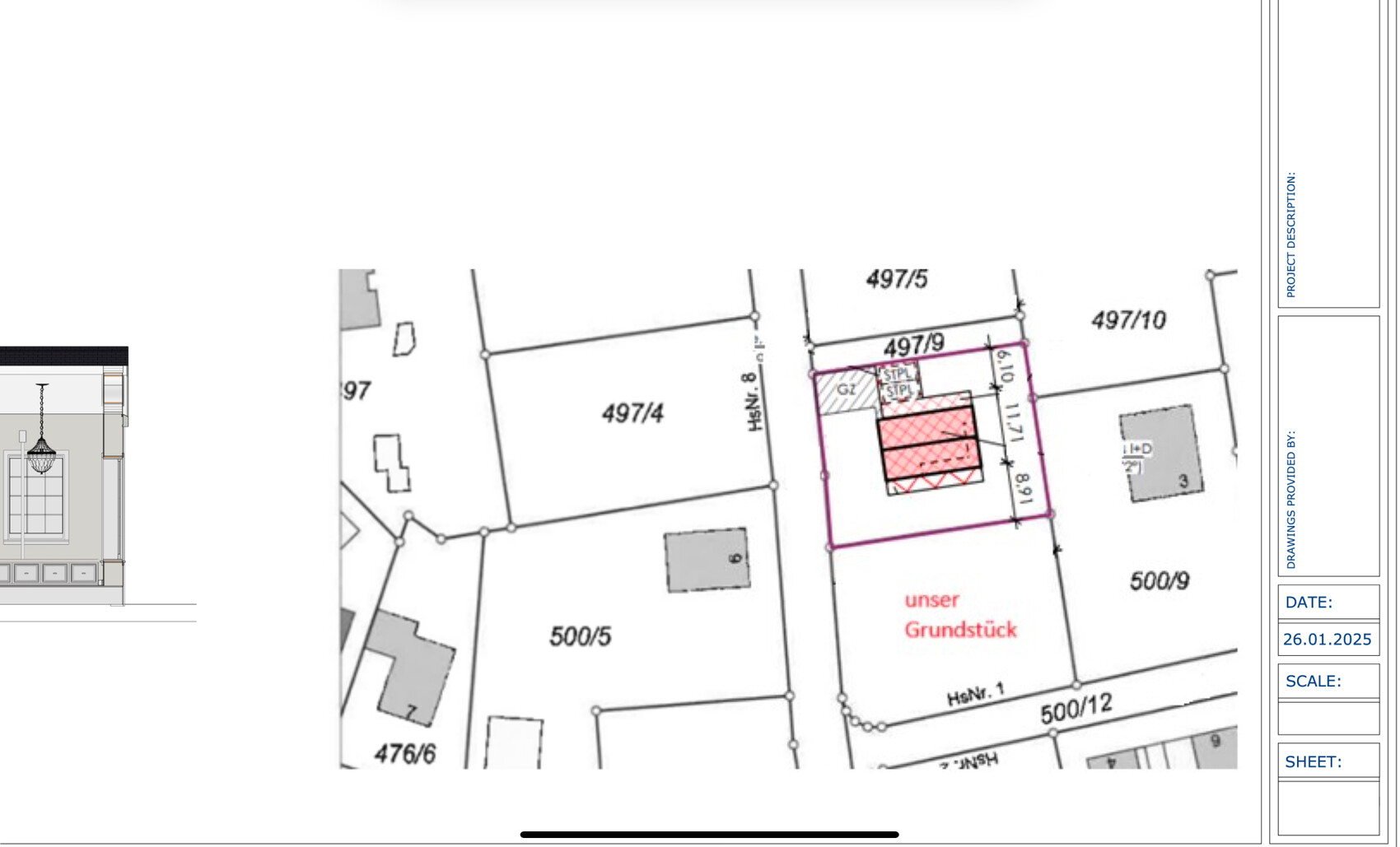
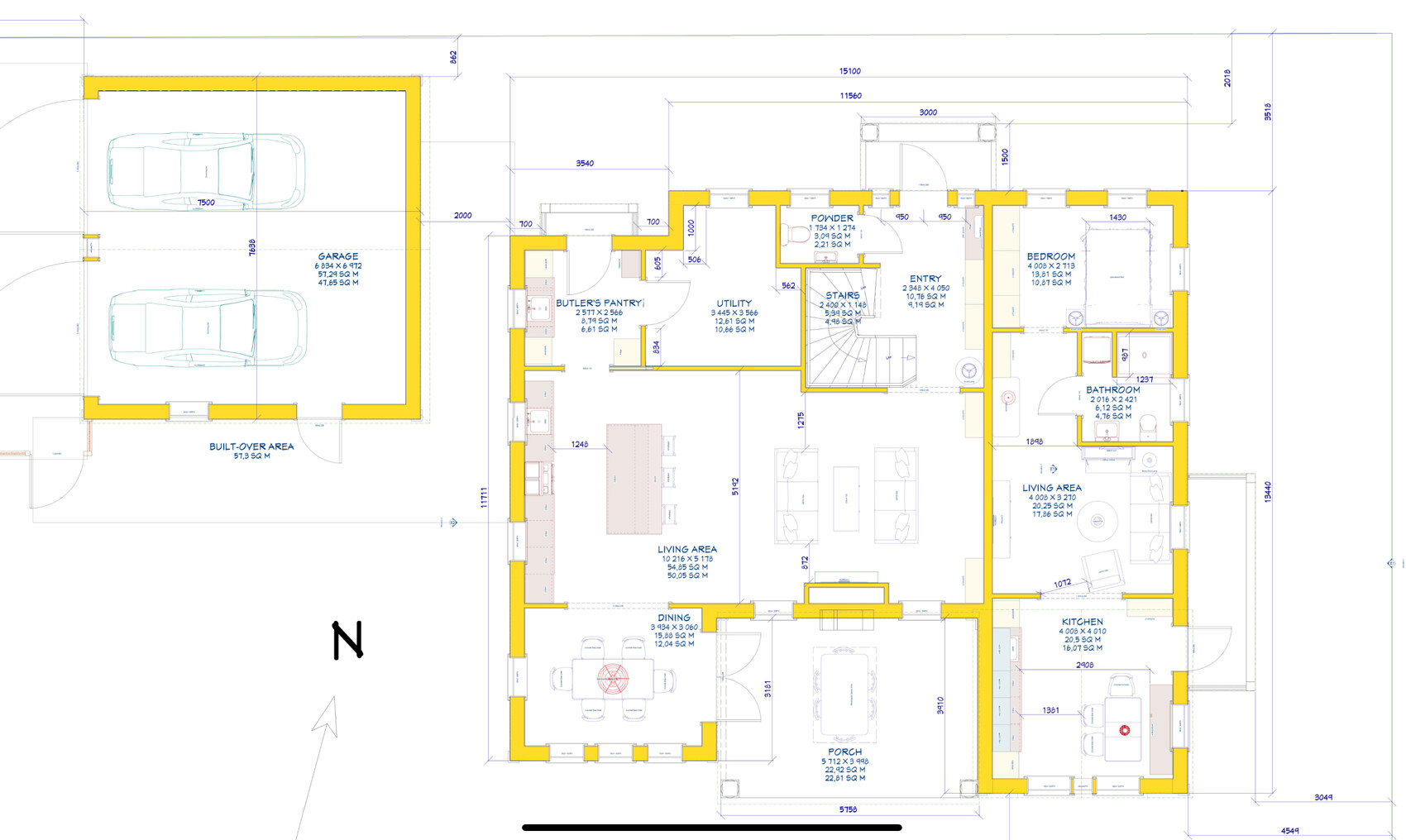
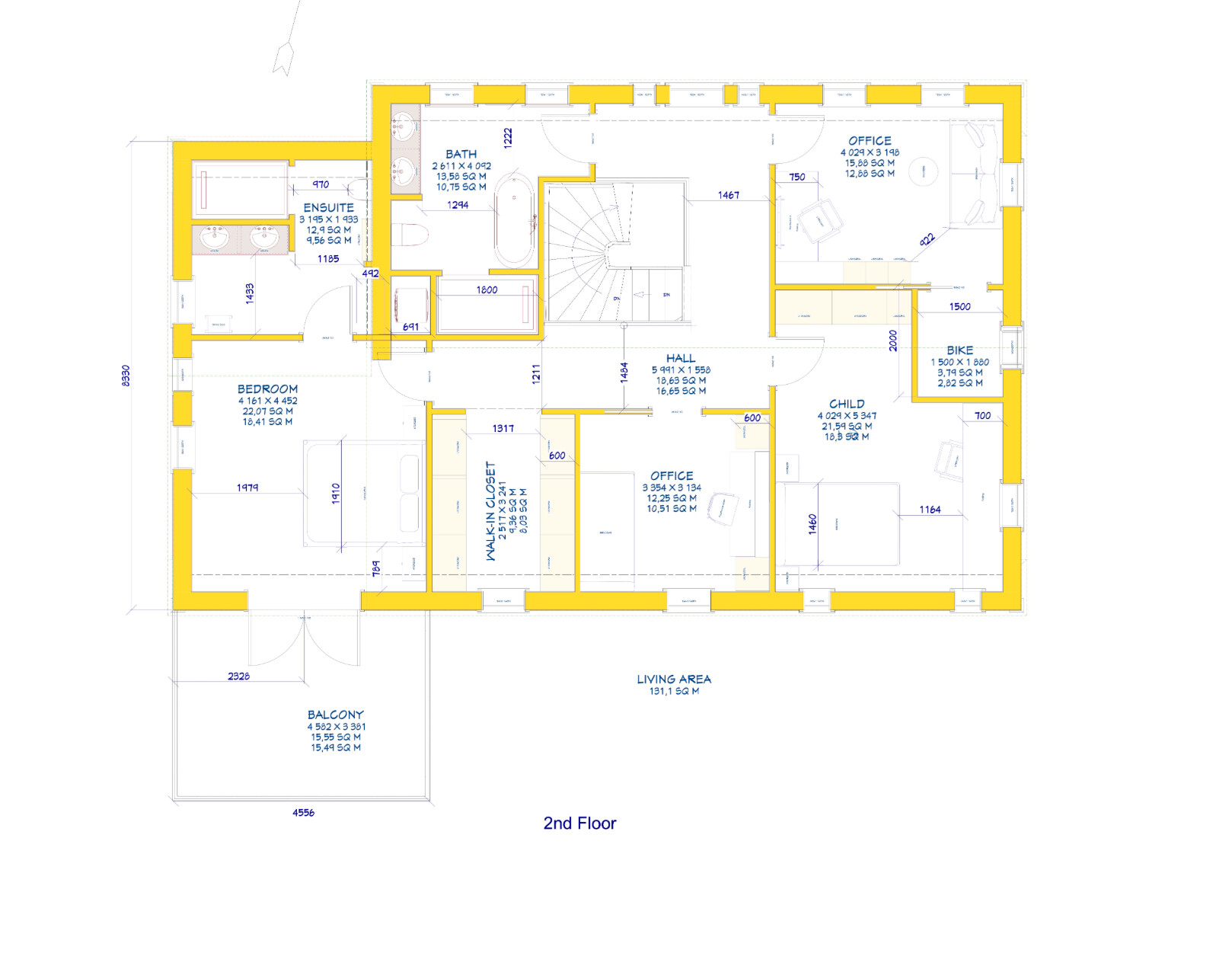
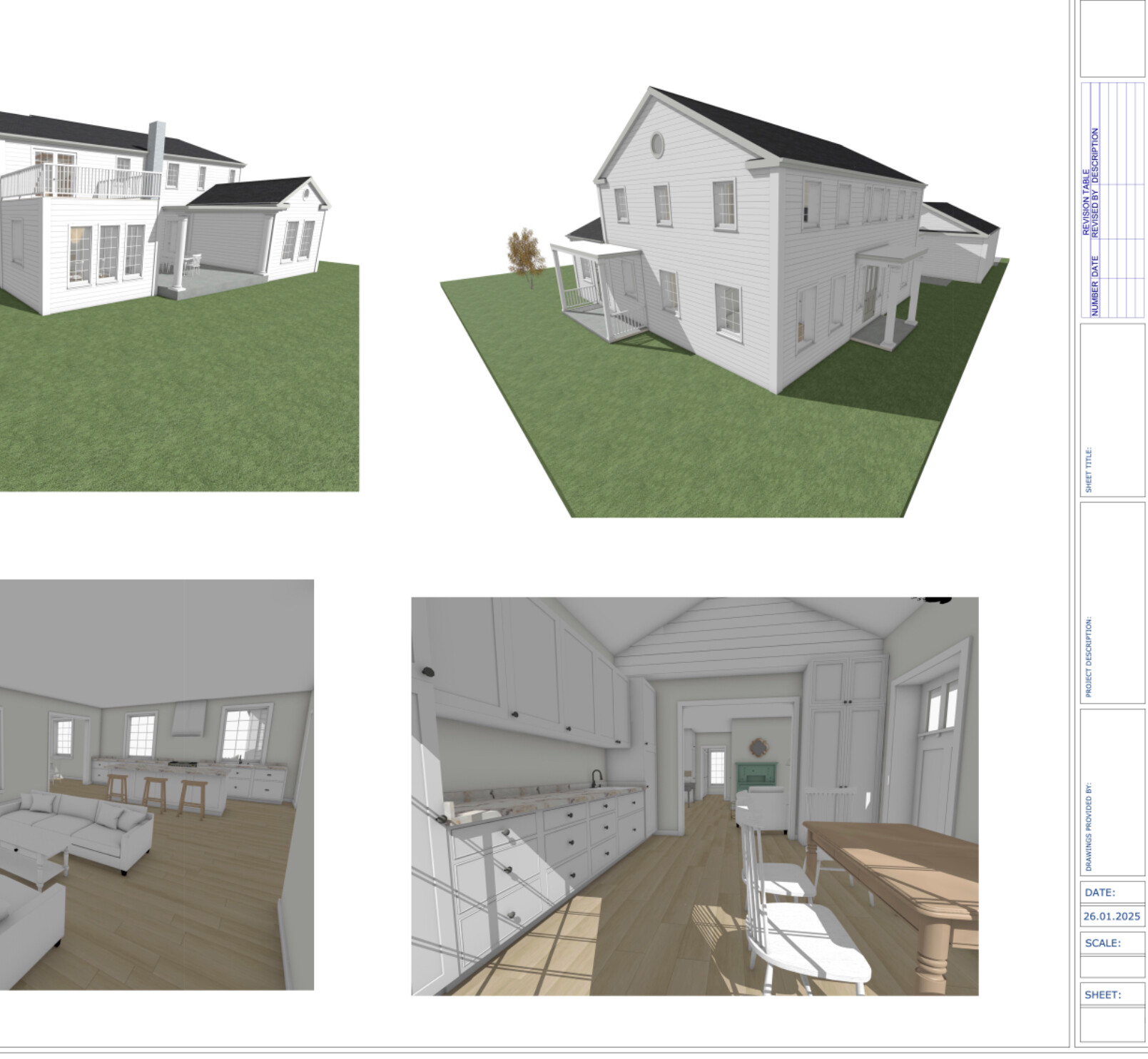
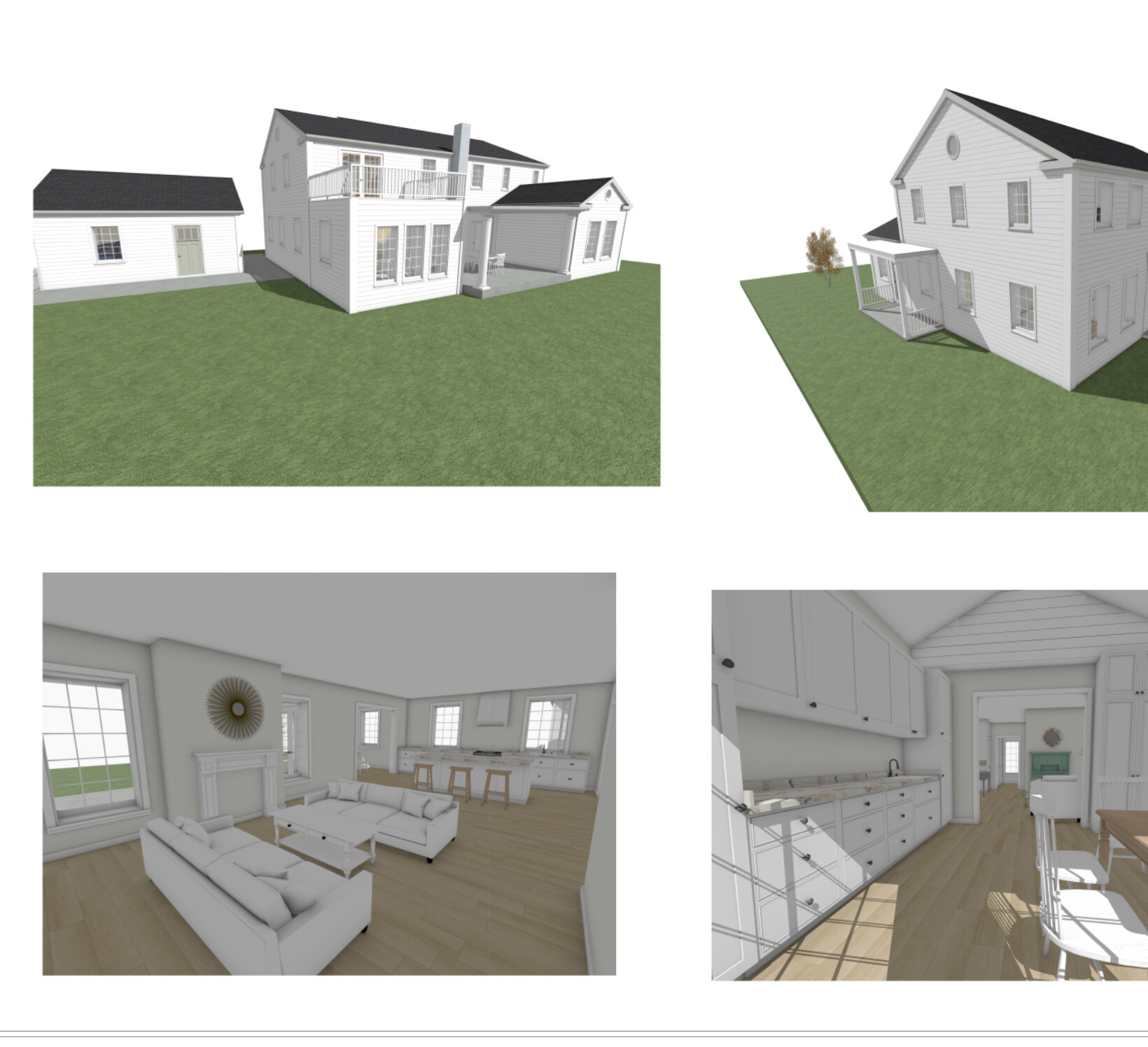
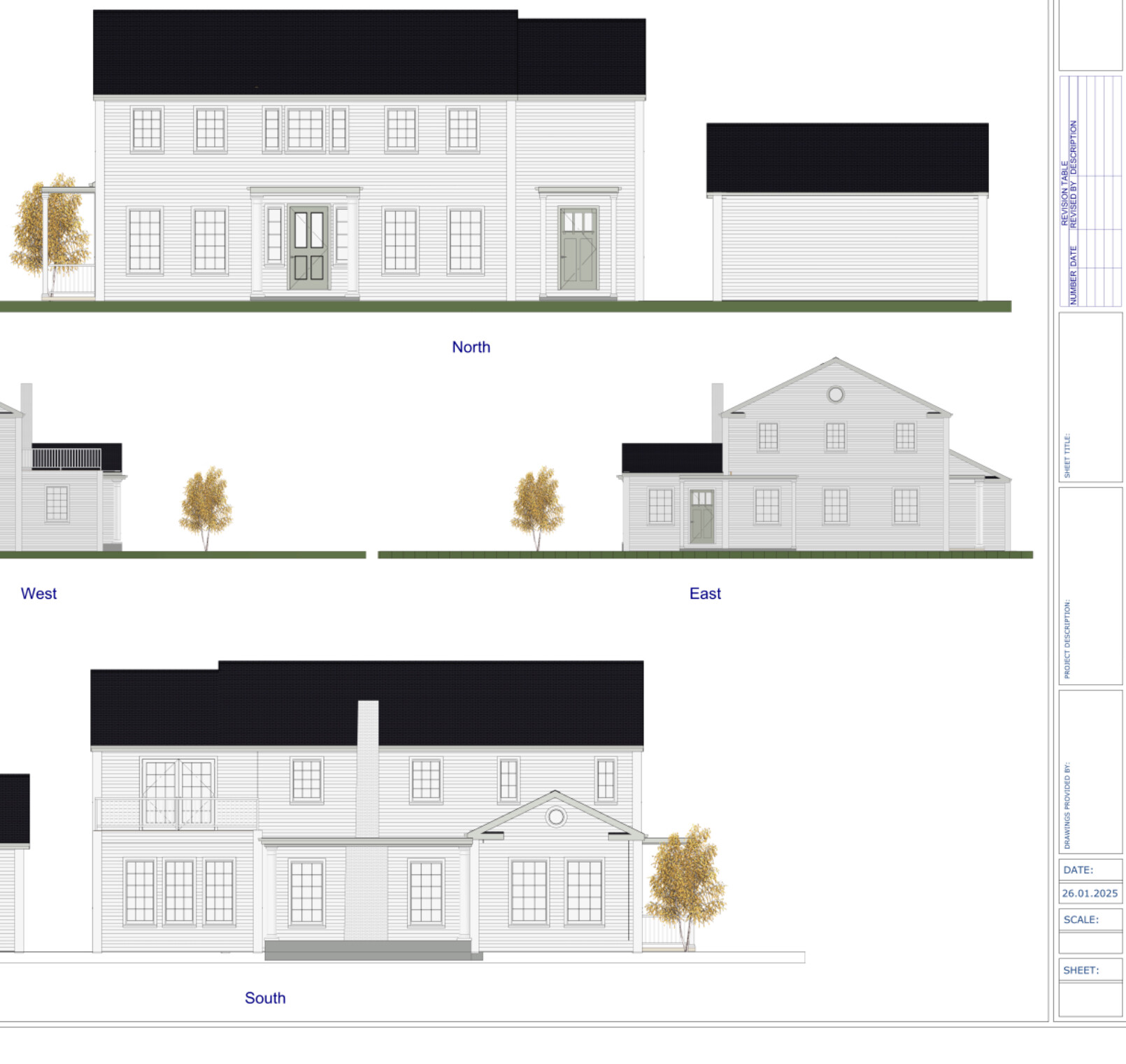
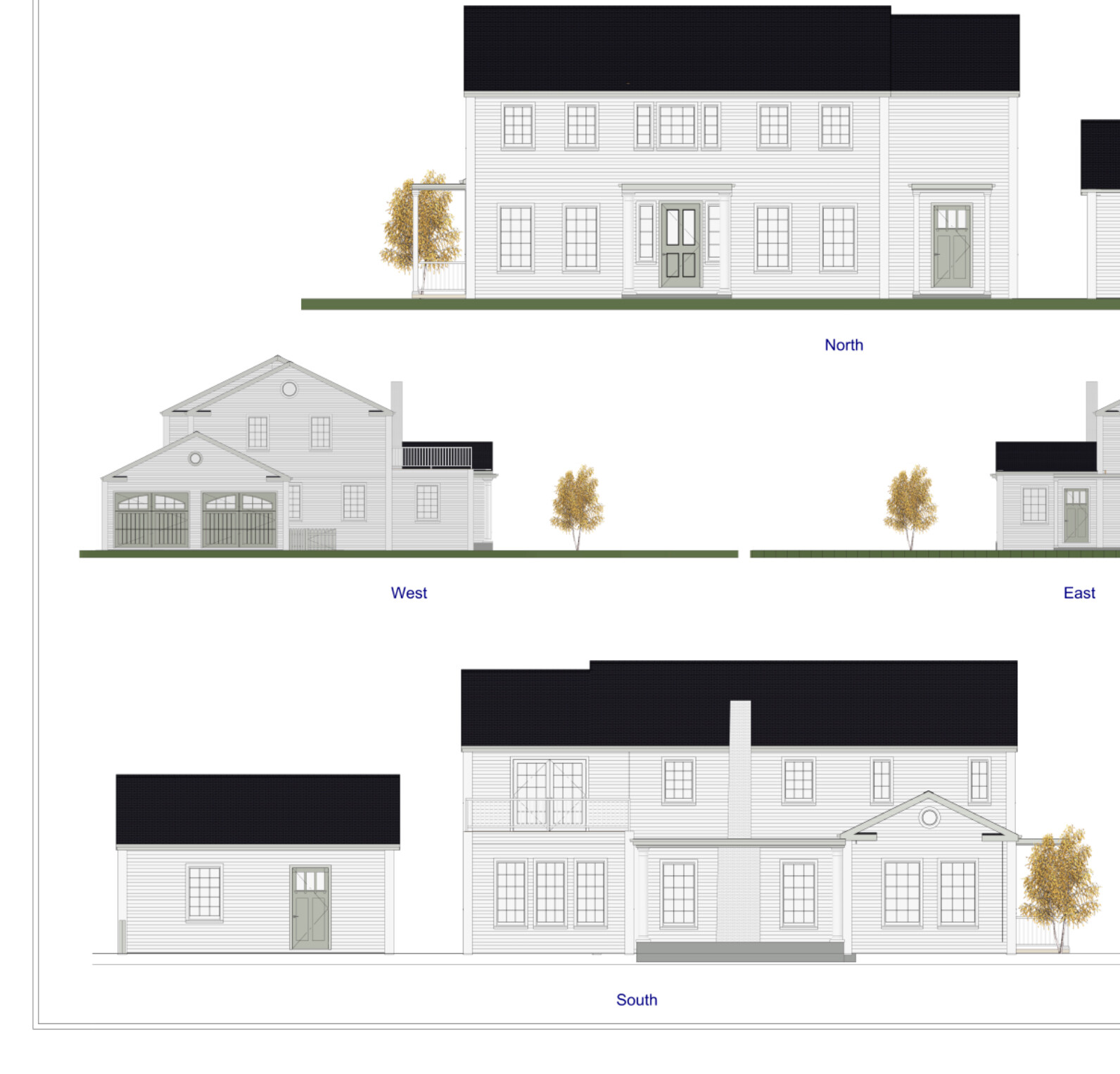
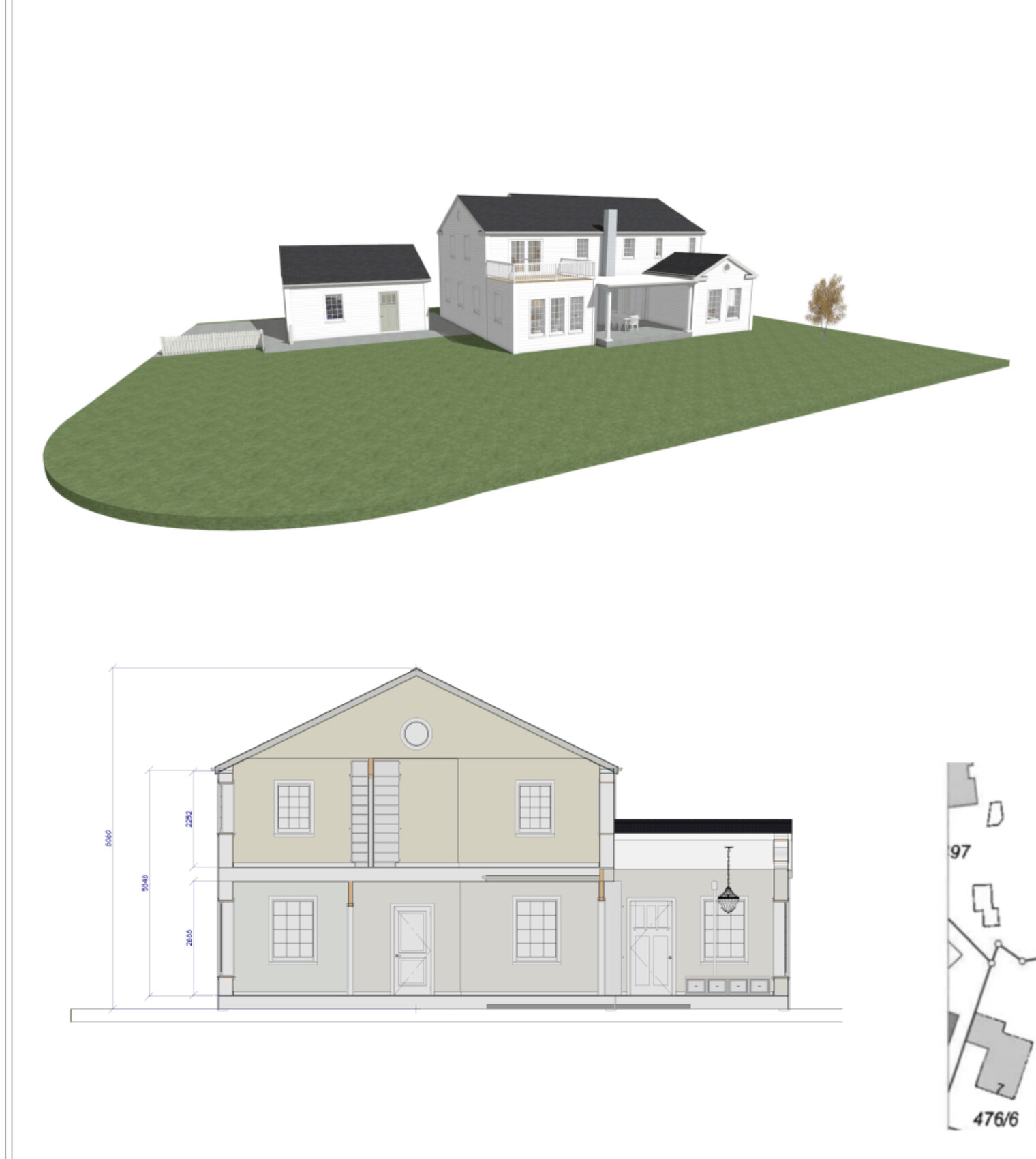
Development Plan / Restrictions
Plot size: 960 m² (10,333 sq ft)
Slope: no
Floor area ratio: 0.2, maximum buildable footprint however <175 m² (1,883 sq ft)
BUT: the 1977 Building Use Ordinance applies
- § 19 IV: Ancillary structures according to § 14 are not counted towards the allowable footprint. The same applies to balconies, loggias, terraces, and structural elements as far as they are permitted within setback areas or distance zones under regional law (here: Bavaria) (…).
- § 21a III: Covered parking spaces and garages are not to be counted towards the allowable footprint as long as they are less than 0.1 of the plot area.
Floor space index: -
Building envelope, building line and boundary: 5 m (16 ft) from the road on the south and west, 3 m (10 ft) from neighbors on the north and east
Edge development: no
Number of parking spaces: 1.5 per dwelling unit
Number of storeys: 1 + attic
Roof style: no fixed style, but roof pitch regulation with 2 options
Option 1: 22–26 degrees
Option 2: 33–44 degrees
Architectural style: no specification
Orientation: flexible
Maximum heights / limits: in red the official restrictions of the development plan, in green the generously granted exceptions we are aware of (several times approved). The neighbors recently submitted a building application aiming for slightly higher eaves and knee wall heights—this will serve as a reference for us.
For roof option 1 (22–26 degrees pitch): ridge height max. 8 m (26 ft) (or 8.15 m / 27 ft), eaves height max. 4.0 m (13 ft) (or 5.20–5.30 m / 17–17.5 ft), knee wall max. 115 cm (45 in) (or 2.20–2.30 m / 7–7.5 ft)
For roof option 2 (33–44 degrees pitch): ridge height max. 10.5 m (34 ft), eaves height max. 3.5 m (11.5 ft), knee wall max. 40 cm (16 in) (exceptions probably possible but no figures known)
Definition of eaves height: Top of rough ground floor slab to intersection of exterior wall with the bottom edge of the rafters
Definition of knee wall: Top of rough attic floor slab to intersection of exterior wall with the bottom edge of the rafters
Client Requirements
Architectural style, roof shape, building type: a new build that does not look like a typical new build
Basement, floors: no basement (high groundwater level, no living space planned underground), two full stories (which are effectively possible due to generous exceptions from the development plan)
Number of people, age: my mother (70+), my husband and I (late 30s), 2 cats, 1 dog, 1 child planned
Space requirements on ground and upper floors: On the ground floor a self-contained apartment for my mother and kitchen / living / dining / utility for us;
Office: 2 offices (both approx. 50% and 80% remote work)
Guest stays per year: about 2–3 weeks
Open or closed layout: open on the ground floor
Conservative or modern building style: conservative
Open kitchen, kitchen island: yes to both
Number of dining seats: 6–8
Fireplace: yes (gas fireplace)
Music/sound system wall: no
Balcony, roof terrace: balcony would be nice
Garage, carport: spacious double garage
Utility garden, greenhouse: rather no
Other wishes / special features / daily routine, including reasons why some things are desired or not:
- Covered terrace / loggia / outdoor seating with reliable but as discreet as possible insect protection (lakeside location, regular mosquito issue) & fireplace (probably gas as well)
- A rather unpopular opinion here, but we explicitly do not want roller shutters or venetian blinds. We currently have them despite many south-facing windows and never use them (feels like a vault). Instead, we plan air conditioning (powered by photovoltaics) and larger trees.
- Gas stove (I just can’t get comfortable with induction)
- Washing machine & dryer on the upper floor
- In one office, a small niche for an exercise bike (turbo trainer)
House Design
Who designed it: DIY
What do you like most and why?
- Style inspired by classic American Colonial architecture
- Living area centered around the fireplace
- Porch with insect protection, fireplace & privacy
- Kitchen island with plenty of workspace
- Small “secondary kitchen” to temporarily hide dirty dishes / cooking mess
What do you not like? Why?
I wouldn’t exactly say “dislike,” but we have doubts about the following points:
- Passage between garage and house might be too narrow?
- Entrance and staircase possibly not spacious enough?
- Staircase: can’t properly design it in the software, but according to a stair calculation tool it should work. Is the space requirement adequate? Are the asymmetrical runs a problem?
- Bedroom in the self-contained apartment is borderline small
- Bathrooms: enough space?
- Utility/technical room: large enough?
- Could a mechanical ventilation system with heat recovery possibly be installed in the crawl space attic?
Personal price limit for the house, including fittings: we’re budgeting €3,000 per m² plus additional costs and landscaping, but have significant equity and thus some flexibility upwards; also plan a lot of personal work.
Preferred heating technology: heat pump with geothermal probe
If you have to give up something, which features/finishes
- Could be sacrificed: balcony
- Cannot be sacrificed: no compromises on the self-contained apartment
Why is the design like it is now?
We originally wanted to buy a house with old-style charm but found nothing suitable. Although we like modern, minimalist architecture, it’s not for us personally.
I’ll help a bit with the images.
S
Schorsch_baut27 Jan 2025 10:00I find it somewhat ambitious to renovate 250 sq meters (2,690 sq ft) of interior space by yourself and expect to lower the overall construction cost, especially given the demands for appearance and style.
C
CornforthWhite27 Jan 2025 10:10ypg schrieb:
I quickly took a detailed look at the floor plan. Without dimensions, though, a lot can only be guessed. (I’m leaving out the windows for now) The windows do have dimensions, but unfortunately they are no longer legible—this is a drawback of uploading the plans as vectorized PDFs, which apparently no longer works as intended (I’d seen PDFs uploaded in older threads, but that seems not possible anymore). I can provide some measurements later.
ypg schrieb:
Well, there are requirements that rental apartments must meet.
That said, I’m not exactly an expert on the law. I’m quite certain that the absence of a dedicated space for drying laundry inside the apartment or a bathroom of the currently planned size should not be an issue. Ultimately, the apartment doesn’t have to satisfy every theoretically conceivable tenant. We are located within commuting distance of Munich, where there is an extreme housing shortage and very high rents. Some of the places offered here for quite a lot of money are by far worse than the planned granny flat, so renting it out should not be a problem.
What’s important to us, of course, is that the apartment works well for my mother. We have read up on how to design an accessible (barrier-free) apartment. However, elsewhere it is mentioned that the dimensions required by the relevant DIN standards for 95% of use cases are quite generous. In public buildings or apartments explicitly marketed as accessible, that certainly makes sense, but in private homes, most people—even those requiring care—can manage well with somewhat smaller dimensions. The question is where the limit lies. I have a family member who needs care (overweight, immobile, requires assistance with showering and washing, and incontinence products are also a significant issue), who copes well with a relatively small bathroom that would certainly not be classified as senior-friendly according to the DIN. I will ask to have the distances in this bathroom measured, maybe we can learn something useful from that.
ypg schrieb:
You plan to do a lot of work yourselves. Don’t forget you also have a full-time job. Managing a lot of self-work on the side is only possible to a limited extent. That’s true. However, we already live just a few minutes’ walk from the plot, so it will be easy to work on the house for a few hours regularly after work. We don’t expect to move in within a very short time anyway.
kbt09 schrieb:
I basically like the concept too.
What immediately stood out to me again is the staircase. What ceiling height is planned? The staircase looks very tight to me. We are somewhat uncertain about this as well, even though we’ve already spent quite a lot of time on the stairs. The floor-to-ceiling height is 305cm (10 ft). The software used for the design creates nice straight and single-flight stairs with landings, but quickly reaches its limits with winding steps. We have calculated the stairs manually as well as using several stair calculators and compared the stair layouts mentioned here in the advice post on floor plan design. According to all these calculations, the stairs should be fine. The tread width is 1m (3 ft 3 in), or 95cm (3 ft 1 in) without the railing, and the tread depth, step length, riser height, pitch, Blondel’s formula, and headroom are all well within acceptable limits. The stairs comply with DIN standards, but whether they are reasonably comfortable to use is something we find difficult to assess. I think we will have a stair specialist review them. I will look up the stair measurements later, maybe someone here can then provide more input.
kbt09 schrieb:
And just a couple more quick points:
- Bedroom: bed headboard next to a passageway
- The path from kitchen to terrace always goes past the table, right? That could be a bit tight.
- Living area is more a passage zone than a quiet area
Also, a tip: for Pax wardrobes, I would always plan them with a depth of 65/66 cm (26/26 inches) because of the doors and shell construction dimensions. We did discuss having the bed headboard next to the passageway and concluded that it doesn’t really bother us (we had that in our previous apartment and didn’t find it problematic). In an earlier version of the design, the bed was placed against the bathroom wall and access to the bath was arranged differently—but for other reasons, we liked it less. We will reconsider this.
The path to the terrace should be okay. At the narrowest point, there is about 90cm (35 inches) of clearance with the chair fully pulled out. Between the passage and the corner of the table, there is over 1m (39 inches). We might slightly enlarge the dining area to gain some extra space.
Regarding the living area, we are facing the conflict between open/generous space versus a separate quiet zone. At the moment, there would only be two of us in the house, and more than three people are unlikely. I’m not sure if through traffic would be a big issue then. Since our entry area is considered quite private (other posters think even too private), I don’t expect a lot of visitors passing through. Possibly this could be addressed with a sliding door, although in our household doors are almost never closed (or can’t be closed… cat owners will know what I mean).
We will give all Pax wardrobes a little extra space. At most locations, we have already planned slightly generously, but we will adjust this consistently. Good tip.
N
nordanney27 Jan 2025 10:17CornforthWhite schrieb:
That’s true. However, we already live just a few minutes’ walk from the plot, so it’s easy to work on the house for a few hours regularly after work. We also don’t expect to move in within a very short time. I would be interested to hear your definition of self-performed work. Regularly doing “a few hours” can easily take up to half a year just for walls and floors, which are classic tasks given the size of the house.
In the original post, “a lot of self-performed work” was mentioned.
C
CornforthWhite27 Jan 2025 10:31Schorsch_baut schrieb:
I find it somewhat ambitious to finish 250 sqm (2700 sq ft) of interior work yourself and still expect to reduce the overall construction costs. Especially with the demands on appearance and style. That’s definitely true, and it won’t be a quick process. However, we’re not too worried about meeting our own expectations regarding appearance and style. For example, we once extensively renovated a listed historic apartment in the upper market segment as a DIY project, and I think we did a good job. At least, the quality of the renovation was praised by all potential buyers, so apparently third parties found the result quite decent. My husband is skilled in various trades and very perfectionist by nature. It will certainly be a lot of work, but we are motivated and enjoy this kind of challenge.
nordanney schrieb:
I’d be interested in your definition of DIY work. Even “a few hours” regularly can take half a year alone for walls and floors in a house of this size.
The initial post mentions “a lot of DIY work.” We plan to do the following as DIY work: installing insulation and closing up walls, plastering, painting, laying parquet and tiles, installing doors, preparing electrical work, planning and purchasing photovoltaic equipment ourselves and only having it connected by a professional (my husband is a mechanical engineer with extensive electrical knowledge), built-in wardrobes, landscaping. Of course, we are not only planning to do “a few hours regularly” but to use all weekends and holidays as well. The comment was only to point out that we can work on the project daily and are not limited to weekends due to long travel times like many other homeowners. If it becomes too much, we can always hire a contractor or get more help.
N
nordanney27 Jan 2025 10:41CornforthWhite schrieb:
Of course, we don’t only plan for “a few hours regularly,” but also all weekends and vacation days. OK. We have some self-builders here who think this can be done “in no time.”
For the tasks mentioned, you simply have to understand that it’s more like 60 person-days rather than 60 hours.
When we built, there was a rule of thumb that saving 100 euros with a tradesperson equals about 3 hours of work for a layperson. You have to think that through carefully.
The house looks stylish—something a bit different.
Try drawing all existing and desired furniture into the floor plan to scale. Especially for the granny flat, you should consider books, shoe collections, etc.
Regarding your area—my first thoughts were large, long walking distances and impracticality.
I completely understand the reason for the second kitchen, but it is incredibly unergonomic. I can’t imagine it being practical for everyday use.
The kitchen and living area will be quite dark.
The entrance is very hidden—seriously, how often do you take out the trash in pajamas?
The upper floor somehow feels cramped and partially dark.
The house looks stylish—something a bit different.
Try drawing all existing and desired furniture into the floor plan to scale. Especially for the granny flat, you should consider books, shoe collections, etc.
Regarding your area—my first thoughts were large, long walking distances and impracticality.
I completely understand the reason for the second kitchen, but it is incredibly unergonomic. I can’t imagine it being practical for everyday use.
The kitchen and living area will be quite dark.
The entrance is very hidden—seriously, how often do you take out the trash in pajamas?
The upper floor somehow feels cramped and partially dark.
Similar topics