
ᐅ Electrical Installation for Bay Window Seating – Wall Outlet vs. Conduit
Created on: 27 Jan 2025 10:58
F
Flitz86Hello everyone,
we are currently working on the electrical installation in our extension (timber frame with a 6cm (2.4 inch) installation space). At one point/window, a window seat will be installed, meaning the seat with the surrounding build-up will be constructed with a depth of about 40cm (16 inches) in front of the finished wall. Electrical work is needed here as well (power, 2 supply lines for LED strips, Loxone supply line for switches and spotlights).
I am now trying to figure out how to implement this and how to route the electrical wiring for the window seat. At the moment, I have 2 or 3 options in mind:
1.) Install conduit on the raw floor
The conduit would come up from the floor in the area of the window seat, and the cables would either be routed directly where needed or re-terminated in a surface-mounted junction box. Everything would be hidden within the window seat structure.
Advantage: Very flexible since the cables do not have to be installed now (regarding lengths, etc.), and a reserve line could be planned. / Disadvantage: The conduit comes out of the floor and is open (but hidden behind the structure) – but what if the window seat is removed later?
2.) Install a flush-mounted distribution box. Pull all necessary cables up to this point and then “branch off” into the window seat or its build-up from there.
Advantage: You could pull all cables up to that point now and extend them later as needed, plus plan a reserve line. / Disadvantage: The later installation would be more or less surface-mounted, and how do you neatly exit from the flush-mounted distribution box? Through the cover or just leave it open behind the structure?
3.) Pull cables with some slack and use outlet boxes
This means I would roughly pull all cables to where I estimate they will be needed and route them through outlet boxes to the outside of the wall. Thus, I would have clean wall outlets but be somewhat limited spatially—I would have to know exactly which cable is needed where.
Advantage: Clean wall outlets, and later the boxes could be closed with a cover and plastered over. / Disadvantage: Less flexible. The exact location (height, etc.) of each cable needs to be known now. There would be 4 outlet boxes in the wall.
Which option do you think is the best or cleanest? Or does anyone have another idea on how to solve this? The question is how to route cables out of the wall with maximum flexibility. For me, a mix of options 2 and 3 would be ideal...
Best regards,
Chris
we are currently working on the electrical installation in our extension (timber frame with a 6cm (2.4 inch) installation space). At one point/window, a window seat will be installed, meaning the seat with the surrounding build-up will be constructed with a depth of about 40cm (16 inches) in front of the finished wall. Electrical work is needed here as well (power, 2 supply lines for LED strips, Loxone supply line for switches and spotlights).
I am now trying to figure out how to implement this and how to route the electrical wiring for the window seat. At the moment, I have 2 or 3 options in mind:
1.) Install conduit on the raw floor
The conduit would come up from the floor in the area of the window seat, and the cables would either be routed directly where needed or re-terminated in a surface-mounted junction box. Everything would be hidden within the window seat structure.
Advantage: Very flexible since the cables do not have to be installed now (regarding lengths, etc.), and a reserve line could be planned. / Disadvantage: The conduit comes out of the floor and is open (but hidden behind the structure) – but what if the window seat is removed later?
2.) Install a flush-mounted distribution box. Pull all necessary cables up to this point and then “branch off” into the window seat or its build-up from there.
Advantage: You could pull all cables up to that point now and extend them later as needed, plus plan a reserve line. / Disadvantage: The later installation would be more or less surface-mounted, and how do you neatly exit from the flush-mounted distribution box? Through the cover or just leave it open behind the structure?
3.) Pull cables with some slack and use outlet boxes
This means I would roughly pull all cables to where I estimate they will be needed and route them through outlet boxes to the outside of the wall. Thus, I would have clean wall outlets but be somewhat limited spatially—I would have to know exactly which cable is needed where.
Advantage: Clean wall outlets, and later the boxes could be closed with a cover and plastered over. / Disadvantage: Less flexible. The exact location (height, etc.) of each cable needs to be known now. There would be 4 outlet boxes in the wall.
Which option do you think is the best or cleanest? Or does anyone have another idea on how to solve this? The question is how to route cables out of the wall with maximum flexibility. For me, a mix of options 2 and 3 would be ideal...
Best regards,
Chris
W
wiltshire27 Jan 2025 11:28I find it difficult to understand the problem since I am not aware of the progress on the construction site. I also did not fully understand where the light points are supposed to be placed. Actually, the installation within the structure should not be problematic if the location of the light points is already planned and the light fixture has been selected – although I might be mistaken due to my lack of knowledge.
I can suggest how to use a wall outlet box and run a cable from there – in my opinion – neatly to the light point with a picture. The box is by Berker, the cable by Gi Gambarelli. We decided on this option because the cable leads to a range hood installed under a solid wood ceiling, where it is not possible to run cables inside.
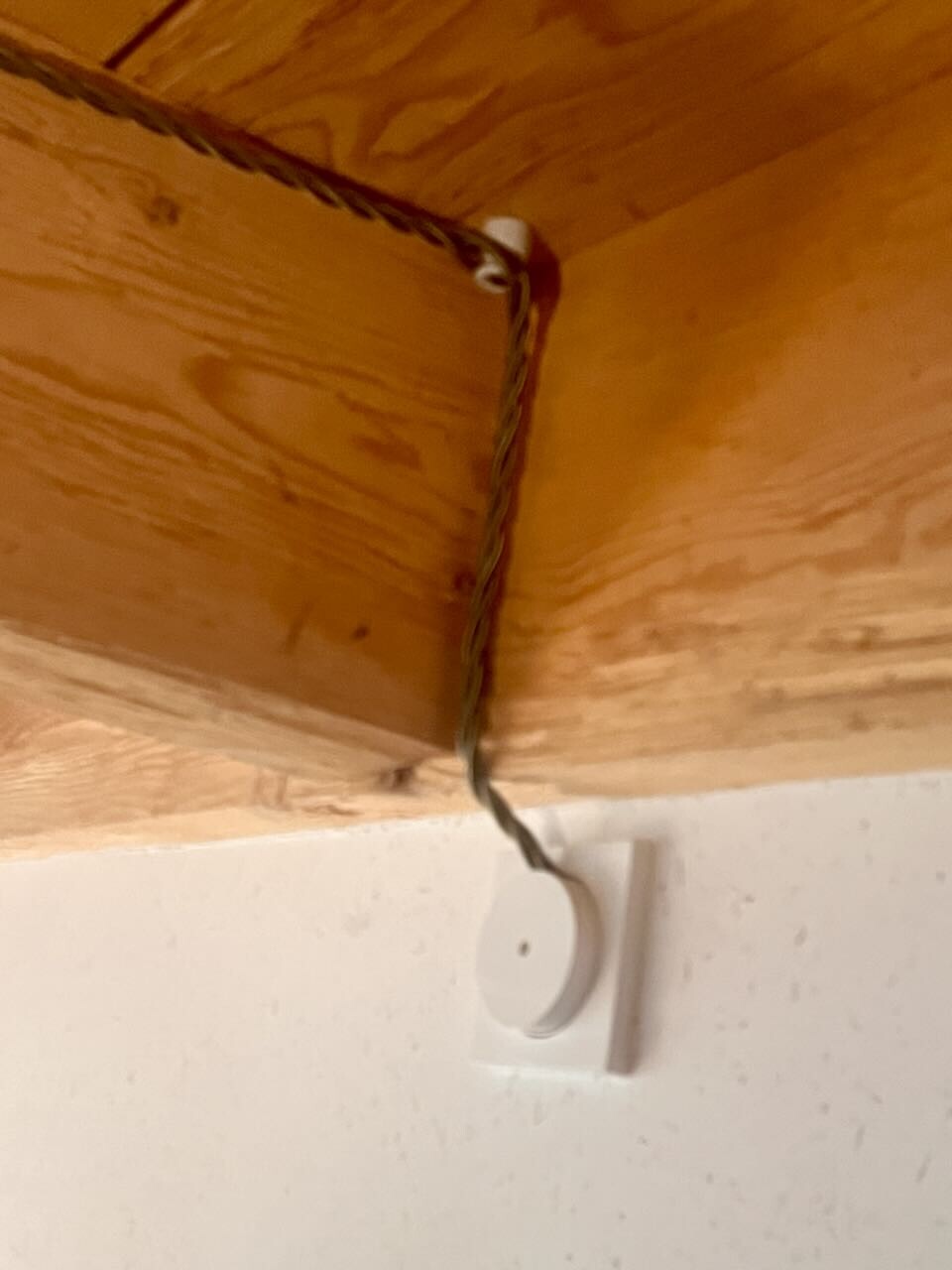
I can suggest how to use a wall outlet box and run a cable from there – in my opinion – neatly to the light point with a picture. The box is by Berker, the cable by Gi Gambarelli. We decided on this option because the cable leads to a range hood installed under a solid wood ceiling, where it is not possible to run cables inside.
N
nordanney27 Jan 2025 11:37I don’t really understand the problem either. As with most electrical installations, you generally know where you want the lights and switches.
I placed the switch normally on a wall and then routed the wiring (small spotlights above the seating bay window) to where I needed them.
I placed the switch normally on a wall and then routed the wiring (small spotlights above the seating bay window) to where I needed them.
Thanks for your feedback... maybe I’m making this more complicated than it needs to be.
@wiltshire
Do I understand correctly that the cable outlet is mounted on a standard 68mm (2.7 inches) hollow wall box / junction box? So you run your NYM cable to the box and then continue with the final cable from there?
To clarify the problem and the current construction status:
The installation space is still completely open at the moment. That means I could run the cables freely.
What is not set in stone—and this is where our situation differs from yours, @nordanney (which might be due to lack of planning)—is how the window seat will be designed (height, exact position of the spotlights, etc.). This is partly because it won’t be just a regular window seat but one with an attached room divider.
Also, from my experience so far, plans often have a limited shelf life, so I want to prepare the electrical installation now in a way that allows the greatest possible flexibility later on.
I’ll try to explain with a specific example:
Electricity. We want to integrate power outlets somewhere in the window seat. For this, I need to provide a suitable supply line. Ideally, I would know exactly where the (at least first) outlet in the window seat will be located, so I could run the supply cable there directly. If I run the supply line inside the installation space, I still need to bring it out of the wall at some point.
This means either I run the cable in one piece and bring it out somewhere in the wall (with or without an outlet box), or I run the supply line to a certain point (a junction box) and then continue outside the wall through a cable outlet like the one @wiltshire uses.
My specific question, then, is how to best prepare for this. For example, by using such outlet boxes or by installing a conduit that can be used later.
@wiltshire
Do I understand correctly that the cable outlet is mounted on a standard 68mm (2.7 inches) hollow wall box / junction box? So you run your NYM cable to the box and then continue with the final cable from there?
To clarify the problem and the current construction status:
The installation space is still completely open at the moment. That means I could run the cables freely.
What is not set in stone—and this is where our situation differs from yours, @nordanney (which might be due to lack of planning)—is how the window seat will be designed (height, exact position of the spotlights, etc.). This is partly because it won’t be just a regular window seat but one with an attached room divider.
Also, from my experience so far, plans often have a limited shelf life, so I want to prepare the electrical installation now in a way that allows the greatest possible flexibility later on.
I’ll try to explain with a specific example:
Electricity. We want to integrate power outlets somewhere in the window seat. For this, I need to provide a suitable supply line. Ideally, I would know exactly where the (at least first) outlet in the window seat will be located, so I could run the supply cable there directly. If I run the supply line inside the installation space, I still need to bring it out of the wall at some point.
This means either I run the cable in one piece and bring it out somewhere in the wall (with or without an outlet box), or I run the supply line to a certain point (a junction box) and then continue outside the wall through a cable outlet like the one @wiltshire uses.
My specific question, then, is how to best prepare for this. For example, by using such outlet boxes or by installing a conduit that can be used later.
W
wiltshire27 Jan 2025 12:33If the installation level is still open, you simply run a "sufficient amount" of cable to a point behind the future bench seat. When the bench seat is later installed, the lighting and outlets are integrated into it, and everything works out fine.
Flitz86 schrieb:That's exactly how we did it.
So you ran your NYM cable up to the outlet and then continued with the final cable from there?
Similar topics