
ᐅ Floor Plan Discussion / Single-Family Home on a Narrow Lot with Northeast Orientation
Created on: 16 Jan 2025 07:05
Z
Zitronenwalter
Hello everyone,
I came across this forum while working on our floor plan and looking for experience reports from potentially suitable home builders.
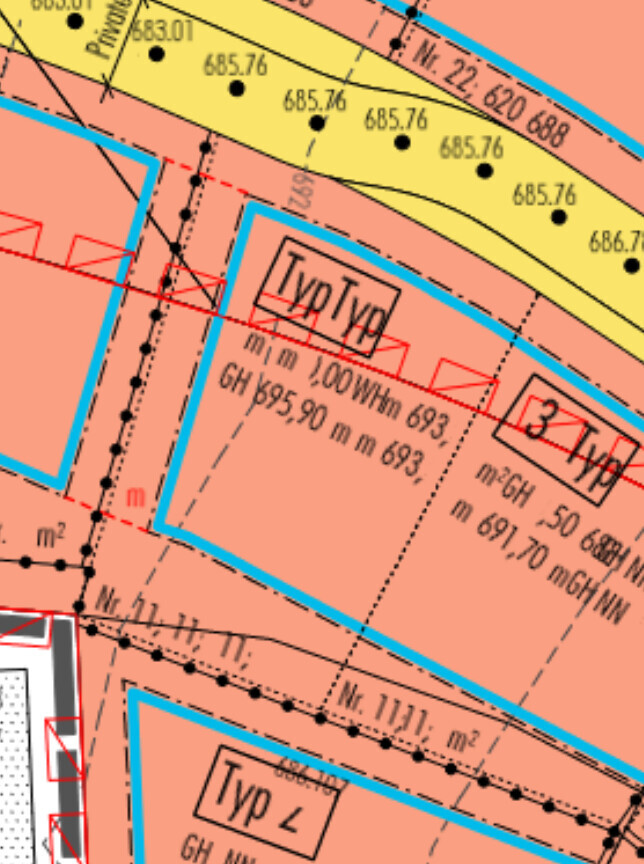
Since there are already detailed and technically knowledgeable discussions here, I would like to present our proposed floor plan for discussion. The plot is located in a new development area, with neighboring buildings from the older stock to the southwest.
Overall, we are quite satisfied with the design in terms of maximizing the use of the plot. However, we are somewhat uncertain about the orientation and size of the windows in the living-dining area (is the glazing sufficient, or will it be too dark in winter?), as well as the location of the main terrace (will it be shaded in the mornings during summer and extremely hot in the evenings?).
We welcome your opinions on the floor plan/layout, especially regarding our “pain points” or anything else you notice (both positive and negative).
Development Plan/Restrictions
Plot size: 500 sqm (5,382 sq ft)
Slope: none
Site occupancy index (floor area ratio): 0.4
Gross floor area ratio: 2
Building envelope, building line, and boundaries
Edge development: none
Number of parking spaces: 2
Number of floors: 2 full stories
Roof type: gable roof
Architectural style: classic/modern
Orientation: SW/NE
Maximum heights/restrictions: see cross-sections
Additional requirements: roof overhang 0.5 m (20 inches)
Client Requirements
Architectural style, roof type, building type: classic/modern, gable roof with minimal pitch preferred, single-family house
Basement, floors: basement, 2 full stories
Number of residents, ages: 5 (37, 37, 5, 3, 0)
Room requirements on ground and upper floors: 3 children’s bedrooms
Office: family use on the ground floor, home office in the basement
Guest overnight stays per year: approximately 10
Open or closed layout: open
Conservative or modern construction: conservative-modern
Open kitchen, kitchen island: kitchen island
Fireplace: no
Music/sound wall: no
Balcony, roof terrace: no
Garage, carport: double garage
Utility garden, greenhouse: no
Additional wishes/particulars/day schedule, and reasons for any inclusions or exclusions: none to mention
House Design
Who planned the design: architect, fine-tuning by us
What do you particularly like? Why?:
Short and direct routes (e.g., kitchen to dining, kitchen to terrace, garage to entrance). Efficient use of space and plot. Clear separation between living and entrance/mudroom areas. All bedrooms on one level with the option to create a simple gallery for the children later.
What do you dislike? Why?:
Uncertainty about the orientation of the living corner with the TV and the wall by the staircase. Does this block off the living-dining area too much from the south? Unfortunately, I have no idea how to change this without drastically disrupting the entire floor plan.
Price estimate according to architect/planner: approximately €700,000 (house including ancillary costs, excluding garage)
Personal budget limit for the house, including fittings: (€700,000)
Preferred heating technology: heat pump/underfloor heating
If you had to omit something, which details/extensions
-can you do without:
-cannot do without:
Why did the design turn out this way? For example:
Which wishes were fulfilled by the architect? Large living-dining area with lift-and-slide door, as much garden space as possible, double garage or carport
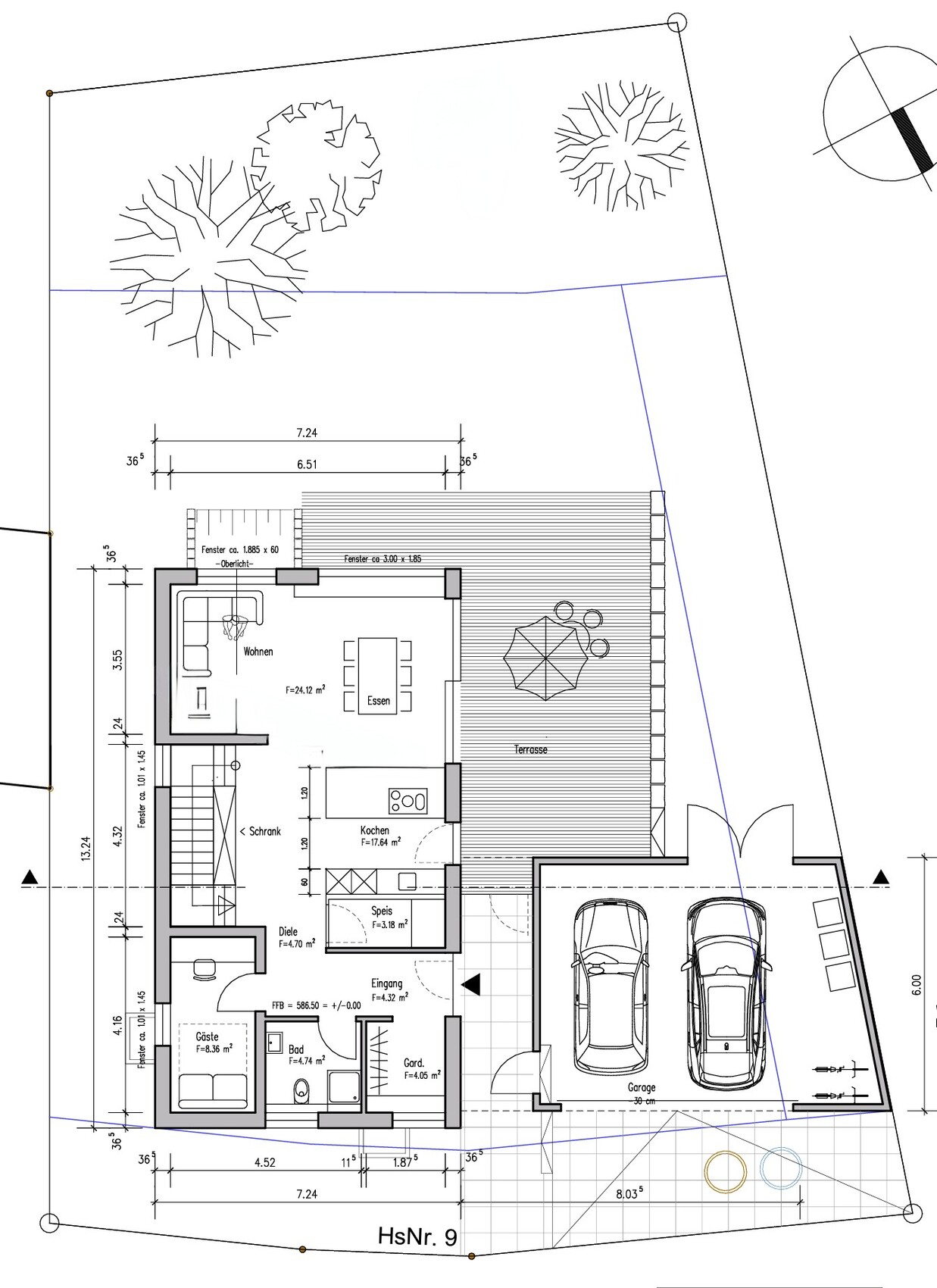
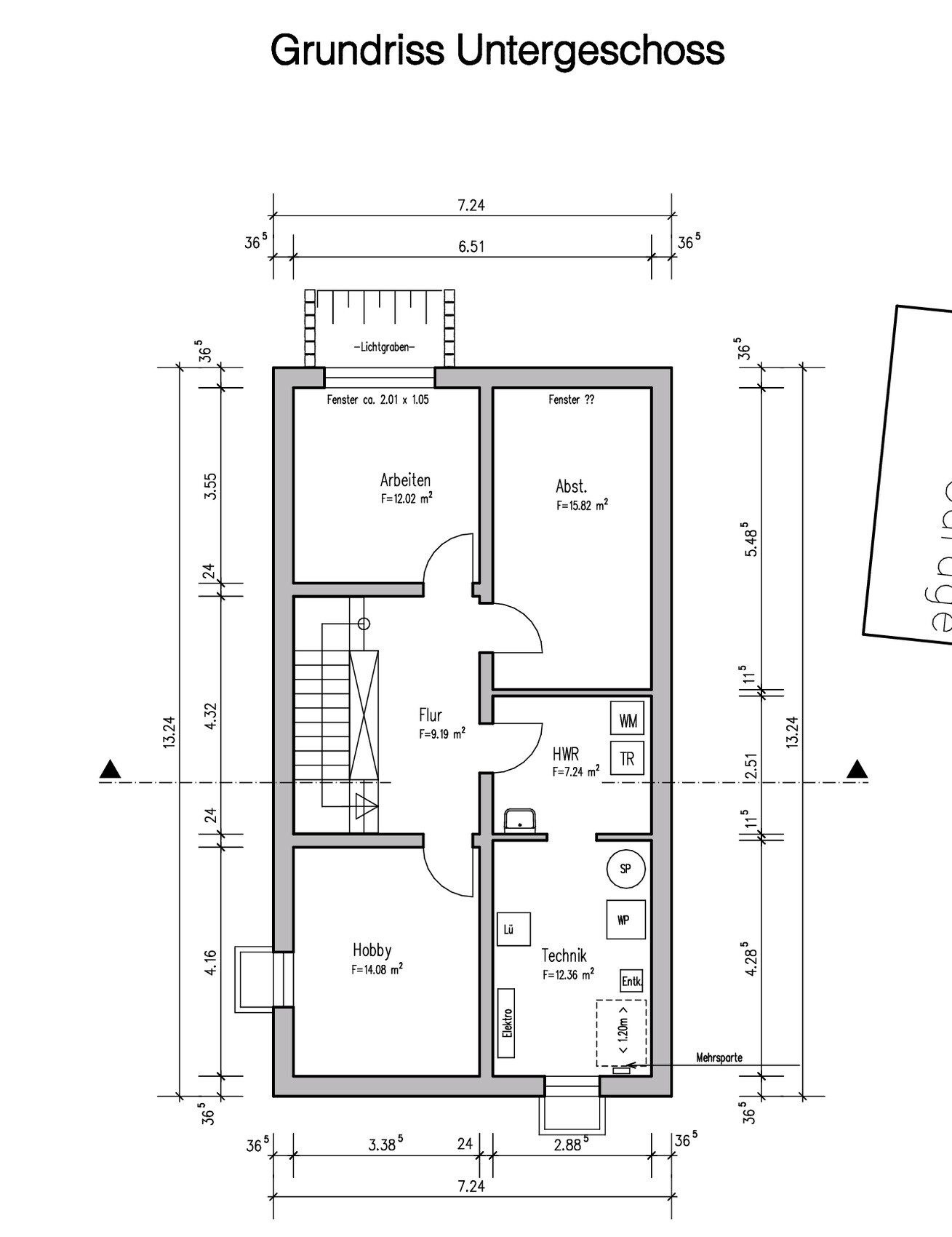
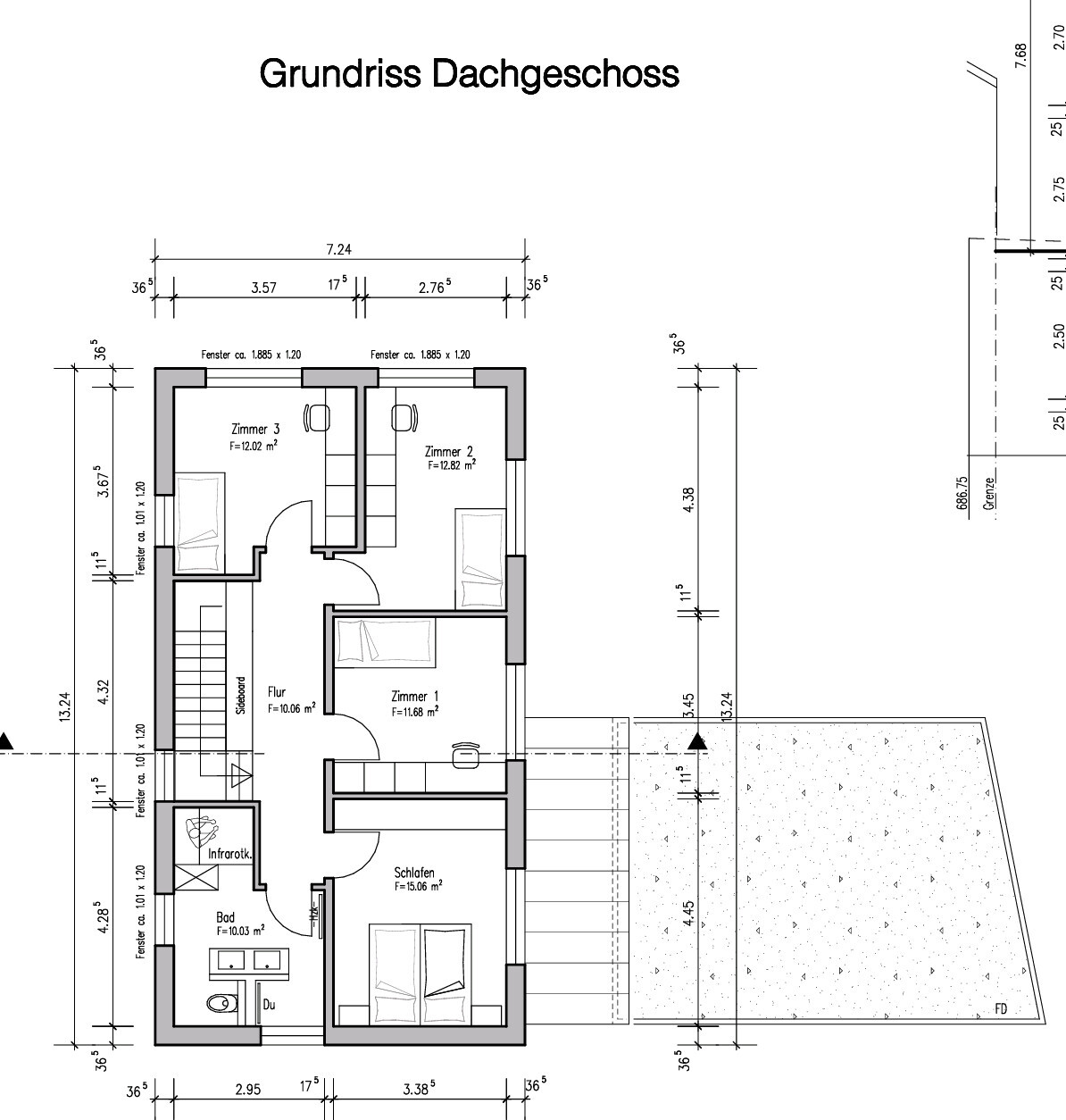
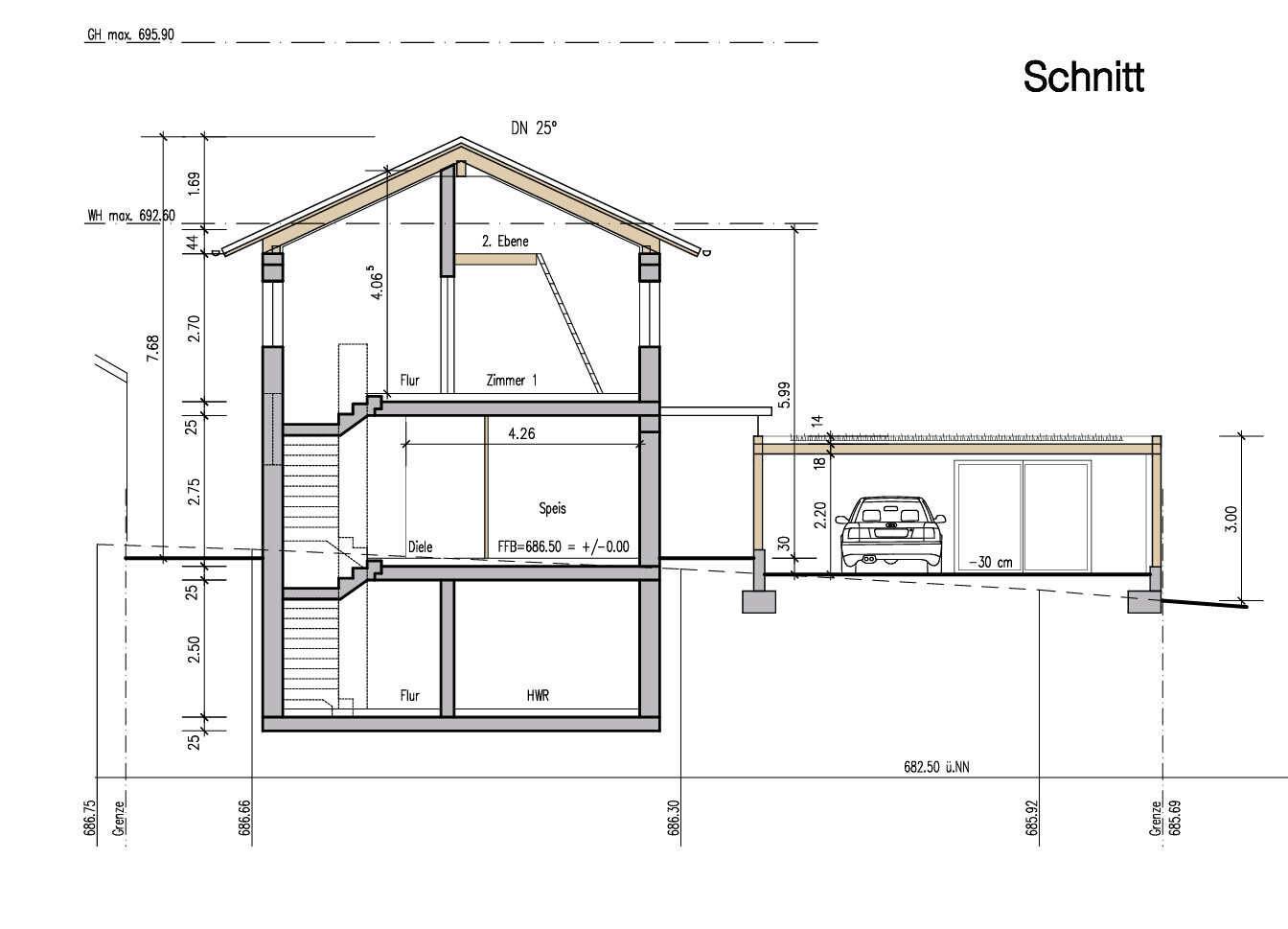
I came across this forum while working on our floor plan and looking for experience reports from potentially suitable home builders.
Since there are already detailed and technically knowledgeable discussions here, I would like to present our proposed floor plan for discussion. The plot is located in a new development area, with neighboring buildings from the older stock to the southwest.
Overall, we are quite satisfied with the design in terms of maximizing the use of the plot. However, we are somewhat uncertain about the orientation and size of the windows in the living-dining area (is the glazing sufficient, or will it be too dark in winter?), as well as the location of the main terrace (will it be shaded in the mornings during summer and extremely hot in the evenings?).
We welcome your opinions on the floor plan/layout, especially regarding our “pain points” or anything else you notice (both positive and negative).
Development Plan/Restrictions
Plot size: 500 sqm (5,382 sq ft)
Slope: none
Site occupancy index (floor area ratio): 0.4
Gross floor area ratio: 2
Building envelope, building line, and boundaries
Edge development: none
Number of parking spaces: 2
Number of floors: 2 full stories
Roof type: gable roof
Architectural style: classic/modern
Orientation: SW/NE
Maximum heights/restrictions: see cross-sections
Additional requirements: roof overhang 0.5 m (20 inches)
Client Requirements
Architectural style, roof type, building type: classic/modern, gable roof with minimal pitch preferred, single-family house
Basement, floors: basement, 2 full stories
Number of residents, ages: 5 (37, 37, 5, 3, 0)
Room requirements on ground and upper floors: 3 children’s bedrooms
Office: family use on the ground floor, home office in the basement
Guest overnight stays per year: approximately 10
Open or closed layout: open
Conservative or modern construction: conservative-modern
Open kitchen, kitchen island: kitchen island
Fireplace: no
Music/sound wall: no
Balcony, roof terrace: no
Garage, carport: double garage
Utility garden, greenhouse: no
Additional wishes/particulars/day schedule, and reasons for any inclusions or exclusions: none to mention
House Design
Who planned the design: architect, fine-tuning by us
What do you particularly like? Why?:
Short and direct routes (e.g., kitchen to dining, kitchen to terrace, garage to entrance). Efficient use of space and plot. Clear separation between living and entrance/mudroom areas. All bedrooms on one level with the option to create a simple gallery for the children later.
What do you dislike? Why?:
Uncertainty about the orientation of the living corner with the TV and the wall by the staircase. Does this block off the living-dining area too much from the south? Unfortunately, I have no idea how to change this without drastically disrupting the entire floor plan.
Price estimate according to architect/planner: approximately €700,000 (house including ancillary costs, excluding garage)
Personal budget limit for the house, including fittings: (€700,000)
Preferred heating technology: heat pump/underfloor heating
If you had to omit something, which details/extensions
-can you do without:
-cannot do without:
Why did the design turn out this way? For example:
Which wishes were fulfilled by the architect? Large living-dining area with lift-and-slide door, as much garden space as possible, double garage or carport
Arauki11 schrieb:
still, I had the question of why people tend to be more generous with space in the basement compared to the actual living area, which is usually more limited.Yes, I can’t stop thinking about that either after reading your comment. Wouldn’t it be more comfortable for a family of five to have two floors without a basement and instead allow more generous living space, for example, in the entrance area and the kitchen? Freezer on the ground floor, utility room on the upper floor, and so on.Z
Zitronenwalter16 Jan 2025 22:40Of course, Zitronenwalter is responding; he’s just been quite busy lately.
First of all, thank you for your many responses! At first, I was a bit hesitant to post the floor plan here (I know your feedback is meant to be constructive), but after weeks of thinking and planning, you just get attached to your ideas. Your comments were really great and show how easily one gets caught up in details and overlooks other important aspects.
About our general ideas / and why it is planned the way it is (or not planned):
We also created a plan without a basement. For us, it’s a “last resort” with 165 m² (1,776 ft²), involving major compromises, especially regarding storage space. I’m happy to share it if you want to see it (but only if you promise not to try to talk me out of having a basement).
Thanks again!
First of all, thank you for your many responses! At first, I was a bit hesitant to post the floor plan here (I know your feedback is meant to be constructive), but after weeks of thinking and planning, you just get attached to your ideas. Your comments were really great and show how easily one gets caught up in details and overlooks other important aspects.
About our general ideas / and why it is planned the way it is (or not planned):
- Overall design, house exterior dimensions: It was important for us to keep the garden as large as possible since we really enjoy being outdoors. We also wanted all bedrooms on one level and to keep the exterior dimensions of the house relatively small.
- Basement: The basement is practically a must for us because we need (a lot of) storage space for sports equipment (fishing gear, bicycles that we don’t want in the garage) and hobby materials, and we want a home office in the basement. The idea to place the office there is based on hoping for a “quieter spot” than on the ground floor. The lighting is actually planned through a large window (2 x 1 m (6.5 x 3.3 ft)) including a light well. The comment regarding 12 m² (130 ft²) is valid; maybe this could be made a bit larger. Moreover, the “hobby” room should have space for a small workshop/crafting corner including a workbench.
- Terrace: The terrace faces away from the street, and the passage to the garden has a door (to prevent the wind tunnel effect you mentioned—would that still be an issue?). It can only be overlooked from the neighboring property. (The site plan from the development plan in the first post must be rotated 180°, which may have caused confusion). Or was something else meant by “overlook,” and I misunderstood?
- Ground floor office: We originally saw this room more as a “family workspace”/a fallback space for homework and a second workstation because sometimes we both work from home simultaneously. The room was actually added during the planning process. It is a bit narrow, yes, but as a simple guest room for short stays, I find it acceptable.
- Second level in children’s rooms: This is intended as a potential sleeping area for later. I already thought it might be a tight fit. Does anyone have concrete design guidelines on what that should look like?
- Kitchen/pantry: Thanks for the tip about planning the kitchen cabinets around the stairwell. Moving the pantry completely out of the ground floor would also create more space, but then there would be no place to put “open appliances” (stand mixer, air fryer, etc.), and the room would feel very tunnel-like... as always, both options have pros and cons, and you’re limited by constraints.
- Living/dining area: The size is based on our current apartment, which works well for us. We also looked at model homes and found the sizes acceptable. Still, we may have to reconsider where and how the children will run and play in the future. Watching TV is not a big deal for us, so we kept that space minimalist.
- Storage in living/dining area: Very good point. I had already noticed this might be an issue but hadn’t thought it through further. One note: the window seat will be designed as a bench with drawers integrated underneath, and to the left, the “backrest” will become a shelf. Do you have any other ideas for additional storage? Apart from reducing the glazing on the right side (which would then block the view), I can’t think of anything.
We also created a plan without a basement. For us, it’s a “last resort” with 165 m² (1,776 ft²), involving major compromises, especially regarding storage space. I’m happy to share it if you want to see it (but only if you promise not to try to talk me out of having a basement).
Thanks again!
Zitronenwalter schrieb:
.... not trying to talk me out of the basement 😉.We won’t do anything else....! – Just kidding. But the reality is, in my opinion, you are prioritizing hobbies over “real life.” I understand that you enjoy being outdoors, fishing, etc., but the primary goal should be to create a suitable living space for five adults. Very soon, each resident will have their own needs (and quirks), as any adult does. Planning based on the current situation (not just the living room) is, in my view, a mistake.
I see this happening often when someone moves from a smaller apartment to a house and tries to replicate old habits or preferences.
I would find it unfortunate if you reduce the amount of glass, but the roughly 40 sqm (430 sq ft) open-plan living area is not much, especially considering the costly basement plans. I don’t mind the size of the home office in the basement, but I have an issue with it being located permanently down there, along with other generous basement spaces, while the upstairs area remains tight or, in my opinion, too small—for five people. In the case of a townhouse, you could say it will be sold at some point, but this house is supposed to be designed to accommodate the family even when the children are grown. Nowadays, children often live at home much longer, so just imagine that scenario (although a basement retreat might suit some people).
You have hardly any storage or usable space on the ground floor, whereas the basement has endless room, which just doesn’t balance out.
Why can’t fishing gear and bikes be stored in the carport or an above-ground garden shed, which could be quite spacious? That’s much more convenient and far less expensive; for example, my workbench is in an extension off the carport.
I would understand if your budget were limited and you had to live in a tiny house; then compromises are necessary. But choosing to live in a fairly small house in order to gain a few square meters (feet) of garden while sacrificing necessary living space just to have room to dance in the basement doesn’t make sense to me.
Imagine extending your good floor plan with the essential and sensible space needed for five people, plus a nice garden house—that wouldn’t be nothing. I think you lack the perspective of five older, sometimes demanding, maybe occasionally ill people or guests, and that over many years.
Build your house—but I wouldn’t do the basement part that way anymore, because it isn’t needed and actually harms the living space in your home.
Yes, try another plan. As I mentioned, I see a big imbalance of priorities here. With all that money, you could even buy your own fishing pond.

Zitronenwalter schrieb:
We also prepared a plan without a basement. For us, it’s a "last resort" solution with 165m² (1776 sq ft), involving major compromises, especially regarding storage space. But I’m happy to share it if you want to see it (only if you promise not to try to persuade me away from having a basement). Yes, please show it (and explain what makes it a "last resort" solution). I don’t try to talk anyone out of basements—in other words, I don’t get involved in that debate myself; I leave that to my 11ant basement rule (though only for Zeichnenknecht’s designs, of course). If there is an architect and they planned with a basement, I accept that (even if I don’t see any site justification here). By design phase 3, that decision point is already past. Since I personally agree with having the home office on the ground floor, I only added notes about the modular dimensions and the single-sided reveals.
https://www.instagram.com/11antgmxde/
https://www.linkedin.com/company/bauen-jetzt/
I really like the floor plan. They made the most out of the given conditions. And I’m definitely in favor of having a basement.
With three children, a lot accumulates before the youngest has outgrown everything: ice skates, rollerblades, bikes, clothes, and more. Then there’s the phase when the pantry starts to look more like a convenience store to keep the teenagers fed.
Keep reviewing the floor plan in everyday life. Make a tape measure your best friend. Anything that’s already too small now should be made bigger, and what fits now should not be made smaller. Draw in your desired or existing furniture, taking circulation space into account. Make sure your room plan fits your needs. I don’t just mean the number of rooms, but also what needs to fit inside them—the trophy cabinet, the shoe collection, the books, and so on.
With three children, a lot accumulates before the youngest has outgrown everything: ice skates, rollerblades, bikes, clothes, and more. Then there’s the phase when the pantry starts to look more like a convenience store to keep the teenagers fed.
Keep reviewing the floor plan in everyday life. Make a tape measure your best friend. Anything that’s already too small now should be made bigger, and what fits now should not be made smaller. Draw in your desired or existing furniture, taking circulation space into account. Make sure your room plan fits your needs. I don’t just mean the number of rooms, but also what needs to fit inside them—the trophy cabinet, the shoe collection, the books, and so on.
Similar topics