
ᐅ Basement – Is it advisable to have 2 separate underfloor heating circuits in a new build?
Created on: 16 Jan 2025 09:58
M
mm56789For a developer-built new house (energy efficiency class B, district heating), I have the choice between a floor heating system (basement corridor with one door) covering the entire 45 sqm (standard, included anyway, there is no option without), OR to divide the basement in the middle (then with 2 separate doors), allowing me to control the temperature separately. Cost: €3,500.
I want to divide the basement either way (either now directly or later build it myself with drywall).
In one basement area (20 sqm), all the building services and washer-dryer, photovoltaic storage, etc., are located, as well as some storage space and planned food supplies.
The other basement area/room is to be used occasionally, as a small hobby room or workshop, and I want this room to be heated in general.
a)
Does it make sense to have separately controllable floor heating so that I could simply keep the storage room cooler, around 15–18°C (59–64°F), and keep the other room generally or occasionally warmer?
Or should I just install one floor heating system without a wall, then add a wall later myself and just keep both rooms heated at a moderate level? Wouldn’t that be a big waste of heat and money, or would it hardly make a difference? Hence my question.
b)
I have no idea what costs a 20 sqm basement room, heated constantly at a low level, would generate yearly. Are we talking about €100 or €400 or even more, roughly? If I leave the door open, does the basement heat the ground floor a bit as well? Or is that negligible?
c)
Is it even possible to install a wall (drywall / no load-bearing) later on a basement floor with floor heating? Or does that cause problems with the screed/fixing/expansion joints/damaging the heating pipes, etc.?
The attached image shows the optional division.
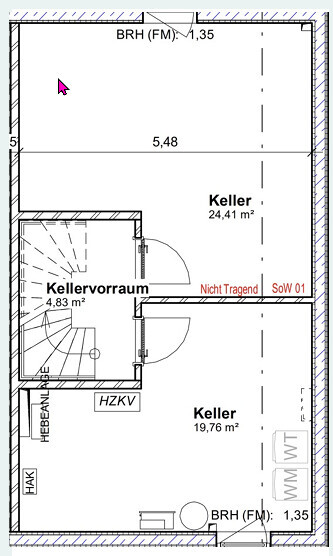
I want to divide the basement either way (either now directly or later build it myself with drywall).
In one basement area (20 sqm), all the building services and washer-dryer, photovoltaic storage, etc., are located, as well as some storage space and planned food supplies.
The other basement area/room is to be used occasionally, as a small hobby room or workshop, and I want this room to be heated in general.
a)
Does it make sense to have separately controllable floor heating so that I could simply keep the storage room cooler, around 15–18°C (59–64°F), and keep the other room generally or occasionally warmer?
Or should I just install one floor heating system without a wall, then add a wall later myself and just keep both rooms heated at a moderate level? Wouldn’t that be a big waste of heat and money, or would it hardly make a difference? Hence my question.
b)
I have no idea what costs a 20 sqm basement room, heated constantly at a low level, would generate yearly. Are we talking about €100 or €400 or even more, roughly? If I leave the door open, does the basement heat the ground floor a bit as well? Or is that negligible?
c)
Is it even possible to install a wall (drywall / no load-bearing) later on a basement floor with floor heating? Or does that cause problems with the screed/fixing/expansion joints/damaging the heating pipes, etc.?
The attached image shows the optional division.
N
nordanney16 Jan 2025 10:15mm56789 schrieb:
For a developer-built new construction (energy efficiency class B, district heating) How can you achieve a B rating in new construction today?
1. You really can’t control the temperature much in new buildings. There are only minor differences in the temperatures. At best, you can simply unscrew the thermostat and let the heating system do its job.
2. We can’t say how much explicit heating will cost you because we would need to know the district heating prices. But a new house is basically like a refrigerator or a thermos flask in reverse: if you set one room to 15°C (59°F), it will be indirectly heated by the other rooms in the house and you might still end up with 18°C (64°F) or more. Where else would the heat go? It shouldn’t escape through the walls to the outside, so it distributes throughout the house.
3. You can install a drywall partition later on yourself. It can be glued to the floor, or you can use an infrared thermometer to locate where the underfloor heating pipes run. Alternatively, you can talk to the heating installer during construction and check the pipe layout directly. Everything is possible.
4. With my heat pump, it costs about €60 per year to heat 20m² (215 ft²) when you simply divide the heating cost evenly per square meter. However, if I disconnect one room, I definitely wouldn’t save that exact amount (see point 2).
If you ask me, I would have the wall with a door installed now—unless the budget is already very tight.
W
wiltshire16 Jan 2025 12:12As long as you do not implement thermal insulation measures when dividing the basement rooms, it will be exactly as @nordanney describes: the separation will not provide you with significant practical benefits. I would not recommend installing separate heating circuits for €3500.
Later, you could maintain the rooms at the low desired temperature—since cold air tends to settle at lower levels, this is somewhat possible. When you then separate the rooms, the thermostat should be placed in the room that should stay cooler, and the occasionally used room, which should be warmer, can have an infrared panel that is switched on only when needed. This way, you have a thermally sensible and cost-effective division that works better than two underfloor heating control circuits.
Later, you could maintain the rooms at the low desired temperature—since cold air tends to settle at lower levels, this is somewhat possible. When you then separate the rooms, the thermostat should be placed in the room that should stay cooler, and the occasionally used room, which should be warmer, can have an infrared panel that is switched on only when needed. This way, you have a thermally sensible and cost-effective division that works better than two underfloor heating control circuits.

Have the optional partition wall "Special Request 01" installed right away. This way, the area where it will be placed will automatically be free of heating loops, and doing this partition wall yourself doesn’t save a significant amount of money.
https://www.instagram.com/11antgmxde/
https://www.linkedin.com/company/bauen-jetzt/
https://www.instagram.com/11antgmxde/
https://www.linkedin.com/company/bauen-jetzt/
Similar topics