
ᐅ Clarification question: Gable roof – load-bearing walls – floor plan
Created on: 10 Jan 2025 18:31
H
HausmitGartenH
HausmitGarten10 Jan 2025 18:31Dear Forum,
I would like to thank you in advance for the many suggestions I have received from reading the numerous posts in this forum over the past period. Now things are becoming more concrete for us: we have been able to purchase a plot of land and are planning to build a single-family house on it.
We are currently at the beginning of the planning stage and are carefully considering possible floor plan layouts. In this context, the question arose as to which structural conditions we need to take into account: specifically, how "free" we are when positioning the walls.
I will first describe our building project:
Our questions:
To illustrate our questions more clearly, I am attaching two sketches of possible floor plans for the ground floor and upper floor. I am not looking to start the discussion about the optimal floor plan at this point, although I am already looking forward to your suggestions on this topic!
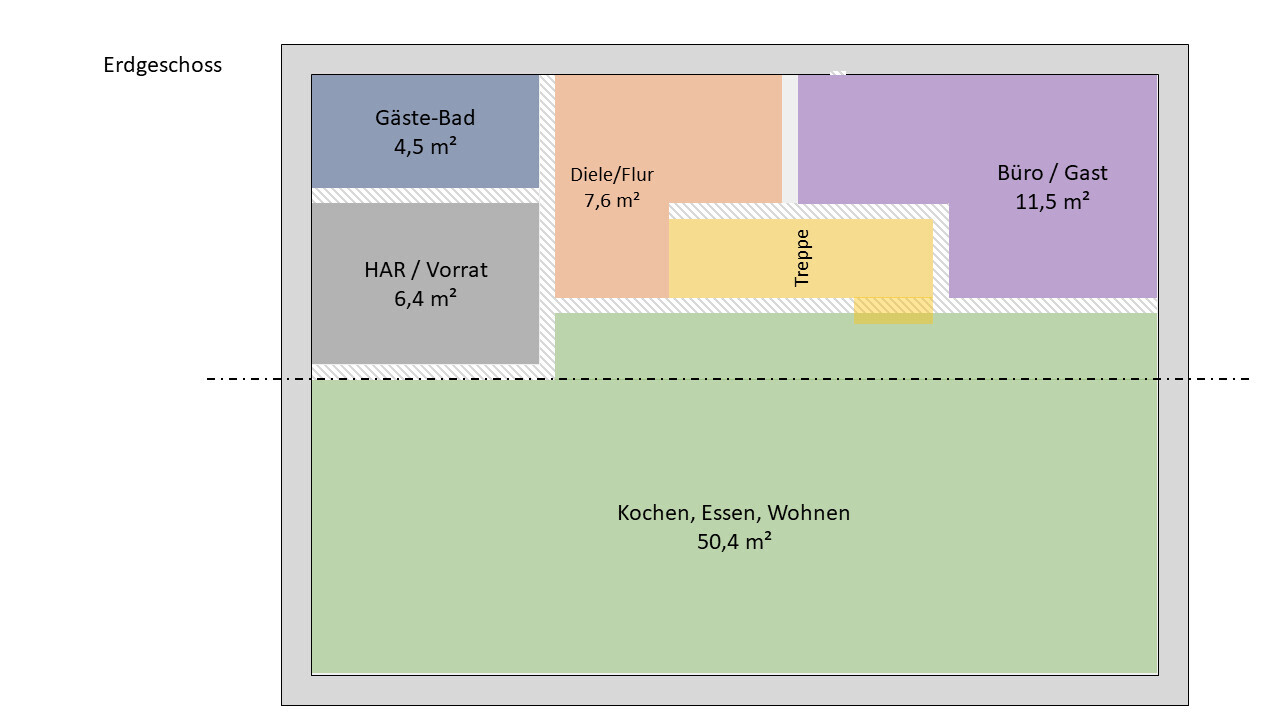
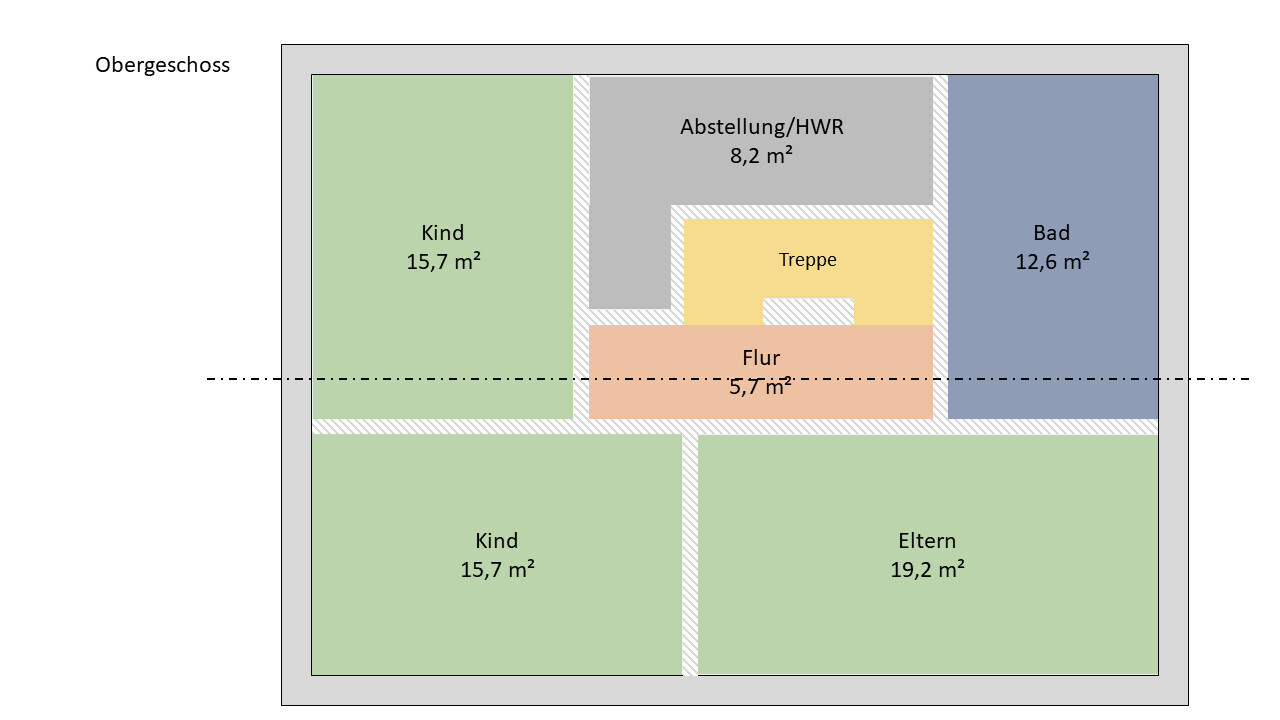
We understand that our plans will be reviewed and approved by a structural engineer in due course. However, on the way there, we would like to align ourselves as closely as possible with the structural framework conditions and hope for your input! This will help us discard floor plan variants early on that might cause major issues later.
Thank you very much and best regards!
I would like to thank you in advance for the many suggestions I have received from reading the numerous posts in this forum over the past period. Now things are becoming more concrete for us: we have been able to purchase a plot of land and are planning to build a single-family house on it.
We are currently at the beginning of the planning stage and are carefully considering possible floor plan layouts. In this context, the question arose as to which structural conditions we need to take into account: specifically, how "free" we are when positioning the walls.
I will first describe our building project:
- We are building on a footprint of about 105 m² (12.0 x 8.75 m (39.4 x 28.7 ft) external dimensions).
- We will construct 2 full stories and an attic as a partial story. No basement will be built.
- The attic is planned as a gable roof without dormers, with a roof pitch of approximately 30 - 35 degrees.
- We prefer to build a "timber house," i.e., timber frame or timber panel construction or similar. However, we are not fixed on this and it could also be a masonry house.
Our questions:
- Which construction type is most suitable for the gable roof? A rafter roof seems to be the most economical option and possibly does not require supports – is this feasible given our building depth (8.75 m (28.7 ft))? Or would another construction type (e.g., purlin roof) be more appropriate, and if so, why?
- Do (possibly) load-bearing walls on the ground floor and upper floor need to be "aligned," or what degree of overlap or spatial proximity should we initially consider to avoid (possibly very costly) special structural solutions later?
- Are there dependencies related to the (central) ridge beam – i.e., should load-bearing walls in the ground and upper floors ideally be arranged near the center as well?
To illustrate our questions more clearly, I am attaching two sketches of possible floor plans for the ground floor and upper floor. I am not looking to start the discussion about the optimal floor plan at this point, although I am already looking forward to your suggestions on this topic!
We understand that our plans will be reviewed and approved by a structural engineer in due course. However, on the way there, we would like to align ourselves as closely as possible with the structural framework conditions and hope for your input! This will help us discard floor plan variants early on that might cause major issues later.
Thank you very much and best regards!
W
wiltshire10 Jan 2025 19:22Answering your questions is quite straightforward. You can basically design any room layout you want. Structural features like long unsupported spans or offset load-bearing walls require more materials and increase costs. Offset load-bearing walls are not suitable for budget-friendly construction.
Apart from that, your initial draft raises quite different questions:
1. What modern technology should be included in a utility room (HAR) of this size?
2. Why does the stairwell have a different shape upstairs compared to downstairs?
3. How should the large living area be arranged without creating excessive circulation space within the room? (Or do you want to have enough space to dance anytime without moving furniture?)
4. How can such a narrow storage room be used effectively?
5. What size limitations for furniture arise from the narrow stairwell and hallway leading to the first floor?
6. Where are the doors, and where does natural light come from?
The daughter of friends built a house with a centrally located stairwell. It works quite well. The idea to place the staircase in the darkest part of the house has merit. I also understand the wish for children to have rooms of equal size, as well as the priority given to a large open living space as a main architectural focus. Write down these considerations clearly and note why you want things placed where you do—not necessarily here in public, but definitely for an advisor or architect. Visit model homes. What you end up building will probably look different—and that’s perfectly fine.
Apart from that, your initial draft raises quite different questions:
1. What modern technology should be included in a utility room (HAR) of this size?
2. Why does the stairwell have a different shape upstairs compared to downstairs?
3. How should the large living area be arranged without creating excessive circulation space within the room? (Or do you want to have enough space to dance anytime without moving furniture?)
4. How can such a narrow storage room be used effectively?
5. What size limitations for furniture arise from the narrow stairwell and hallway leading to the first floor?
6. Where are the doors, and where does natural light come from?
The daughter of friends built a house with a centrally located stairwell. It works quite well. The idea to place the staircase in the darkest part of the house has merit. I also understand the wish for children to have rooms of equal size, as well as the priority given to a large open living space as a main architectural focus. Write down these considerations clearly and note why you want things placed where you do—not necessarily here in public, but definitely for an advisor or architect. Visit model homes. What you end up building will probably look different—and that’s perfectly fine.

HausmitGarten schrieb:
Which construction type is most suitable for the gable roof? A rafter roof seems to be the most economical option. No, for use as a storage room, a dry attic truss is more likely the most cost-effective choice – essentially spanning freely and also forming the top floor ceiling; this also allows for a more flexible layout of the upper floor.
HausmitGarten schrieb:
Do (possibly) load-bearing walls on the ground floor and upper floor need to be aligned vertically, or what degree of overlap or spatial proximity should we initially consider, so that we don’t require (potentially very expensive) special structural solutions later? Load-bearing walls should indeed be positioned directly above or rather below each other, which is highly recommended. For more information, search externally (including the quotation marks) for "The upper floor has priority," "Plan change: from concrete to timber ceiling," and "Lightweight walls in solid houses?"
HausmitGarten schrieb:
Are there dependencies related to the (central) roof ridge – i.e., do load-bearing walls on the ground and upper floors also need to be aligned as centrally as possible? Not exactly; it’s not necessary for all load transfer to be strictly aligned under the ridge beam. With the layout shown, even if the upper floor were an attic, I see no issues.
HausmitGarten schrieb:
We are building two full stories plus an attic as a non-full story. A basement will not be constructed. What do the plot and development plan say about this? Was the 11ant basement rule ("With or without a basement: a rule as a decision-making tool") considered?
HausmitGarten schrieb:
We prefer building a "timber house," i.e., timber frame or timber panel construction, etc. However, we are not fixed on this; a solid house is also possible. Remain open to being surprised during the decision-making process which construction method ultimately proves best in your particular case. Where does this preference come from?
wiltshire schrieb:
That the children should have rooms of equal size. This is not a value in itself but usually just an irrational parental obsession. It only really makes sense for identical twins.
wiltshire schrieb:
Visit show homes. But not before you have met your architect or another independent building advisor. Show homes should really only be "prescribed by a doctor."
https://www.instagram.com/11antgmxde/
https://www.linkedin.com/company/bauen-jetzt/
HausmitGarten schrieb:
Our questions:
- Which roof structure is most suitable for a gable roof? A rafter roof seems to be the most cost-effective option and possibly doesn’t require supports – is this feasible given our building depth of 8.75 meters (29 feet)? Or would another roof type (e.g., a purlin roof) be more appropriate, and if so, why?
- Do (possibly) load-bearing walls on the ground floor and upper floor need to be aligned vertically? What degree of overlap or proximity should we initially consider to avoid requiring (potentially very expensive) special structural solutions later?
- Are there dependencies related to the (central) roof ridge – i.e., do load-bearing walls on the ground and upper floors need to be positioned as close to the center as possible?
These are questions you ask your architect. They will initially design the structure to keep the engineering as straightforward as possible. If you have unusual requests, they will explain whether and how these can be achieved. There are many ways to reach the goal; different approaches can make various implementations possible. A lot can be done.HausmitGarten schrieb:
We understand that our plans will be reviewed and approved by a structural engineer at the appropriate time.I don’t think it works that way. It won’t be your plans going to the engineer, but those of the designer or architect – the professional.wiltshire schrieb:
Putting that aside, your initial draft raises quite different questions:I’m always glad when a house design is more than just a floor plan made up of lines or colored blocks that look like Tetris pieces.
A house is three-dimensional. It starts on a plot of land, fulfilling the needs of oneself and possibly one’s family. Pencil drawings are often more meaningful than Excel or similar programs. When working on an idea, you shouldn’t be confronted with (lack of) knowledge that could stifle creativity, but rather let your ideas flow freely.
W
wiltshire11 Jan 2025 00:5411ant schrieb:
But not before meeting your architect or another independent building consultant. Model homes should really only be visited under medical supervision.That may be true. A warning about side effects would be enough: It can cause overwhelm in people who struggle with decision-making.wiltshire schrieb:
That may be true. A warning about side effects would suffice: It can lead to feelings of being overwhelmed in indecisive people. While the phase of overloading oneself with building ideas is still in full swing, the following digestive issues have not yet started. Therefore, the "what our zoning plan can’t accommodate" filter should be applied before visiting the exhibition (and ideally already established during the discussion with the expert). The "antiserum afterward" tastes bitter/expensive.
https://www.instagram.com/11antgmxde/
https://www.linkedin.com/company/bauen-jetzt/
Similar topics