
ᐅ Lighting design for new single-family home construction – potential for improvement?
Created on: 8 Jan 2025 18:56
M
MC123456
Hello,
due to the many interesting discussions here, we have decided to share our thoughts with the experts and to get further useful suggestions for the lighting planning of our new single-family home.
We are building a solid house approximately 10x11 m (33x36 ft). KfW 55 standard, conventional electrical installation (no smart home system, KNX, etc.). Ceiling height on the ground floor about 2.4 m (8 ft), no suspended ceiling; on the upper floor the ceiling will be suspended to about 2.4 m (8 ft) as well; ceiling height in the basement about 2.3 m (7.5 ft), no suspended ceiling.
We are currently in the planning phase for the electrical work, especially lighting, which is slowly but surely driving us crazy. For our considerations, we initially referred to houses of parents, friends, acquaintances, but hardly any modern new builds were available as references.
Overall, we have planned relatively few recessed spots. On the one hand, we don’t like a flood of recessed spots across the entire ceilings of the rooms; on the other hand, recessed spots (especially in the concrete ceiling) are very inflexible.
Therefore, they will only be installed on the ground floor kitchen in the concrete ceiling and in the bathroom on the upper floor in the suspended drywall ceiling.
In most other rooms and corridors, we initially opted for one or more classic electrical outlets (ceiling boxes) where a ceiling lamp will be installed.
The large room in the basement will initially be used as a hobby room but could be converted in the future into a small apartment for relatives (for care purposes). For this reason, only two outlets for ceiling lights are planned here (switched separately).
In the stairwell, we would provide wall lamps at about half the height of the stairs, controlled together with the ceiling lamp in the upper floor corridor and basement corridor.
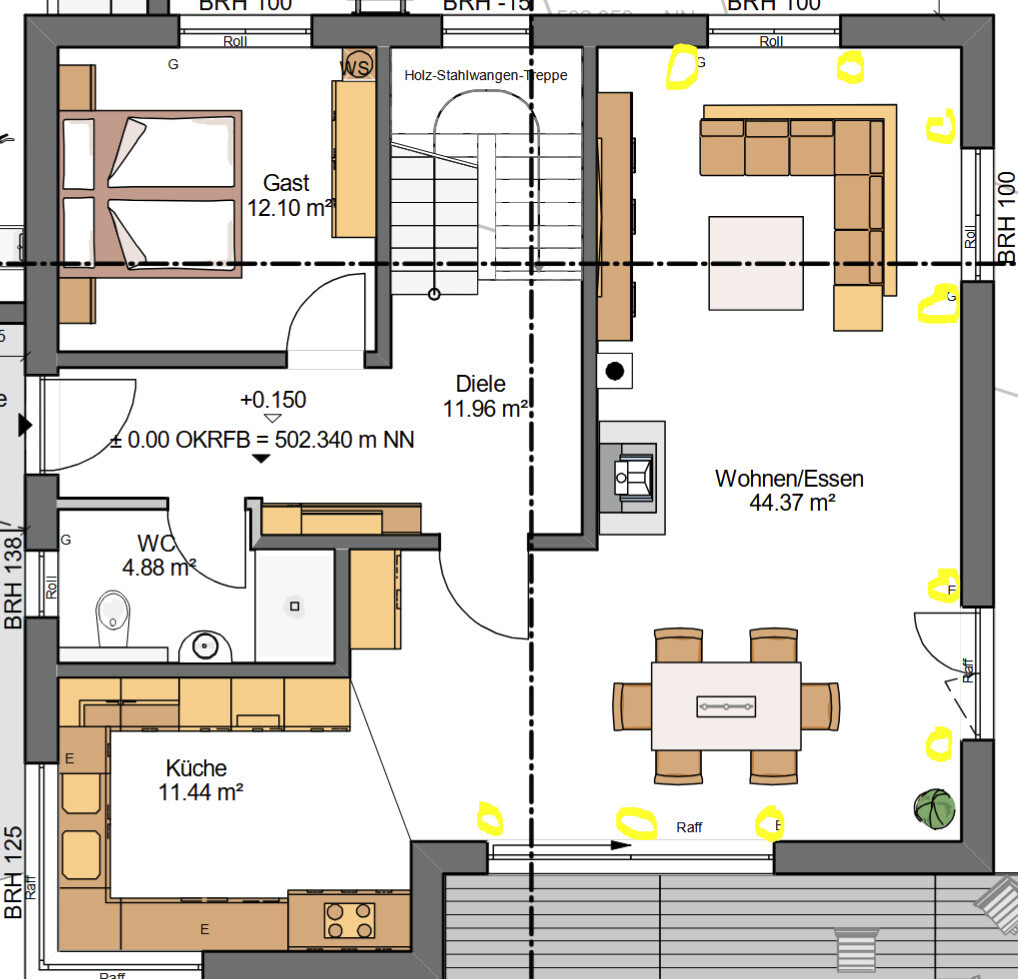
The large living/dining area, however, is causing us some difficulties:
- We planned a ceiling lamp with 2-3 adjustable spotlights in the area between kitchen and dining table to illuminate this transition zone.
- Then a classic pendant lamp (probably triple) above the dining table.
- In the living room area, centrally a ceiling light to provide basic illumination.
Additionally, a combination of a floor lamp (possibly with integrated reading light) next to the sofa, wall lamps at the fireplace and behind the dining table, as well as background lighting for the TV or TV unit. These would be connected so that a cozy atmosphere can be created when relaxing on the sofa in the evening.
What do you think? Could this roughly work, or are there major planning errors?
We would be very grateful for tips, suggestions and improvements.
We look forward to many responses.
Kind regards
Attached are the floor plan sketches
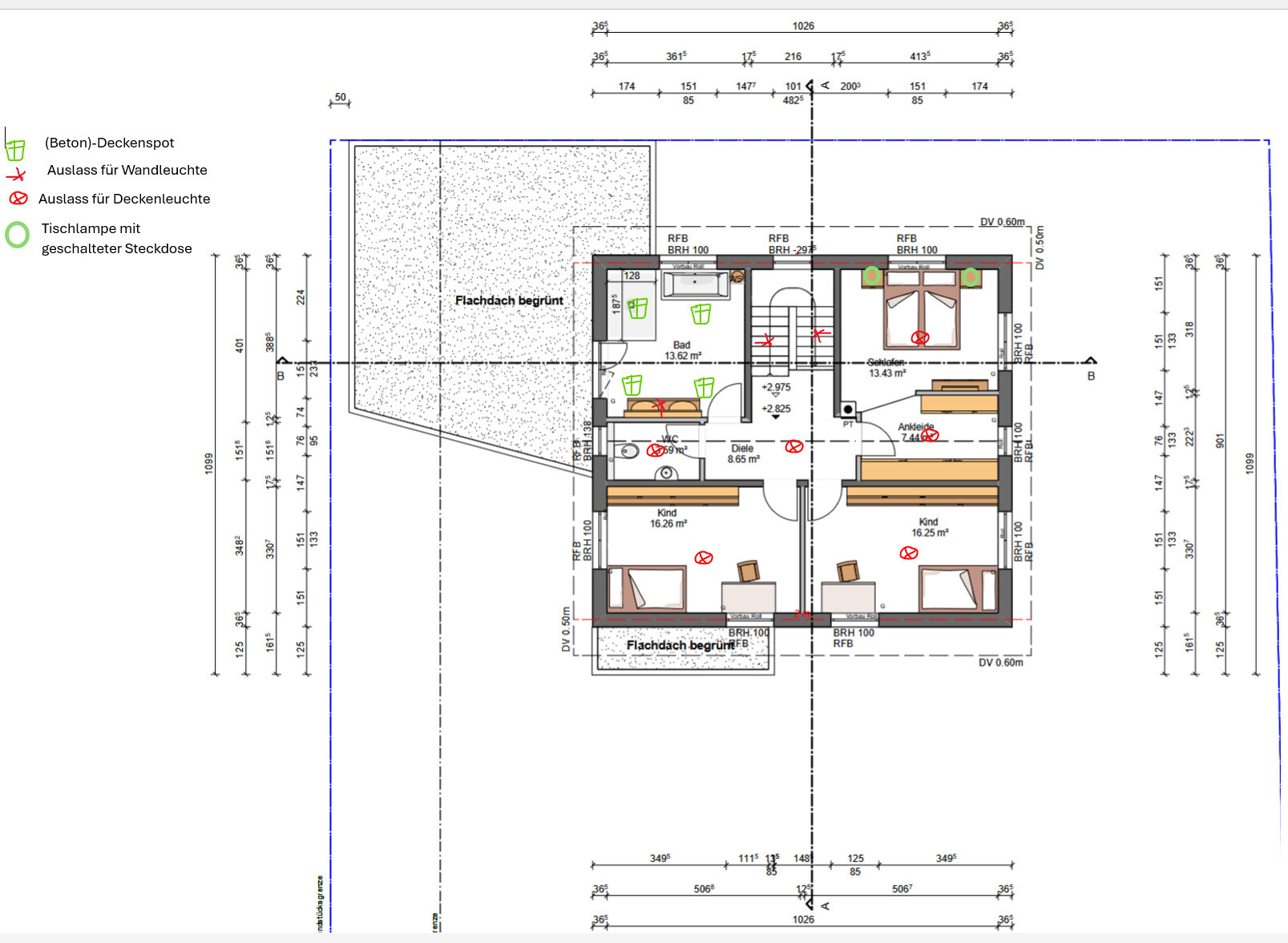
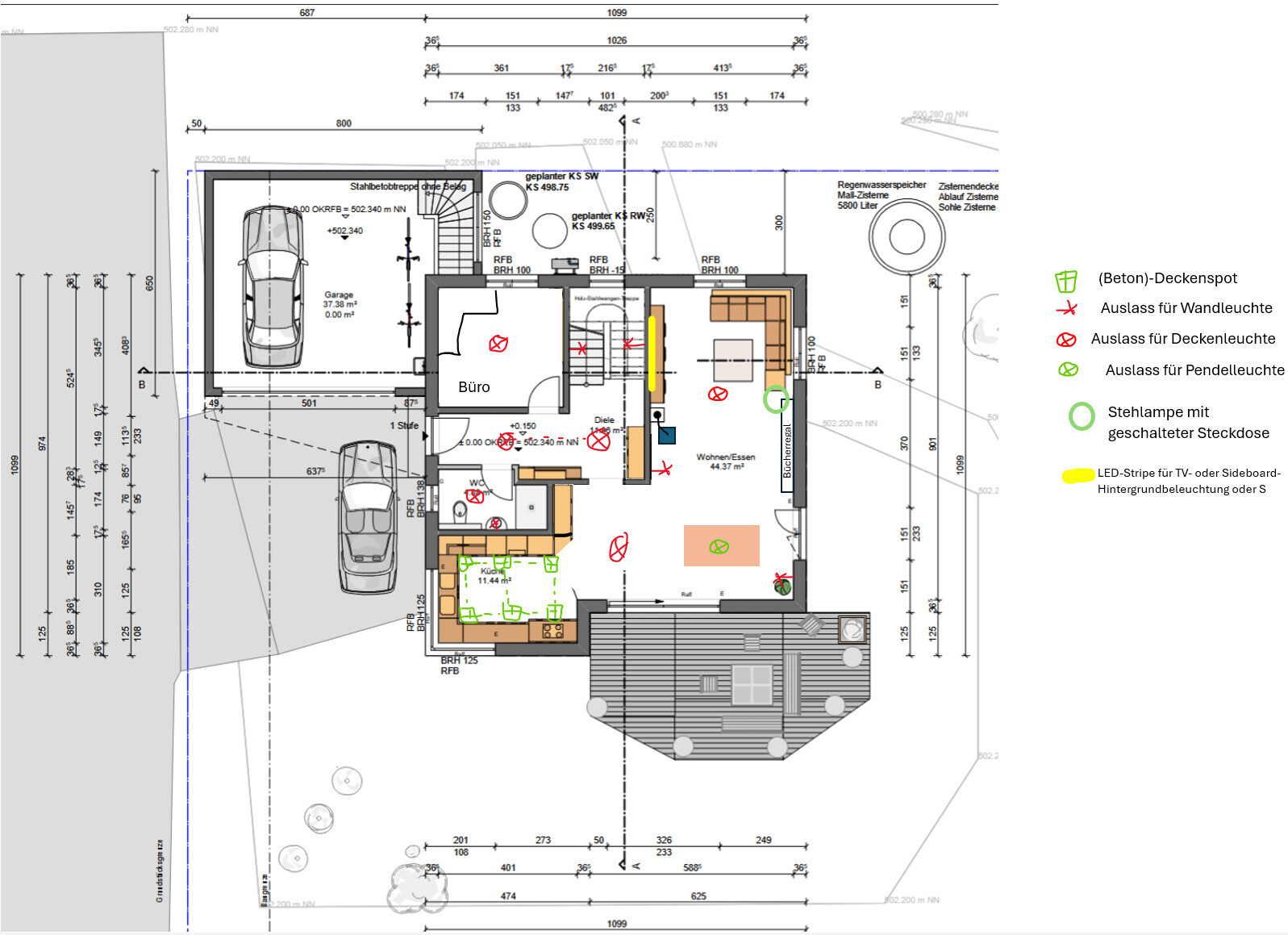
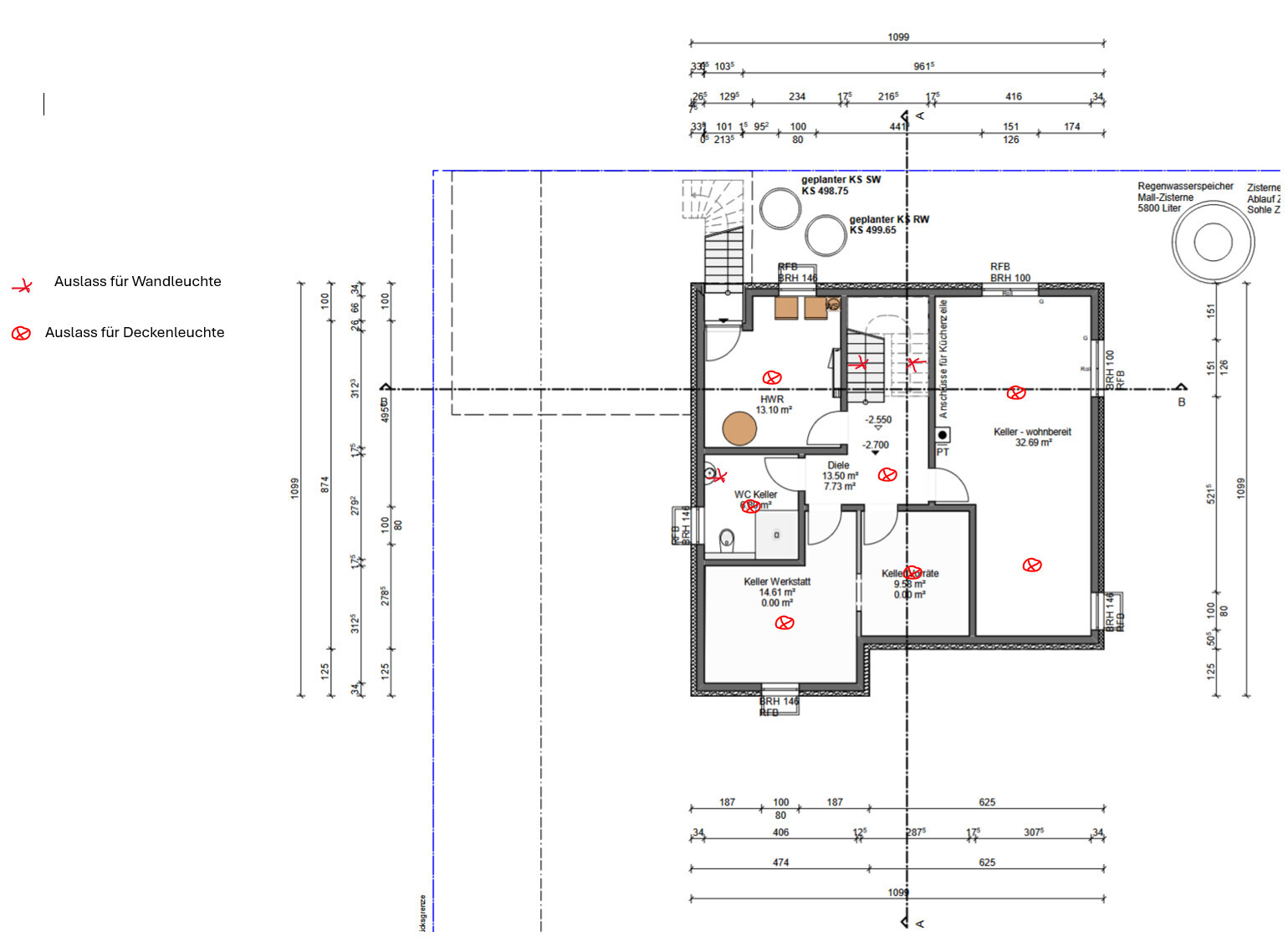
due to the many interesting discussions here, we have decided to share our thoughts with the experts and to get further useful suggestions for the lighting planning of our new single-family home.
We are building a solid house approximately 10x11 m (33x36 ft). KfW 55 standard, conventional electrical installation (no smart home system, KNX, etc.). Ceiling height on the ground floor about 2.4 m (8 ft), no suspended ceiling; on the upper floor the ceiling will be suspended to about 2.4 m (8 ft) as well; ceiling height in the basement about 2.3 m (7.5 ft), no suspended ceiling.
We are currently in the planning phase for the electrical work, especially lighting, which is slowly but surely driving us crazy. For our considerations, we initially referred to houses of parents, friends, acquaintances, but hardly any modern new builds were available as references.
Overall, we have planned relatively few recessed spots. On the one hand, we don’t like a flood of recessed spots across the entire ceilings of the rooms; on the other hand, recessed spots (especially in the concrete ceiling) are very inflexible.
Therefore, they will only be installed on the ground floor kitchen in the concrete ceiling and in the bathroom on the upper floor in the suspended drywall ceiling.
In most other rooms and corridors, we initially opted for one or more classic electrical outlets (ceiling boxes) where a ceiling lamp will be installed.
The large room in the basement will initially be used as a hobby room but could be converted in the future into a small apartment for relatives (for care purposes). For this reason, only two outlets for ceiling lights are planned here (switched separately).
In the stairwell, we would provide wall lamps at about half the height of the stairs, controlled together with the ceiling lamp in the upper floor corridor and basement corridor.
The large living/dining area, however, is causing us some difficulties:
- We planned a ceiling lamp with 2-3 adjustable spotlights in the area between kitchen and dining table to illuminate this transition zone.
- Then a classic pendant lamp (probably triple) above the dining table.
- In the living room area, centrally a ceiling light to provide basic illumination.
Additionally, a combination of a floor lamp (possibly with integrated reading light) next to the sofa, wall lamps at the fireplace and behind the dining table, as well as background lighting for the TV or TV unit. These would be connected so that a cozy atmosphere can be created when relaxing on the sofa in the evening.
What do you think? Could this roughly work, or are there major planning errors?
We would be very grateful for tips, suggestions and improvements.
We look forward to many responses.
Kind regards
Attached are the floor plan sketches
Great choice with the classic lighting.
We mostly use floor lamps and table lamps; for searching and cleaning, the ceiling light is turned on, and when working in the kitchen, task lights at eye level or a desk lamp at the desk are used.
Forget it. They are completely unsuitable and useless there. If you install a lamp with two spotlights there, like the planned three next to it, that will serve you well. And of course, task lighting under the upper cabinets.
I would rather install a ceiling lamp above each landing.
Make sure this is aligned with the corridor light on the right side, aligned with the pendant lamp, and that the pendant lamp is aligned with the ceiling outlet in the living room.
Wall lamps are hardly used anymore because they interfere with furniture placement. It’s more common to place a sideboard or cabinet and then put a table lamp on it. There are so many beautiful options you can easily get carried away.
Tip: In the guest bathroom, install a proper washbasin. A shower and hand basin together usually don’t work well in that space.
In the bedroom, connect the bedside lamps to a two-way switch so they can be controlled from the door and from above the bed.
We mostly use floor lamps and table lamps; for searching and cleaning, the ceiling light is turned on, and when working in the kitchen, task lights at eye level or a desk lamp at the desk are used.
MC123456 schrieb:
So they are only used on the ground floor kitchen in the concrete ceiling,
Forget it. They are completely unsuitable and useless there. If you install a lamp with two spotlights there, like the planned three next to it, that will serve you well. And of course, task lighting under the upper cabinets.
MC123456 schrieb:
In the stairwell, we would like to place a wall lamp at halfway up the steps, controlled together with the ceiling lamps in the upper floor corridor and the lower floor corridor.
I would rather install a ceiling lamp above each landing.
MC123456 schrieb:
Challenges:
- We planned to have a ceiling lamp with 2-3 adjustable spotlights in the area between the kitchen and dining table to illuminate this transition area.
Make sure this is aligned with the corridor light on the right side, aligned with the pendant lamp, and that the pendant lamp is aligned with the ceiling outlet in the living room.
MC123456 schrieb:
Wall lamps
Wall lamps are hardly used anymore because they interfere with furniture placement. It’s more common to place a sideboard or cabinet and then put a table lamp on it. There are so many beautiful options you can easily get carried away.
Tip: In the guest bathroom, install a proper washbasin. A shower and hand basin together usually don’t work well in that space.
In the bedroom, connect the bedside lamps to a two-way switch so they can be controlled from the door and from above the bed.
W
wiltshire9 Jan 2025 13:20Placement is one thing, choosing the lighting fixtures is another.
With LED lighting, not only the color temperature (measured in Kelvin and typically categorized as "warm," "neutral," or "cool") matters, but also PWM and CRI play a significant role.
PWM stands for pulse-width modulation. This can cause a flickering effect. You can detect PWM in lights by quickly moving an object underneath them, such as a long ruler or, if needed, just a pen, back and forth while rotating it (a full rotation is not necessary; a quarter turn is sufficient). If the object appears to move in a jerky way, similar to what you see under a strobe light, PWM is present. Unfortunately, many lights perform poorly in this regard. Such lighting can negatively impact wellbeing and even affect mood and health.
CRI is an index that indicates how natural the colors of illuminated objects appear. This is important for LED lighting because it does not have a full spectrum like an incandescent light source. The higher the CRI number, the better. I would not want a CRI below 92; performance becomes really good from 96 onwards. Manufacturers who do not specify the CRI often have weak spots here. You can compare CRI by illuminating, for example, a rose with red petals and green leaves. You’ll be surprised how pale some lights appear compared to those with a high CRI.
With LED lighting, not only the color temperature (measured in Kelvin and typically categorized as "warm," "neutral," or "cool") matters, but also PWM and CRI play a significant role.
PWM stands for pulse-width modulation. This can cause a flickering effect. You can detect PWM in lights by quickly moving an object underneath them, such as a long ruler or, if needed, just a pen, back and forth while rotating it (a full rotation is not necessary; a quarter turn is sufficient). If the object appears to move in a jerky way, similar to what you see under a strobe light, PWM is present. Unfortunately, many lights perform poorly in this regard. Such lighting can negatively impact wellbeing and even affect mood and health.
CRI is an index that indicates how natural the colors of illuminated objects appear. This is important for LED lighting because it does not have a full spectrum like an incandescent light source. The higher the CRI number, the better. I would not want a CRI below 92; performance becomes really good from 96 onwards. Manufacturers who do not specify the CRI often have weak spots here. You can compare CRI by illuminating, for example, a rose with red petals and green leaves. You’ll be surprised how pale some lights appear compared to those with a high CRI.

k-man2021 schrieb:
There is a lighting design manual by Prediger that I find quite useful; in my opinion, it is still available for free. It includes good alternatives for many types of rooms. Unfortunately, it is only available by postal mail, not as a PDF. Thanks for the hint!
wiltshire schrieb:
CRI is an index, Oh, that too. The responsibilities of lux, lumen, and candela are confusing enough for me already.
https://www.instagram.com/11antgmxde/
https://www.linkedin.com/company/bauen-jetzt/
Hello and thank you very much for the numerous and informative feedback.
The Prediger catalog has already been ordered; I might be able to find something useful there.
The recessed ceiling spotlights will be positioned at the height of the countertop edge or slightly closer to the wall so that no shadows are cast.
Our kitchen has no wall cabinets, which is why we want to do the task lighting here using recessed ceiling spotlights. Additionally, we are considering installing a ceiling light in the center of the kitchen for general lighting.
I’ll post a picture of the kitchen plan. (On the left corner are tall cabinets for pantry and fridge)
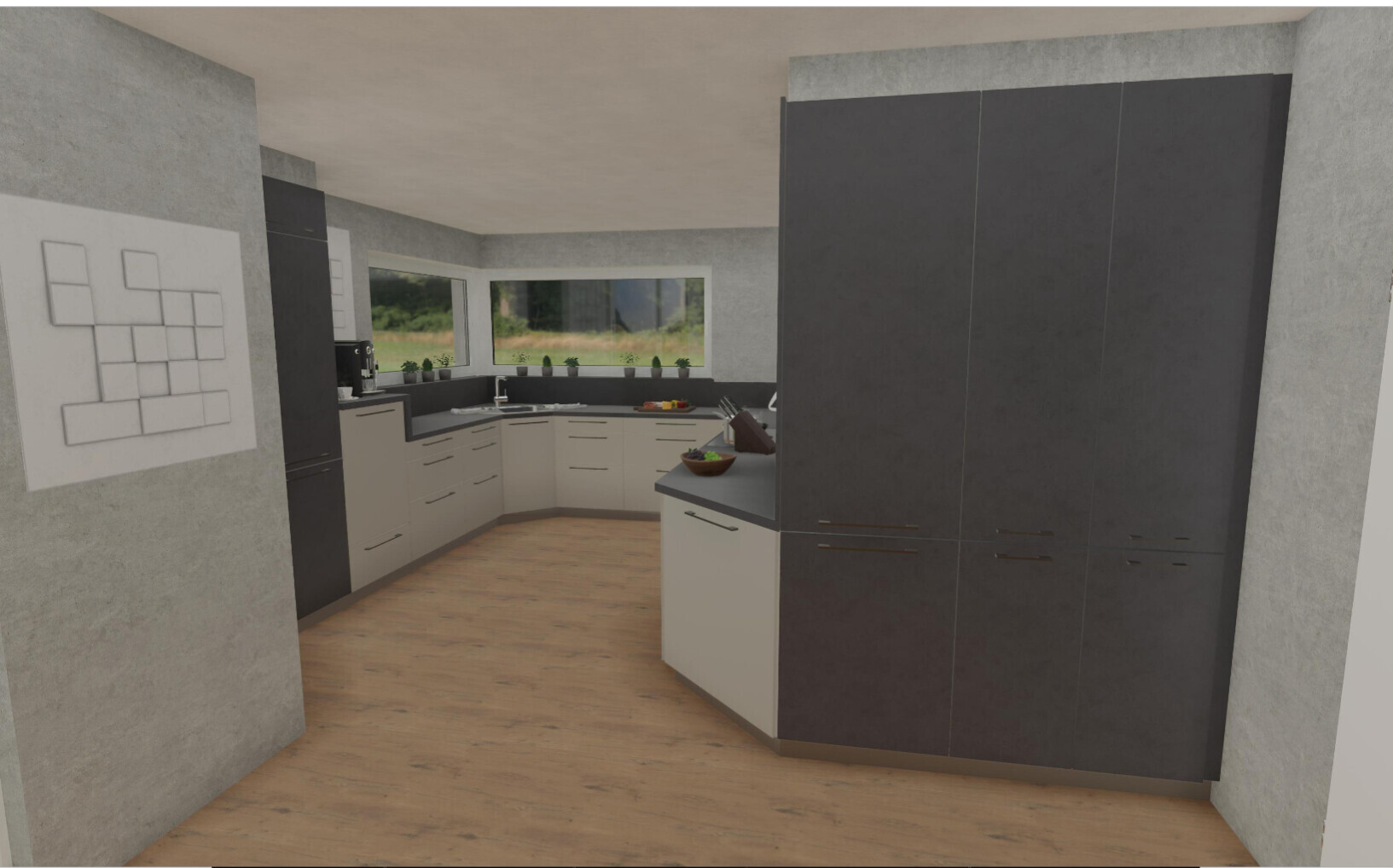
Do you have suggestions for the specifications of light bulbs here (wattage, beam angle, color temperature, lumens, etc.) to sufficiently illuminate the countertop? Our electrician offered us "RUTEC recessed spotlights made from die-cast aluminum, adjustable for MR16." Can the bulbs in such recessed spotlights be easily replaced?
Wi-Fi access points will be installed on the ceiling per floor and powered via PoE.
Our builder advised us to place spotlights at the windows/doors in the open space to highlight them, similar to the following illustration. This is supposed to look very good.
Would you use spotlights with a low wattage and warm light to serve as ambient lighting here?
As general room lighting, this arrangement along the outer wall hardly makes sense, does it?
Does anyone have experience with this?
Regards
M.
The Prediger catalog has already been ordered; I might be able to find something useful there.
Arauki11 schrieb:
...
Bedroom: think about a simple on/off switch reachable from the bed, plus at least 2-3 sockets per side of the bed or, if the bed size is known, a wall outlet for bedside/wall lamps on each side...
We have planned it that way as well.
It will also be very important what you want to control from where and how. In the end, it shouldn’t be confusing with too many options. I was convinced to install a motion sensor in the hallway; today we would no longer do that but rather prefer to operate a switch each time.
Good point, we need to reconsider the switches carefully.
....
ypg schrieb:
Tip: a proper washbasin in the guest WC. Shower and hand basin don’t really fit together.
Have the bedside lamps in the bedroom controlled by two-way switches from the door and over the bed.
We have planned that way.
hanse987 schrieb:
If the lights are also supposed to serve as task lighting, they need to be in front of you. If the light is behind you, there will always be shadows. I would maybe install a wall light near the stove area.
Is there a reason why the ceiling heights are so low?
It’s standard with this builder; we have had that all our lives and it never bothered us.
Will the Wi-Fi access points also be installed on the ceiling? If yes, plan for that now as well.
The recessed ceiling spotlights will be positioned at the height of the countertop edge or slightly closer to the wall so that no shadows are cast.
Our kitchen has no wall cabinets, which is why we want to do the task lighting here using recessed ceiling spotlights. Additionally, we are considering installing a ceiling light in the center of the kitchen for general lighting.
I’ll post a picture of the kitchen plan. (On the left corner are tall cabinets for pantry and fridge)
Do you have suggestions for the specifications of light bulbs here (wattage, beam angle, color temperature, lumens, etc.) to sufficiently illuminate the countertop? Our electrician offered us "RUTEC recessed spotlights made from die-cast aluminum, adjustable for MR16." Can the bulbs in such recessed spotlights be easily replaced?
Wi-Fi access points will be installed on the ceiling per floor and powered via PoE.
Our builder advised us to place spotlights at the windows/doors in the open space to highlight them, similar to the following illustration. This is supposed to look very good.
Would you use spotlights with a low wattage and warm light to serve as ambient lighting here?
As general room lighting, this arrangement along the outer wall hardly makes sense, does it?
Does anyone have experience with this?
Regards
M.
MC123456 schrieb:
Our builder advised us to install spotlights above the windows and doors in the open-plan area to highlight them, similar to the illustration below. This is supposed to always look very appealing. What exactly is supposed to be highlighted in the dark? The dark window? I have never heard of or seen this and would consider it unnecessary. The general contractor probably just wants to make some extra profit somewhere.
MC123456 schrieb:
Our kitchen has no wall cabinets, so we want to use recessed ceiling spotlights for the task lighting here. One cannot replace the other. If you don’t want wall cabinets, then the lighting needs to be wall-mounted or come from pendant lights above the countertop. As several have already mentioned: ceiling lighting creates shadows and can cause difficulties when working in the kitchen.
W
wiltshire10 Jan 2025 20:34ypg schrieb:
What exactly is supposed to be highlighted in the dark there?Maybe the reflective effect is meant to create an impression of a larger space, making the window appear less "dark."ypg schrieb:
If you don’t want upper cabinets, then the lighting needs to be mounted on the wall or as a pendant light above the countertop. As several people have already mentioned: ceiling lights create shadows and can cause difficulties while working in the kitchen.Absolutely true. I really enjoy cooking often and noticed that we overlooked this aspect above the kitchen peninsula for interior design reasons. Ideally, it would be different. Sometimes I just move my less'n'more "Jules Verne" rechargeable floor lamp over, and then it works perfectly.Similar topics