
ᐅ Lighting design for new single-family home construction – potential for improvement?
Created on: 8 Jan 2025 18:56
M
MC123456Hello,
due to the many interesting discussions here, we have decided to share our thoughts with the experts and to get further useful suggestions for the lighting planning of our new single-family home.
We are building a solid house approximately 10x11 m (33x36 ft). KfW 55 standard, conventional electrical installation (no smart home system, KNX, etc.). Ceiling height on the ground floor about 2.4 m (8 ft), no suspended ceiling; on the upper floor the ceiling will be suspended to about 2.4 m (8 ft) as well; ceiling height in the basement about 2.3 m (7.5 ft), no suspended ceiling.
We are currently in the planning phase for the electrical work, especially lighting, which is slowly but surely driving us crazy. For our considerations, we initially referred to houses of parents, friends, acquaintances, but hardly any modern new builds were available as references.
Overall, we have planned relatively few recessed spots. On the one hand, we don’t like a flood of recessed spots across the entire ceilings of the rooms; on the other hand, recessed spots (especially in the concrete ceiling) are very inflexible.
Therefore, they will only be installed on the ground floor kitchen in the concrete ceiling and in the bathroom on the upper floor in the suspended drywall ceiling.
In most other rooms and corridors, we initially opted for one or more classic electrical outlets (ceiling boxes) where a ceiling lamp will be installed.
The large room in the basement will initially be used as a hobby room but could be converted in the future into a small apartment for relatives (for care purposes). For this reason, only two outlets for ceiling lights are planned here (switched separately).
In the stairwell, we would provide wall lamps at about half the height of the stairs, controlled together with the ceiling lamp in the upper floor corridor and basement corridor.
The large living/dining area, however, is causing us some difficulties:
- We planned a ceiling lamp with 2-3 adjustable spotlights in the area between kitchen and dining table to illuminate this transition zone.
- Then a classic pendant lamp (probably triple) above the dining table.
- In the living room area, centrally a ceiling light to provide basic illumination.
Additionally, a combination of a floor lamp (possibly with integrated reading light) next to the sofa, wall lamps at the fireplace and behind the dining table, as well as background lighting for the TV or TV unit. These would be connected so that a cozy atmosphere can be created when relaxing on the sofa in the evening.
What do you think? Could this roughly work, or are there major planning errors?
We would be very grateful for tips, suggestions and improvements.
We look forward to many responses.
Kind regards
Attached are the floor plan sketches
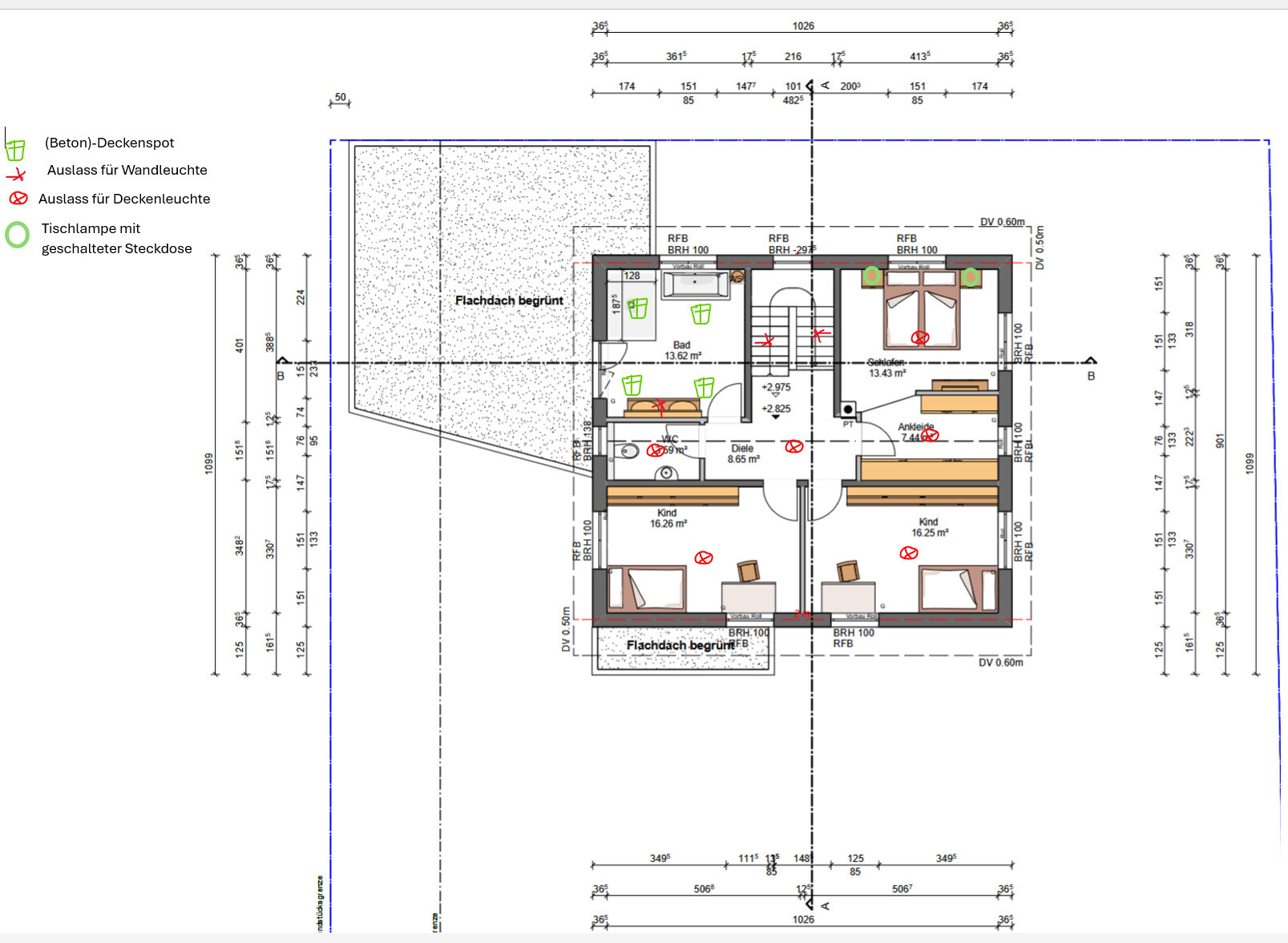
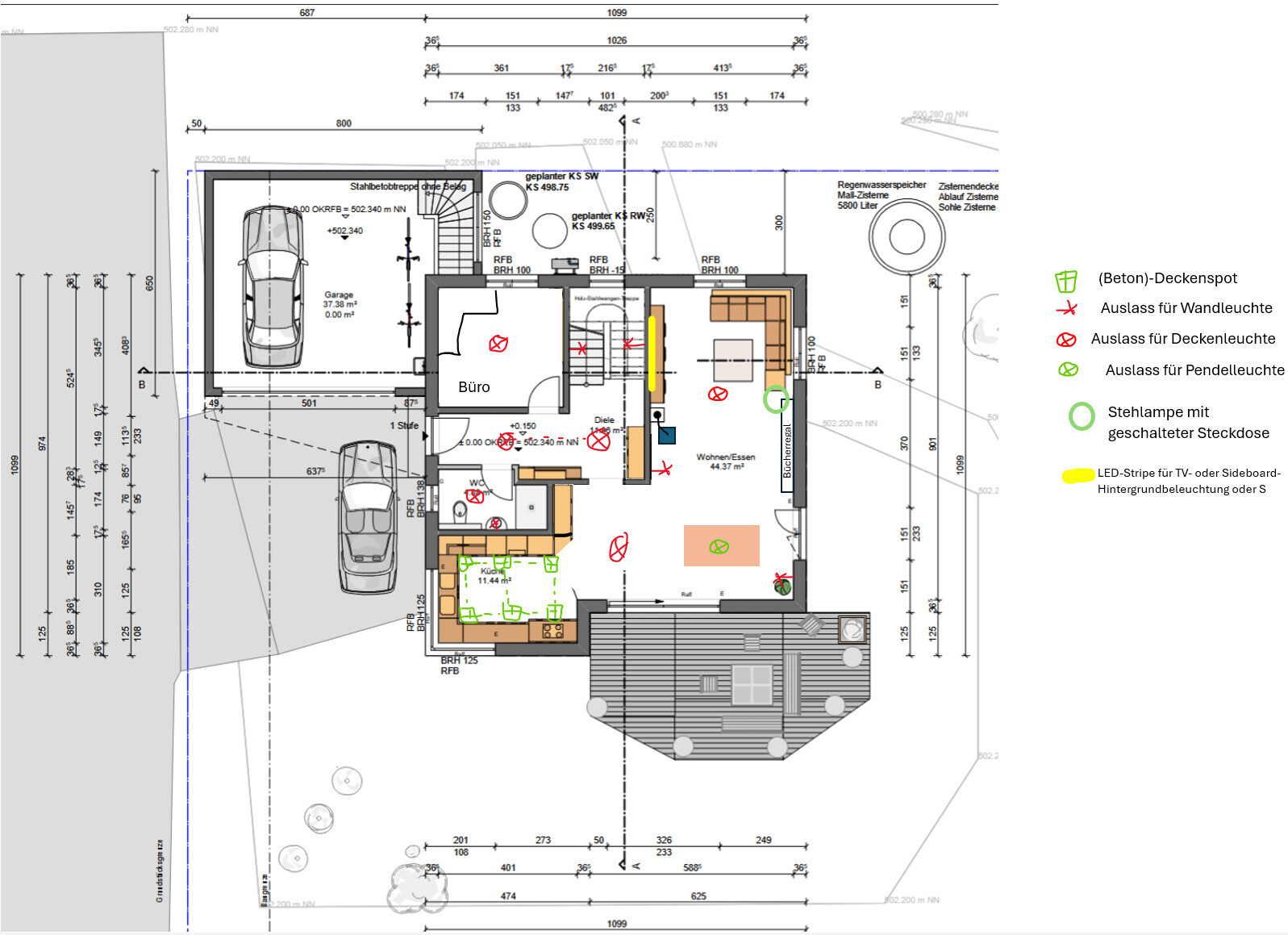
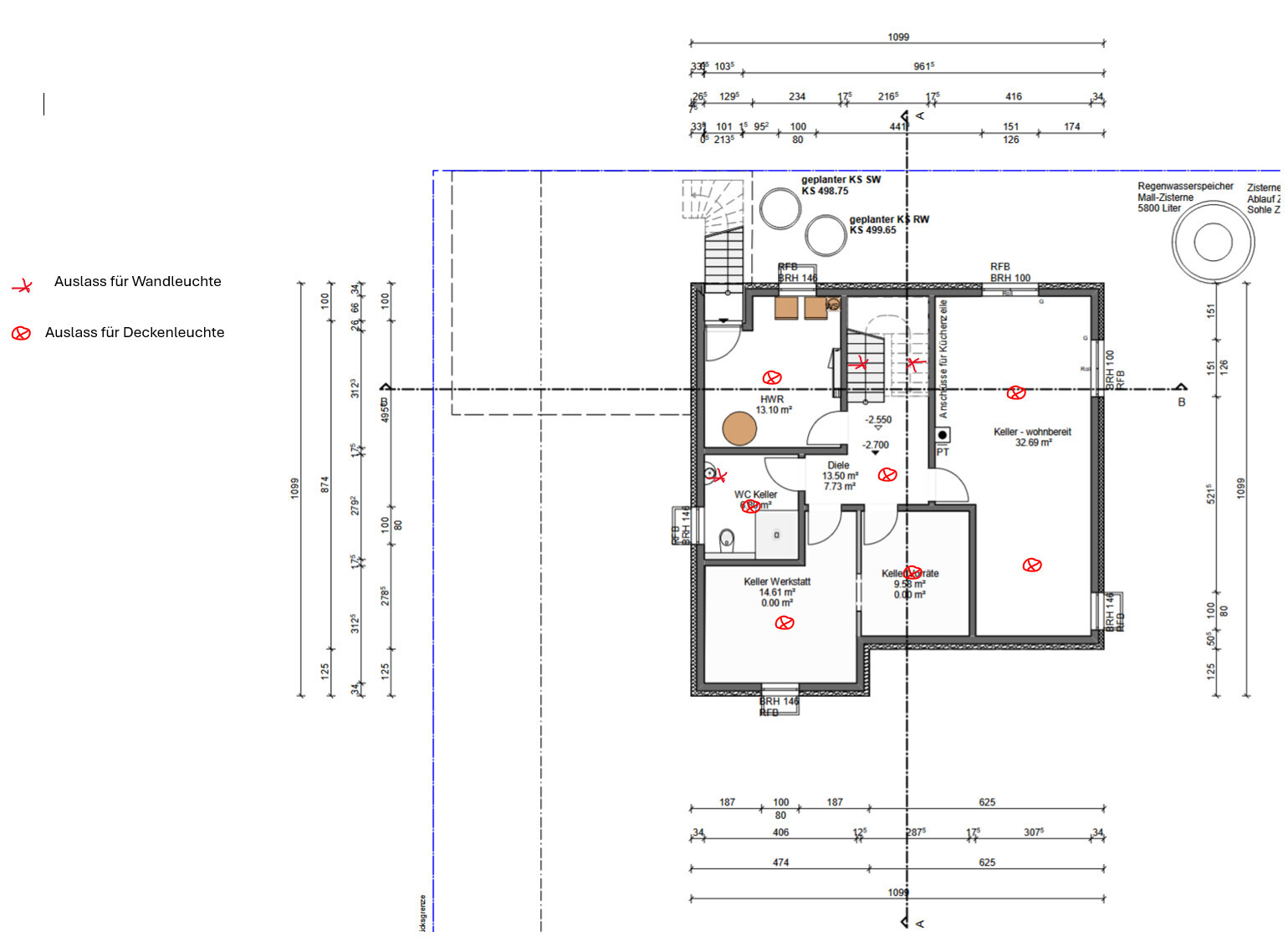
due to the many interesting discussions here, we have decided to share our thoughts with the experts and to get further useful suggestions for the lighting planning of our new single-family home.
We are building a solid house approximately 10x11 m (33x36 ft). KfW 55 standard, conventional electrical installation (no smart home system, KNX, etc.). Ceiling height on the ground floor about 2.4 m (8 ft), no suspended ceiling; on the upper floor the ceiling will be suspended to about 2.4 m (8 ft) as well; ceiling height in the basement about 2.3 m (7.5 ft), no suspended ceiling.
We are currently in the planning phase for the electrical work, especially lighting, which is slowly but surely driving us crazy. For our considerations, we initially referred to houses of parents, friends, acquaintances, but hardly any modern new builds were available as references.
Overall, we have planned relatively few recessed spots. On the one hand, we don’t like a flood of recessed spots across the entire ceilings of the rooms; on the other hand, recessed spots (especially in the concrete ceiling) are very inflexible.
Therefore, they will only be installed on the ground floor kitchen in the concrete ceiling and in the bathroom on the upper floor in the suspended drywall ceiling.
In most other rooms and corridors, we initially opted for one or more classic electrical outlets (ceiling boxes) where a ceiling lamp will be installed.
The large room in the basement will initially be used as a hobby room but could be converted in the future into a small apartment for relatives (for care purposes). For this reason, only two outlets for ceiling lights are planned here (switched separately).
In the stairwell, we would provide wall lamps at about half the height of the stairs, controlled together with the ceiling lamp in the upper floor corridor and basement corridor.
The large living/dining area, however, is causing us some difficulties:
- We planned a ceiling lamp with 2-3 adjustable spotlights in the area between kitchen and dining table to illuminate this transition zone.
- Then a classic pendant lamp (probably triple) above the dining table.
- In the living room area, centrally a ceiling light to provide basic illumination.
Additionally, a combination of a floor lamp (possibly with integrated reading light) next to the sofa, wall lamps at the fireplace and behind the dining table, as well as background lighting for the TV or TV unit. These would be connected so that a cozy atmosphere can be created when relaxing on the sofa in the evening.
What do you think? Could this roughly work, or are there major planning errors?
We would be very grateful for tips, suggestions and improvements.
We look forward to many responses.
Kind regards
Attached are the floor plan sketches

Welcome to the forum,
we also have a traditional electrical installation.
Two points regarding the lighting design of a room:
first, basic lighting for general visibility, supplemented by additional wall lamps, floor lamps, reading lamps, etc.
Our basic lighting uses lamps with screw bases and, in some cases, three-step dimmers.
This has proven to be effective.
PS, it’s better to live with construction lamps for some time, experience the room, and calmly look for new lamps.
we also have a traditional electrical installation.
Two points regarding the lighting design of a room:
first, basic lighting for general visibility, supplemented by additional wall lamps, floor lamps, reading lamps, etc.
Our basic lighting uses lamps with screw bases and, in some cases, three-step dimmers.
This has proven to be effective.
PS, it’s better to live with construction lamps for some time, experience the room, and calmly look for new lamps.
MC123456 schrieb:
So, in our case, they only appear on the ground floor kitchen in the concrete ceiling.If the lights are also meant to serve as task lighting, they need to be in front of you. If the light is behind you, you will always have shadows. I would consider adding a wall light near the stove area.Is there a particular reason why the ceiling heights are so low?
Will the Wi-Fi access points also be installed on the ceiling? If so, you should plan for that at the same time.
N
NatureSys8 Jan 2025 21:02We had professional lighting design done for the living spaces. What do we like best? In the living and dining area, we have several wall lamps installed at a height of 1.80 meters (5 ft 11 in) that only shine upwards.
What is less good? In the office, there is a central ceiling light, as you planned. It feels uncomfortable and creates shadows while working. A different solution would be better there.
What is less good? In the office, there is a central ceiling light, as you planned. It feels uncomfortable and creates shadows while working. A different solution would be better there.
Here are some unfiltered ideas that were important to us or have proven more or less useful after three years. We don’t like spotlights, but we have chosen nice lamps.
Bedroom: Consider having a switch that can be reached from the bed, plus at least 2-3 outlets per side of the bed or, if the bed size is known, one wall outlet per side for bedside or wall lamps.
Wow, the bathroom is huge—maybe I would still install a toilet there since there is plenty of space. Of course, you can play with ceiling lighting if you like. You need bright light at the sink area, and I would definitely have a central, dimmable ceiling light plus bright lighting in or near the shower depending on the type of shower. In my opinion, spotlights have the drawback that they literally direct light, usually in a limited direction. Given your ceiling heights, I would recommend either recessed lights or the flat LED panels that come in all kinds of versions. I wouldn’t need a light above the bathtub, but maybe you could find a nice wall lamp for indirect light on an empty wall.
For stairway lighting, I would research more because it’s important to illuminate the steps properly to avoid tripping. We also have side lighting there, but that’s more for decoration.
In the walk-in closet, I would definitely install several bright downlights over the cabinets on each side—these are available from Ikea, for example. We had a leftover track system from Paulmann. The lighting there must be bright and shadow-free.
Ground floor: The hallway absolutely must be bright. We have a flat LED light, and for your space, you could add a second one at the front or perhaps use a longer one instead of two.
In the kitchen or at the workspace, it also needs to be bright. Here too, I would prefer LED lights rather than spotlights. We had spotlights in our old house, but now I like the flat LED panels better for this purpose. Above the dining table, have an outlet and then a long lamp with warm light.
It will be very important to think about what you want to control from where and how. In the end, it shouldn’t be confusing with too many options. I was convinced to install a motion sensor in the hallway, but today we wouldn’t do that and would rather prefer using switches.
Don’t forget various necessary outdoor outlets and lighting around the house.
Generally, for the open-plan area or ground floor, I would plan a basic lighting with wall lamps and two main lights in the kitchen/dining area. For the rest (except the kitchen), I think wall lamps would be nice, along with the occasional floor lamp that can be added over time.
Bedroom: Consider having a switch that can be reached from the bed, plus at least 2-3 outlets per side of the bed or, if the bed size is known, one wall outlet per side for bedside or wall lamps.
Wow, the bathroom is huge—maybe I would still install a toilet there since there is plenty of space. Of course, you can play with ceiling lighting if you like. You need bright light at the sink area, and I would definitely have a central, dimmable ceiling light plus bright lighting in or near the shower depending on the type of shower. In my opinion, spotlights have the drawback that they literally direct light, usually in a limited direction. Given your ceiling heights, I would recommend either recessed lights or the flat LED panels that come in all kinds of versions. I wouldn’t need a light above the bathtub, but maybe you could find a nice wall lamp for indirect light on an empty wall.
For stairway lighting, I would research more because it’s important to illuminate the steps properly to avoid tripping. We also have side lighting there, but that’s more for decoration.
In the walk-in closet, I would definitely install several bright downlights over the cabinets on each side—these are available from Ikea, for example. We had a leftover track system from Paulmann. The lighting there must be bright and shadow-free.
Ground floor: The hallway absolutely must be bright. We have a flat LED light, and for your space, you could add a second one at the front or perhaps use a longer one instead of two.
In the kitchen or at the workspace, it also needs to be bright. Here too, I would prefer LED lights rather than spotlights. We had spotlights in our old house, but now I like the flat LED panels better for this purpose. Above the dining table, have an outlet and then a long lamp with warm light.
It will be very important to think about what you want to control from where and how. In the end, it shouldn’t be confusing with too many options. I was convinced to install a motion sensor in the hallway, but today we wouldn’t do that and would rather prefer using switches.
Don’t forget various necessary outdoor outlets and lighting around the house.
Generally, for the open-plan area or ground floor, I would plan a basic lighting with wall lamps and two main lights in the kitchen/dining area. For the rest (except the kitchen), I think wall lamps would be nice, along with the occasional floor lamp that can be added over time.
K
k-man20218 Jan 2025 22:40There is a lighting design manual by prediger that I find quite good; in my opinion, it is still available for free. It includes good alternatives for many types of rooms.
Similar topics