
ᐅ New Construction – Vapor Retarder in a Pitched Roof More Challenging Than Expected
Created on: 5 Jan 2025 16:50
M
Maraum91Hello everyone,
I need your help once again.
In our new build, the plastering is done, the screed has been poured, and I am currently working on the interior finishing. I am likely heading toward a problem that I would like to clarify before the drywall ceiling is fixed to the roof structure 🙂 It specifically concerns airtightness and condensation issues in the roof area.
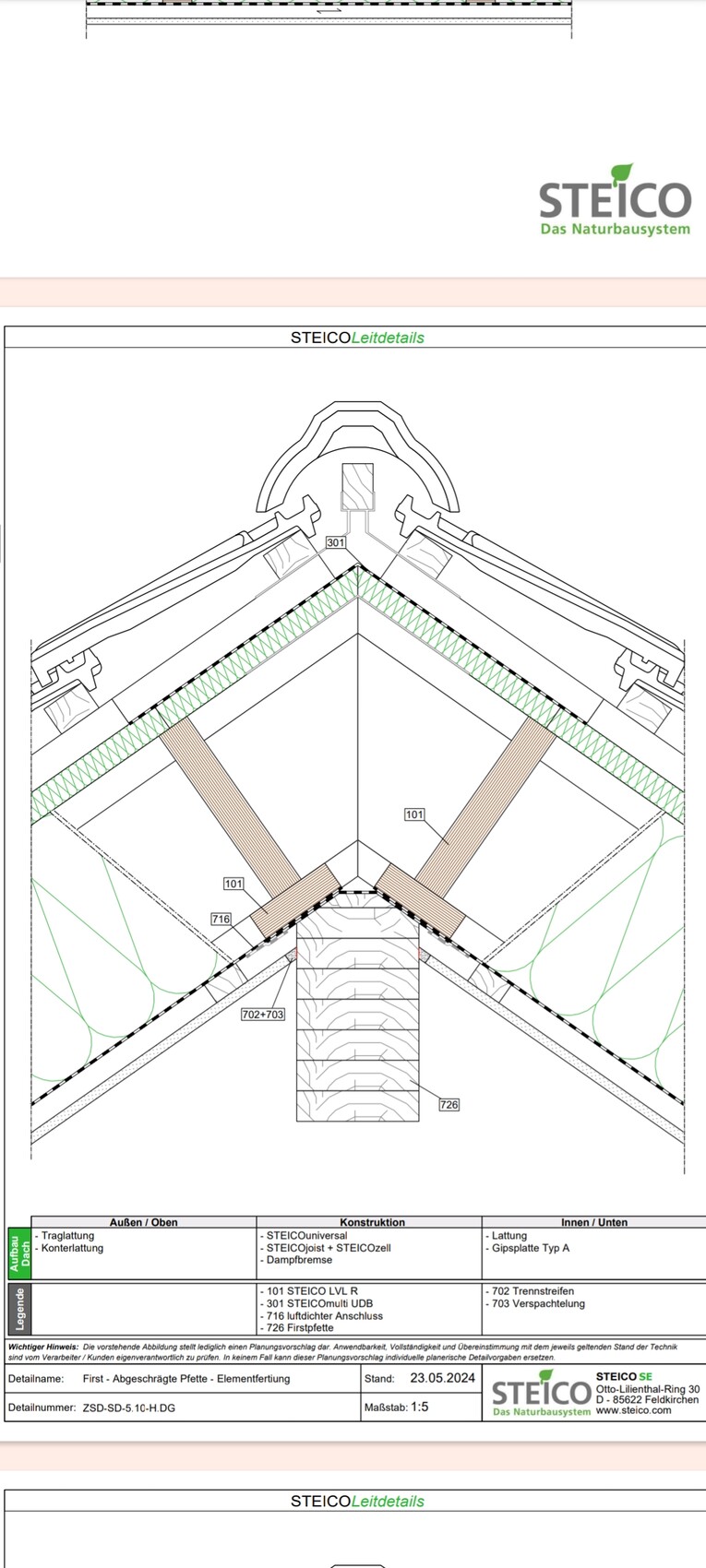
Our roof construction is as shown in the detailed drawing. The vapor retarder was connected to the gable walls and purlins using joint adhesive, as well as at the ridge purlin. To check airtightness before the blower door test, I created negative pressure inside the house using our construction fan and checked for leaks in every possible way (using my hand and a thermal imaging camera), then sealed any areas found. In my opinion, the vapor retarder was airtight.
However, with the currently very cold outside temperatures, I noticed that the bricks on the outside, around the ridge, especially underneath, have become damp. It must be warm air inevitably escaping from the inside and condensing there.
My assumption is that the ridge was not properly plastered on the inside in the area below the vapor retarder, and now warm air is escaping underneath the vapor retarder towards the outside.
The problem is that the ridge rests on the load-bearing interior wall, and this area was covered with wood panels to maintain the beam aesthetic, which have now also been plastered. So I can no longer access the ridge support from the inside.
Our construction supervisor sees two options: either dismantle the panels again or fill the joints around the ridge from the outside with expanding foam.
Expanding foam would of course be practical since it can be done quickly. But is this a viable solution that is commonly used in practice, or how should the ridge at the gable wall actually be sealed correctly? Since the ridge does not sit completely flush on the interior wall, in my view there is always the possibility of air escaping from the load-bearing interior wall through the exterior wall.
I need your help once again.
In our new build, the plastering is done, the screed has been poured, and I am currently working on the interior finishing. I am likely heading toward a problem that I would like to clarify before the drywall ceiling is fixed to the roof structure 🙂 It specifically concerns airtightness and condensation issues in the roof area.
Our roof construction is as shown in the detailed drawing. The vapor retarder was connected to the gable walls and purlins using joint adhesive, as well as at the ridge purlin. To check airtightness before the blower door test, I created negative pressure inside the house using our construction fan and checked for leaks in every possible way (using my hand and a thermal imaging camera), then sealed any areas found. In my opinion, the vapor retarder was airtight.
However, with the currently very cold outside temperatures, I noticed that the bricks on the outside, around the ridge, especially underneath, have become damp. It must be warm air inevitably escaping from the inside and condensing there.
My assumption is that the ridge was not properly plastered on the inside in the area below the vapor retarder, and now warm air is escaping underneath the vapor retarder towards the outside.
The problem is that the ridge rests on the load-bearing interior wall, and this area was covered with wood panels to maintain the beam aesthetic, which have now also been plastered. So I can no longer access the ridge support from the inside.
Our construction supervisor sees two options: either dismantle the panels again or fill the joints around the ridge from the outside with expanding foam.
Expanding foam would of course be practical since it can be done quickly. But is this a viable solution that is commonly used in practice, or how should the ridge at the gable wall actually be sealed correctly? Since the ridge does not sit completely flush on the interior wall, in my view there is always the possibility of air escaping from the load-bearing interior wall through the exterior wall.

Maraum91 schrieb:
Our site supervisor sees two options: either dismantle the false chimney cap again or fill the joints around the ridge from the outside with expanding foam.If the site supervisor is a professional, I would trust their advice and not override it based on a forum discussion.T
Teimo19889 Jan 2025 19:57If I understand you correctly, your assumption is that there is unplastered masonry behind the cladding? If the exterior is also unplastered, it’s clear that air exchange is taking place here.
Where exactly do you plan to apply foam on the outside? Do you have a picture? By the way, expanding foam is not vapor-tight.
Where exactly do you plan to apply foam on the outside? Do you have a picture? By the way, expanding foam is not vapor-tight.
Similar topics