
ᐅ Floor plan for a newly built two-story single-family house, 200 m² (2,150 sq ft)
Created on: 26 Dec 2024 16:14
H
HaseUndIgel
Hello everyone and Merry Christmas,
after I posted a question about the heat pump to be used a few days ago, I now want to continue with the main and fundamental thread regarding the floor plan.
Development Plan / Restrictions
Plot size: 618 m² (6660 sq ft)
Slope: None
Site coverage ratio: 0.4
Floor area ratio: None
Building envelope, building line and boundary: See image
Peripheral development: No
Number of parking spaces: 2
Number of stories: up to 2
Roof shape: All allowed; for hip or gable roofs 25° - 50° pitch
Architectural style: None specified
Orientation: None specified
Maximum height / limits: 9 m ridge height (29.5 ft)
Other requirements: Photovoltaic system covering at least 50% of usable roof surface
Homeowner Requirements
Architectural style, roof type, building type: "Urban villa but Northern German style"
Basement, floors: 2 full stories, no basement
Number of occupants, ages: 4 people, 32, 32, 1, -2 years
Room requirements on ground and upper floors: Study (ground floor), Study/guest room (upper floor)
Office: Family use or home office? 1 office for full-time use, 1 additional as a guest room hybrid
Number of guest stay days per year: approx. 10-15 days, mostly family
Open or closed layout: Open
Conservative or modern construction: More modern
Open kitchen, kitchen island: Open kitchen, with island if it fits, otherwise U- or L-shaped
Number of dining seats: 8
Fireplace: No
Music / stereo wall: No
Balcony, roof terrace: No
Garage, carport: Carport for 1 car
Utility garden, greenhouse: No
Additional wishes / special features / daily routine, also reasons why certain things are wanted or not: Nothing noteworthy
House Design
Who designed the plan: Planner (Architect?) of the general contractor (GC)
What do you particularly like and why?
What do you dislike and why?
Price estimate according to architect/planner: 565,000 EUR
Personal price limit for the house, including fittings: 730,000 EUR (including garden, carport, photovoltaics, kitchen, additional costs)
Preferred heating technology: Heat pump is basically a must (no gas connection)
If you have to give up, which details / extras
Why did the design turn out the way it did?
Three-hour meeting with the architect at the general contractor, starting from a similar model house (this was a 1.5-story house with a gable roof), several iterations on tracing paper, then a week later the digital design was received.
Which wishes were implemented by the architect? Covered entrance and terrace set back under the upper floor, bedroom with dressing room, 2 studies (1 ground floor, 1 upper floor).
What do you think makes the design good or bad? Overall we quite like the whole package.
I’m looking forward to your opinions and am curious about what you think. If we still like the design in January, we will probably proceed with further planning with the general contractor.
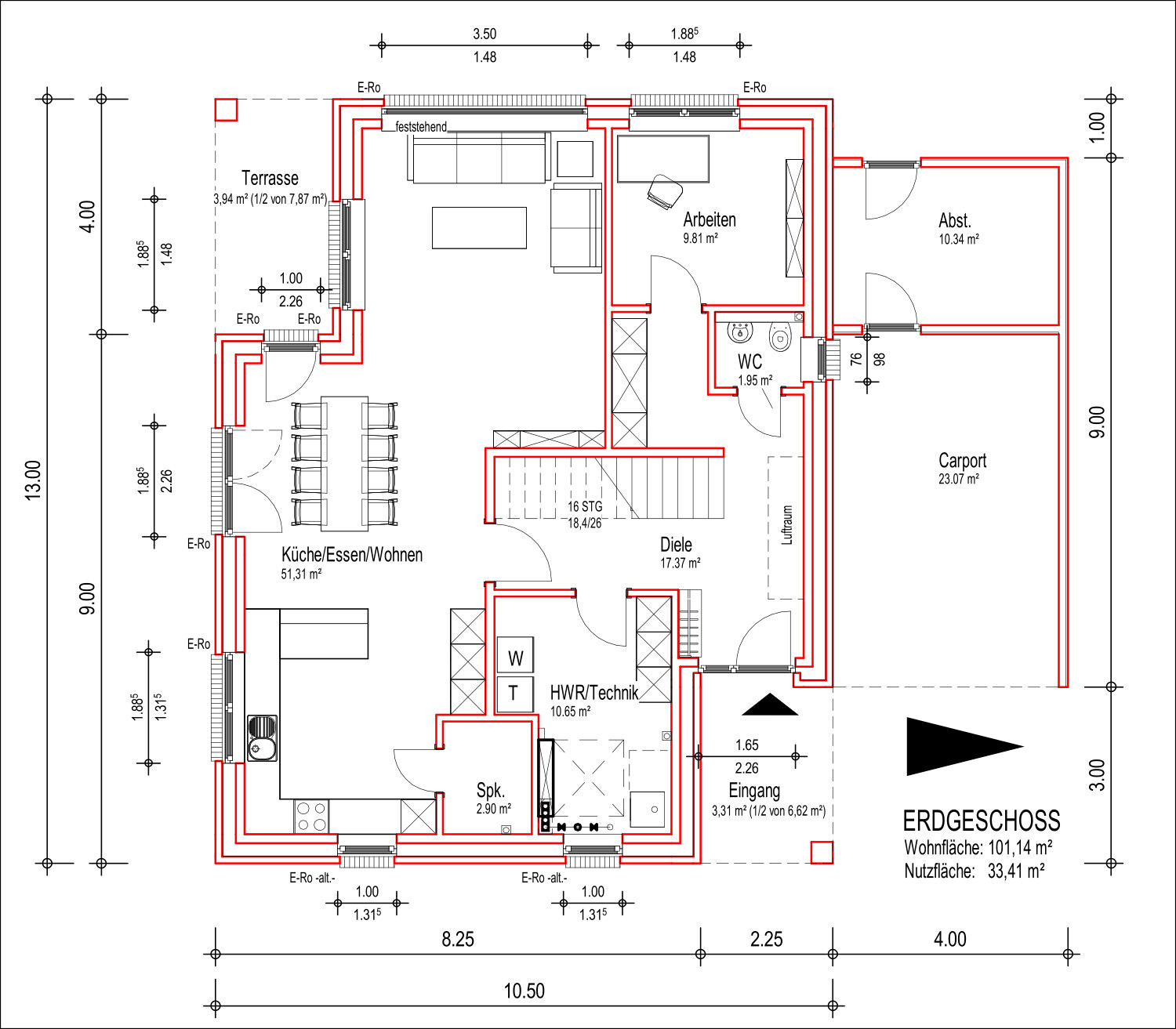
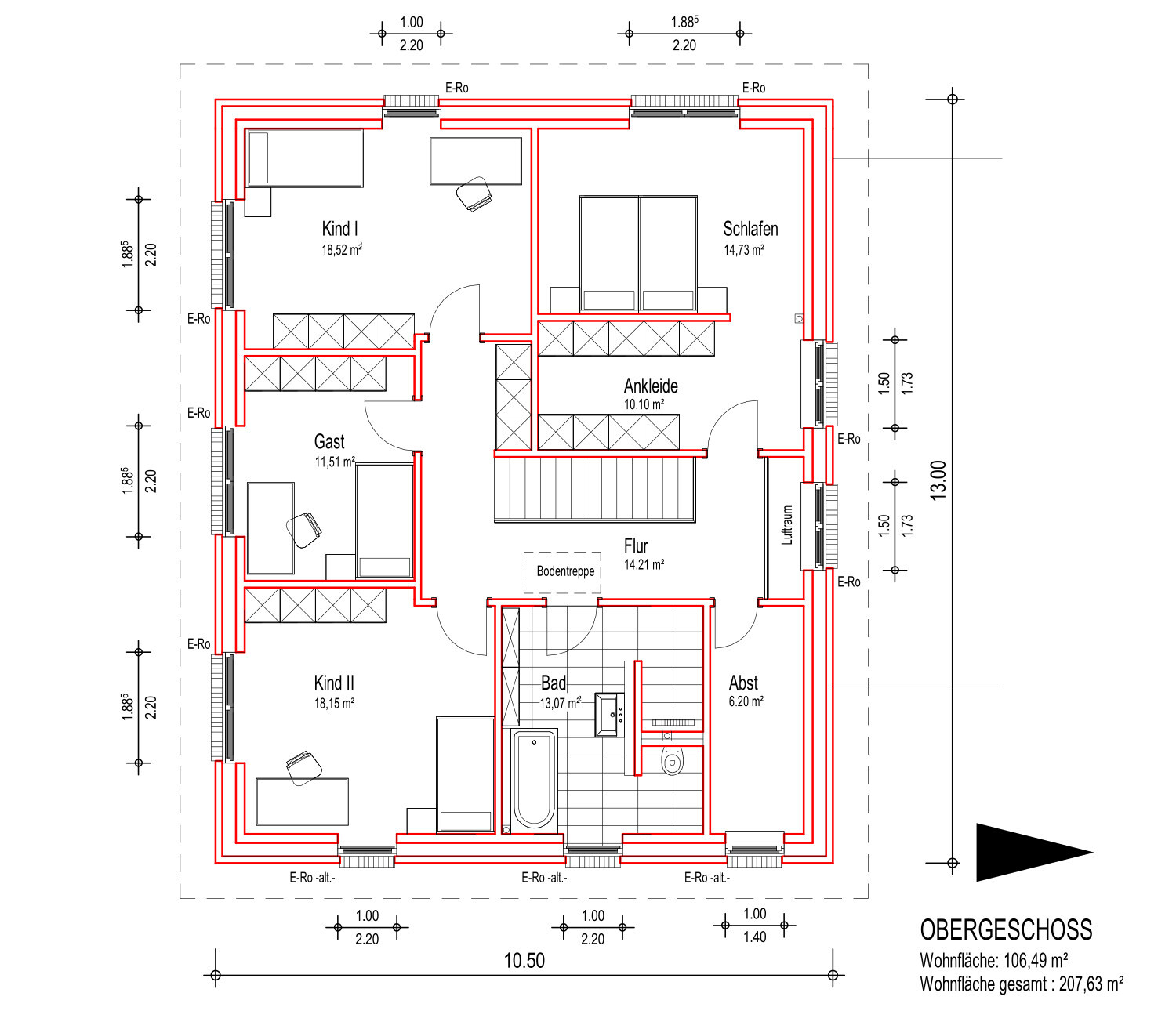
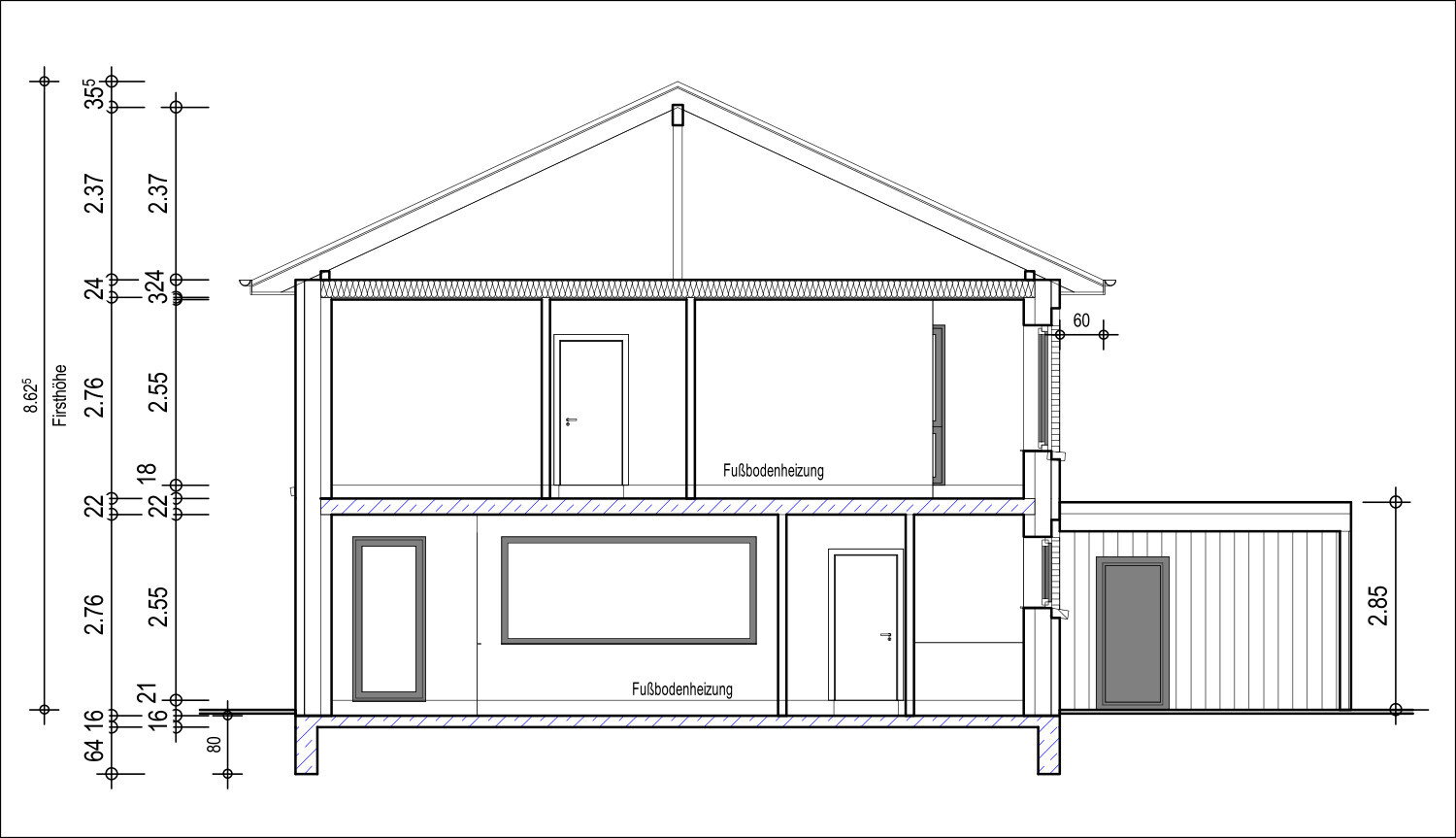
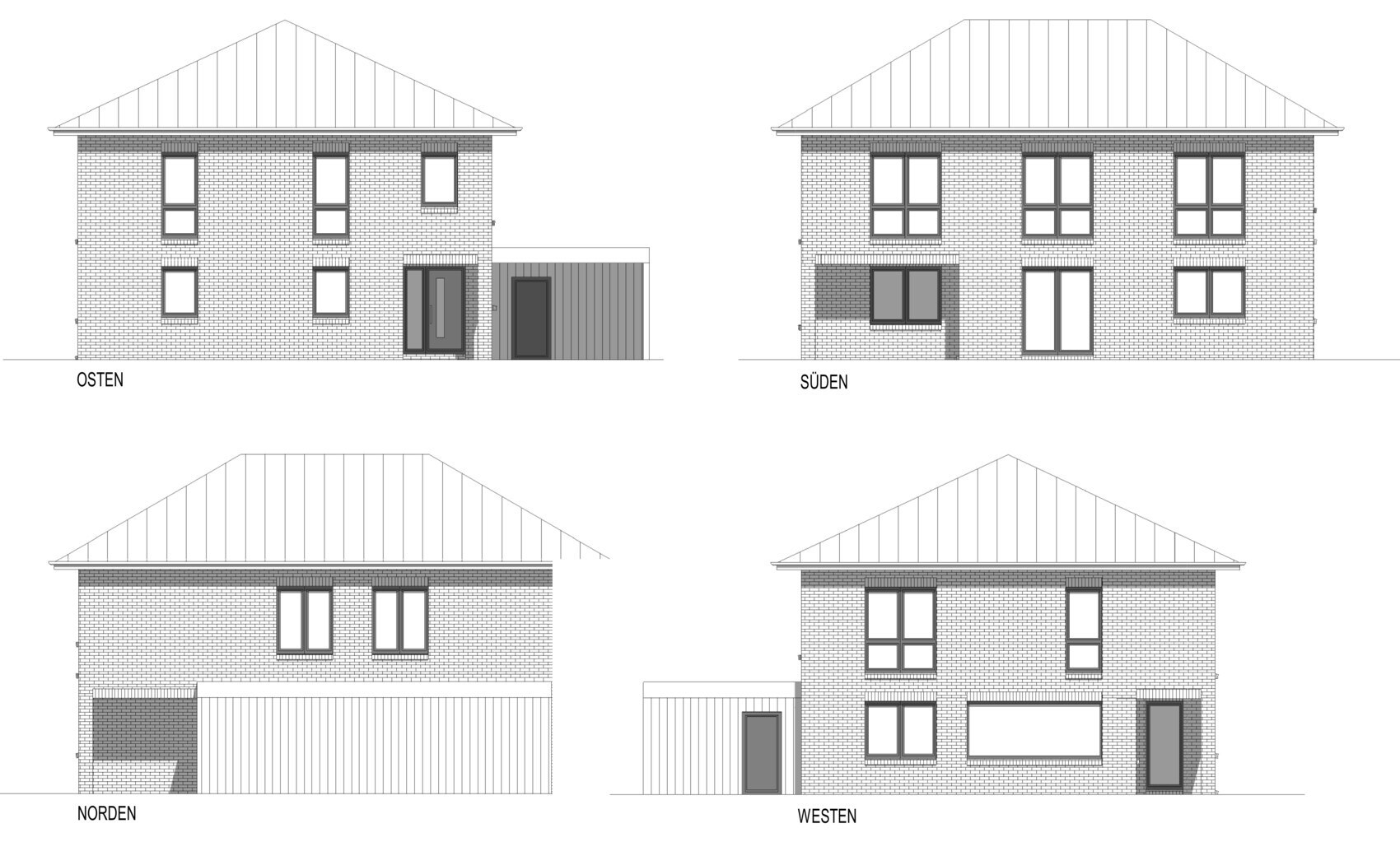
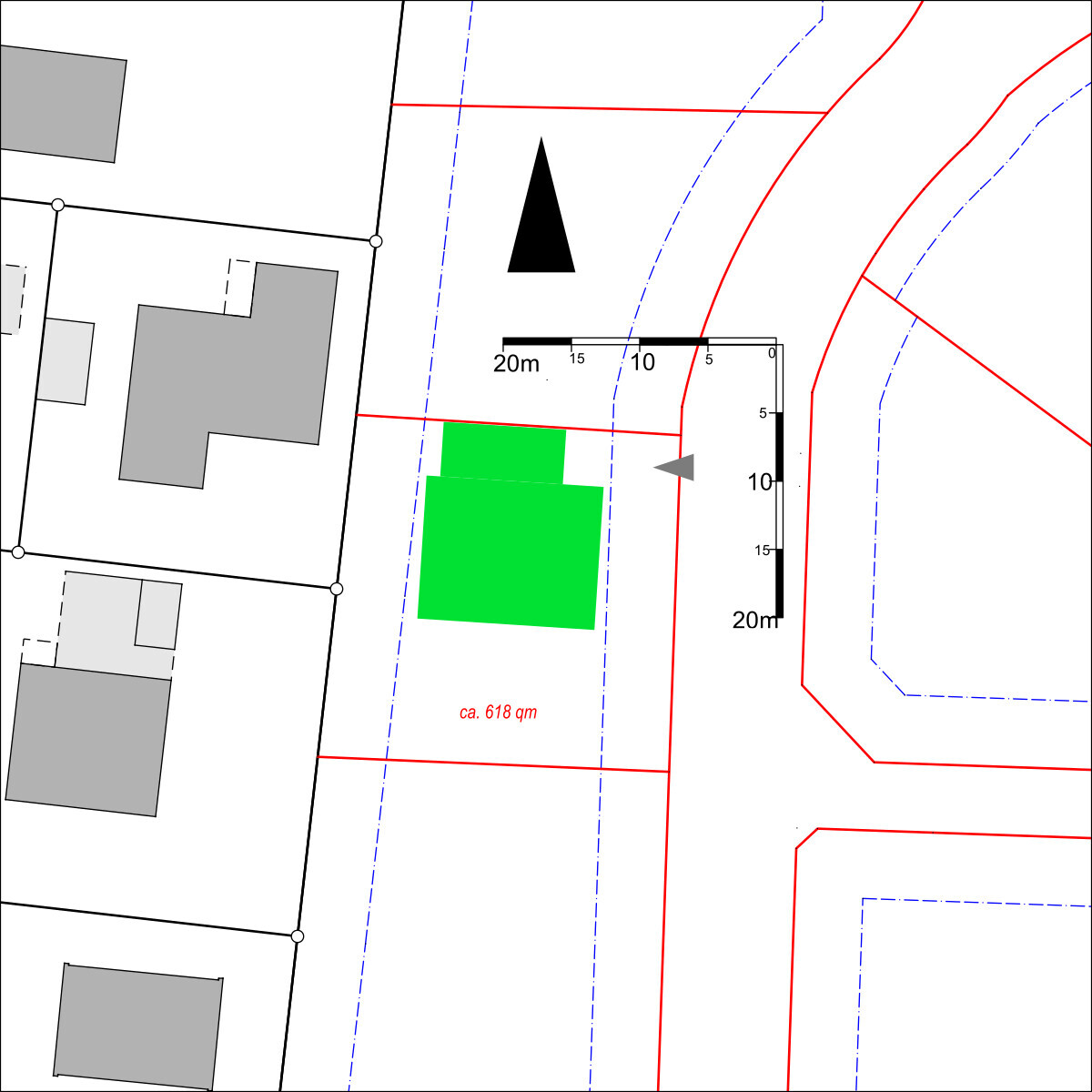
after I posted a question about the heat pump to be used a few days ago, I now want to continue with the main and fundamental thread regarding the floor plan.
Development Plan / Restrictions
Plot size: 618 m² (6660 sq ft)
Slope: None
Site coverage ratio: 0.4
Floor area ratio: None
Building envelope, building line and boundary: See image
Peripheral development: No
Number of parking spaces: 2
Number of stories: up to 2
Roof shape: All allowed; for hip or gable roofs 25° - 50° pitch
Architectural style: None specified
Orientation: None specified
Maximum height / limits: 9 m ridge height (29.5 ft)
Other requirements: Photovoltaic system covering at least 50% of usable roof surface
Homeowner Requirements
Architectural style, roof type, building type: "Urban villa but Northern German style"
Basement, floors: 2 full stories, no basement
Number of occupants, ages: 4 people, 32, 32, 1, -2 years
Room requirements on ground and upper floors: Study (ground floor), Study/guest room (upper floor)
Office: Family use or home office? 1 office for full-time use, 1 additional as a guest room hybrid
Number of guest stay days per year: approx. 10-15 days, mostly family
Open or closed layout: Open
Conservative or modern construction: More modern
Open kitchen, kitchen island: Open kitchen, with island if it fits, otherwise U- or L-shaped
Number of dining seats: 8
Fireplace: No
Music / stereo wall: No
Balcony, roof terrace: No
Garage, carport: Carport for 1 car
Utility garden, greenhouse: No
Additional wishes / special features / daily routine, also reasons why certain things are wanted or not: Nothing noteworthy
House Design
Who designed the plan: Planner (Architect?) of the general contractor (GC)
What do you particularly like and why?
- Straight staircase
- Covered entrance and terrace
- Spacious enough for our needs
What do you dislike and why?
- Ground floor WC probably too small
- Pantry doesn’t make much sense (maybe omit)
- Layout of the bathroom upstairs (we already have alternative ideas)
- Unsure if there is enough light in the living/dining area
- Slightly too big / bulky
- A bit too expensive
Price estimate according to architect/planner: 565,000 EUR
Personal price limit for the house, including fittings: 730,000 EUR (including garden, carport, photovoltaics, kitchen, additional costs)
Preferred heating technology: Heat pump is basically a must (no gas connection)
If you have to give up, which details / extras
- Can be skipped: open atrium, pantry, if necessary the type of covering on entrance and terrace (set back under the upper floor)
- Cannot be skipped: Storage space
Why did the design turn out the way it did?
Three-hour meeting with the architect at the general contractor, starting from a similar model house (this was a 1.5-story house with a gable roof), several iterations on tracing paper, then a week later the digital design was received.
Which wishes were implemented by the architect? Covered entrance and terrace set back under the upper floor, bedroom with dressing room, 2 studies (1 ground floor, 1 upper floor).
What do you think makes the design good or bad? Overall we quite like the whole package.
I’m looking forward to your opinions and am curious about what you think. If we still like the design in January, we will probably proceed with further planning with the general contractor.

HaseUndIgel schrieb:
Three-hour appointment with the architect at the general contractor, starting with a similar model house (it was a one-and-a-half-story building with a gable roof), several iterations on tracing paper, then the digital design was received a week later.
Which requests were implemented by the architect? Covered entrance and terrace recessed under the upper floor, bedroom with walk-in closet, two offices (one on the ground floor, one on the upper floor). From your descriptions, I assume that the "model house" had the dormer / captain’s bedroom, while through the variation to the Anstatt villa the children’s rooms next to it also became very large. On the opposite eaves side, the original had only the space under the sloping roof behind the bathroom instead of the storage room. The master bedroom gained room for rotating the layout to accommodate a walk-in closet thanks to the vertical wall along the eaves side.
Regarding the “several iterations,” I find it unfortunate that these were not shared with the discussants—this could make it easier to identify where and how things went wrong.
And I will never understand how someone working within this type of living space budget can agree to be completely controlled by the general contractor.
At least measurements for just the windows would be helpful.
https://www.instagram.com/11antgmxde/
https://www.linkedin.com/company/bauen-jetzt/
 HaseUndIgel27 Dec 2024 00:55
11ant schrieb:
I find it awkward not to share these "multiple iterations" with the discussion participants.Unfortunately, we haven’t done that; the planner needed them for drafting. I might be able to locate and share the model house design, but I’m not sure right now if that could have disadvantages for me if I reveal the general contractor here.
11ant schrieb:
And I will never understand how someone can go to the general contractor as a mere lackey in this living area weight class.In this case, he has the same degree as other architects, and we knew he could produce functional designs since he also created the model houses we looked at. We mostly liked those.
If I choose another architect, I rarely get to visit their houses, and I wouldn’t generally assume that independent architects are always better qualified.
The oddities mostly came from our own wishes. Our mistake was probably not being advised more strongly against unreasonable excesses.
Of course, conflicts of interest between architects and construction companies play a role here. That’s why I’m crowd-sourcing sensible advice here to help balance things out.
11ant schrieb:
More or less exact measurements just for the windows wouldn’t be bad.I’ll try to find time tomorrow to add dimensions to the ground floor and adjust the first floor size accordingly, including dimensions.
kbt09 schrieb:
The person sleeping on the left definitely has to always pass by their partner’s head when leaving the room (for nighttime bathroom visits, or getting up earlier), which is often a disturbance.That hasn’t bothered us in over 10 years. If I develop a different feeling about it in my later years, I can always rearrange the bed, but for the next 20 years we’re happy with the orientation shown.
11ant schrieb:
From your descriptions, I suspect the "model house" with the dormer/captain’s cabin had the guest room there, and by varying it to a detached villa, the children’s rooms next door became enormous.For children’s rooms, the floor area matters more than the living area. I think it’s wrong to reduce a children’s room just because it’s calculated smaller under a pitched roof in a two-story house due to the sloping ceiling, only because the living area in square meters is high.
I couldn’t resist and redesigned the first floor once more, adding dimensions for the key room sizes on both drawings.
kbt09 schrieb:
And the kitchen just doesn’t work with such a tiny island.That’s true, the little island is gone.
kbt09 schrieb:
And with the passage left of the bed being 60-70 cm (24-28 inches).In the current design, it’s 80 cm (31 inches).
Now that the recessed entrance is gone, the bathroom upstairs could also be moved entirely to the northeast corner. That would create new possibilities for windows.
We could also just take a bit from the storage room instead of swapping rooms, but I think a rectangular bathroom is generally better than a too awkwardly shaped one.
Does anyone have ideas or comments on this?
kbt09 schrieb:
Regarding windows... floor-to-ceiling windows that are 100 cm (40 inches) wide provide light only across that width, with some diffusion. If turned 90°, so more like about 210 cm (83 inches) wide and usually about 120 cm (47 inches) high, they provide light across the 210 cm (83 inches) width, again with some diffusion.HaseUndIgel schrieb:
that more light is almost always better, and our experience with floor-to-ceiling windows in terms of light gain is more positive than how ypg presents it.Of course, more light is better. However, I did not express an opinion on that but tried to explain the issue of light (which mostly moves laterally, i.e., from left to right, east to west) based on physical principles. Unfortunately, here it must pass through a vertically oriented narrow opening before it can spread across the width. A room is usually limited vertically by floor and ceiling to about ± 250 cm (± 98 inches). There is usually more space available in width for lighting, which is not achieved through a one-meter-wide (40 inches) vertical slit. It is a simple misconception by non-experts that floor-to-ceiling windows necessarily provide more light. If you don’t believe it, you can recreate this with a box, scissors, and a flashlight.HaseUndIgel schrieb:
We are just worried that we might not have enough light otherwise.Well... tell me about it. This applies to bathroom windows as well. You just need to want to understand it!HaseUndIgel schrieb:
I find any kind of staircase with a turn to be a serious tripping hazard, especially when carrying a child or awkward items. Maybe I’m just clumsy, but a staircase with a turn would be an absolute last resort for me.Floor-to-ceiling windows are mainstream—just like straight staircases. If you don’t like turns, that’s one thing; then just avoid them and install a straight staircase in your home. This allows for longer steps and a continuous run throughout the floor. Worth considering if you think of yourself as clumsy.HaseUndIgel schrieb:
Currently, we actually find this surplus of space quite comfortable.HaseUndIgel schrieb:
The entire furnishing is the architect’s “decor.”If you arrange the furniture lengthwise, the open space makes more sense again. I would still recommend omitting the window on the south side to allow better furniture placement on the terrace and instead have a floor-to-ceiling window instead of the fixed window on the west side. Possibly, a terrace door in the kitchen might also be an option for you. The architect’s initial draft is intended for you to place your intended furniture within the plan.HaseUndIgel schrieb:
From the west, only a neighbor can see in, which we don’t care much about. As long as the facades are not completely random, that’s enough for us, but on the west side, we’re pretty much indifferent.Well, deliberately arranged irregular windows can look more harmonious than vertical strips that make the house appear tilted. You could, if you wanted, move the small utility window on the upper floor to the north side. Then you have the opportunity to align the windows on the north and east nicely. Taking the time to work on the facade doesn’t cost anything but, like sightlines, can add great value to the house for free.HaseUndIgel schrieb:
County of Harburg, more in the western part.I once saw a similar graphic drawing (with a red double line) from residential construction. It was a building complex in NeuW OT. HaseUndIgel lives in Buxtehude right next door.
HaseUndIgel27 Dec 2024 12:05ypg schrieb:
However, there is usually more width to be illuminated. This cannot be achieved with a one-meter wide (about 3 feet) slit.
It is simply a misconception by laypeople that windows without parapets provide more light gain. You have convinced me/us. The arguments make sense even without building a model in a shoebox. It’s quite interesting how, despite the best intentions, one can be easily influenced by opinions and trends. Many of these impressions come from the house tour videos of the "Hausbau Helden" on YouTube. There, floor-to-ceiling windows always seem like a great advantage.
ypg schrieb:
The architect’s preliminary draft is meant for you to place your desired furniture into the plan yourself. That is correct and has now partly been done. However, besides the sofa, living room table, and dining table with chairs, very little substantial furniture will be moved or remain long term.
ypg schrieb:
If you want, you could place the utility window on the upper floor on the north side. Then you have the option to nicely align the windows on the north and east sides. Spending some time on the facade doesn’t cost anything – like sightlines, it adds value to the house for free. ypg schrieb:
I would still recommend leaving out the window on the south side so you can better furnish the terrace and instead use a floor-to-ceiling window instead of the fixed window on the west side. I will adjust the drawing again regarding the windows and also try to incorporate the facade design. The plan is now to have windows with parapets on the east and west (probably north as well). We actually like the southern view very much, so we will keep the floor-to-ceiling windows there.
Regarding the south window in the living area, I am still undecided. I am currently sitting in almost the same living room (also with a recessed terrace) and find it quite good as it is, both in terms of light exposure and view.
Outside, a bench would be placed below the parapet, and inside, the sofa.
ypg schrieb:
It might be an option for you to have a terrace door in the kitchen. Yes, we are considering that option. To be honest, the kitchen planning is the hardest part for me, especially in terms of visualizing space requirements and layout. You can see that in the draft with the small kitchen island.
Once the floor plan is roughly finalized, I would like to steer the thread later (not now, of course) toward kitchen and bathroom planning. In addition, early next year we plan to visit a kitchen showroom to assess whether the proposed layout is practical.
ypg schrieb:
HaseUndIgel live right next door in Buxtehude. Caught me.
N
nordanney27 Dec 2024 12:17HaseUndIgel schrieb:
I will adjust the drawing again regarding the windows To be honest? One word doesn’t fit in that sentence. And that word is "I."
I’m not a floor plan analyst. That’s why I would never presume to design a floor plan myself.
And that’s exactly what I recommend to you. Not "I," but an architect you hire should plan.
HaseUndIgel schrieb:
If I choose another architect, I can rarely visit the houses, and I wouldn’t simply assume that self-employed architects are always better qualified. So here’s my brief two cents. What do you think an architect employed by a general contractor (GC) will advise you? Exactly. The same thing as a VW dealer recommending a VW model—take this one. Oh, and you can change the specifications this way or that. And the GC’s salesperson does the same. I deliberately say the GC’s salesperson because that person is paid by them. Not directly by you. YOUR architect is paid by you and acts in your interest according to your wishes.

I prefer the revised design. The kitchen now makes a lot more sense. Overall, I think the design works well, although it is certainly quite extravagant and could easily function just as well with around 30 square meters (about 320 square feet) less space. By the way, I now really like the small corner in the living room south of the TV. It could easily become a cozy reading nook or a nice little area.
What bothers me most are the unnecessarily long hallways, which take up valuable square meters and create extra walking distances. I also don’t think the straight staircase is being used optimally. Especially the cloakroom behind the stairs feels out of place to me and would be better situated closer to the entrance. Maybe you could swap the guest toilet with the cloakroom. However, then you would need access to the toilet or utility room through the living room. The advantage would be a larger bathroom and a more sensibly positioned, contiguous cloakroom. The disadvantage is that the bathroom would no longer be located directly below the upstairs bathroom.
Other than that, I would agree with the suggestions to reconsider the windows, especially the patio door alongside the dining table. Think about how you want to access the garden in your daily routine.
Personally, I’m not a fan of covered terraces. The corner space will be quite small and definitely won’t fit a large table with many chairs around it. With a depth of 2 meters (about 6.5 feet), the terrace will probably only provide about 1 meter (about 3 feet) of shade at midday in summer. Also, I don’t see the point of the walk-in closet. I just can’t understand the trend at all.
What bothers me most are the unnecessarily long hallways, which take up valuable square meters and create extra walking distances. I also don’t think the straight staircase is being used optimally. Especially the cloakroom behind the stairs feels out of place to me and would be better situated closer to the entrance. Maybe you could swap the guest toilet with the cloakroom. However, then you would need access to the toilet or utility room through the living room. The advantage would be a larger bathroom and a more sensibly positioned, contiguous cloakroom. The disadvantage is that the bathroom would no longer be located directly below the upstairs bathroom.
Other than that, I would agree with the suggestions to reconsider the windows, especially the patio door alongside the dining table. Think about how you want to access the garden in your daily routine.
Personally, I’m not a fan of covered terraces. The corner space will be quite small and definitely won’t fit a large table with many chairs around it. With a depth of 2 meters (about 6.5 feet), the terrace will probably only provide about 1 meter (about 3 feet) of shade at midday in summer. Also, I don’t see the point of the walk-in closet. I just can’t understand the trend at all.
Similar topics