
Hello,
unfortunately, my post simply disappeared again yesterday, so I’ll try my luck once more.
A brief introduction: I am 48, female, single, and based in northern Baden-Württemberg.
I’m still at the very beginning of my house-building planning but already own a plot of land, for which I will sign the purchase contract in the coming weeks.
I want a small, single-story house without a basement, with a small, low-maintenance garden and nothing fancy.
It is unclear whether another person might move in ever, so I don’t want to plan for that at this point.
Basically, it would depend on the cost what 10-15 m² (100-160 sq ft) more would mean, as my budget is naturally limited.
Room plan
Kitchen + Dining + Living + Work approx. 40 m² (430 sq ft)
Bedroom approx. 14 m² (150 sq ft)
Dressing room -
Work/Guest/Child room approx. 10 m² (110 sq ft) optional
Bathroom + WC approx. 7 m² (75 sq ft)
Hallway approx. 5 m² (55 sq ft)
Utility room approx. 8 m² (85 sq ft)
Guest WC -
Storage room -
Total approx. 75 - 85 m² (810 - 915 sq ft)
Questionnaire regarding the floor plan:
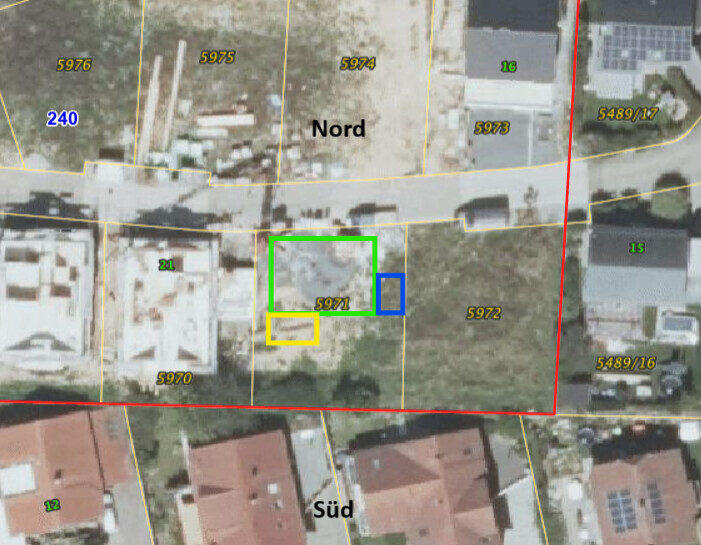
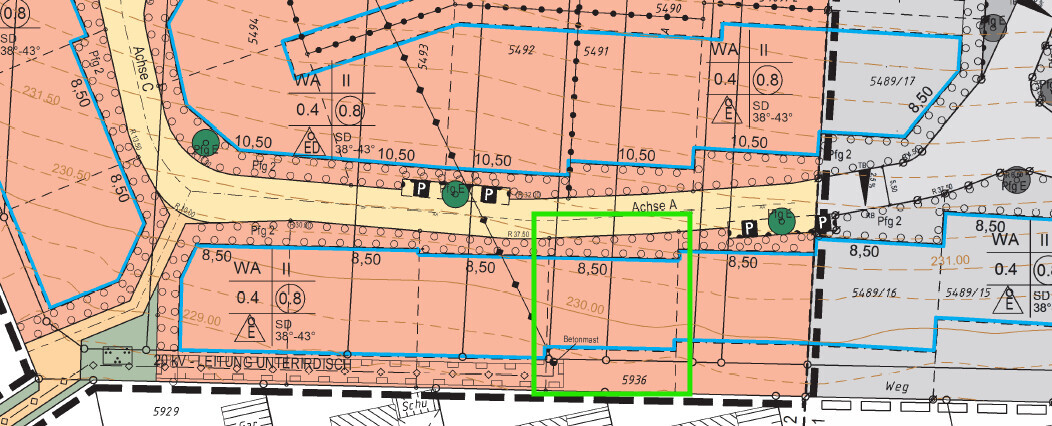
Attached are a section of the development plan and a rough drawing of the house (green), carport (blue) and patio (yellow) on the screenshot from Boris BW.
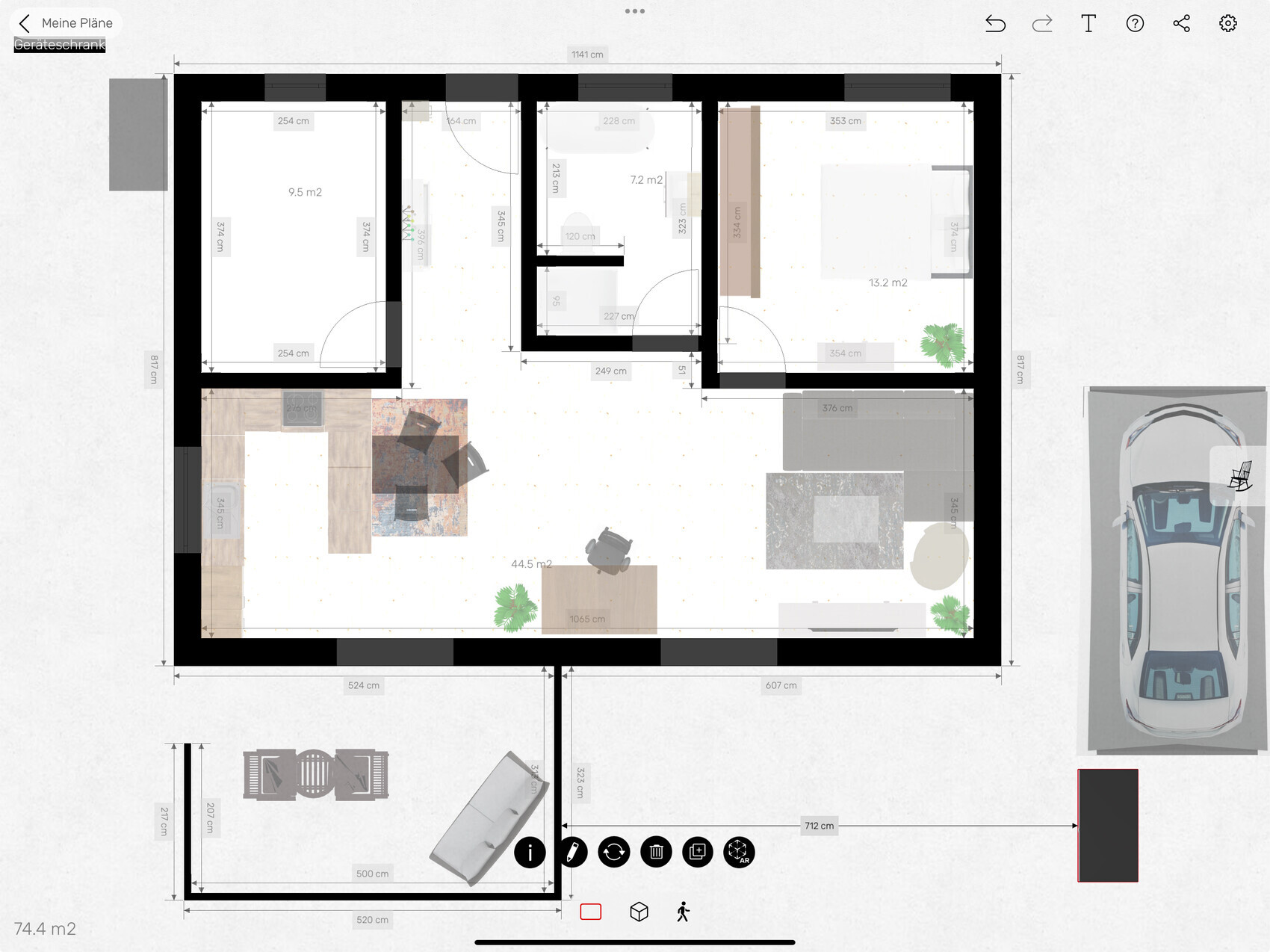
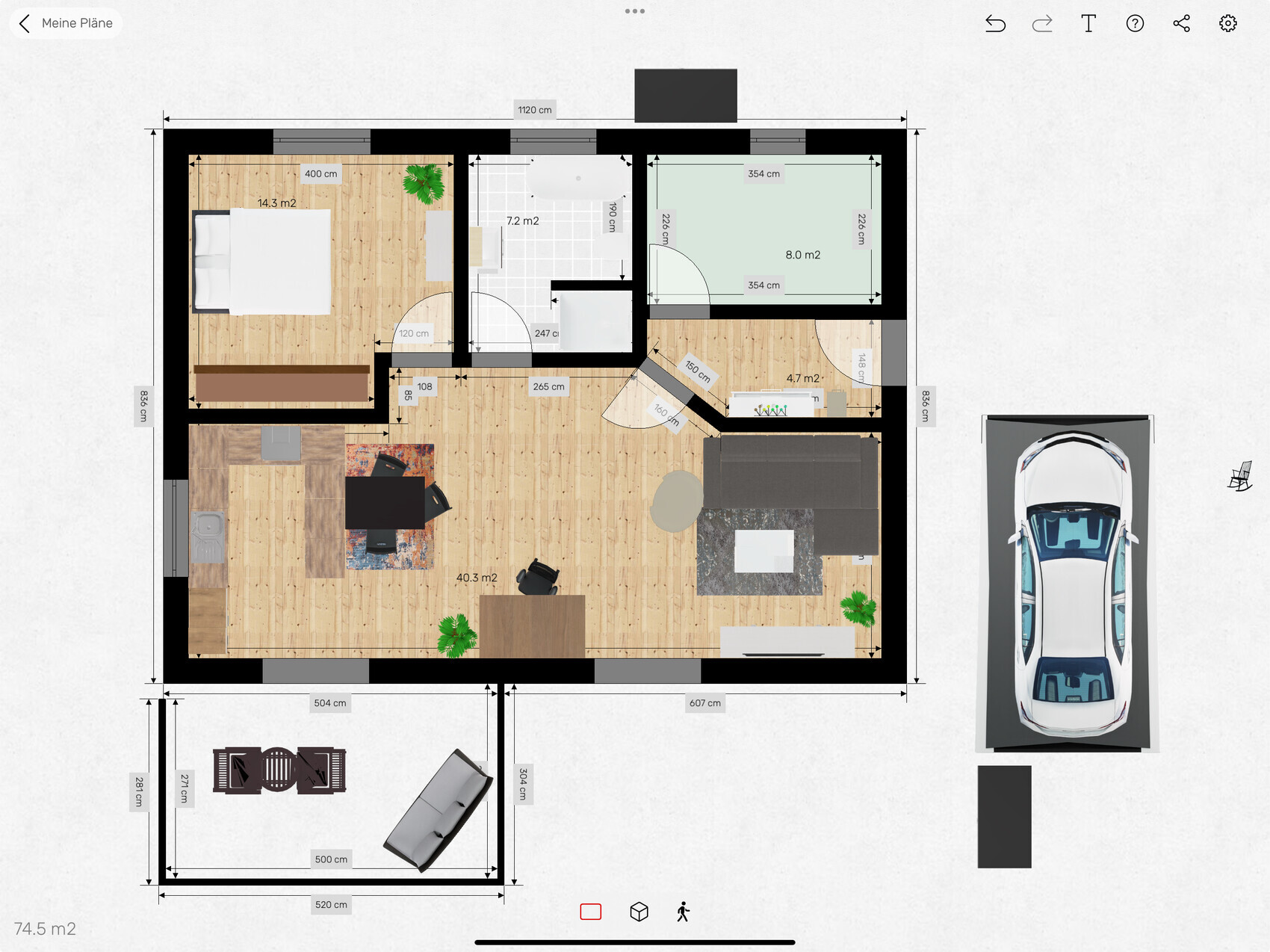
I have also attached my first attempts at floor plans (once with the entrance in the north and once in the east). I probably used the wrong tool for drafting, but I hope something can still be understood or used.
I look forward to constructive feedback.
Thank you in advance for your time.
unfortunately, my post simply disappeared again yesterday, so I’ll try my luck once more.
A brief introduction: I am 48, female, single, and based in northern Baden-Württemberg.
I’m still at the very beginning of my house-building planning but already own a plot of land, for which I will sign the purchase contract in the coming weeks.
I want a small, single-story house without a basement, with a small, low-maintenance garden and nothing fancy.
It is unclear whether another person might move in ever, so I don’t want to plan for that at this point.
Basically, it would depend on the cost what 10-15 m² (100-160 sq ft) more would mean, as my budget is naturally limited.
Room plan
Kitchen + Dining + Living + Work approx. 40 m² (430 sq ft)
Bedroom approx. 14 m² (150 sq ft)
Dressing room -
Work/Guest/Child room approx. 10 m² (110 sq ft) optional
Bathroom + WC approx. 7 m² (75 sq ft)
Hallway approx. 5 m² (55 sq ft)
Utility room approx. 8 m² (85 sq ft)
Guest WC -
Storage room -
Total approx. 75 - 85 m² (810 - 915 sq ft)
Questionnaire regarding the floor plan:
| Development plan / restrictions | |
| Plot size | 392 m² (4,220 sq ft) |
| Slope | North-south gradient approx. 1.5 m on 21 m (5 ft on 69 ft) |
| Site coverage ratio | 0.4 |
| Floor area ratio | 0.8 |
| Building envelope, building line and boundary | see development plan |
| Edge development | Setbacks according to open construction style |
| Number of parking spaces | 1.5 (rounded up) per dwelling unit, so 2 |
| Number of stories | II (two stories) |
| Roof type | Pitch 38–43°, half-hip roof or double shed roof |
| Architectural style | ? |
| Orientation | East-West |
| Maximum heights / limits | 8.5 m (28 ft) |
| Further requirements | Cistern of 4.5 m³ (160 cu ft) recommended Garage: with gable roof or green flat roof, carports? Filling allowed up to 1.8 m (6 ft) |
| Builder’s requirements | |
| Style, roof form, building type | Exemption from gable roof at 30°? Bungalow |
| Basement, number of floors | One story without basement |
| Number of people, age | see introduction |
| Space requirements on ground and upper floors | Ground floor 75-80 m² (810 - 860 sq ft) |
| Office: family use or home office? | Home office, integrated in living-dining area |
| Number of overnight guests per year | 0–1 |
| Open or closed architecture | ? |
| Traditional or modern construction style | ? |
| Open kitchen, kitchen island | Kitchen island with depth like regular kitchen cabinets, followed by dining table |
| Number of dining seats | max 4 |
| Fireplace | Undecided |
| Music / stereo wall | No |
| Balcony, roof terrace | No |
| Garage, carport | 1 carport, 1 parking space |
| Vegetable garden, greenhouse | No |
| Further wishes / special features / daily routine, including reasons why some things should be included or not | - No separate office for home office because I don’t want to spend most of the day in a smaller room but rather in the living room with a view of the garden - Retractable staircase to the attic (additional storage space) - Wall in bedroom for wardrobe at least 2.75 m (9 ft) long - Wall in living room at least 2.45 m (8 ft) long for lowboard with TV - Bathtub – uncertain if necessary - Larger shower 90 x 120 cm (36 x 47 inches) with tiled partition wall (avoid glass wall) |
| House design | |
| Who designed the plan: | DIY, based on floor plans from Hanse Haus and various other small house providers |
| What do you like? Why? | Open living-dining-working area in the southern part of the house, utility room not directly next to the bedroom (noise from technical equipment) |
| What do you dislike? Why? | Possibly the hallway / entrance area is rather small |
| Cost estimate according to architect / planner: | ? |
| Personal price limit for the house, incl. equipment: | 250,000–270,000 Euros (approx. 270,000–290,000 USD) turnkey, excluding foundation slab, earthworks, secondary building costs, furnishings, and landscaping |
| Preferred heating system: | Not yet decided, possibly underfloor heating |
| Other considerations | Maximum house length 11.5 m (38 ft) because plot width approx. 18 m (59 ft) minus carport 3 m (10 ft) minus setback 2.5 m (8 ft) minus 1 m (3 ft) buffer in case plot is shorter than 18 m (measured on Boris BW) Carport position could also be on the west side To maximize green space and deal with the slope: house with long side parallel to the street No preference yet regarding solid construction or timber frame, KfW 55 or 40 or X standard |
| Outdoor facilities | - Patio approx. 15 m² (160 sq ft) level with the house - Lawn may have slope - Carport with parking space in front |
| Earthworks | Southern boundary: retaining wall needed to manage slope, neighbors (right and left) have done this with 1.4 m (4.5 ft) L-shaped concrete blocks or hollow blocks, rough offer from earthworks company is available (wall, grading, compacting and preparations for foundation slab, foundation slab, patio and carport [= crane location], graveling, drainage, grounding ring, multi-utility lines, site setup etc. all together approx. 60,000 Euros) |
Attached are a section of the development plan and a rough drawing of the house (green), carport (blue) and patio (yellow) on the screenshot from Boris BW.
I have also attached my first attempts at floor plans (once with the entrance in the north and once in the east). I probably used the wrong tool for drafting, but I hope something can still be understood or used.
I look forward to constructive feedback.
Thank you in advance for your time.
11ant schrieb:
It’s not me, but the original poster who is hesitant about having the utility room directly next to the bedroom.That’s true. I wanted to address that. In a two-room house, some rooms naturally share walls or are adjacent to each other. Regarding the noise issue: a ventilation system is not planned; there will be a heat pump—does the indoor unit make noise? I don’t know. We use silent gas heating.
You can’t hear our washing machine at all anymore. There are mats for spin cycles. However, I wouldn’t change the floor plan just because of 5 minutes of noise per week—probably the dishwasher is more relevant. Anyway.
We have the washing machine in the adjoining bathroom, which is actually not a problem; besides, as a single person, one probably does laundry less often than a large family. We run the dishwasher before going to bed, and I don’t see that as an issue with today’s appliances either.
The great thing about living alone is that you can do everything exactly the way you want, and decide what bothers you and what doesn’t; this is highly individual. Even our domestic hot water heat pump in the utility room next to the kitchen is not really disturbing when it runs for a while.
Living in a more open or “smaller” space, like here, naturally comes with such “downsides,” but I don’t see them as negatives because I like my way of living. In the end, every decision about a detail always has some kind of consequence, so I focus on my priorities.
You could criticize any great house floor plan by pointing out extreme cooking smells, loud kitchen activity or machines, lack of privacy when guests visit, etc., but in my opinion, the principle mentioned above helps: I live in “my” normal situation, not in a possible extreme case.
I would first look at how many square meters are truly needed to create a nice layout for me, rather than trying to stick to 75sqm (810 sq ft) by force. If you avoid wasting money on unnecessary things during construction and consistently skip unnecessary cost drivers (and I know that’s not how you operate), it should work within the budget even with 85sqm (915 sq ft).
The great thing about living alone is that you can do everything exactly the way you want, and decide what bothers you and what doesn’t; this is highly individual. Even our domestic hot water heat pump in the utility room next to the kitchen is not really disturbing when it runs for a while.
Living in a more open or “smaller” space, like here, naturally comes with such “downsides,” but I don’t see them as negatives because I like my way of living. In the end, every decision about a detail always has some kind of consequence, so I focus on my priorities.
You could criticize any great house floor plan by pointing out extreme cooking smells, loud kitchen activity or machines, lack of privacy when guests visit, etc., but in my opinion, the principle mentioned above helps: I live in “my” normal situation, not in a possible extreme case.
ypg schrieb:
I admit, I had 3 designs around 70/75sqm (750/810 sq ft), but discarded them again. Planning a house is not easier just because you only have 3 rectangles to zone (bedroom, bathroom, technical room).
I would first look at how many square meters are truly needed to create a nice layout for me, rather than trying to stick to 75sqm (810 sq ft) by force. If you avoid wasting money on unnecessary things during construction and consistently skip unnecessary cost drivers (and I know that’s not how you operate), it should work within the budget even with 85sqm (915 sq ft).
Arauki11 schrieb:
instead of trying to strictly stick to the 75sqm (807 sq ft) by force. No one is trying to strictly adhere to fixed sizes here by force. The original poster initially aimed for 70sqm (753 sq ft) and allows some flexibility upward.
However, a bathroom of 8-10sqm (86-108 sq ft) and a utility room of 7-10sqm (75-108 sq ft) should be sufficient for a one- to two-person household. And if you know the standard dimensions of furniture, everything fits well according to the preferences. But if you start working with castle-like dimensions, you are doing something wrong.
Arauki11 schrieb:
but in my opinion, the above principle helps here; I live in "my" normality and not the possible extreme case. Exactly.
ypg schrieb:
No one strictly sticks to fixed sizes here. The original poster (OP) initially planned for 70sqm (750 sq ft) and leaves room for flexibility. I already understand that; it was more a suggestion for the OP to get comfortable with "necessarily" having a bit more square meters.
ypg schrieb:
But a bathroom of 8-10sqm (86-108 sq ft) and a utility room of 7-10sqm (75-108 sq ft) should be sufficient for a one- to two-person household. Our ground floor bathroom is 6.91sqm (74 sq ft), and I was skeptical during the planning stage. Now, I would do it the same way again—it has become "my" bathroom, just like our utility/technical room including photovoltaic system and a domestic hot water heat pump. Despite an additional garden exit and a hand basin, there is still plenty of shelf space next to the technical equipment. Of course, bigger is always better, but this size is absolutely enough for us; if necessary, we would rather declutter again.
I can’t draw floor plans myself, more likely just criticize them, but our rectangular ground floor with an entrance on the long eaves side has exactly 90sqm (970 sq ft) for the utility room, bathroom, open hallway (7sqm / 75 sq ft), a large open-plan area, and a staircase (which the OP does not have). That’s why I understand that even with 5-10sqm (54-108 sq ft) less, the OP’s layout can feel very spacious if it is kept open and bright (with windows).
Arauki11 schrieb:
Of course, bigger is always betterI actually don’t agree with that. When it comes to the bathroom, for example, having too much space can make the layout feel uncomfortable. The living room area, on the other hand, gains atmosphere with walls around it. But if it’s too small, it limits the activity space in front of the TV. Some don’t need much space there, but many like to do some exercise or other activities in that area (we still have the Nintendo Wii tucked away in a drawer. Haha). You don’t need to overdo it or apply a one-size-fits-all approach. This issue often comes up with secondary apartments, which according to many forum opinions are usually allowed to have around 120 m² (1300 sq ft). Haha, a small apartment works just fine if it is well designed.
What the hallway on the eaves side is to a rectangular floor plan is the door to a room: if it’s placed incorrectly, you might need more square meters to achieve the same level of comfort.
ypg schrieb:
I don’t agree with that at all. When it comes to the bathroom, for example, planning with too much space can actually make it feel quite uncomfortable.That’s true, or rather I wasn’t very precise. I actually meant this more for the utility room, where space can sometimes become a problem. But even there, it’s important to exercise some restraint. Quite often, bathrooms are unnecessarily large without deeper reasoning. I already mentioned that I love my 6.91m² (74 sq ft) bathroom.
Similar topics