
Hello,
unfortunately, my post simply disappeared again yesterday, so I’ll try my luck once more.
A brief introduction: I am 48, female, single, and based in northern Baden-Württemberg.
I’m still at the very beginning of my house-building planning but already own a plot of land, for which I will sign the purchase contract in the coming weeks.
I want a small, single-story house without a basement, with a small, low-maintenance garden and nothing fancy.
It is unclear whether another person might move in ever, so I don’t want to plan for that at this point.
Basically, it would depend on the cost what 10-15 m² (100-160 sq ft) more would mean, as my budget is naturally limited.
Room plan
Kitchen + Dining + Living + Work approx. 40 m² (430 sq ft)
Bedroom approx. 14 m² (150 sq ft)
Dressing room -
Work/Guest/Child room approx. 10 m² (110 sq ft) optional
Bathroom + WC approx. 7 m² (75 sq ft)
Hallway approx. 5 m² (55 sq ft)
Utility room approx. 8 m² (85 sq ft)
Guest WC -
Storage room -
Total approx. 75 - 85 m² (810 - 915 sq ft)
Questionnaire regarding the floor plan:
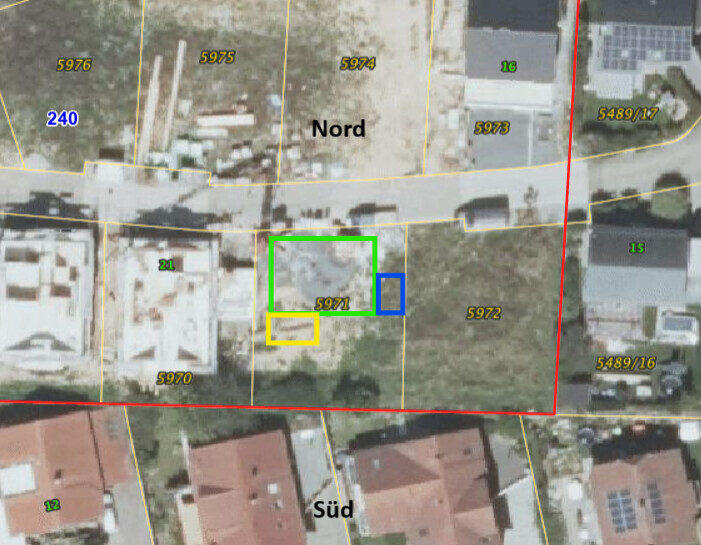
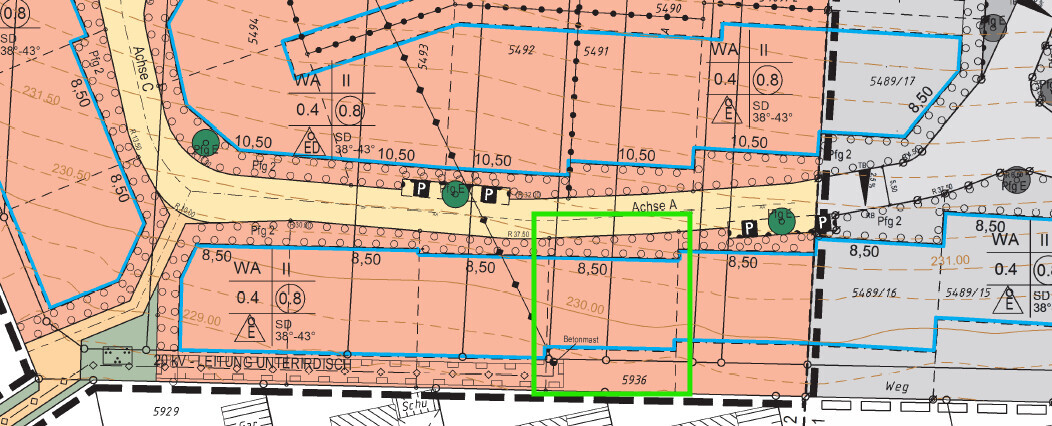
Attached are a section of the development plan and a rough drawing of the house (green), carport (blue) and patio (yellow) on the screenshot from Boris BW.
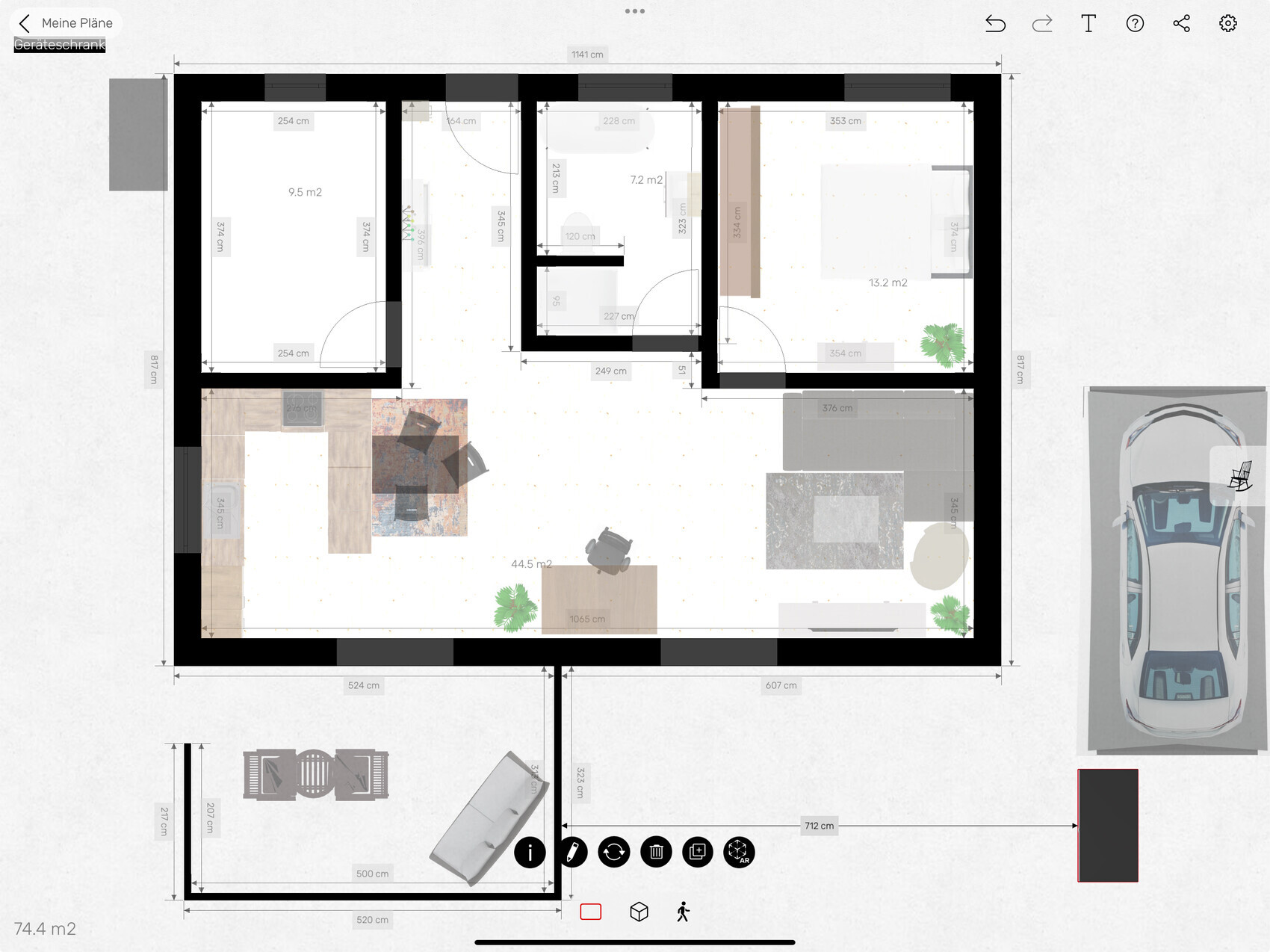
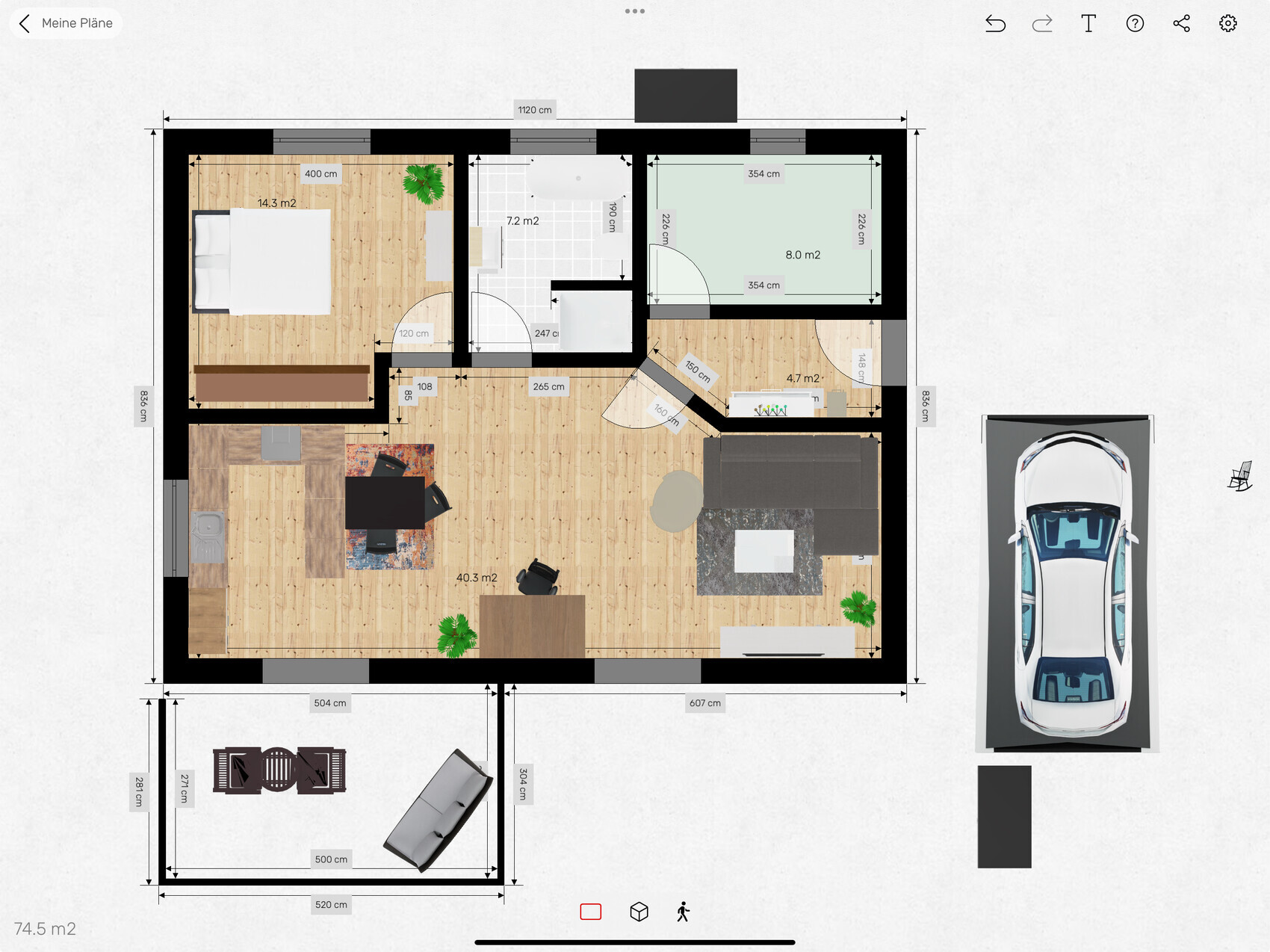
I have also attached my first attempts at floor plans (once with the entrance in the north and once in the east). I probably used the wrong tool for drafting, but I hope something can still be understood or used.
I look forward to constructive feedback.
Thank you in advance for your time.
unfortunately, my post simply disappeared again yesterday, so I’ll try my luck once more.
A brief introduction: I am 48, female, single, and based in northern Baden-Württemberg.
I’m still at the very beginning of my house-building planning but already own a plot of land, for which I will sign the purchase contract in the coming weeks.
I want a small, single-story house without a basement, with a small, low-maintenance garden and nothing fancy.
It is unclear whether another person might move in ever, so I don’t want to plan for that at this point.
Basically, it would depend on the cost what 10-15 m² (100-160 sq ft) more would mean, as my budget is naturally limited.
Room plan
Kitchen + Dining + Living + Work approx. 40 m² (430 sq ft)
Bedroom approx. 14 m² (150 sq ft)
Dressing room -
Work/Guest/Child room approx. 10 m² (110 sq ft) optional
Bathroom + WC approx. 7 m² (75 sq ft)
Hallway approx. 5 m² (55 sq ft)
Utility room approx. 8 m² (85 sq ft)
Guest WC -
Storage room -
Total approx. 75 - 85 m² (810 - 915 sq ft)
Questionnaire regarding the floor plan:
| Development plan / restrictions | |
| Plot size | 392 m² (4,220 sq ft) |
| Slope | North-south gradient approx. 1.5 m on 21 m (5 ft on 69 ft) |
| Site coverage ratio | 0.4 |
| Floor area ratio | 0.8 |
| Building envelope, building line and boundary | see development plan |
| Edge development | Setbacks according to open construction style |
| Number of parking spaces | 1.5 (rounded up) per dwelling unit, so 2 |
| Number of stories | II (two stories) |
| Roof type | Pitch 38–43°, half-hip roof or double shed roof |
| Architectural style | ? |
| Orientation | East-West |
| Maximum heights / limits | 8.5 m (28 ft) |
| Further requirements | Cistern of 4.5 m³ (160 cu ft) recommended Garage: with gable roof or green flat roof, carports? Filling allowed up to 1.8 m (6 ft) |
| Builder’s requirements | |
| Style, roof form, building type | Exemption from gable roof at 30°? Bungalow |
| Basement, number of floors | One story without basement |
| Number of people, age | see introduction |
| Space requirements on ground and upper floors | Ground floor 75-80 m² (810 - 860 sq ft) |
| Office: family use or home office? | Home office, integrated in living-dining area |
| Number of overnight guests per year | 0–1 |
| Open or closed architecture | ? |
| Traditional or modern construction style | ? |
| Open kitchen, kitchen island | Kitchen island with depth like regular kitchen cabinets, followed by dining table |
| Number of dining seats | max 4 |
| Fireplace | Undecided |
| Music / stereo wall | No |
| Balcony, roof terrace | No |
| Garage, carport | 1 carport, 1 parking space |
| Vegetable garden, greenhouse | No |
| Further wishes / special features / daily routine, including reasons why some things should be included or not | - No separate office for home office because I don’t want to spend most of the day in a smaller room but rather in the living room with a view of the garden - Retractable staircase to the attic (additional storage space) - Wall in bedroom for wardrobe at least 2.75 m (9 ft) long - Wall in living room at least 2.45 m (8 ft) long for lowboard with TV - Bathtub – uncertain if necessary - Larger shower 90 x 120 cm (36 x 47 inches) with tiled partition wall (avoid glass wall) |
| House design | |
| Who designed the plan: | DIY, based on floor plans from Hanse Haus and various other small house providers |
| What do you like? Why? | Open living-dining-working area in the southern part of the house, utility room not directly next to the bedroom (noise from technical equipment) |
| What do you dislike? Why? | Possibly the hallway / entrance area is rather small |
| Cost estimate according to architect / planner: | ? |
| Personal price limit for the house, incl. equipment: | 250,000–270,000 Euros (approx. 270,000–290,000 USD) turnkey, excluding foundation slab, earthworks, secondary building costs, furnishings, and landscaping |
| Preferred heating system: | Not yet decided, possibly underfloor heating |
| Other considerations | Maximum house length 11.5 m (38 ft) because plot width approx. 18 m (59 ft) minus carport 3 m (10 ft) minus setback 2.5 m (8 ft) minus 1 m (3 ft) buffer in case plot is shorter than 18 m (measured on Boris BW) Carport position could also be on the west side To maximize green space and deal with the slope: house with long side parallel to the street No preference yet regarding solid construction or timber frame, KfW 55 or 40 or X standard |
| Outdoor facilities | - Patio approx. 15 m² (160 sq ft) level with the house - Lawn may have slope - Carport with parking space in front |
| Earthworks | Southern boundary: retaining wall needed to manage slope, neighbors (right and left) have done this with 1.4 m (4.5 ft) L-shaped concrete blocks or hollow blocks, rough offer from earthworks company is available (wall, grading, compacting and preparations for foundation slab, foundation slab, patio and carport [= crane location], graveling, drainage, grounding ring, multi-utility lines, site setup etc. all together approx. 60,000 Euros) |
Attached are a section of the development plan and a rough drawing of the house (green), carport (blue) and patio (yellow) on the screenshot from Boris BW.
I have also attached my first attempts at floor plans (once with the entrance in the north and once in the east). I probably used the wrong tool for drafting, but I hope something can still be understood or used.
I look forward to constructive feedback.
Thank you in advance for your time.
Thanks for the kind words.
I’ll take that as referring to us friendly users.
With the house size you want, almost everything is possible since you don’t really need to consider any significantly complex structural engineering. Small and neat can work well, for example, a Pax wardrobe can serve as a built-in closet in the hallway, providing storage space even in a small room for miscellaneous items.
Anyway, your two designs are a good starting point – I’ll take a look this evening to see if I can come up with some straightforward ideas. Or do you definitely want this slanted wall? (Don’t say the wrong thing…)
By the way: has the question about the plot width already been answered? And how tall are the neighboring houses? Is there already a neighbor on the right side of the property?
Newbee-BW schrieb:
Simply wow! Thank you so much for your feedback – it’s great to be here!
I’ll take that as referring to us friendly users.
With the house size you want, almost everything is possible since you don’t really need to consider any significantly complex structural engineering. Small and neat can work well, for example, a Pax wardrobe can serve as a built-in closet in the hallway, providing storage space even in a small room for miscellaneous items.
Anyway, your two designs are a good starting point – I’ll take a look this evening to see if I can come up with some straightforward ideas. Or do you definitely want this slanted wall? (Don’t say the wrong thing…)
By the way: has the question about the plot width already been answered? And how tall are the neighboring houses? Is there already a neighbor on the right side of the property?
N
Newbee-BW4 Dec 2024 15:00ypg schrieb:
Small and neat, a built-in wardrobe like a Pax can occasionally be used in the cloakroom, so that even in a small space there are storage options for clutter?! Yes, the Pax is definitely welcome. I like to keep things practical.
ypg schrieb:
Or do you really want that slanted wall? (Don’t say anything wrong...) No, it’s not a must. I saw it on the Hanse Haus floor plan for the “Bungalow 80” and thought it was nice because it’s something different from a straight wall. But it’s not essential.
Thank you for taking an interest in my “masterpieces” – much appreciated!
Plot width: measured on Boris BW online about 18 m (59 feet)
Neighboring buildings: now on both right and left, each with a basement, garages, and two stories. Both have their garages located right on the boundaries of “my” plot. I hope that makes sense...
N
Newbee-BW4 Dec 2024 15:35@ypg I have two more, but please don’t laugh—I tried to be creative. For the angled bungalow, you have to mentally rotate it 180 degrees so that north is at the top and south at the bottom.
I’m only sharing them because I find it charming that there is already a roof over the terrace, but I can’t judge if that makes financial sense. With the staggered layout, I like the front entrance, which also has a covered area... However, the interior layout of both is not ideal...
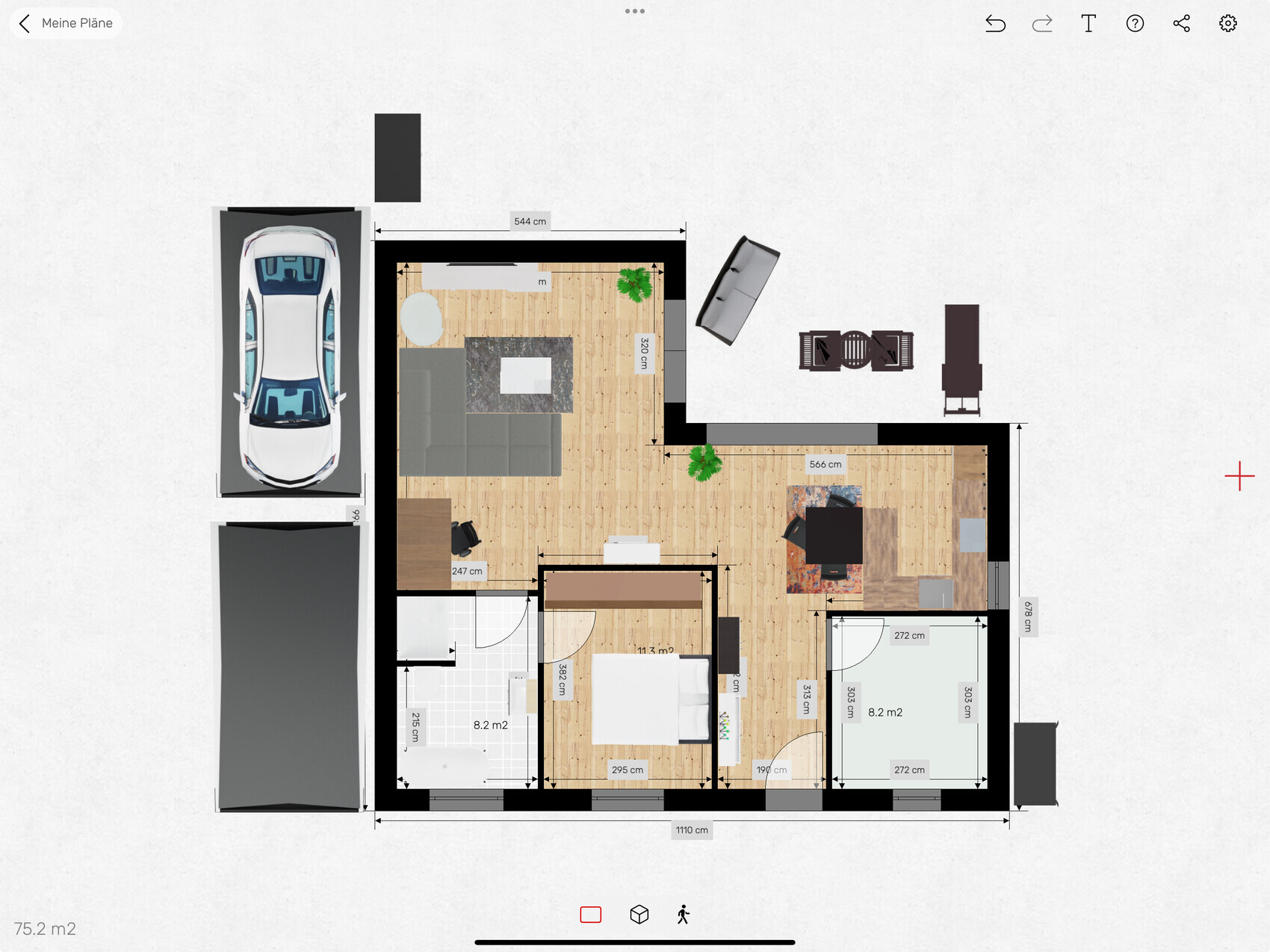
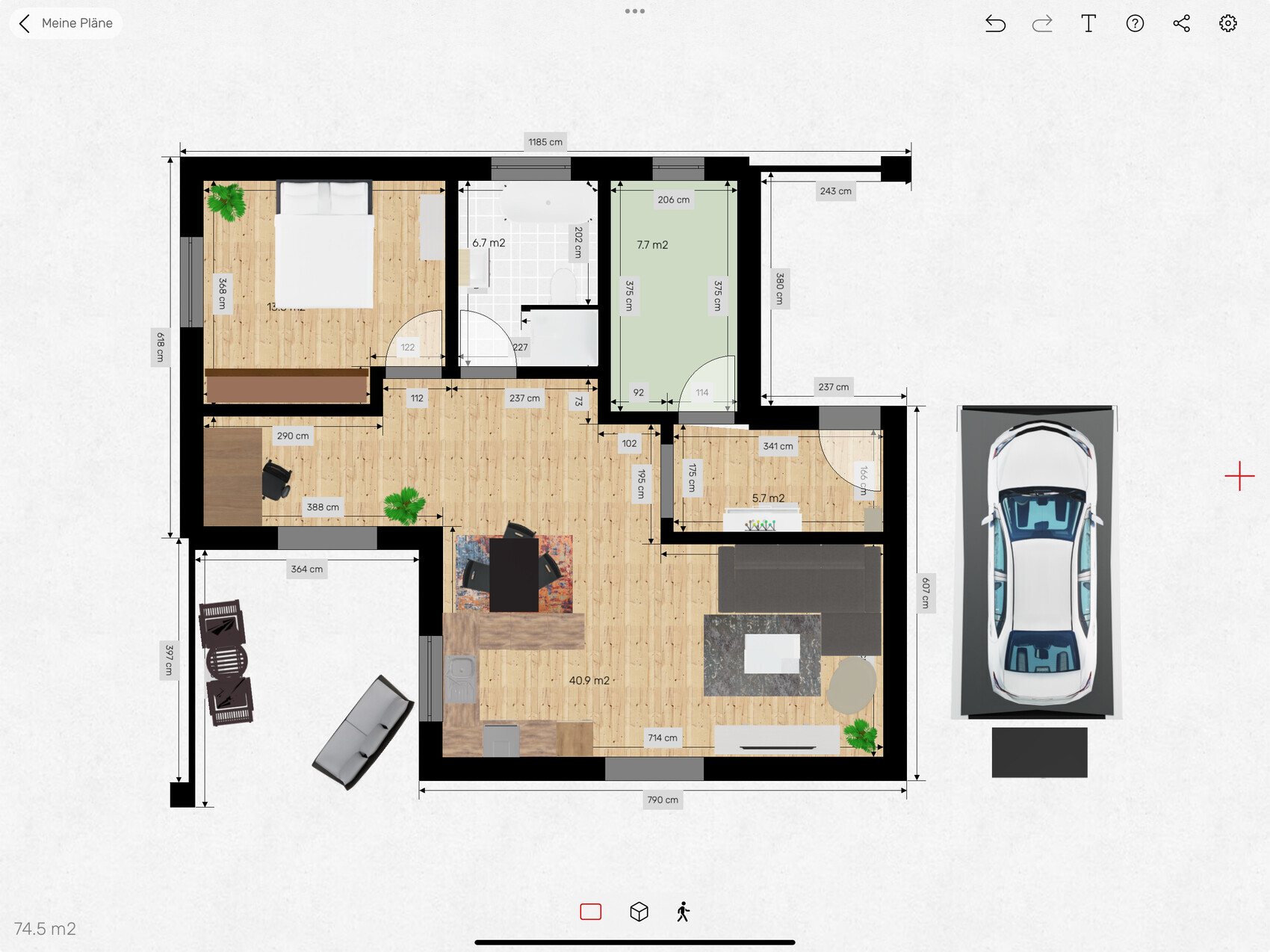
I’m only sharing them because I find it charming that there is already a roof over the terrace, but I can’t judge if that makes financial sense. With the staggered layout, I like the front entrance, which also has a covered area... However, the interior layout of both is not ideal...

Newbee-BW schrieb:
So, it seems there’s no way around involving an architect, right? I’m still undecided about that.
@11ant regarding this
Module A, dough proofing with softening setting – then things become clearer.
I would like to contact you by email. I just don’t have a clear direction in this whole process yet. Message received – did you get the answer too? (the clear direction is on the same page)
Newbee-BW schrieb:
No, it’s not absolutely necessary. I saw it on the Hanse Haus floor plan "Bungalow 80" and thought it was quite nice, because it’s something other than just straight lines. But it’s not a must-have. I think the way you implemented it fits well.
Newbee-BW schrieb:
Richard or George might actually move up to the attic temporarily for a trial. Richard is already 75 and would definitely need a proper staircase to get up there, while George Kluny is only 63.
https://www.instagram.com/11antgmxde/
https://www.linkedin.com/company/bauen-jetzt/
Nobody will laugh, why would they, since you are expressing your thoughts and wishes. In the end, you will have to decide for yourself what fits best. In the discussion section, it is more helpful to learn about the small details to better visualize the whole picture.
That was just one idea, and there are others, while the topic of the fireplace and its use could influence further decisions. It will always be warm if it’s well insulated, and even easier then. Almost any heating system can be adapted to the house, including meeting energy efficiency standards like KfW; it just has to fit your heating habits. But this can develop over time—first comes the floor plan.
Otherwise, the key people have understood you or at least what might work for you. Your active participation and apparent openness help a great deal.
We have a controlled mechanical ventilation system, but since it’s a two-story home, I would forget about manually ventilating—or would be too lazy to do so. If that’s different for you, then you wouldn’t need such a system. That’s exactly how it should be. You are the way you are, so you only need to buy what fits you.
I completely understand your approach regarding technology. That’s also why we opted for IR panels in addition. If one breaks, it can simply be reordered and clicked back in—done. Our local contractors were a nightmare, and I wanted to be as independent from them as possible in the future. The setup of the domestic hot water heat pump and the controlled ventilation was only done by continuous phone calls with the manufacturer and was set on “auto” mode, even though it was a specialized company.
I don’t think so. I believe that the experts on floor planning can help you enough so that you get the right layout for you. Your chosen builder can then address the rest or any concerns. Once the first drafts are rejected or crumpled up, it will become clearer how things will turn out in principle; it’ll work out.
The spot where the floor cushion is now could later become a table area, or maybe an option will emerge during kitchen planning as well.
The thread will develop naturally as your floor plan evolves. Your active involvement will lead to good results; unfortunately, not everyone understands that.
A first floor plan from @ypg has already been suggested. Your drafts will follow. After that, the journey begins—because people really enjoy helping.
Newbee-BW schrieb:
Your idea for the heating system sounds good too; I’m completely open to moving away from the standard air-to-water heat pump. It needs to suit the house (size). Unfortunately, I’m a bit sensitive to cold and like it warm. My comfort temperature starts at 23°C (73°F).
That was just one idea, and there are others, while the topic of the fireplace and its use could influence further decisions. It will always be warm if it’s well insulated, and even easier then. Almost any heating system can be adapted to the house, including meeting energy efficiency standards like KfW; it just has to fit your heating habits. But this can develop over time—first comes the floor plan.
Otherwise, the key people have understood you or at least what might work for you. Your active participation and apparent openness help a great deal.
We have a controlled mechanical ventilation system, but since it’s a two-story home, I would forget about manually ventilating—or would be too lazy to do so. If that’s different for you, then you wouldn’t need such a system. That’s exactly how it should be. You are the way you are, so you only need to buy what fits you.
I completely understand your approach regarding technology. That’s also why we opted for IR panels in addition. If one breaks, it can simply be reordered and clicked back in—done. Our local contractors were a nightmare, and I wanted to be as independent from them as possible in the future. The setup of the domestic hot water heat pump and the controlled ventilation was only done by continuous phone calls with the manufacturer and was set on “auto” mode, even though it was a specialized company.
Newbee-BW schrieb:
So there’s probably no way around hiring an architect, right? I’m still undecided about that.
I don’t think so. I believe that the experts on floor planning can help you enough so that you get the right layout for you. Your chosen builder can then address the rest or any concerns. Once the first drafts are rejected or crumpled up, it will become clearer how things will turn out in principle; it’ll work out.
The spot where the floor cushion is now could later become a table area, or maybe an option will emerge during kitchen planning as well.
The thread will develop naturally as your floor plan evolves. Your active involvement will lead to good results; unfortunately, not everyone understands that.
A first floor plan from @ypg has already been suggested. Your drafts will follow. After that, the journey begins—because people really enjoy helping.
Oops, I overlooked that aspect earlier:
The process doesn’t just mean a simple yes or no decision about hiring an architect, but often rather a “somewhat” approach. My house-building roadmap recommends definitely starting with “a bit of involvement,” meaning not signing a one-part architect contract that mandates the architect from design phase 1 through 8 all at once. Instead, you should pause and carefully consider your options at intervals. Whether and how to continue with the architect after that is explained more specifically in the “Reloaded” episodes following the foundational parts 1 to 5 of the roadmap.
Those following my suggestion first complete Module A with the architect and then — very importantly! — take the “dough rest” phase on their own. At the end of Module A, you have a preliminary design that you can use (with or without the architect, although in Hamburg, a planning permission exemption is reportedly legally required here) to submit a building pre-application to the municipality and also a first orientation inquiry (setting the course, with or without me) to a handful of providers.
Based on the responses from this course-setting phase, it becomes clear whether the project will stay within budget and whether, instead of often ending up as a futile effort, it might be more cost-effective in some cases to build with timber or masonry. So by now, you know whether the preliminary design should be further developed as timber or masonry. It’s helpful to know this before continuing with the planning. In the course-setting phase I conduct or recommend, participants also indicate whether and which proven house designs (standard model homes or individual-custom designs) from their portfolios resemble the preliminary design underlying the inquiry. The similarity mainly refers to fitting the same framework conditions (customer wishes, zoning regulations, etc.) and often also the building form.
At this point, you have the choice to make the current preliminary design (usually further developed by the same architect) or a proven alternative (also created by the architect or a planner from the builder/house manufacturer) the basis for your design. You will also have a clearer idea by now whether to commission the architect for the entire Module B or just design phase 3.
https://www.instagram.com/11antgmxde/
https://www.linkedin.com/company/bauen-jetzt/
Newbee-BW schrieb:
So, there’s no way around using an architect, right? I’m still unsure about this.
The process doesn’t just mean a simple yes or no decision about hiring an architect, but often rather a “somewhat” approach. My house-building roadmap recommends definitely starting with “a bit of involvement,” meaning not signing a one-part architect contract that mandates the architect from design phase 1 through 8 all at once. Instead, you should pause and carefully consider your options at intervals. Whether and how to continue with the architect after that is explained more specifically in the “Reloaded” episodes following the foundational parts 1 to 5 of the roadmap.
Those following my suggestion first complete Module A with the architect and then — very importantly! — take the “dough rest” phase on their own. At the end of Module A, you have a preliminary design that you can use (with or without the architect, although in Hamburg, a planning permission exemption is reportedly legally required here) to submit a building pre-application to the municipality and also a first orientation inquiry (setting the course, with or without me) to a handful of providers.
Based on the responses from this course-setting phase, it becomes clear whether the project will stay within budget and whether, instead of often ending up as a futile effort, it might be more cost-effective in some cases to build with timber or masonry. So by now, you know whether the preliminary design should be further developed as timber or masonry. It’s helpful to know this before continuing with the planning. In the course-setting phase I conduct or recommend, participants also indicate whether and which proven house designs (standard model homes or individual-custom designs) from their portfolios resemble the preliminary design underlying the inquiry. The similarity mainly refers to fitting the same framework conditions (customer wishes, zoning regulations, etc.) and often also the building form.
At this point, you have the choice to make the current preliminary design (usually further developed by the same architect) or a proven alternative (also created by the architect or a planner from the builder/house manufacturer) the basis for your design. You will also have a clearer idea by now whether to commission the architect for the entire Module B or just design phase 3.
https://www.instagram.com/11antgmxde/
https://www.linkedin.com/company/bauen-jetzt/
Similar topics