
ᐅ Cable sheath damaged, but cable core filling and conductor insulation remain intact.
Created on: 21 Nov 2024 12:34
T
Thilo1979T
Thilo197921 Nov 2024 12:34Yesterday, I chased channels into the sand-lime brick of an interior wall for the flush-mounted cables behind the sauna insulation and paneling that will soon be installed. At a distance from the flush-mounted boxes, where I no longer expected or was looking for any cables, I accidentally nicked the jacket of a NYM 3x1.5 cable over a short length (2cm (1 inch)).
The filler inside the cable is intact, as is the insulation of the individual conductors; the cut only scratched the cable jacket, so you can see the filler material (see picture).
Is this
a) a real problem because of possible chemical reactions between the filler/conductor insulation, the sand-lime brick, and moisture or the plaster I will use to seal the channel, which could damage the conductor insulation,
or
b) solely an issue from the point of view of electrical regulations such as VDE or our insurance, in case any cable problems ever arise in that area, since the cable jacket mainly provides mechanical protection in an otherwise dry environment but must remain intact according to the rules, or
c) both, or
d) neither?
If it is a problem, what would be a VDE-compliant solution?
I could detach the cable from the rest of the wall and apply heat shrink tubing at the damaged spot, or—more involved, since I would need to carve out some additional space—I could install a cable joint sleeve.
If anyone feels the need to give additional advice on electrical installations beyond my question: the electrician will see everything and will be the one to connect the sauna heater in the end. I just don’t want to bother him with questions every other day before then.
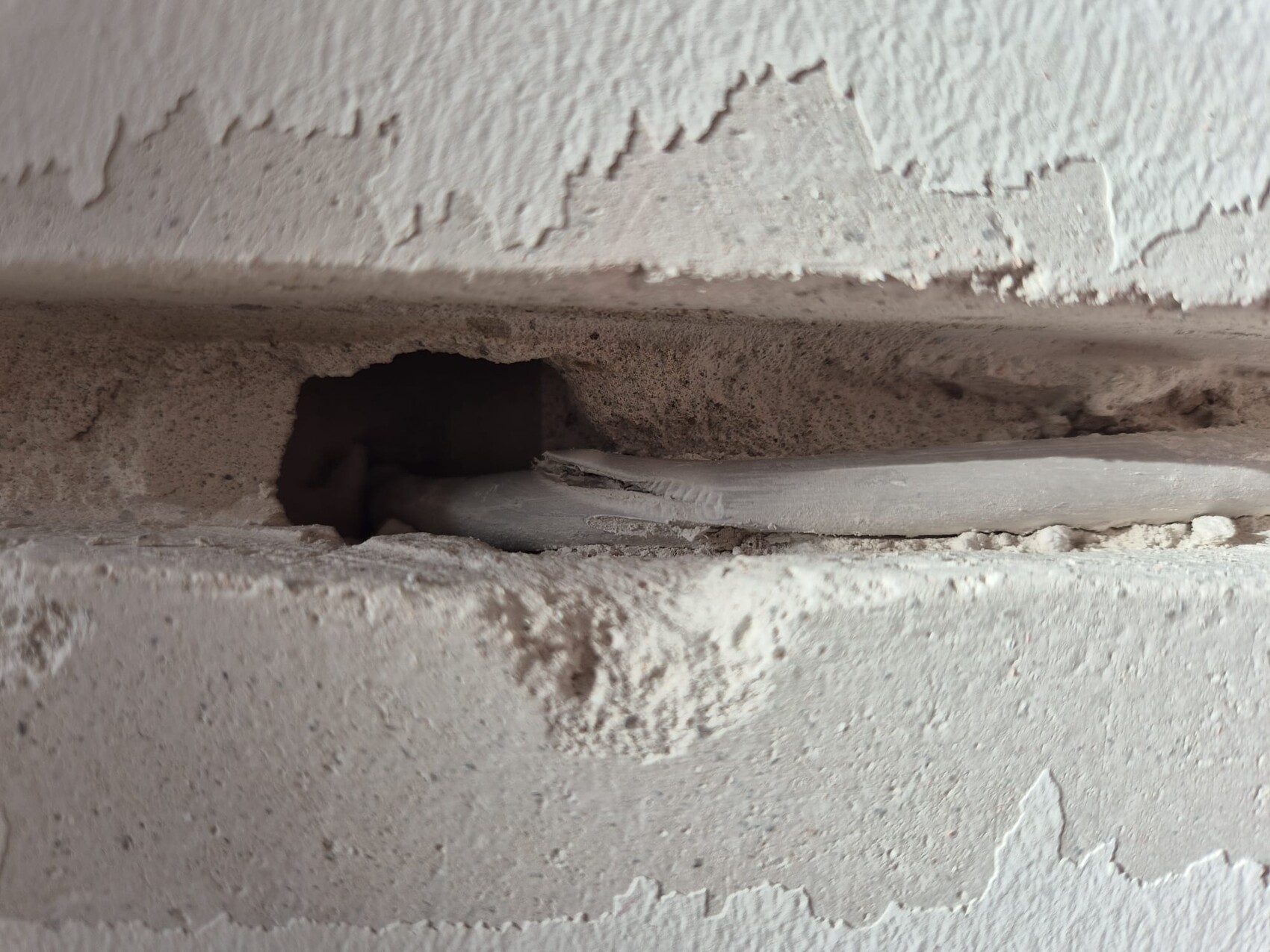
The filler inside the cable is intact, as is the insulation of the individual conductors; the cut only scratched the cable jacket, so you can see the filler material (see picture).
Is this
a) a real problem because of possible chemical reactions between the filler/conductor insulation, the sand-lime brick, and moisture or the plaster I will use to seal the channel, which could damage the conductor insulation,
or
b) solely an issue from the point of view of electrical regulations such as VDE or our insurance, in case any cable problems ever arise in that area, since the cable jacket mainly provides mechanical protection in an otherwise dry environment but must remain intact according to the rules, or
c) both, or
d) neither?
If it is a problem, what would be a VDE-compliant solution?
I could detach the cable from the rest of the wall and apply heat shrink tubing at the damaged spot, or—more involved, since I would need to carve out some additional space—I could install a cable joint sleeve.
If anyone feels the need to give additional advice on electrical installations beyond my question: the electrician will see everything and will be the one to connect the sauna heater in the end. I just don’t want to bother him with questions every other day before then.

M
MachsSelbst21 Nov 2024 23:16It’s impossible to say whether the wires inside are intact. Considering how deep the cut is in the rear area, it would be a miracle if at least one wire insulation wasn’t damaged. But ultimately, anything done now without replacing the damaged section is just poor workmanship.
It’s like showing a car mechanic a picture of a tire with a crack and asking if you can safely drive 200 miles per hour (320 km/h) for another five years on it. What do you expect them to say? Of course, they would say, “Buy a new tire; anything else is unprofessional.” They wouldn’t advise putting a bicycle patch on it.
Do you really want to risk a house fire just to save 50-100 euros by avoiding a proper repair?
It’s like showing a car mechanic a picture of a tire with a crack and asking if you can safely drive 200 miles per hour (320 km/h) for another five years on it. What do you expect them to say? Of course, they would say, “Buy a new tire; anything else is unprofessional.” They wouldn’t advise putting a bicycle patch on it.
Do you really want to risk a house fire just to save 50-100 euros by avoiding a proper repair?
M
MachsSelbst21 Nov 2024 23:35And I just can’t help myself... But imagine if that were a gas or water pipe that you scratched. You definitely wouldn’t consider just sticking a patch on it to fix it, right?
So why do people assume electrical work can be handled so casually, and that the electrical standards were created by overly cautious hypochondriacs who don’t trust their own shadow? What’s the reason for that?
There is a good reason for these rules, based on decades of experience and analysis of damage and fires...
So why do people assume electrical work can be handled so casually, and that the electrical standards were created by overly cautious hypochondriacs who don’t trust their own shadow? What’s the reason for that?
There is a good reason for these rules, based on decades of experience and analysis of damage and fires...
T
Thilo197929 Nov 2024 09:38MachsSelbst schrieb:
And I can't help myself... But just imagine if that were a gas or water pipe that you had scratched. You surely wouldn’t think of simply fixing it with a piece of tape, right?Actually, if I scratched any kind of patina or a purely cosmetic coating on a gas or water pipe, I probably wouldn’t even bother patching it with tape. That’s just how cautious I am.
It is clearly evident on-site that the conductors are not damaged, as not even the insulation filler is scratched. I also mentioned this explicitly, but apparently the German schoolmaster in you felt the need to lecture with pointless comparisons of apples and oranges, tires and cables—meaningless and unfortunate that you spent your time on such comments.
By the way, our electrician sees no issue at all with the scratch on the jacket, since no forces act on the cable at that spot, and would approve it as is. Still, since it was much easier to access both ends of the cable than I expected, I decided to replace it completely.
M
MachsSelbst29 Nov 2024 09:39You shouldn’t ask if you don’t like the answer and already believe you know better, even without being a professional.
Similar topics