
ᐅ Single-family house floor plan with basement, 150 sqm, only one single-story level permitted
Created on: 24 Nov 2024 13:20
G
GeraldG
Hello everyone,
we are approaching the final stage of the floor plan design and thought someone might take a look and provide some feedback.
What we wanted:
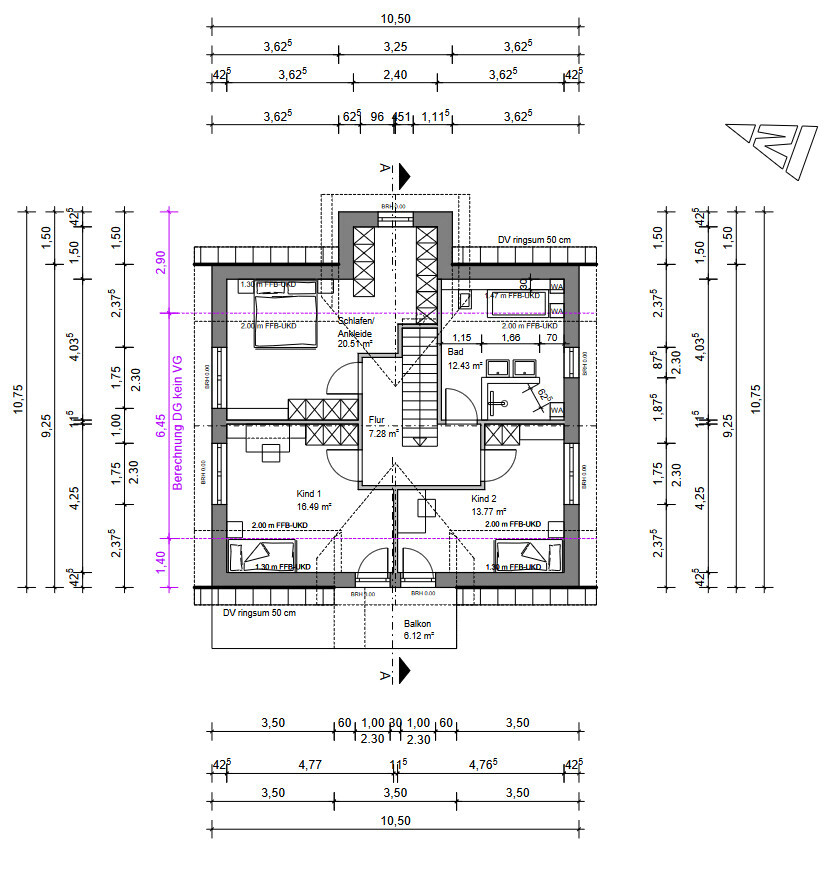
The house should be about 150-160 sqm (1,615-1,722 sq ft). Also, the attic level (according to the old development plan, i.e. the 2/3 rule in BW) must not count as a full story.
We actually like these Nordic-style houses with a central gable and also brick cladding, although we had to give up on the brick cladding because apparently no one here does it, and if they do, it’s incredibly expensive.
The architect advised us against a central bay window facing the garden because that would place one side of the terrace almost facing north.
Otherwise, we wanted a fairly classic layout:
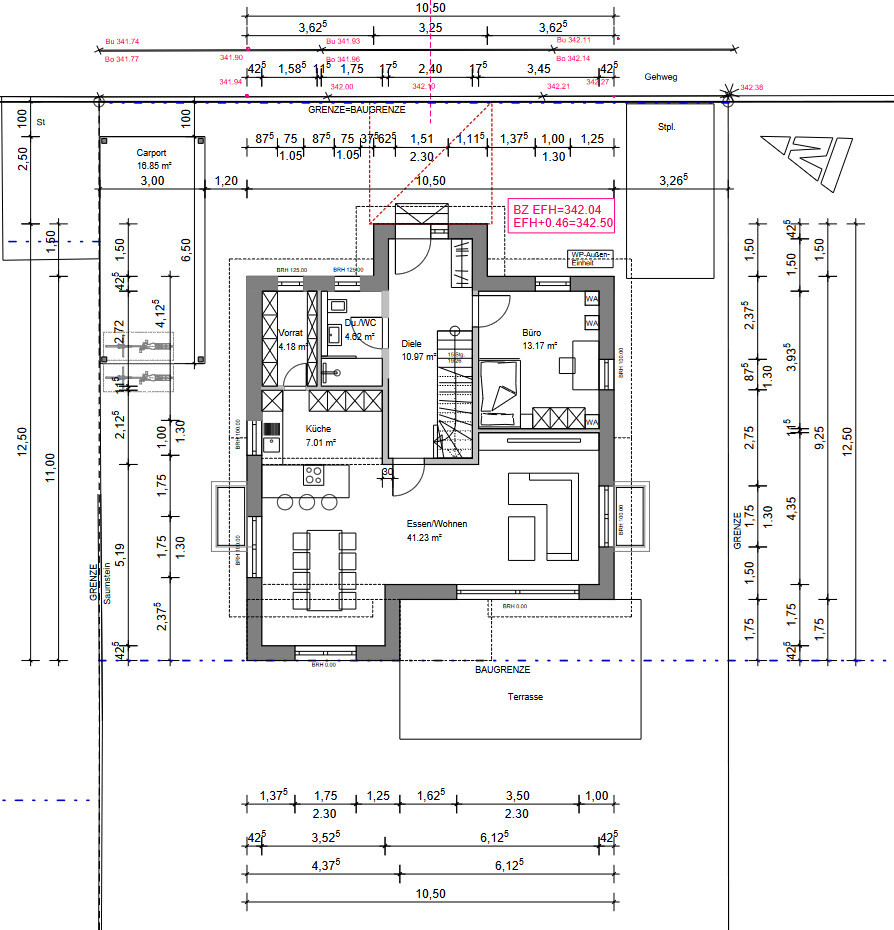
An open living/kitchen/dining area, plus a shower restroom and an office on the ground floor. The attic should have two children’s bedrooms and a master bedroom. If there is space, also a walk-in closet and a large bathroom. I also wanted the knee wall to be as high as possible.
In the current round, the attached floor plans were developed. We only want to make minor adjustments now, so I thought this would be a good time for others to take a look.
There are several proposals for a laundry chute on WhatsApp.
I would appreciate your feedback.
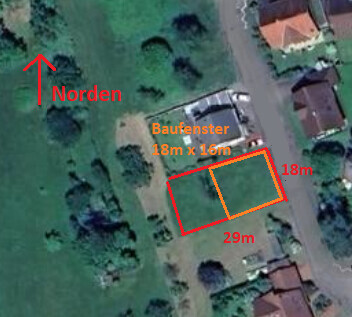
Plot:
Ground floor:
Attic:
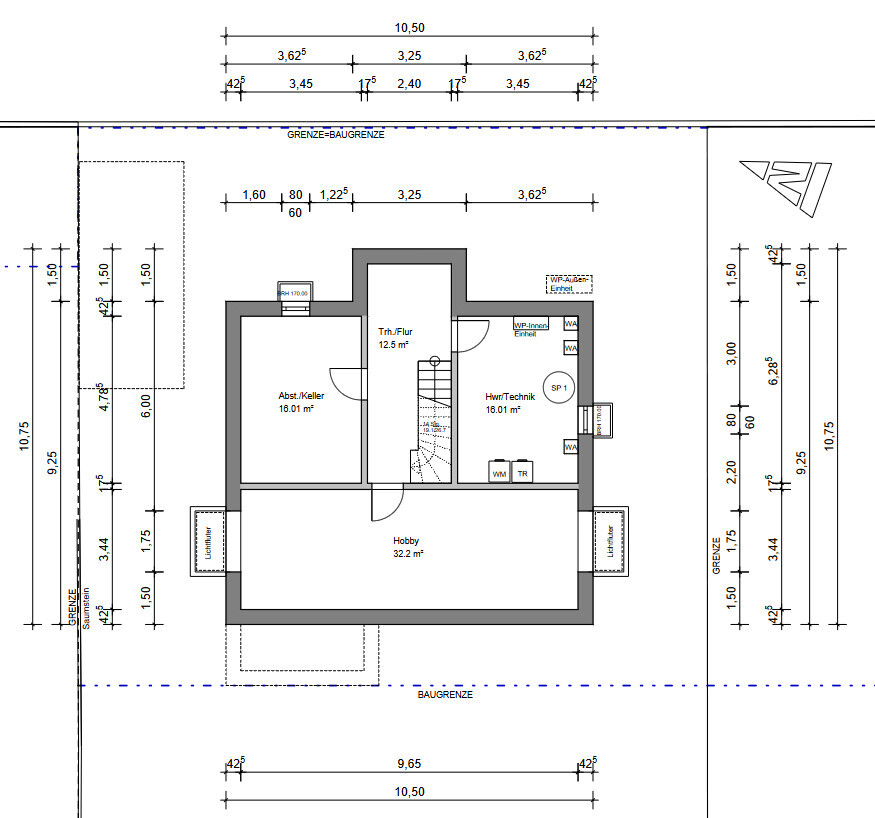
Basement:
3D views:
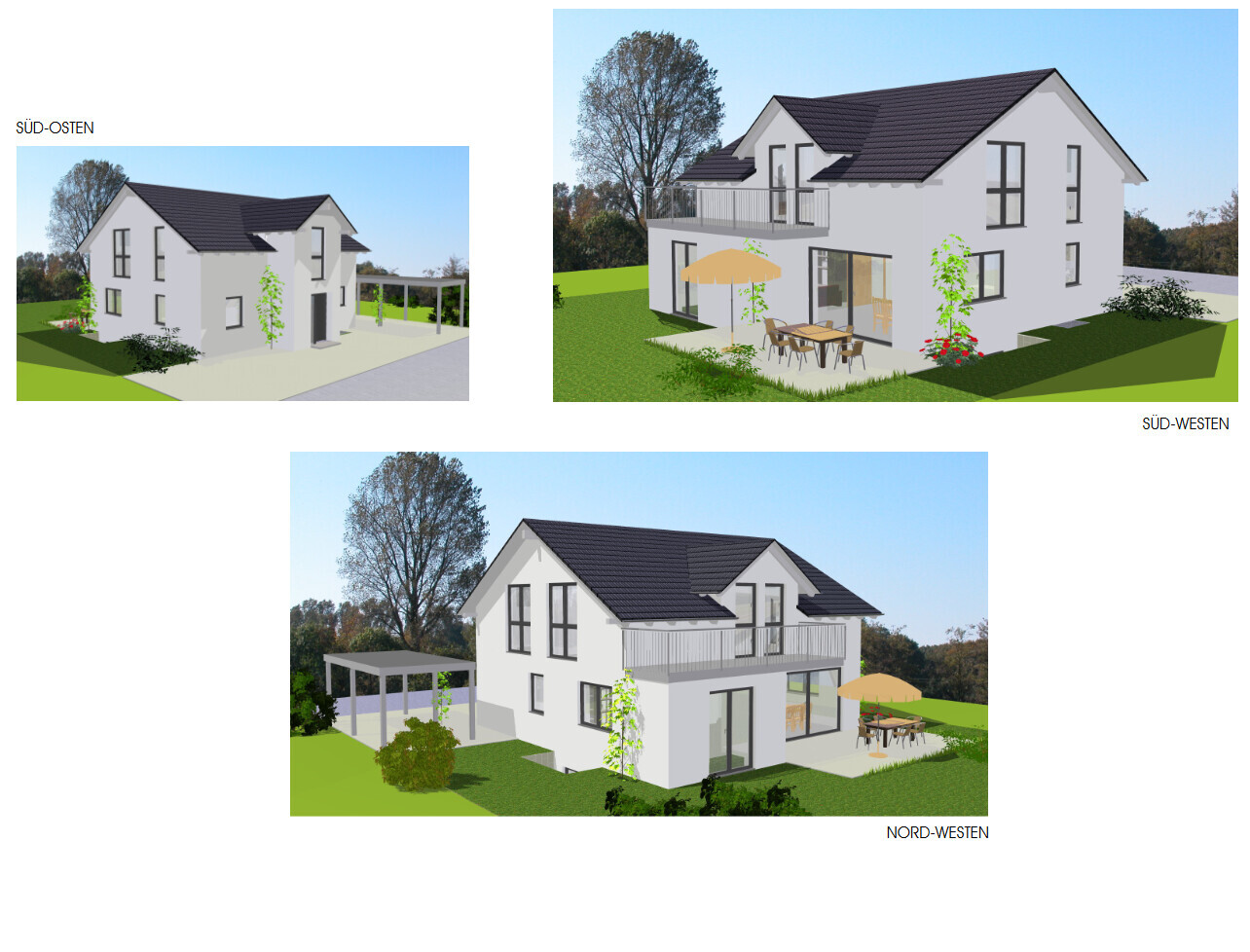
we are approaching the final stage of the floor plan design and thought someone might take a look and provide some feedback.
What we wanted:
The house should be about 150-160 sqm (1,615-1,722 sq ft). Also, the attic level (according to the old development plan, i.e. the 2/3 rule in BW) must not count as a full story.
We actually like these Nordic-style houses with a central gable and also brick cladding, although we had to give up on the brick cladding because apparently no one here does it, and if they do, it’s incredibly expensive.
The architect advised us against a central bay window facing the garden because that would place one side of the terrace almost facing north.
Otherwise, we wanted a fairly classic layout:
An open living/kitchen/dining area, plus a shower restroom and an office on the ground floor. The attic should have two children’s bedrooms and a master bedroom. If there is space, also a walk-in closet and a large bathroom. I also wanted the knee wall to be as high as possible.
In the current round, the attached floor plans were developed. We only want to make minor adjustments now, so I thought this would be a good time for others to take a look.
There are several proposals for a laundry chute on WhatsApp.
I would appreciate your feedback.
Plot:
Ground floor:
Attic:
Basement:
3D views:

GeraldG schrieb:
She somehow always fears that the rooms won’t be big enough. It’s hard to put into words because she tries to argue very much based on “feelings,” which I find difficult to relate to. Her spatial imagination is also quite limited, so I always have to show her examples to explain it. Female spatial imagination doesn’t work “worse,” just differently: men describe spaces using dimensions with coordinates and vectors, women by landmarks (not “turn east at the junction with Bahnhofstraße,” but rather “turn left behind the pharmacy”). My aunt can park head-in in half the time it takes me to back in, perfectly straight and without fuss. So it can’t be that “underdeveloped.” Get one of those silly colorful 3D apps—which I usually advise against for new house planning—and recreate your current apartment in it. Use real measurements of your actual furniture (fitting that in takes longer than drawing the whole place), then she will have a comparison between what she can feel and how it looks in a simulation. If she prefers a smartphone over a PC, choose a suitable app instead of a desktop version.
Arauki11 schrieb:
Lazy compromises between husband and wife are arguably the worst starting point for building a house. “Now the idiot is building us a new house with the same deficiencies—we could have just stayed in the old apartment.” Basically, you could invite the divorce lawyer to the topping-out ceremony already. No happy wife, no happy life; this stakeholder must be actively involved in the planning. Maybe the architect should be a female architect, and your wife even goes there alone while you are just represented by a list or something similar. @roteweste and his wife are very satisfied with Ms Forster (whom I somewhat recommend), even in an online consultation (which I strongly advise against). Maybe your wife could go alone and you join later by Zoom call.
GeraldG schrieb:
The reason “office” is in quotation marks is that although I’m officially supposed to plan my home office there, for her it’s already decided that things will be stored there that are often needed but not all the time. Certain shoes, thick winter jackets, the vacuum cleaner. Also, a cupboard for everything you might need on the ground floor. Sometimes we already call it the “utility room.” So broom closet I (“office”) and II (XL coat cupboard). Add those to the list right away. Maybe the “dressing room” goes on the ground floor due to the single-story design.
GeraldG schrieb:
That’s why I’m already planning my office in the basement. [...] As you can tell, my wife likes to store things somewhere without putting them in the basement. Sounds like a contradiction or conflict—you notice yourself, right?
GeraldG schrieb:
I already explained this. Two bathrooms in the house are clear. Currently one is on the ground floor and one upstairs. You could shift the second bathroom upstairs to free up space on the ground floor where the storage your wife planned for the dressing room could go—although then the dressing room wouldn’t exist anymore. So: family bathroom in the attic, plan for a shower upgrade in the guest WC for the teenage years. If the attic can legally count as an upper floor [planning permission / building permit status], add the option of a second bathroom upstairs to the list. You see: this can be overwhelming for a draftsman.
GeraldG schrieb:
As I have written several times, I’m first waiting to see what comes from Katja’s plan. Katja herself already mentioned that a “Plan A” relaunch is a more elegant solution.
K a t j a schrieb:
Well, I have the feeling that you don’t exactly know what you really want and need yet. But you want to go into the final phase without clarifying that first. That’s not good, to put it mildly. The list of must-haves and no-gos must be set. Otherwise, there will only be disappointment and trouble. The six lists (hers and his—must-haves, nice-to-haves, and no-gos) especially need to be included before the preliminary draft, not only iterated into the design afterward.
GeraldG schrieb:
Yes, in our company we call that the “requirements capture phase.” And as there, the client (here me/us) doesn’t know what they want unless someone experienced nudges them in the right direction. Then act as if you are your own client. Maybe your team wants to work on that together during lunch or after work.
K a t j a schrieb:
In this case, it’s really a shame you came here only now. The needs can be best discussed with other homeowners. But better now than too late. The restart can soon be discussed even from the first sketch.
Arauki11 schrieb:
Of course, a good independent architect could guide you through the project and give you the necessary security or act as a mediator between your wishes; a designer from a general contractor will often only implement it to a limited extent in your interest. A draftsman’s main job is to produce the ready-to-stamp paperwork. Concrete workers and masons won’t have downtime, subcontractors can follow in sequence. How long the clients stay married is not important to the construction company.
Arauki11 schrieb:
For example, we didn’t know where our favorite spots would be; now it’s our super-comfortable dining room sofa, and we hardly use the living room because everyone tends to find their own corner in the house to do their own thing. Also an interesting approach, not only relevant to this thread.
Arauki11 schrieb:
I really have the impression the basement was planned precisely because of this uncertainty—to serve as a placeholder for all sorts of things. But for that it is way too expensive and in the end it won’t bring the overall success hoped for, since a basement remains a basement and not sunny living space. Maybe you should find a trusted person with a clear view and sufficient rationality, at least once, to come up with a clear plan for everyday items like: actually needed indoor storage space for vacuum cleaner, brooms, cleaning supplies, step ladder, extra kitchen appliances, suitcases, etc., plus a buffer for each, but not necessarily ending up in a possibly six-figure basement. Maybe a nice, dry garden shed could cover many of these needs for much less money. I fully agree with the impression concerning the basement as well as the suggestion.
Arauki11 schrieb:
I wouldn’t do that because you have guests or strangers in the house who shouldn’t access the upper floor, but an extra WC upstairs connected to the bathroom for shared plumbing could make sense with growing children. A staircase doesn’t necessarily have to be placed between family and guest bathrooms, yes.
Arauki11 schrieb:
If she doesn’t want to change that, then let her plan the utility room on the ground floor as she needs it. Then that is one of the fixed requirements for a planner to include exactly such a room on the ground floor. And [...] if it then results in a bay window, great—but not the other way around. The house must work internally for the residents, so I would proceed like that and then see what options arise. With the money not wasted on a diffuse basement, you could visit the captain’s bay windows more often in person. And in the garden, a path paved with bricks leads to the Friesenwall raised bed.
https://www.instagram.com/11antgmxde/
https://www.linkedin.com/company/bauen-jetzt/
GeraldG schrieb:
I also find a bay window "for practical reasons" generally difficult to imagine. I suspect they are usually built mainly for aesthetic purposes. P.S., the two main reasons for bay windows (sometimes both at once) are:
1. due to the total length of a straight, single-flight staircase and an extendable dining table, the floor plan is forced to "carry the clients’ wishes with the hatch wide open";
2. the desire for a captain-gable “Frisian” style (and on the upper floor, dormer windows with desks for the children, standing height in the dressing room or similar).
Additionally, providers of “suburban villa” style houses often market the problem of not being able to fit the entire ground floor layout into a square as a cleverly varied building form. They unfortunately consider their clientele to be very naive.
https://www.instagram.com/11antgmxde/
https://www.linkedin.com/company/bauen-jetzt/
So – I have now read many different and extremely helpful tips from several other original posters. One suggestion is to take your time and read through the forum threads related to similar building projects; especially in the older posts, you’ll find detailed discussions that mostly describe situations like yours. From these, if you feel uncertain, you can draw your own conclusions. Taking the time to do this is invaluable!
If your development plan allows it (I’m not very familiar with that), I would definitely recommend skipping a basement in your case and instead realize the necessary space above ground, where there is natural light and you can avoid unnecessary stairs. This also lets you better plan for the expected change in needs as children grow older. No one wants to live in a basement; the access is usually narrow, dark, and building it unnecessarily expensive.
I know that would set your planning back to square one, but as you’ve read several times, this is strongly advised anyway. Of course, you may not want to postpone your project and finally get started, but waking up to such issues later is very frustrating and would be a shame.
Having an initial draft created within the permitted conditions shouldn’t be a real problem. If you had a slope or another circumstance that requires a basement, I would understand, but otherwise, I think it would be a waste of money that could be put to good use above ground.
If I were the husband reaching this solid conclusion (as I have here), I would insist on it and then address the understandable needs of the wife—not out of stubbornness, but because I would have thoroughly and deeply considered it… right here in this forum.
A neighbor of ours, for example, built a basement on a flat field. When asked why, he justified it with potatoes that store better in the dark and smiled about cooler beer. However, it’s obvious that he ran out of financial resources in several parts of the house itself. I’m definitely not comparing you to him and this is an extreme example, but in the end, he said you just always had a basement. I have had houses with basements but would always prefer a single-level layout for comfort and usability reasons. In the new house, we don’t have a basement but a large carport with an attached “shed” for the lawnmower, storage, tools, buckets, wood, and so on.
If your development plan allows it (I’m not very familiar with that), I would definitely recommend skipping a basement in your case and instead realize the necessary space above ground, where there is natural light and you can avoid unnecessary stairs. This also lets you better plan for the expected change in needs as children grow older. No one wants to live in a basement; the access is usually narrow, dark, and building it unnecessarily expensive.
I know that would set your planning back to square one, but as you’ve read several times, this is strongly advised anyway. Of course, you may not want to postpone your project and finally get started, but waking up to such issues later is very frustrating and would be a shame.
Having an initial draft created within the permitted conditions shouldn’t be a real problem. If you had a slope or another circumstance that requires a basement, I would understand, but otherwise, I think it would be a waste of money that could be put to good use above ground.
If I were the husband reaching this solid conclusion (as I have here), I would insist on it and then address the understandable needs of the wife—not out of stubbornness, but because I would have thoroughly and deeply considered it… right here in this forum.
A neighbor of ours, for example, built a basement on a flat field. When asked why, he justified it with potatoes that store better in the dark and smiled about cooler beer. However, it’s obvious that he ran out of financial resources in several parts of the house itself. I’m definitely not comparing you to him and this is an extreme example, but in the end, he said you just always had a basement. I have had houses with basements but would always prefer a single-level layout for comfort and usability reasons. In the new house, we don’t have a basement but a large carport with an attached “shed” for the lawnmower, storage, tools, buckets, wood, and so on.
Arauki11 schrieb:
One of our neighbors, for example, built a cellar on a flat meadow. When asked why, he justified it by saying that potatoes can be stored better in the dark [...]. An earth cellar like the one @Steffi33 has is a great solution.
https://www.instagram.com/11antgmxde/
https://www.linkedin.com/company/bauen-jetzt/
Regarding the larger house, I unfortunately have to say that it is not possible due to the Z15 subsidy. This limits the living area to 160 sqm (1,722 sq ft). Since the basement does not count towards this, it is a practical extension for us. A larger house without a basement and without the subsidy would be significantly more expensive for us than a 150 sqm (1,615 sq ft) house with a basement.
I really like the idea of an earth cellar. I wasn’t familiar with the term, but I would like to build one adjacent to our basement, which, however, will be fully heated and insulated.
I really like the idea of an earth cellar. I wasn’t familiar with the term, but I would like to build one adjacent to our basement, which, however, will be fully heated and insulated.

GeraldG schrieb:
Regarding the larger house, unfortunately, that's not possible due to the Z15 subsidy. It caps living space at 160 sqm (1720 sq ft). Since the basement does not count towards this, it serves as a practical extension for us. A bigger house without a basement and without the subsidy would be significantly more expensive for us than a 150 sqm (1615 sq ft) house with a basement. Why not go right up to the 160 sqm (1720 sq ft) limit? With your needs, that should be quite feasible with good planning.
Similar topics