
ᐅ Single-family house floor plan with basement, 150 sqm, only one single-story level permitted
Created on: 24 Nov 2024 13:20
G
GeraldG
Hello everyone,
we are approaching the final stage of the floor plan design and thought someone might take a look and provide some feedback.
What we wanted:
The house should be about 150-160 sqm (1,615-1,722 sq ft). Also, the attic level (according to the old development plan, i.e. the 2/3 rule in BW) must not count as a full story.
We actually like these Nordic-style houses with a central gable and also brick cladding, although we had to give up on the brick cladding because apparently no one here does it, and if they do, it’s incredibly expensive.
The architect advised us against a central bay window facing the garden because that would place one side of the terrace almost facing north.
Otherwise, we wanted a fairly classic layout:
An open living/kitchen/dining area, plus a shower restroom and an office on the ground floor. The attic should have two children’s bedrooms and a master bedroom. If there is space, also a walk-in closet and a large bathroom. I also wanted the knee wall to be as high as possible.
In the current round, the attached floor plans were developed. We only want to make minor adjustments now, so I thought this would be a good time for others to take a look.
There are several proposals for a laundry chute on WhatsApp.
I would appreciate your feedback.
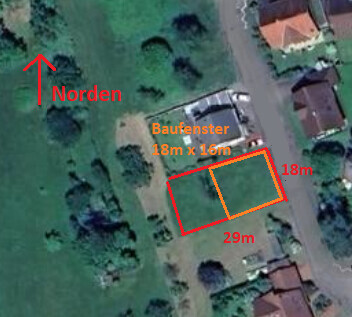
Plot:
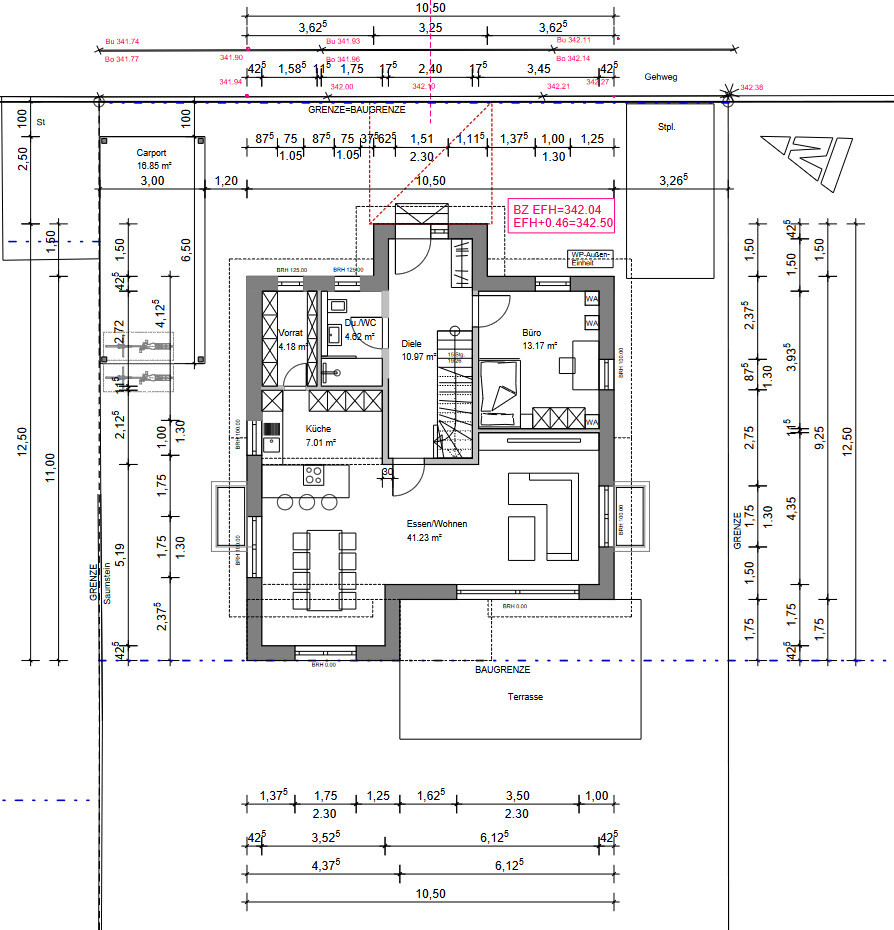
Ground floor:
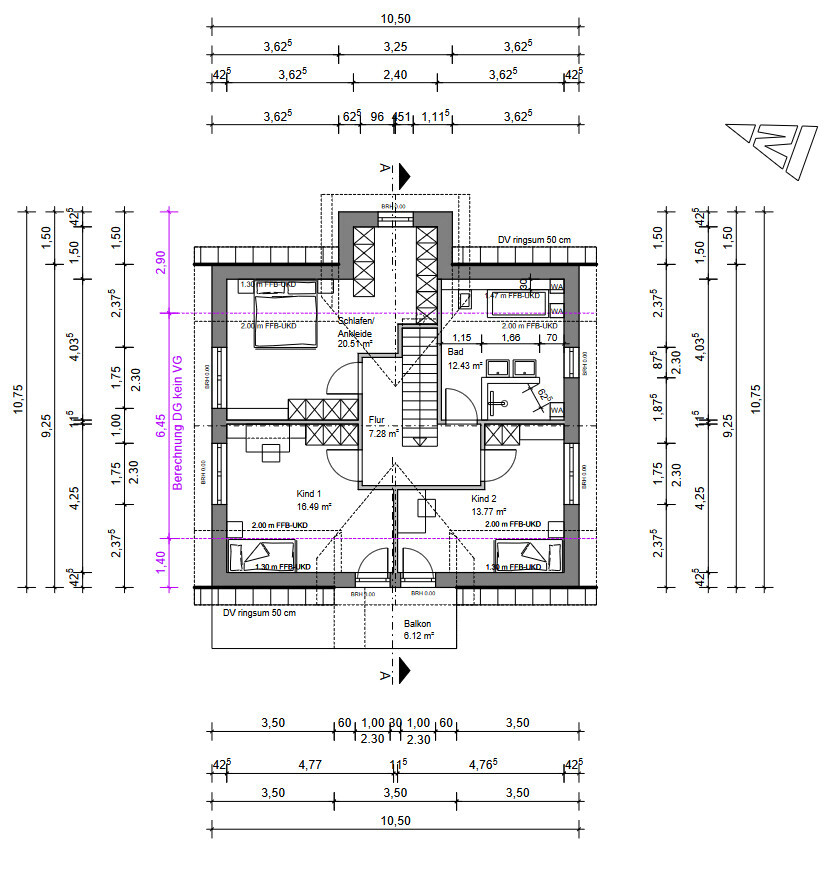
Attic:
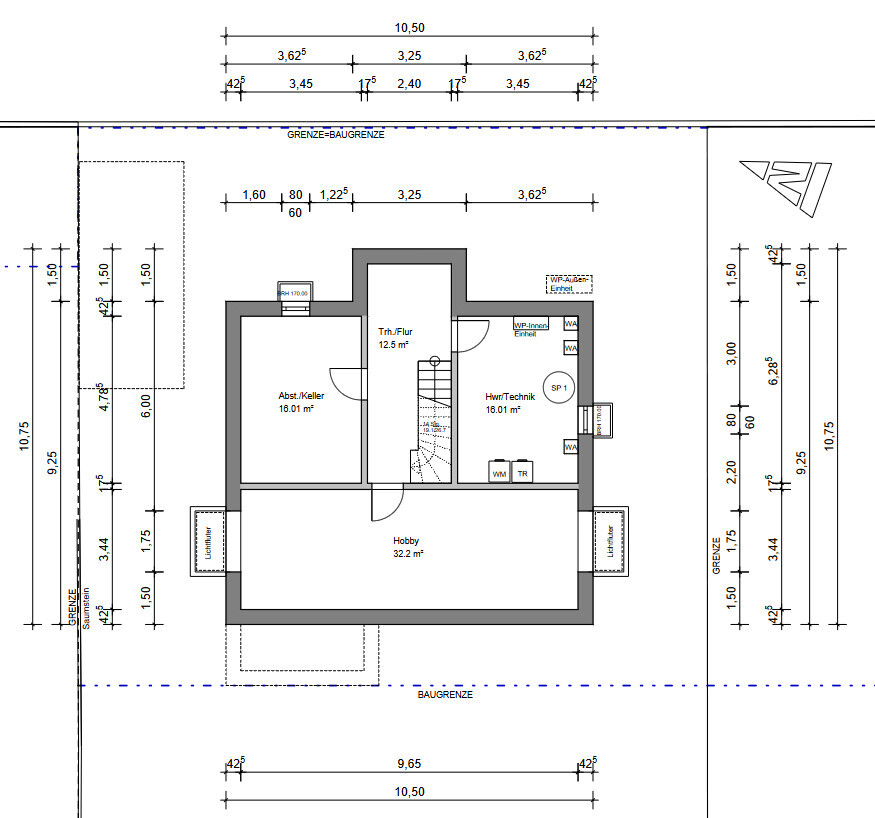
Basement:
3D views:
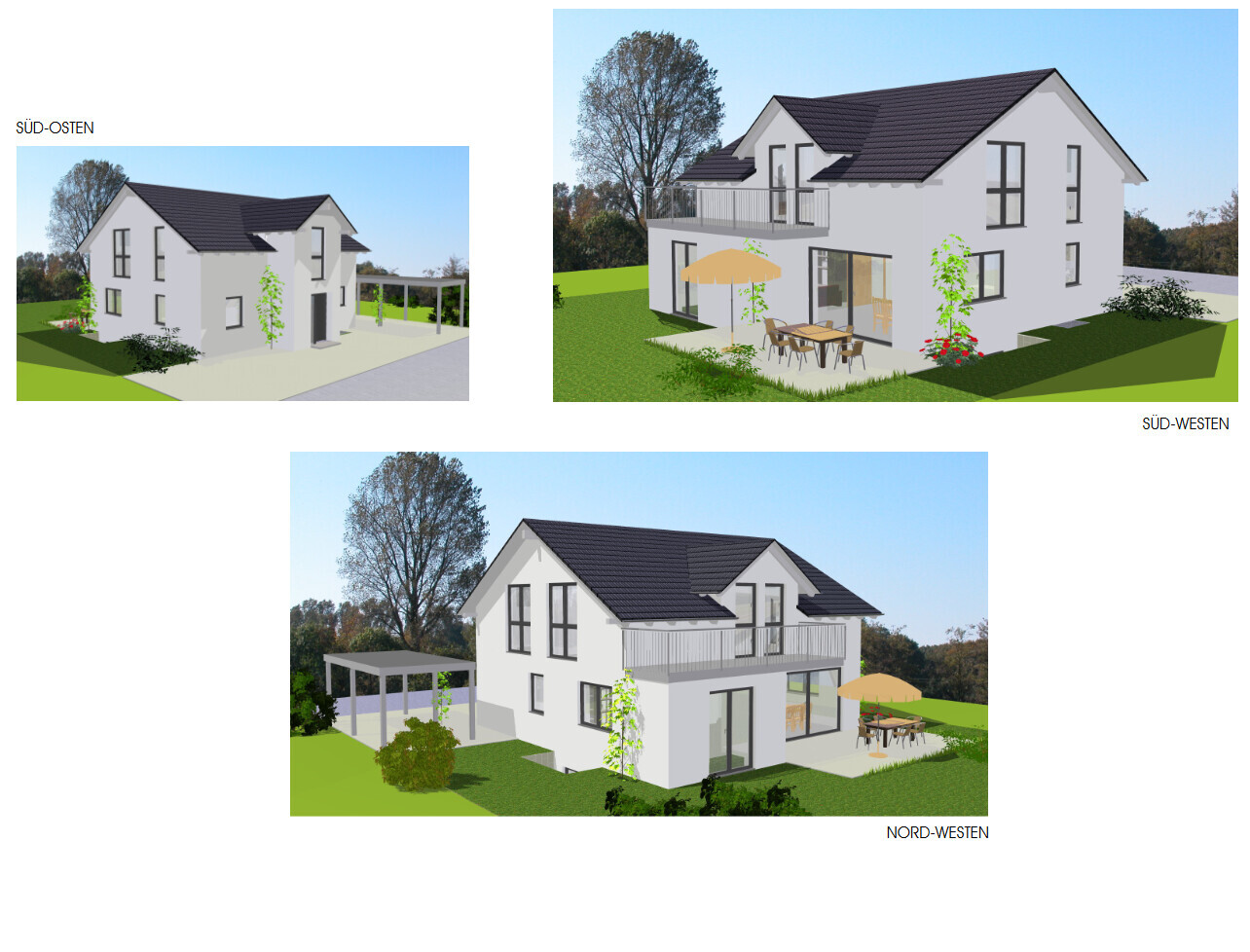
we are approaching the final stage of the floor plan design and thought someone might take a look and provide some feedback.
What we wanted:
The house should be about 150-160 sqm (1,615-1,722 sq ft). Also, the attic level (according to the old development plan, i.e. the 2/3 rule in BW) must not count as a full story.
We actually like these Nordic-style houses with a central gable and also brick cladding, although we had to give up on the brick cladding because apparently no one here does it, and if they do, it’s incredibly expensive.
The architect advised us against a central bay window facing the garden because that would place one side of the terrace almost facing north.
Otherwise, we wanted a fairly classic layout:
An open living/kitchen/dining area, plus a shower restroom and an office on the ground floor. The attic should have two children’s bedrooms and a master bedroom. If there is space, also a walk-in closet and a large bathroom. I also wanted the knee wall to be as high as possible.
In the current round, the attached floor plans were developed. We only want to make minor adjustments now, so I thought this would be a good time for others to take a look.
There are several proposals for a laundry chute on WhatsApp.
I would appreciate your feedback.
Plot:
Ground floor:
Attic:
Basement:
3D views:

Well, I have the feeling that you’re not quite sure yet what you really want and need. But you want to go ahead with the final stage without clarifying that first. That’s not a good approach, to put it mildly. The list of must-haves and deal-breakers needs to be clearly defined. Otherwise, it will only lead to disappointment and problems.
K a t j a schrieb:
Well, I have the feeling that you still don’t really know what you want and need. Yes, in our company we call this the "Requirements Capture Phase." And just like there, the customer (in this case me/us) doesn’t know what they want unless someone knowledgeable guides them in the right direction.
For us, it’s difficult because we have never lived in a house of our own and have always adapted to the apartment where we have lived for 12 years. We simply don’t have enough experience. I also don’t see a way to figure it out without actually living in a house. The uncertainty about the future (what will the children need when they get older?) remains.
I have tried to answer all the questions that came up as honestly as possible (which I hope is clear).
We are probably also the type that thinks “next time I’ll do it differently,” but at this point, I don’t have any more information than what I have already shared.
Dear @GeraldG, thank you for your open reply! With my sometimes exaggerated remarks, I certainly don’t want to upset you but rather encourage you to think about this as well.
The "problem" seems to be that you have not yet found a shared requirements plan. In that respect, I agree with @K a t j a that it is both fundamental and "risky" to start finalizing things already. Stress and frustration during construction are almost inevitable, and if mutual disagreements are added, the pressure can quickly become overwhelming.
I am the type of person who relies on intuition and always needs to visualize things, so I look closely at details like stairs, distances, heights, etc., to be able to decide for myself. Of course, a good independent architect could guide you through the project and provide the necessary reassurance or act as a mediator between your ideas; a planner working for a general contractor will often only implement things to a limited extent according to your needs.
However, nobody can take away from you the genuine exploration of your needs. I understand this is your first house—many have been in that position—and even with multiple projects behind us, there are always things that cannot be predicted or imagined beforehand.
For example, we didn’t know where our favorite spots would be; it has become our super-comfortable dining room couch, and we barely use the living room because everyone tends to find their own corner in the house to do their own thing. You are a family with children, so it does make sense that everyone can have their own nice place.
That will also change once you live in the house, but creating a lot of space from the start just to cover all possibilities is not advisable. That’s what I meant with the "broom closet" example. A nice tall cabinet, for example in the walk-in closet or bathroom, can hold all that and doesn’t require a separate room with door, walls, electrical installation, and planning. Or the broom closet becomes a utility room with the washing machine, storage, and so on—then a separate room makes sense.
You are not alone with that, and anyone here who is self-critical enough could tell you about their own mistakes during building.
I really get the impression here that the basement was planned exactly for this reason: as a placeholder for all kinds of things. But it is far too expensive for that and in the end doesn’t deliver the overall success hoped for, since a basement remains a basement and will not become a sunny living area. Maybe you could find a trusted person with a clear head and enough reason to at least create a clear plan for everyday needs such as actually required indoor storage space for vacuum cleaners, brooms, cleaning supplies, step ladder, extra kitchen appliances, suitcases, and so on, plus a buffer—but that doesn’t necessarily have to result in a possibly six-figure basement. Maybe a nice dry garden shed could fulfill many of these needs at much lower cost.
I wouldn’t do that, because you have guests or occasional visitors in the house who shouldn’t be upstairs, but having an additional toilet connected to the upper floor bathroom could make sense with growing children due to shared plumbing.
Everyone feels that way, so a plan or structure can help at least to be as prepared as possible for the unknown. You can create sufficiently large rooms and then discipline yourself to manage with them. More space and fuller is always possible. So you could base it on the current amount of clothing, etc., plus a small buffer. But you and your wife will not need to have double the amount of clothes that you have now.
If she does not change or want to change that, then she should plan this multipurpose room on the ground floor according to her needs. That is then a fixed requirement for a planner: to include exactly such a room on the ground floor. And the same applies to your office... Step by step, room by room, firmly establish the actual needs, then maybe some of these knots will loosen.
These must-haves—such as a multipurpose room, possibly a small extra toilet on the upper floor, your office really as an office plus a fold-out bed for occasional overnight guests, sufficient practical seating in the kitchen/dining area for the often present extended family, a tall cabinet in the bathroom or walk-in closet for vacuum cleaner, cleaning supplies, buckets, etc.—I would gradually write into my “requirements list” and if a bay window or similar feature emerges from that, that’s nice, but not the other way around. The house must work internally for the residents; I would proceed this way and then see what options arise.
The "problem" seems to be that you have not yet found a shared requirements plan. In that respect, I agree with @K a t j a that it is both fundamental and "risky" to start finalizing things already. Stress and frustration during construction are almost inevitable, and if mutual disagreements are added, the pressure can quickly become overwhelming.
I am the type of person who relies on intuition and always needs to visualize things, so I look closely at details like stairs, distances, heights, etc., to be able to decide for myself. Of course, a good independent architect could guide you through the project and provide the necessary reassurance or act as a mediator between your ideas; a planner working for a general contractor will often only implement things to a limited extent according to your needs.
However, nobody can take away from you the genuine exploration of your needs. I understand this is your first house—many have been in that position—and even with multiple projects behind us, there are always things that cannot be predicted or imagined beforehand.
For example, we didn’t know where our favorite spots would be; it has become our super-comfortable dining room couch, and we barely use the living room because everyone tends to find their own corner in the house to do their own thing. You are a family with children, so it does make sense that everyone can have their own nice place.
GeraldG schrieb:
We are not familiar enough with that. I also see no way to figure it out without actually living in a house. The uncertainty of the future (what will the children need when they grow older?) remains.
That will also change once you live in the house, but creating a lot of space from the start just to cover all possibilities is not advisable. That’s what I meant with the "broom closet" example. A nice tall cabinet, for example in the walk-in closet or bathroom, can hold all that and doesn’t require a separate room with door, walls, electrical installation, and planning. Or the broom closet becomes a utility room with the washing machine, storage, and so on—then a separate room makes sense.
GeraldG schrieb:
We are probably also the "next time I’ll do it differently" type,
You are not alone with that, and anyone here who is self-critical enough could tell you about their own mistakes during building.
I really get the impression here that the basement was planned exactly for this reason: as a placeholder for all kinds of things. But it is far too expensive for that and in the end doesn’t deliver the overall success hoped for, since a basement remains a basement and will not become a sunny living area. Maybe you could find a trusted person with a clear head and enough reason to at least create a clear plan for everyday needs such as actually required indoor storage space for vacuum cleaners, brooms, cleaning supplies, step ladder, extra kitchen appliances, suitcases, and so on, plus a buffer—but that doesn’t necessarily have to result in a possibly six-figure basement. Maybe a nice dry garden shed could fulfill many of these needs at much lower cost.
GeraldG schrieb:
You can move the second bathroom to the upper floor,
I wouldn’t do that, because you have guests or occasional visitors in the house who shouldn’t be upstairs, but having an additional toilet connected to the upper floor bathroom could make sense with growing children due to shared plumbing.
GeraldG schrieb:
It’s hard to know what the next twenty years will bring. I know what I know but not what I don’t know.
Everyone feels that way, so a plan or structure can help at least to be as prepared as possible for the unknown. You can create sufficiently large rooms and then discipline yourself to manage with them. More space and fuller is always possible. So you could base it on the current amount of clothing, etc., plus a small buffer. But you and your wife will not need to have double the amount of clothes that you have now.
GeraldG schrieb:
As you noticed, my wife tends to store things somewhere without putting them in the basement,
If she does not change or want to change that, then she should plan this multipurpose room on the ground floor according to her needs. That is then a fixed requirement for a planner: to include exactly such a room on the ground floor. And the same applies to your office... Step by step, room by room, firmly establish the actual needs, then maybe some of these knots will loosen.
These must-haves—such as a multipurpose room, possibly a small extra toilet on the upper floor, your office really as an office plus a fold-out bed for occasional overnight guests, sufficient practical seating in the kitchen/dining area for the often present extended family, a tall cabinet in the bathroom or walk-in closet for vacuum cleaner, cleaning supplies, buckets, etc.—I would gradually write into my “requirements list” and if a bay window or similar feature emerges from that, that’s nice, but not the other way around. The house must work internally for the residents; I would proceed this way and then see what options arise.
GeraldG schrieb:
I also don’t see any way to figure that out without actually living in a house. There’s a saying for a reason: “The first house you build is for your enemy, the second for your friend,” and so on.
But ultimately, that saying doesn’t always apply, because often the first house fits your needs, although they change over time. Also, some things aren’t important in a young family. Only when life becomes quieter and you get used to children, family, and more than just your partnership, do you start improving and rearranging—and that’s often when dissatisfaction with the house begins. But one shouldn’t forget that by then, usually 10 years have passed.
GeraldG schrieb:
I imagine a bay window “for practical reasons” is generally tricky. I suspect they’re mostly built for aesthetic reasons. A bay window is often built to create standing height in the middle of the roof area for a centrally located room in the attic.
Or it’s used to bring daylight into the center of the roof by placing windows there (as can be seen in your design).
GeraldG schrieb:
As you noticed, my wife likes to store things somewhere without taking them down to the basement. I completely understand wanting to store things where you actually use them. That’s why many nowadays opt against a basement because leaving the space unused—except for technical equipment—is not justified.
Maybe you should consider integrating the basement more into your planning if you can’t do without it.
For me, given your needs, it wouldn’t be necessary. While you want to accommodate a hobby room or office there, you shouldn’t forget that with a single-story house and a pitched roof, you still have nice attic space that could be developed. Lawn mowers and outdoor equipment are usually stored on the ground floor, ideally in a shed, so you don’t have to use stairs for those items. You can easily get two or more rooms in the attractive attic space without having to install artificial light shafts on the house. Enlarging the ground floor footprint can relieve a lot of pressure.
But if you don’t want to do without a basement, then include it properly in the house planning instead of thinking “it doesn’t matter, we’ll just fit an office in there.”
I really don’t see any reason to stress over the zoning or building regulations here. Why bother? Only if you definitely want to build a town villa. For me, a pitched roof house, even as a single story, offers many more advantages than a two-story house.
Regarding your current design on page 1:
The problem is the staircase. Because it’s pushed forward, a bottleneck is created towards the back (southwest). It’s not enough space for a dining area if there are still doors in the hallway. The hallway in turn isn’t sufficient for a proper wardrobe and access to the pantry. You can twist and turn it, but it doesn’t work. Even worse in the upper floor, where roof slopes reduce the standing area. If you build 20sqm (215 sq ft) larger and include a walk-in closet, things would improve somewhat. But this is not an invitation to add needs just to make it fit.
Most houses with a central bay window by the entrance have the staircase right at the door. This opens up the living space and the upper floor area is often used to bring daylight into the hallway. Everything has its pros and cons.
Regarding Nordic style: classic Nordic houses have little or no significant knee wall and often have roof pitches above 42 degrees. Just as a side note.
Tip: Read through the floor plan discussions here in the forum. (“Long and narrow” you can skip.) Look at the arguments and needs of others here. Sit together over the weekend and write down your needs, then develop your room program.
Ask yourselves on which floor what is best and most practical to place.
Not everything is always feasible.
Regarding storage: don’t plan small clutter corners everywhere but rather a central cupboard space. Of course, it is “allowed” to keep a closet with seasonal clothing in the office, but using that room as a passage and large storage room, thereby losing its purpose, is wrong. Then you should name it accordingly so that what you’re planning becomes clear.
Right now, it looks like none of the rooms have a clear function.
Always draw the furniture arrangements yourself with a pencil. That’s what the architect’s plans are for!
There was something else, but I forgot it.
Similar topics