
ᐅ Proper Adjustment of the Heat Pump in Combination with a Wood Stove
Created on: 22 Nov 2024 16:55
T
Thomas.WHello everyone,
I have a question regarding an efficient control system for my heat pump. Here is my situation:
We have a newly built house with only underfloor heating and a heat pump from Ait (LWD 70A), plus a 10 kW water-driven wood stove and a 1000L (264 US gallons) buffer tank.
Both systems work perfectly fine. However, I want to optimize the settings between the two systems. The goal is to use the wood stove as much as possible for heating and domestic hot water and use the heat pump as little as possible.
The control is quite simple to begin with. If the buffer reaches a domestic hot water temperature of 51°C (124°F), the heat pump does not start. For the heating circuit, it is not that straightforward since it depends on the outside temperature (at least that’s my understanding). Usually, I light the stove around 4 p.m. and it burns until about 10:30 p.m.
When the outdoor temperature was still mild a few days ago, that was enough to keep things comfortable until the same time the next day. But over the last weeks, the situation changed, and the heat pump runs way too often. Of course, I could light the stove earlier, but I’m at work during the day.
Regarding domestic hot water, I was able to manage it quite easily by setting time schedules. I mostly block domestic hot water heating and only allow a short time window when the heat pump is allowed to heat if needed, and it follows that rule well.
But with the heating circuit, it doesn’t work that way. I can change time schedules for both the heating circuit and mixing circuit 1.
How should I set it up for the heating system to make sense? As far as I understand, the heating schedules are not blocking times.
If I forgot any important information or if it is unclear, please let me know. I’m basically just a layperson.
It usually takes the stove half an hour to reach 65°C (149°F) in the combustion chamber before the pump starts. Then it takes quite a while (2–3 hours) for the temperature to build up in the heating circuit and buffer. Domestic hot water is always heated first. I don’t want the heat pump to start during this time. I basically want to set a small time window, like from 11 a.m. to 1 p.m., when the heat pump may run if necessary, but not outside this period.
I know there is the option to disable the heat pump via the utility company (EVU) contact as soon as I turn on the wood stove control. However, I would have to run a cable to the basement for that, and I would prefer not to do that right now. I think this should be possible to control directly via the heat pump’s control unit.
Thanks in advance and best regards
I have a question regarding an efficient control system for my heat pump. Here is my situation:
We have a newly built house with only underfloor heating and a heat pump from Ait (LWD 70A), plus a 10 kW water-driven wood stove and a 1000L (264 US gallons) buffer tank.
Both systems work perfectly fine. However, I want to optimize the settings between the two systems. The goal is to use the wood stove as much as possible for heating and domestic hot water and use the heat pump as little as possible.
The control is quite simple to begin with. If the buffer reaches a domestic hot water temperature of 51°C (124°F), the heat pump does not start. For the heating circuit, it is not that straightforward since it depends on the outside temperature (at least that’s my understanding). Usually, I light the stove around 4 p.m. and it burns until about 10:30 p.m.
When the outdoor temperature was still mild a few days ago, that was enough to keep things comfortable until the same time the next day. But over the last weeks, the situation changed, and the heat pump runs way too often. Of course, I could light the stove earlier, but I’m at work during the day.
Regarding domestic hot water, I was able to manage it quite easily by setting time schedules. I mostly block domestic hot water heating and only allow a short time window when the heat pump is allowed to heat if needed, and it follows that rule well.
But with the heating circuit, it doesn’t work that way. I can change time schedules for both the heating circuit and mixing circuit 1.
How should I set it up for the heating system to make sense? As far as I understand, the heating schedules are not blocking times.
If I forgot any important information or if it is unclear, please let me know. I’m basically just a layperson.
It usually takes the stove half an hour to reach 65°C (149°F) in the combustion chamber before the pump starts. Then it takes quite a while (2–3 hours) for the temperature to build up in the heating circuit and buffer. Domestic hot water is always heated first. I don’t want the heat pump to start during this time. I basically want to set a small time window, like from 11 a.m. to 1 p.m., when the heat pump may run if necessary, but not outside this period.
I know there is the option to disable the heat pump via the utility company (EVU) contact as soon as I turn on the wood stove control. However, I would have to run a cable to the basement for that, and I would prefer not to do that right now. I think this should be possible to control directly via the heat pump’s control unit.
Thanks in advance and best regards
N
nordanney22 Nov 2024 17:39Thomas.W schrieb:
I just want to set a small time window for it, for example from 11 a.m. to 1 p.m. During that time, it can run if necessary, but not outside of those hours. Sorry, I’m not familiar with your heat pump. But my heat pump has daily schedules for when it should operate. There are daily schedules for hot water and for heating periods. If I set it to “heat from 12 p.m. to 2 p.m.,” the heat pump will only turn on during that time—and only heat if needed.
D
derdietmar23 Nov 2024 09:59Hello,
the LWD is a fixed-speed heat pump, so it can only be on or off. The control is return temperature controlled and is based on the outdoor temperature via the set characteristic curve. This curve defines a target return temperature directly and solely depending on the outdoor temperature, while the controller tries to adjust the measured return temperature to this target return temperature. If the return temperature leaves a defined hysteresis range around the target return temperature, the pump switches on or off. Basically, a heat pump should run for as long as possible to minimize cycling.
Since you have a mixing circuit, there is probably a second characteristic curve (depending on the specific hardware configuration of your system). This one is supply temperature controlled, meaning the controller measures the supply temperature and compares it to the target within a hysteresis range.
So, when your heat pump turns on, the return temperature from the buffer is too low, and therefore the temperature inside the house, in the screed floor, and in the buffer decreases accordingly. The underfloor heating is slow to respond; when you fire up the stove, it initially only warms the room air, then with a delay the floor, and even later the buffer—and only then the measured return temperature. Your heat pump will therefore never noticeably respond to these short run times of your wood stove.
You have three timer programs:
Best regards
the LWD is a fixed-speed heat pump, so it can only be on or off. The control is return temperature controlled and is based on the outdoor temperature via the set characteristic curve. This curve defines a target return temperature directly and solely depending on the outdoor temperature, while the controller tries to adjust the measured return temperature to this target return temperature. If the return temperature leaves a defined hysteresis range around the target return temperature, the pump switches on or off. Basically, a heat pump should run for as long as possible to minimize cycling.
Since you have a mixing circuit, there is probably a second characteristic curve (depending on the specific hardware configuration of your system). This one is supply temperature controlled, meaning the controller measures the supply temperature and compares it to the target within a hysteresis range.
So, when your heat pump turns on, the return temperature from the buffer is too low, and therefore the temperature inside the house, in the screed floor, and in the buffer decreases accordingly. The underfloor heating is slow to respond; when you fire up the stove, it initially only warms the room air, then with a delay the floor, and even later the buffer—and only then the measured return temperature. Your heat pump will therefore never noticeably respond to these short run times of your wood stove.
You have three timer programs:
- Domestic hot water: Here, you define lockout times when the pump will not run. I recommend scheduling the hot water preparation during the afternoon hours and blocking all other times, as it tends to be warmest outside during this period (for example, between 3 and 6 p.m.).
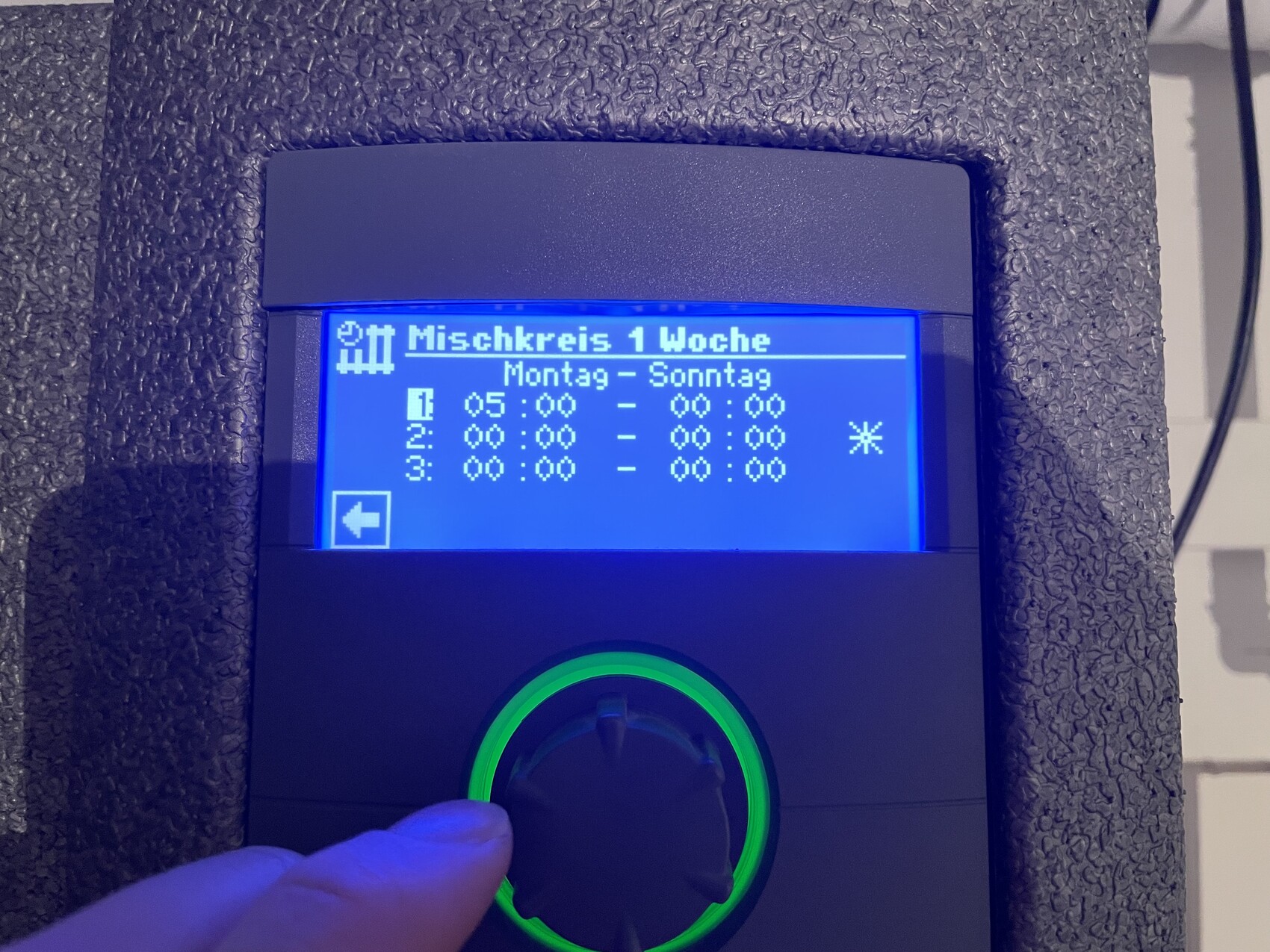
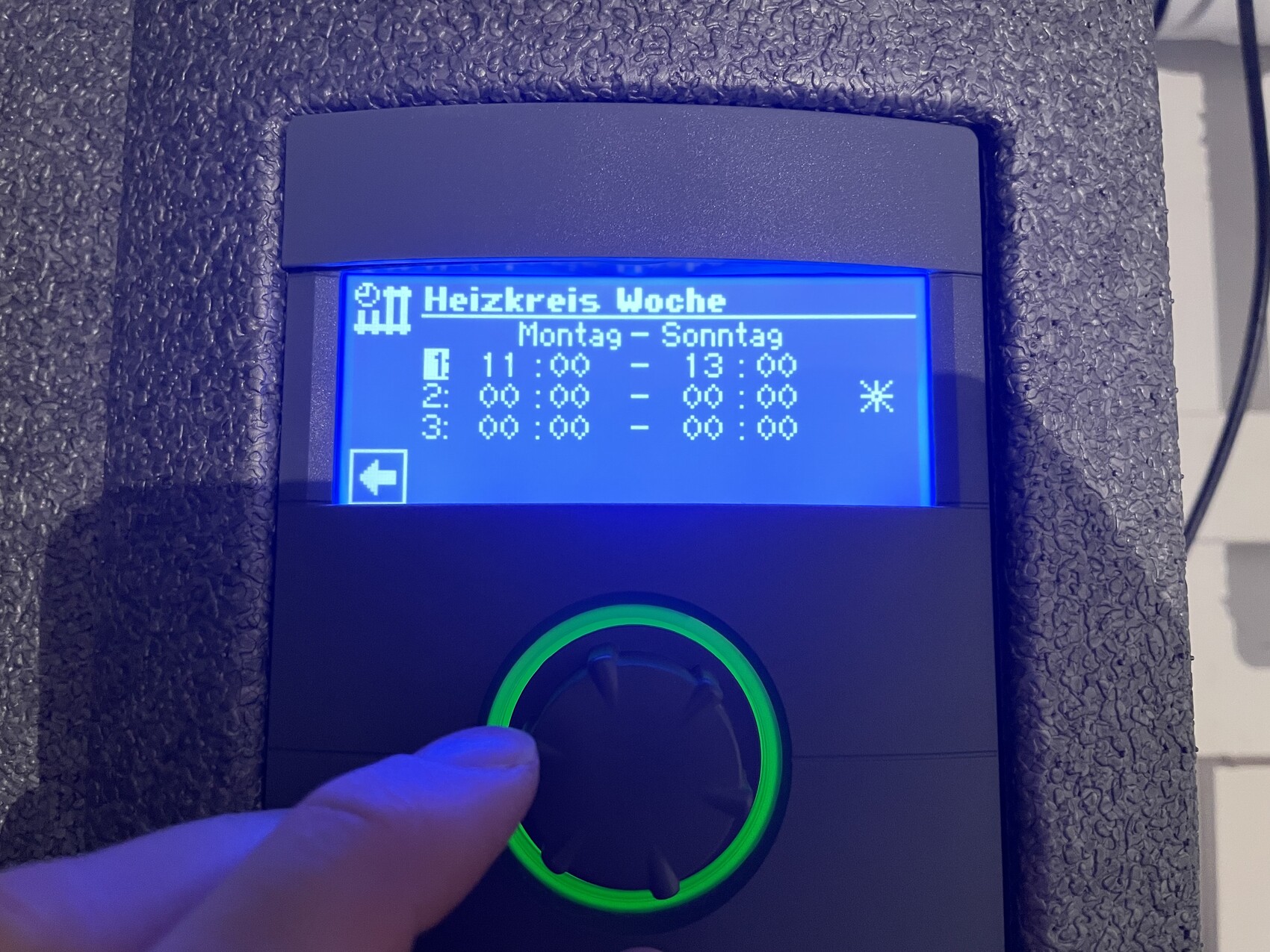
- Heat pump heating circuit: These times are permissions, meaning the heat pump is only allowed to run during these periods. However, it will only start if the other conditions (outdoor temperature and return temperature) are also met.
- Underfloor heating circuit: This program controls the circulation pump that pumps water from the buffer to the underfloor heating system.
Best regards
First of all,
thank you for the detailed explanation.
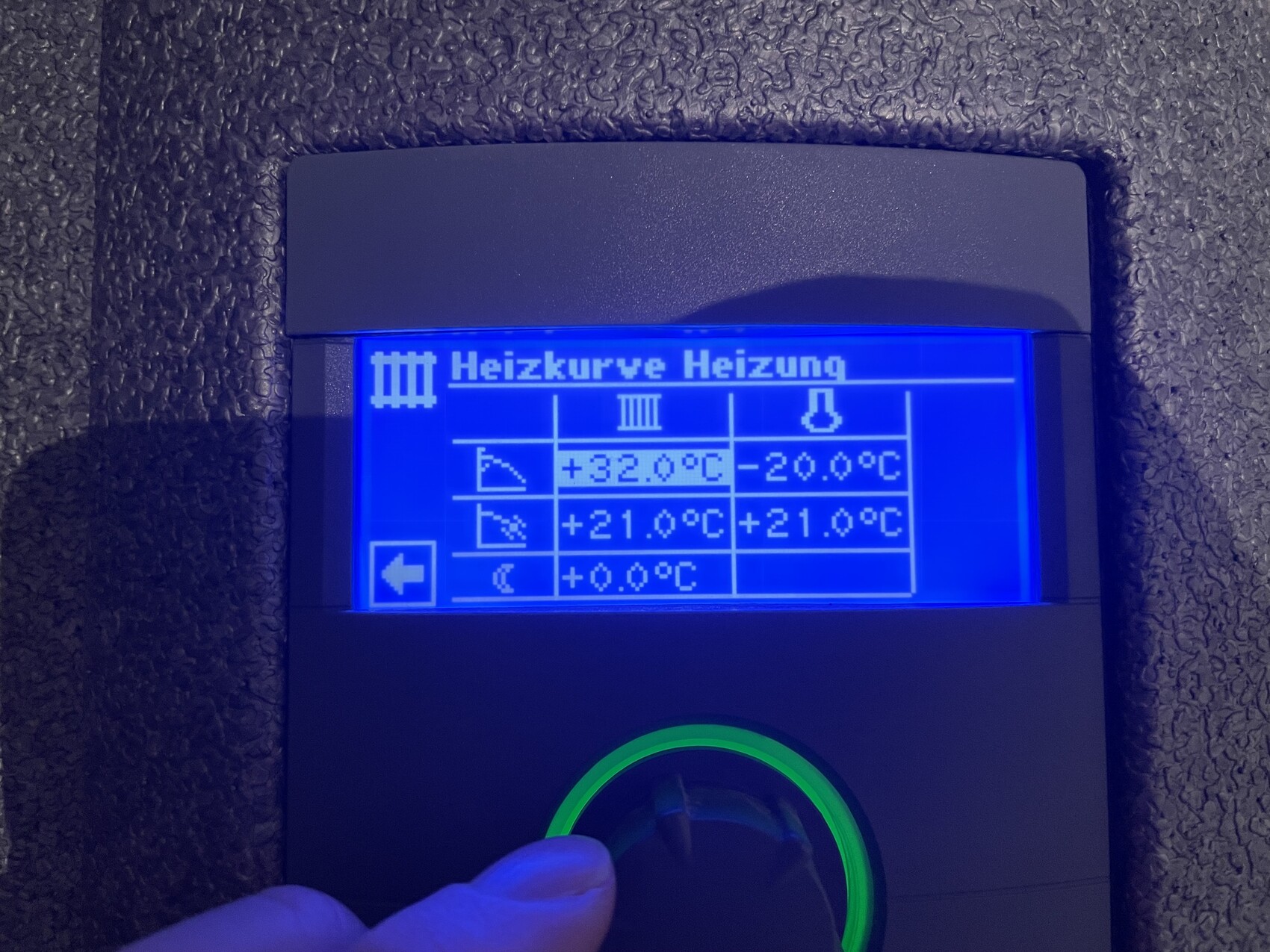
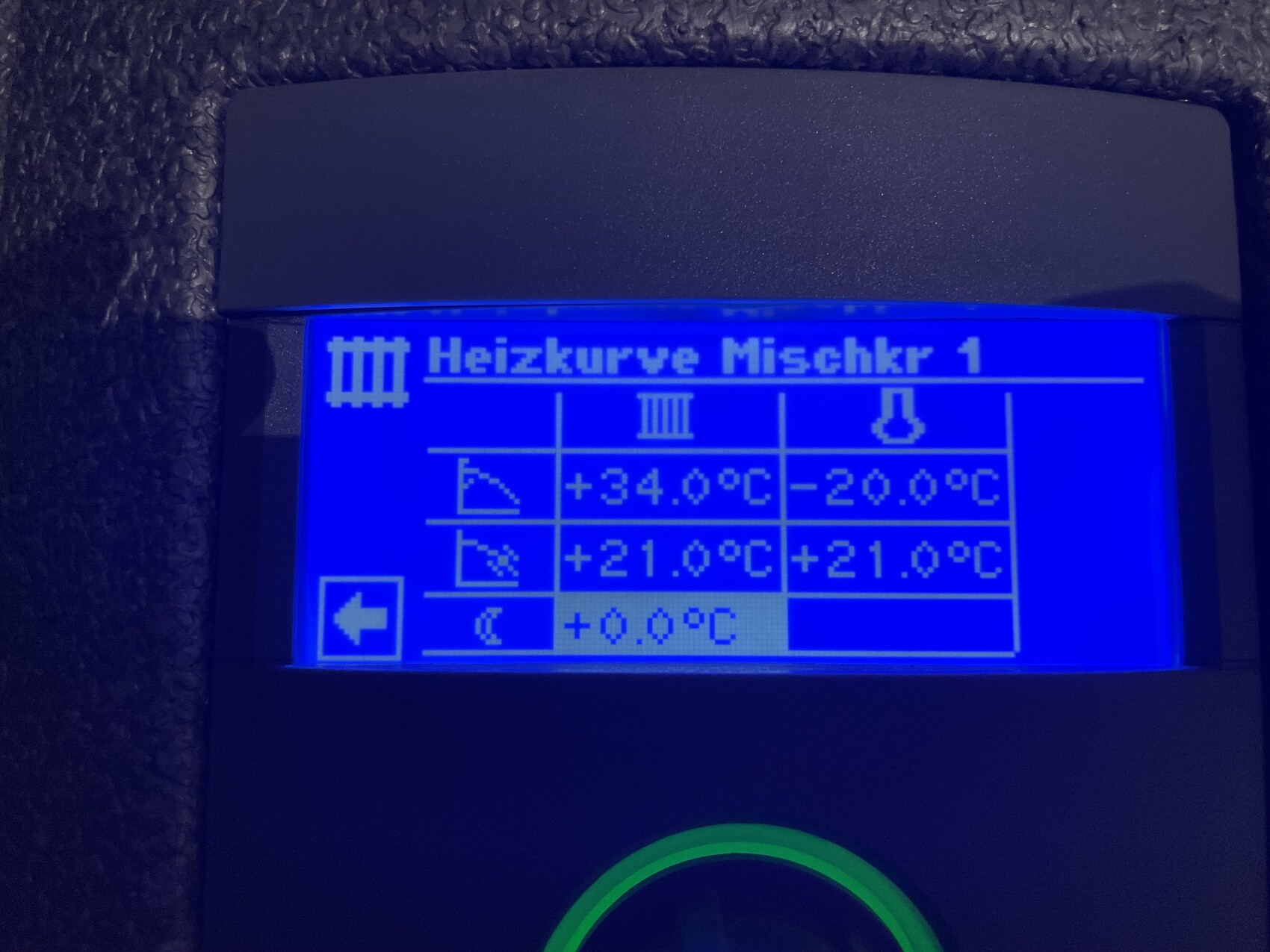
My understanding was similar. However, it doesn’t quite add up. I’ll now share the heating schedules and the heating curves. By the way, I only have heating circuit 1 and mixing circuit 1.
My problem is that although the heating circuit is set to only heat between 11 a.m. and 1 p.m., it also heats outside of those times. And I don’t understand why.
Regards
Thomas
thank you for the detailed explanation.
My understanding was similar. However, it doesn’t quite add up. I’ll now share the heating schedules and the heating curves. By the way, I only have heating circuit 1 and mixing circuit 1.
My problem is that although the heating circuit is set to only heat between 11 a.m. and 1 p.m., it also heats outside of those times. And I don’t understand why.
Regards
Thomas
D
derdietmar23 Nov 2024 10:51Hello,
for clarification:
Therefore, you first need to set a value for the night setback temperature in the settings. If you want to completely turn off the heating, this value must be set accordingly high (up to 10 degrees Celsius (50°F) can be set). Then you define the boost periods in the switching times.
Best regards
for clarification:
- Heating circuit: This is the loop from the heat pump to the buffer tank and back.
- Mixing circuit: This is the loop from the buffer tank to the underfloor heating and back.
Therefore, you first need to set a value for the night setback temperature in the settings. If you want to completely turn off the heating, this value must be set accordingly high (up to 10 degrees Celsius (50°F) can be set). Then you define the boost periods in the switching times.
Best regards
Similar topics