
ᐅ Is the quote for liquid screed and installation of fixing strips too expensive?
Created on: 10 Nov 2024 14:42
O
OzCi1305
Hello everyone,
I have received the following quote for our screed.
The installation of the insulation panels is included in the price.
It seems a bit high to me... what do you think?
I don’t have any comparison quotes yet but will invite other screed contractors for an inspection.
However, I would like to get an idea if the prices from other companies will be in a similar range.
Best regards

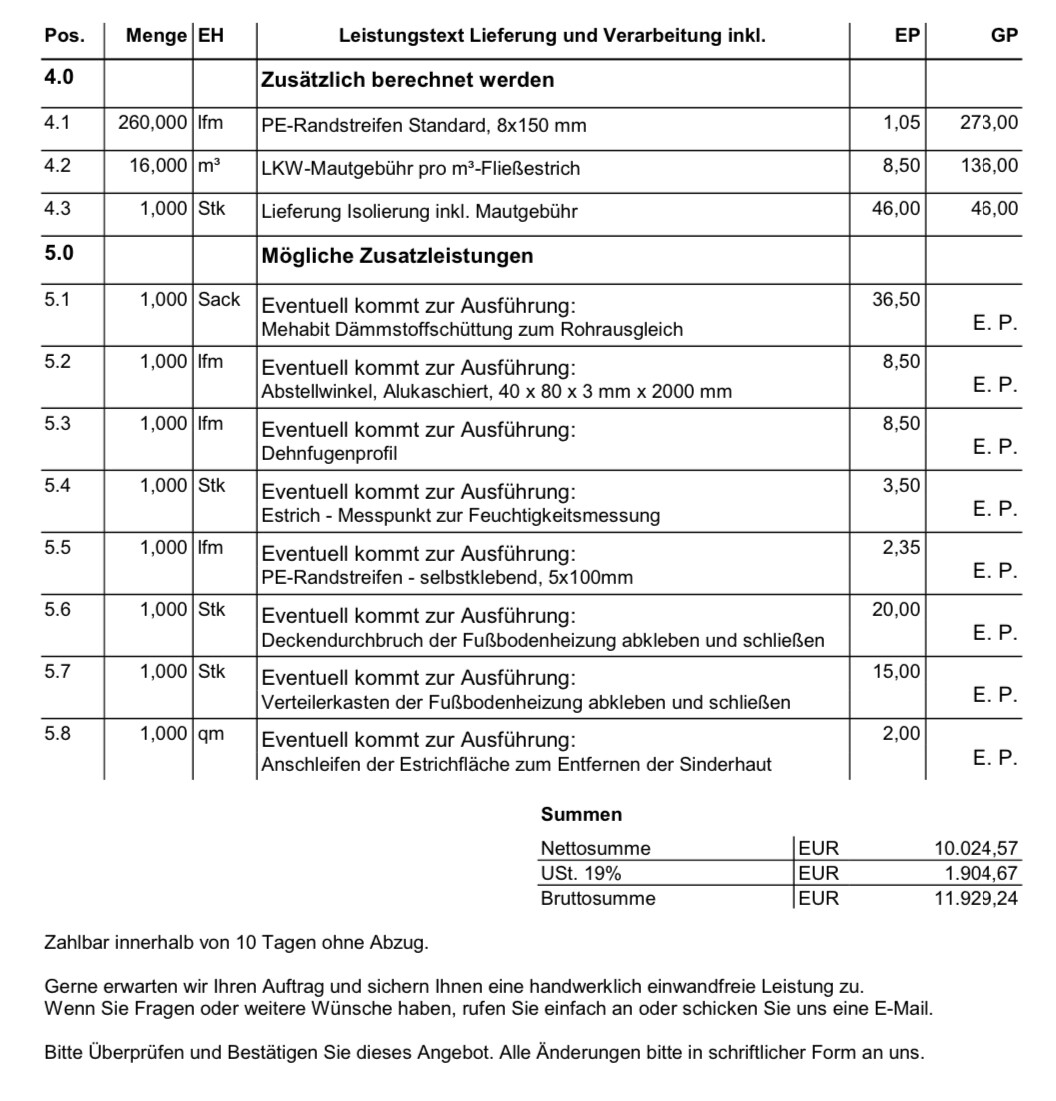

I have received the following quote for our screed.
The installation of the insulation panels is included in the price.
It seems a bit high to me... what do you think?
I don’t have any comparison quotes yet but will invite other screed contractors for an inspection.
However, I would like to get an idea if the prices from other companies will be in a similar range.
Best regards
nordanney schrieb:
Well, if the concrete slab was supposed to be 12cm (5 inches) thick back then, but in some areas it measures only 7cm (3 inches) (assuming the areas where a lot of screed is needed were poured too thinly), that is a defect where, in new construction, you would have to say: remove everything and redo. The reinforcement has to be properly embedded in the concrete.
But with older buildings, you have no idea how it was constructed. You can't really worry too much about it.
So increased moisture penetration is more likely. Better avoid anhydrite screed in that case.
For example, with (bound) loose fill. Self-leveling compound will exceed your budget, and the thickness differences are too large for that anyway. So far, there have been no moisture problems in the basement.
Additionally, as part of the renovation, drainage including exterior basement wall insulation with dimpled membrane was installed.
Is there still a real risk of increased moisture?
N
nordanney11 Nov 2024 15:19OzCi1305 schrieb:
Is there really still an increased moisture risk? With the rammed concrete, moisture can—but does not necessarily have to—move upward. However, this can be controlled with a vapor barrier. If, apart from that, the basement has been properly sealed from the outside, then it’s a green light from me.
B
Buchsbaum06611 Nov 2024 17:03OzCi1305 schrieb:
So far, it was a utility basement, but it is now being converted into a living basement.
Built in 1963
The house is founded on a strip foundation, and the floor has been filled with rammed concrete.
What problems could arise from the thickness of the floor? You have a completely wrong idea. However, you are well advised by the construction expert @nordanney.
If you only have a strip foundation in the basement, you can assume that it offers limited protection against rising damp. So far, the rammed concrete has regulated the moisture in the basement. If you now seal this with a plastic sheet, moisture will rise through the foundation into the walls. The moisture barrier from buildings of this era is usually no longer in good condition.
If you also have anhydrite in the floor, it will deteriorate very quickly. As I said, your new construction will disrupt the entire moisture behavior of the masonry. I would be very cautious here.
First, I would clarify how intact the damp-proof course in the wall is—that is, from the foundation to the wall. In the 1960s, roofing felt was often used for this, which deteriorates over time.
You don’t want to finish everything nicely with underfloor heating and screed only to have to pay a specialist a lot of money later to install a new horizontal damp-proof course with injections. You wouldn’t be the first to experience this.
N
nordanney11 Nov 2024 17:12Buchsbaum066 schrieb:
You have a completely wrong idea. But you are very well advised.Yes. To the latter, not the former.Buchsbaum066 schrieb:
You have a completely wrong idea. However, you are getting great advice from the construction expert @nordanney.
If you only have a strip foundation in the basement, you can assume that it provides limited protection against rising damp. So far, the tamped concrete has regulated the moisture in the basement. If you now cover it with a plastic sheet, moisture will travel through the foundation and rise into the walls. The damp-proof course is usually no longer effective in buildings from that era.
If you also have anhydrite in the floor, it will deteriorate very quickly. As mentioned, your new construction method will disrupt the entire moisture behavior of the masonry. I would approach this very cautiously.
First, I would check to what extent the damp-proof membrane in the wall—the one between the foundation and the wall—is still intact. In the 1960s, roofing felt was often used there, which breaks down over time.
You don’t want to fully finish everything with underfloor heating and screed, only to have to pay a specialist a lot later to install a new horizontal damp-proof course using injection methods. You wouldn’t be the first to experience this. This is what I found regarding waterproofing. What do you think?
B
Buchsbaum06611 Nov 2024 20:27Theoretically, it looks good, of course. Your basement walls were surely properly waterproofed on the outside as well.
However, you had to redo it because it simply doesn't last 60 years.
The same will apply to the inside. If it is going to be a living basement, I would also expose the foundations about 20 cm (8 inches).
Otherwise, there could be an unpleasant surprise in the end.
Of course, everything may still be fine. We just don’t know.
You could also measure the moisture in the wall above the waterproofing layer. That will provide a clear indication of the actual condition.
However, you had to redo it because it simply doesn't last 60 years.
The same will apply to the inside. If it is going to be a living basement, I would also expose the foundations about 20 cm (8 inches).
Otherwise, there could be an unpleasant surprise in the end.
Of course, everything may still be fine. We just don’t know.
You could also measure the moisture in the wall above the waterproofing layer. That will provide a clear indication of the actual condition.
Similar topics