
ᐅ Is the quote for liquid screed and installation of fixing strips too expensive?
Created on: 10 Nov 2024 14:42
O
OzCi1305Hello everyone,
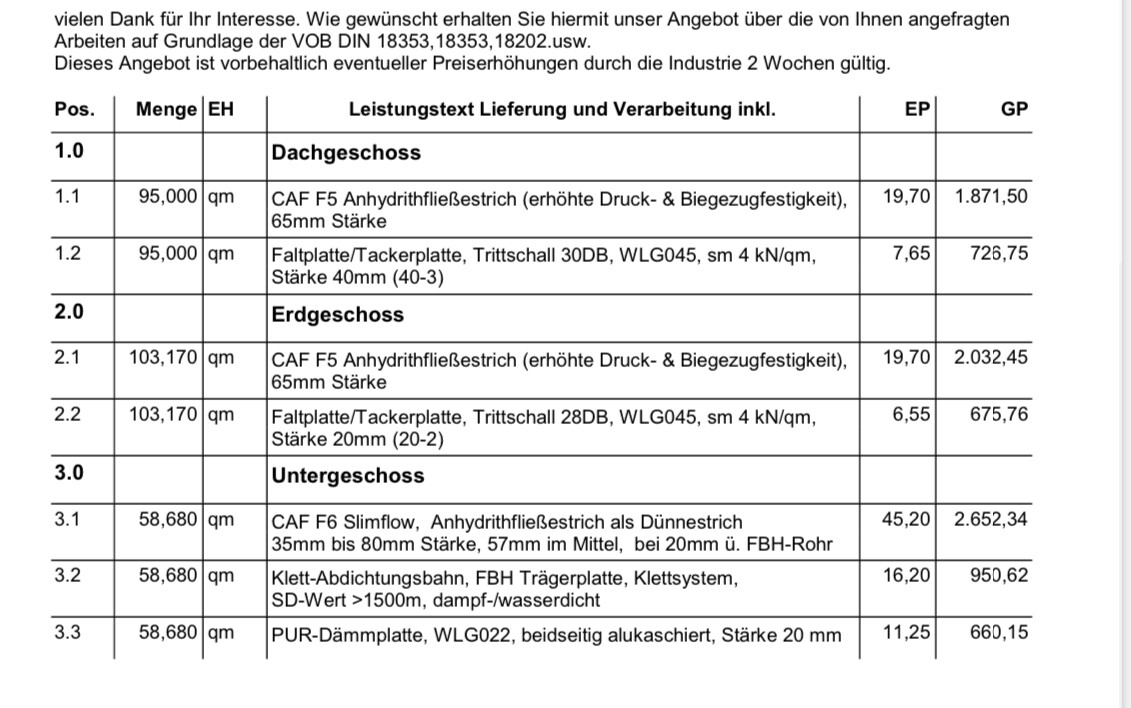
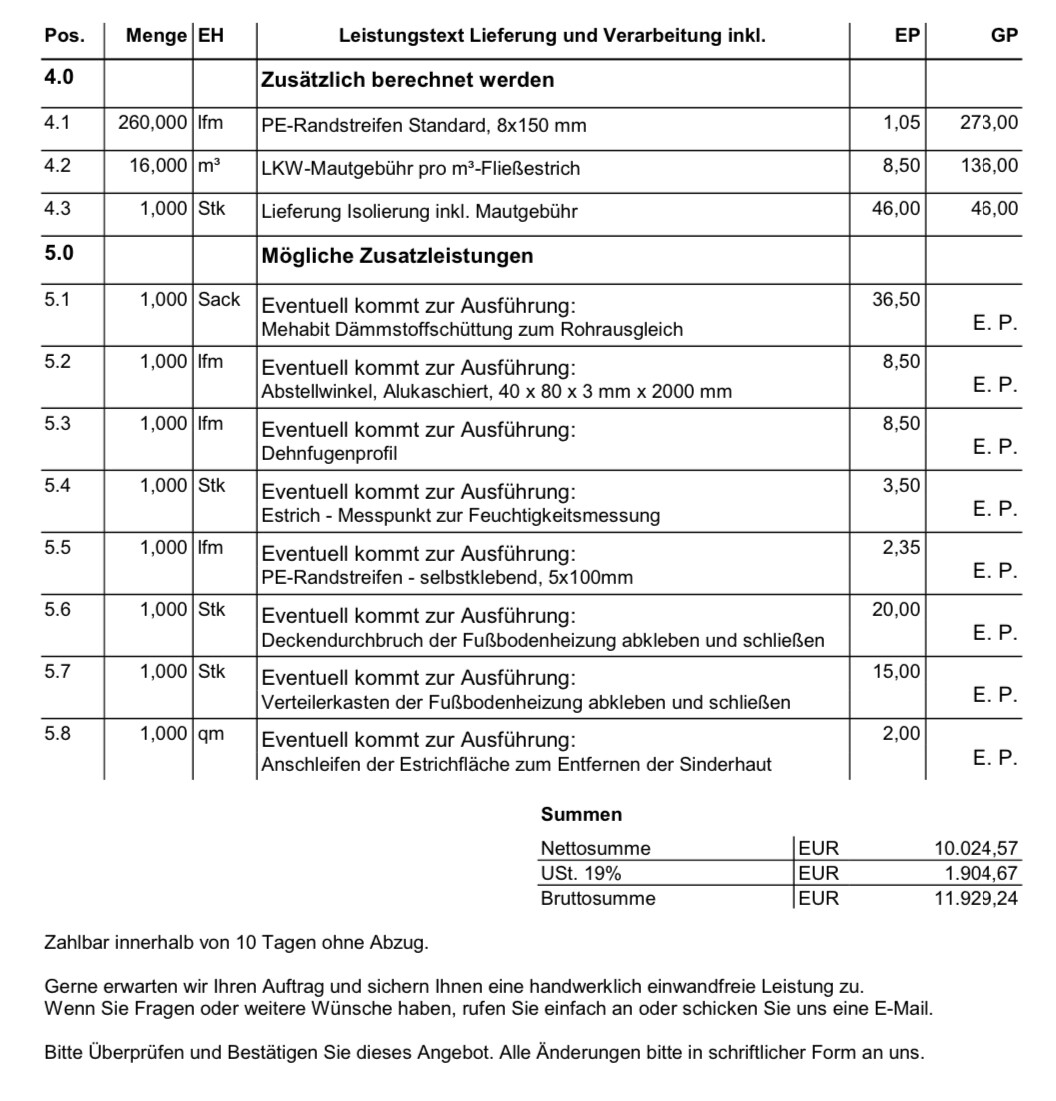
I have received the following quote for our screed.
The installation of the insulation panels is included in the price.
It seems a bit high to me... what do you think?
I don’t have any comparison quotes yet but will invite other screed contractors for an inspection.
However, I would like to get an idea if the prices from other companies will be in a similar range.
Best regards

I have received the following quote for our screed.
The installation of the insulation panels is included in the price.
It seems a bit high to me... what do you think?
I don’t have any comparison quotes yet but will invite other screed contractors for an inspection.
However, I would like to get an idea if the prices from other companies will be in a similar range.
Best regards
B
Buchsbaum06610 Nov 2024 22:24Why is the screed so expensive in the basement? Upstairs it’s 19.70 and downstairs 45.20 per square meter.
I’m not a fan of anhydrite screed. The thickness you have is already borderline. It introduces a lot of moisture into the building.
I would go with regular screed there, which will probably also be cheaper.
65 mm (2.6 inches) is generally no longer done with anhydrite self-leveling screed. But that’s just my humble opinion.
I’m not a fan of anhydrite screed. The thickness you have is already borderline. It introduces a lot of moisture into the building.
I would go with regular screed there, which will probably also be cheaper.
65 mm (2.6 inches) is generally no longer done with anhydrite self-leveling screed. But that’s just my humble opinion.
N
nordanney10 Nov 2024 23:53The price is fine.
Why anhydrite?
Why so thick?
Why is the basement F6 thin-layer (up to 80mm (3 inches) thick)?
Why anhydrite?
Why so thick?
Why is the basement F6 thin-layer (up to 80mm (3 inches) thick)?
nordanney schrieb:
The price is okay.
Why anhydrite?
Why so thick?
Why basement F6 thin layer (up to 80mm (3 inches) thick)?Since the basement floor is quite uneven and to ensure proper pipe coverage, the thickness ranges between 35 and 80 mm (1.4 and 3 inches).
What alternative would I have?
Buchsbaum066 schrieb:
Why is the screed in the basement so expensive? Upstairs it’s 19.70 and downstairs 45.20 per square meter.
I’m not a fan of anhydrite screed. The thickness you have is already borderline. It introduces a lot of moisture into the building.
I would go with regular cement screed, which is probably also cheaper.
65 mm (2.6 inches) thickness with anhydrite flow screed is usually not done anymore. But that’s just my humble opinion. Because it is screed with higher flexural strength due to the sometimes low pipe cover.
B
Buchsbaum06611 Nov 2024 08:02The basement is generally not suitable for anhydrite screed. Basements are always damp areas. Naturally, you will have more moisture there than on the upper floors. Anhydrite absorbs moisture. This inevitably leads to problems.
You have probably finished the drywall and newly plastered the walls. Have you considered how much moisture you are introducing into your building? You will never be able to remove it completely.
I estimate that your flow screed contains around 4,000 liters (1,057 gallons) of water. You surely understand how much that is, where it distributes itself, and how long it actually takes to dry completely.
If the walls have also been plastered and the masonry is still damp, drying will take several months. No matter what some building experts tell you. This is why mold issues often occur in new constructions.
You have probably finished the drywall and newly plastered the walls. Have you considered how much moisture you are introducing into your building? You will never be able to remove it completely.
I estimate that your flow screed contains around 4,000 liters (1,057 gallons) of water. You surely understand how much that is, where it distributes itself, and how long it actually takes to dry completely.
If the walls have also been plastered and the masonry is still damp, drying will take several months. No matter what some building experts tell you. This is why mold issues often occur in new constructions.
Similar topics