
ᐅ Floor Plan Design for a Gable Roof House Measuring 9x13 m with an Attached 6x9 m Loft Extension
Created on: 24 Oct 2024 12:46
B
Biker99
Hello,
I came across this interesting forum yesterday and would like to take the opportunity to present my first floor plan draft here in the hope of receiving valuable advice. Often, being too focused on one direction limits ideas, so fresh eyes and new inspiration from others are always very helpful.
The general idea is to have the house built completely turnkey by a prefab house company, without any DIY efforts on our part. So far, no architect has been hired because I first wanted to try putting my own wishes and ideas on paper. I believe that with this DIY preliminary planning, there might be a better basis to go directly to an architect or even several prefab home providers to obtain feasible implementations and corresponding cost estimates.
I look forward to your feedback (and I’m already bracing myself...).
Development Plan / Restrictions
Currently, paragraph 34 applies. However, a design guideline is expected next year. The house has already been initially designed within the preliminary framework of this guideline.
The plot size is about 650 m² (7000 sq ft). It is a flat lot on a road with through traffic. Floor area ratio is 1.5. A detached garage will be attached to an existing building with two full floors plus an attic conversion on the right side, and next to the garage will be the new house.
The existing building is oriented with the eaves side to the street. The new house is planned to be positioned with the gable end facing the street.
The neighboring house on the other side (directly on the street) also has its gable end facing the street. Parking spaces: 2 (in front of the garage) plus a double garage (6 x 9 m (20 x 30 ft)). Number of floors: 1.5. Roof type: pitched roof, 25 to max 35 degrees. Style: conventional. Orientation: northeast to southwest.
Maximum heights/limits
The planned maximum height is about 8.5 m (28 ft).
The house must be set back 3 m (10 ft) from the front property line. The double garage should/setback 5 m (16 ft) from the front property line (unfortunately, no more was allowed in the planning approval inquiry, so from my view, only a front entrance to the house is currently feasible).
A direct connection from the double garage to the house is desired.
A corresponding positively approved preliminary building permit is available.
Homeowners’ Requirements
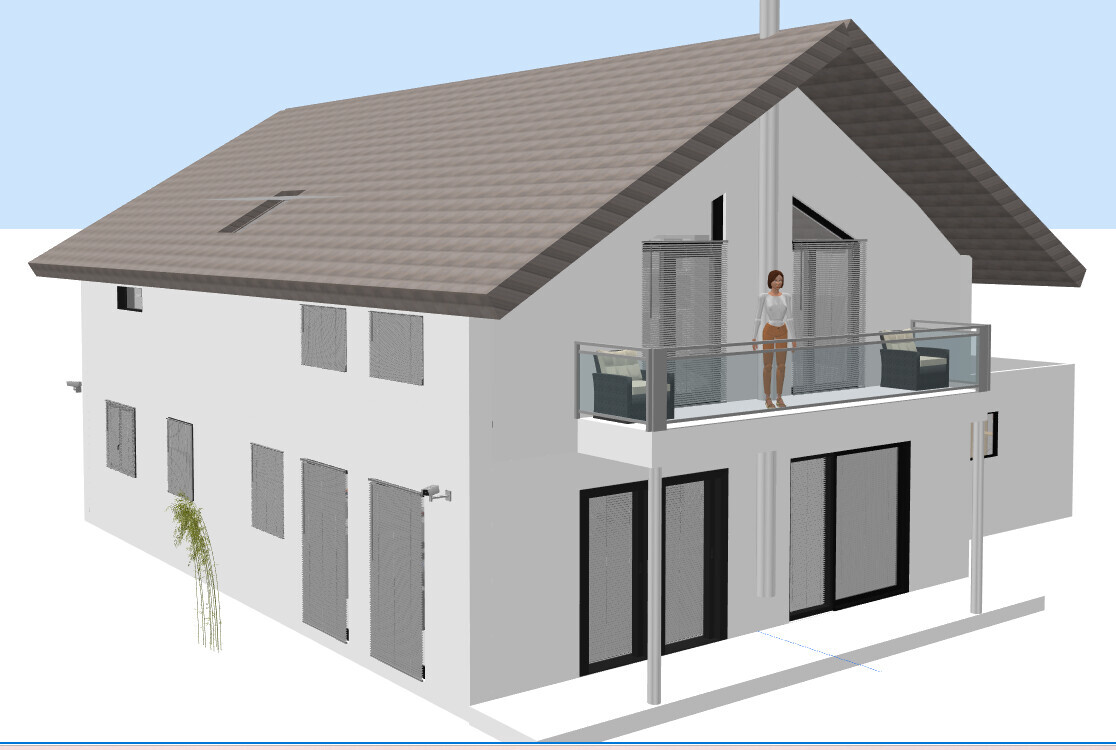
We want a modern house with a pitched roof.
A basement (possibly a partial basement) is desired and unfortunately required due to space constraints (not for living purposes; the basement should only serve as storage or a hobby/craft room).
For the knee wall height of the 1.5-story building, we envision 1.60 to 1.80 m (5’3” to 6’0”).
Number of occupants: 2 persons, 60 years old.
The house should be designed to be barrier-free as much as possible and should allow living only on the ground floor at an advanced age.
The total required area on the ground floor and upper floor should be around 180 m² (1937 sq ft).
The office will be used privately only.
We expect about 5 guest stays per year.
The living/dining area should be spacious and as open as possible.
A storage room between the double garage and the house (which also allows access from the garage to the house) is required.
The kitchen should be open with a cooking island or peninsula.
A central fireplace in the living/dining area is planned/desired.
A balcony with access from the gallery and the office is also desired. Alternatively, a loggia (either one-sided or spanning the width of the house) could be considered.
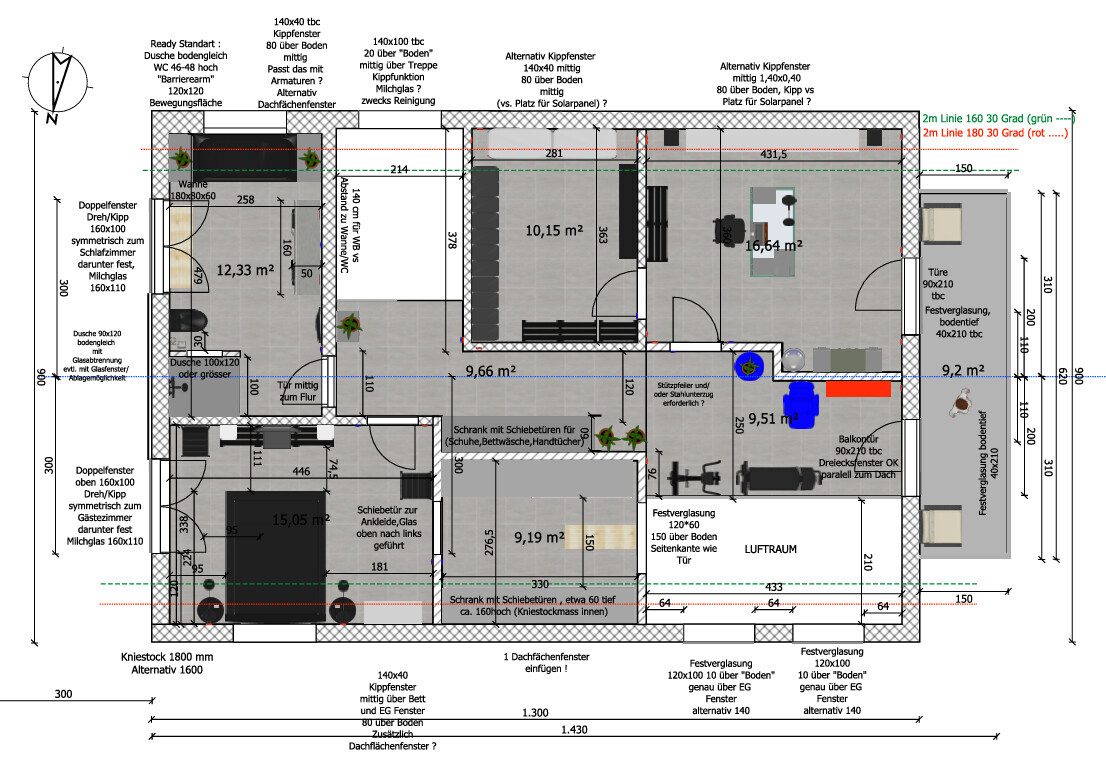
It is important for us to have an open gallery over the dining area where you can stay and where fitness equipment will also be placed.
The double garage measuring 6 x 9 m (20 x 30 ft) is fixed, as several vehicles need to be accommodated.
House Design
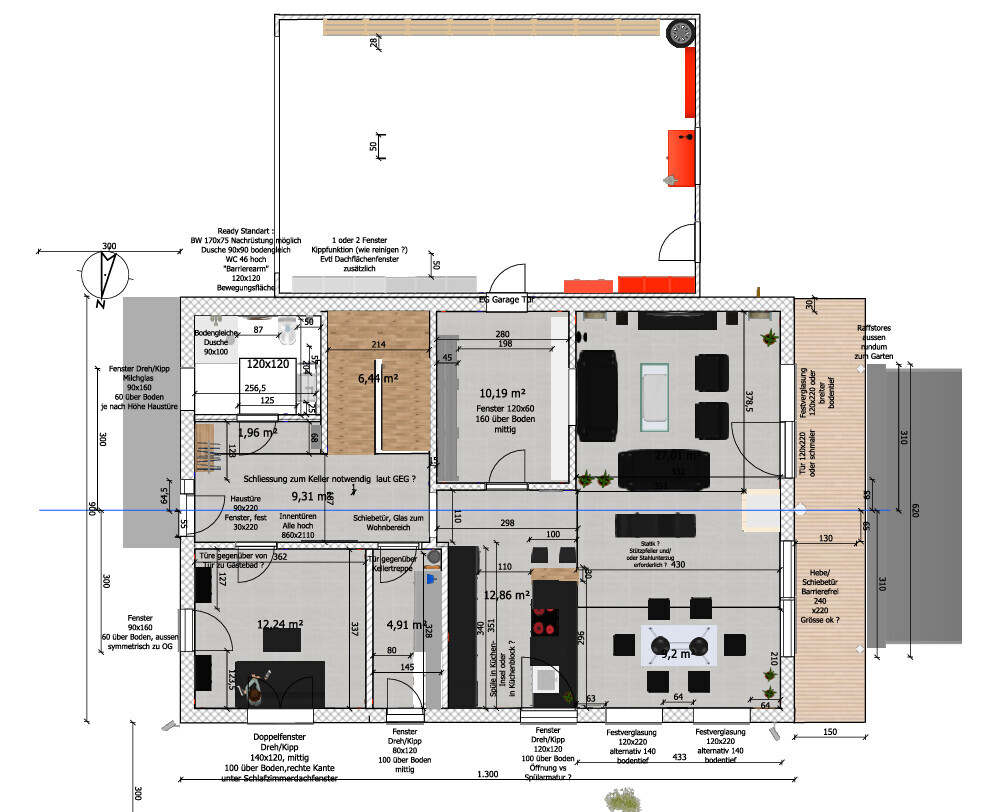
A first preliminary plan created using a 3D program is available.
What I like about the initial plan are the open sight lines, the gallery, and the large living/dining area facing the garden (southwest).
I especially struggled with the staircase design. Initially, I wanted a straight staircase with access from the living/dining area, but I discarded this for various reasons (also because a cellar staircase is still needed “underneath,” which makes a straight staircase less visually appealing).
After initially planning bathroom access from the sleeping area (which also leads to the dressing room), I eventually decided for an access from the hallway to allow a wider shower, a large double washbasin in front of the window, and a toilet with at least 90 cm (35 inches) clearance to the side.
What I don’t like yet is the gable side area between the open space and the office with the 90-degree angle.
In the (probably too) narrow utility room, the washing machine and dryer are to be accommodated.
Why did the design turn out this way?
For example, only about 18 m (59 ft) of plot width is available, which limits the house width to a maximum of 9 m (30 ft) with a set double garage width of 6 m (20 ft).
I came across this interesting forum yesterday and would like to take the opportunity to present my first floor plan draft here in the hope of receiving valuable advice. Often, being too focused on one direction limits ideas, so fresh eyes and new inspiration from others are always very helpful.
The general idea is to have the house built completely turnkey by a prefab house company, without any DIY efforts on our part. So far, no architect has been hired because I first wanted to try putting my own wishes and ideas on paper. I believe that with this DIY preliminary planning, there might be a better basis to go directly to an architect or even several prefab home providers to obtain feasible implementations and corresponding cost estimates.
I look forward to your feedback (and I’m already bracing myself...).
Development Plan / Restrictions
Currently, paragraph 34 applies. However, a design guideline is expected next year. The house has already been initially designed within the preliminary framework of this guideline.
The plot size is about 650 m² (7000 sq ft). It is a flat lot on a road with through traffic. Floor area ratio is 1.5. A detached garage will be attached to an existing building with two full floors plus an attic conversion on the right side, and next to the garage will be the new house.
The existing building is oriented with the eaves side to the street. The new house is planned to be positioned with the gable end facing the street.
The neighboring house on the other side (directly on the street) also has its gable end facing the street. Parking spaces: 2 (in front of the garage) plus a double garage (6 x 9 m (20 x 30 ft)). Number of floors: 1.5. Roof type: pitched roof, 25 to max 35 degrees. Style: conventional. Orientation: northeast to southwest.
Maximum heights/limits
The planned maximum height is about 8.5 m (28 ft).
The house must be set back 3 m (10 ft) from the front property line. The double garage should/setback 5 m (16 ft) from the front property line (unfortunately, no more was allowed in the planning approval inquiry, so from my view, only a front entrance to the house is currently feasible).
A direct connection from the double garage to the house is desired.
A corresponding positively approved preliminary building permit is available.
Homeowners’ Requirements
We want a modern house with a pitched roof.
A basement (possibly a partial basement) is desired and unfortunately required due to space constraints (not for living purposes; the basement should only serve as storage or a hobby/craft room).
For the knee wall height of the 1.5-story building, we envision 1.60 to 1.80 m (5’3” to 6’0”).
Number of occupants: 2 persons, 60 years old.
The house should be designed to be barrier-free as much as possible and should allow living only on the ground floor at an advanced age.
The total required area on the ground floor and upper floor should be around 180 m² (1937 sq ft).
The office will be used privately only.
We expect about 5 guest stays per year.
The living/dining area should be spacious and as open as possible.
A storage room between the double garage and the house (which also allows access from the garage to the house) is required.
The kitchen should be open with a cooking island or peninsula.
A central fireplace in the living/dining area is planned/desired.
A balcony with access from the gallery and the office is also desired. Alternatively, a loggia (either one-sided or spanning the width of the house) could be considered.
It is important for us to have an open gallery over the dining area where you can stay and where fitness equipment will also be placed.
The double garage measuring 6 x 9 m (20 x 30 ft) is fixed, as several vehicles need to be accommodated.
House Design
A first preliminary plan created using a 3D program is available.
What I like about the initial plan are the open sight lines, the gallery, and the large living/dining area facing the garden (southwest).
I especially struggled with the staircase design. Initially, I wanted a straight staircase with access from the living/dining area, but I discarded this for various reasons (also because a cellar staircase is still needed “underneath,” which makes a straight staircase less visually appealing).
After initially planning bathroom access from the sleeping area (which also leads to the dressing room), I eventually decided for an access from the hallway to allow a wider shower, a large double washbasin in front of the window, and a toilet with at least 90 cm (35 inches) clearance to the side.
What I don’t like yet is the gable side area between the open space and the office with the 90-degree angle.
In the (probably too) narrow utility room, the washing machine and dryer are to be accommodated.
Why did the design turn out this way?
For example, only about 18 m (59 ft) of plot width is available, which limits the house width to a maximum of 9 m (30 ft) with a set double garage width of 6 m (20 ft).
Arauki11 schrieb:
I haven’t reread everything, but placing the main entrance on the eaves side would probably solve most layout issues, at least the narrow hallway would be gone. Is that really not possible? Originally, I planned it that way too.
For that, the house would have to be moved forward (where the plot narrows again a bit, and with the 9m (30 feet) it gets tight again) or the garage pushed further back (and they’re only allowing me 5m (16.5 feet) instead of the 7m (23 feet) I originally planned) in front of the garage.
ypg schrieb:
So, I’m currently experimenting and playing a sort of Tetris with walls, but now I’ve backtracked.
However, I’m a bit half-hearted about it: on one hand, it’s about the optimum setup for the biker; on the other, I initially said this plan contains some thinking errors from Biker’s side that I cannot support.
I’ve also never really understood, as a mature adult, why someone wouldn’t use the main entrance and would always want to get to a secondary room through the garage that has nothing to do with the entrance and often just has laundry lying on the floor.
Well, once she lives there, she’ll probably realize the garage isn’t as magical as the gallery room.
I remind you that this room will (hopefully) be filled with natural light, making it naturally warmer than other areas that only have a skylight. Maybe it’s not the right place for bike training?!
And what is the basement intended for now?
There are many possibilities. But with this idea, I wonder why everything else should be closed off, yet all of a sudden a basement staircase is supposed to create transparency. A steel staircase has many downsides: noise, vibrations, coldness. It looks nice if you just look at it. A glass wall takes up usable floor space. Or what do you mean by a steel staircase?
Yes, most (basement stairs) are either narrow or tight. Usually, that’s intentional. I don’t see most of them as age-friendly. There simply isn’t enough room.
Here are my two alternatives (with different furnishing; I didn’t save the small furniture pieces).Thank you!
Regarding the two options, I’ve somewhat moved away from the idea of a straight staircase. In my opinion, it only works in its open, transparent form if you don’t have a basement stair underneath it.
Otherwise, you’d see the basement entrance directly from the main door area.
Also, you lose the space for a proper cloakroom right by the door, as you correctly pointed out in my initial rough design.
I also want to stick to the idea of an as-open-as-possible kitchen and avoid creating a “kitchen corridor” behind the stairs.
How much space does the other staircase you showed take up compared to the two-flight staircase in my sketch?
I assume it uses less space across the width of the house, allowing, together with a slightly shorter kitchen run or kitchen island, for the rooms on the other side—including the living area—to be somewhat more spacious (at least that’s how I understand that variation).
My original thought with both the straight and the two-flight staircase was to ensure easier and safer access, especially in later years. But if you spend most of your time on the ground floor when you’re older, maybe compromises can be made.
The now straighter, less convoluted access to the dressing room with the bedroom entrance located further forward (without having to go through a corridor first) makes sense.
I suspect I already know what you’ll think again (without you having to say it). But I believe I need the basement (even if only a partial basement) not just for the building services but also for my bikes and other “excess stuff,” including a workshop. The double garage is already occupied with cars and the motorcycle.
Biker99 schrieb:
How much space does the other staircase you showed roughly require compared to the two-flight staircase with landing in my sketch? Yes, I was just following one idea because the "long hallway" is there anyway. So it makes sense to use it. But you’re right: sometimes I forget that a basement is going to be built. An alternative would be to equip the basement staircase with a door and side panel.
Biker99 schrieb:
I need space not only for the building services but also for my bicycles and other “unnecessary stuff,” including a workshop room. The double garage is occupied with cars and a motorcycle. You’re not seriously planning to carry bicycles up and down the stairs? Then you need to make sure that there is enough space opposite the basement stair access—not immediately a wall—so that you can maneuver a bicycle that is 200cm (79 inches) long around the corner.
Actually, alongside the motorcycle and cars, there should still be room for two or three bicycles in a 6 x 9 m (20 x 30 ft) garage.
Just saying.

Biker99 schrieb:
(and they only want to approve 5 m (16 feet) instead of the 7 m (23 feet) I originally applied for) in front of the garageWhat is their reason for that?https://www.instagram.com/11antgmxde/
https://www.linkedin.com/company/bauen-jetzt/
The space for the staircase also depends on the floor-to-ceiling height. I currently have a clear height of 2.65 m (8.7 ft) in my 3D software for both the ground floor and the upper floor. If the attic (which is difficult to use for storage anyway) were left out in favor of an interior open gable to the upper floor
To begin with, I have to say that the basis for the new build should/must be the subdivision of the existing lot alongside the existing property.
My submitted plan included a 7 m (23 ft) recessed roof extension attached on the left side of the existing property, and the house with a gable facing the street set back 3 m (10 ft), with a carport planned on the right side extending to the property boundary. The first thing that was not approved, citing too much sealed surface area, was the “many” parking spaces, so I initially removed the carport from the plan. Then it was suddenly said that the local district or city planners had concerns because I would not be building directly adjacent (with the eaves facing the street). The local planning authority actually did not want me to build a detached house at all since the houses in the immediate area (apart from an old timber-framed house on the right side of the plot) are also not detached. They then said they could only approve a possible land subdivision with a 3 m (10 ft) gap to the existing building. This meant, however, that the width of my lot would no longer be sufficient for the double garage. I then made a deliberately impractical alternative proposal to place the roof extension fully set back to the southeast property boundary (with a “nice” sealed driveway crossing the entire plot), since the lot widens significantly there and, even with the 3 m (10 ft) narrower plot, there would be space for both the roof extension and the house. I also argued that a 3 m (10 ft) gap from the existing building would create a 3 m (10 ft) wide strip of land that would be neglected by both the owner of the existing building and the new owner of the subdivided lot, and that this would not be beneficial to the local appearance.
After that, they approved my plan—after I provided photos of my vehicles, which were to be housed in the roof extension, and argued that I really needed the space or the remaining parking spaces—for the house set back 3 m (10 ft) with a gable toward the street, but only with a 5 m (16 ft) driveway (again with concerns about sealed surface area). Additionally, the fire-proof gable of the existing property must be greened or otherwise designed… Only then could I have a land subdivision without the 3 m (10 ft) distance to the existing building.
At times, I felt like I was in an oriental bazaar or at the mercy of arbitrary decisions by local planners and heritage protection (the timber-framed house on the right is listed). They also did not want to accept more than a 50 cm (20 inch) roof overhang until I provided photos of neighboring houses that have roof overhangs up to 1 m (39 inches). Then the colleagues agreed to 1 m (39 inches).
11ant schrieb:
What is the reason for that?
To begin with, I have to say that the basis for the new build should/must be the subdivision of the existing lot alongside the existing property.
My submitted plan included a 7 m (23 ft) recessed roof extension attached on the left side of the existing property, and the house with a gable facing the street set back 3 m (10 ft), with a carport planned on the right side extending to the property boundary. The first thing that was not approved, citing too much sealed surface area, was the “many” parking spaces, so I initially removed the carport from the plan. Then it was suddenly said that the local district or city planners had concerns because I would not be building directly adjacent (with the eaves facing the street). The local planning authority actually did not want me to build a detached house at all since the houses in the immediate area (apart from an old timber-framed house on the right side of the plot) are also not detached. They then said they could only approve a possible land subdivision with a 3 m (10 ft) gap to the existing building. This meant, however, that the width of my lot would no longer be sufficient for the double garage. I then made a deliberately impractical alternative proposal to place the roof extension fully set back to the southeast property boundary (with a “nice” sealed driveway crossing the entire plot), since the lot widens significantly there and, even with the 3 m (10 ft) narrower plot, there would be space for both the roof extension and the house. I also argued that a 3 m (10 ft) gap from the existing building would create a 3 m (10 ft) wide strip of land that would be neglected by both the owner of the existing building and the new owner of the subdivided lot, and that this would not be beneficial to the local appearance.
After that, they approved my plan—after I provided photos of my vehicles, which were to be housed in the roof extension, and argued that I really needed the space or the remaining parking spaces—for the house set back 3 m (10 ft) with a gable toward the street, but only with a 5 m (16 ft) driveway (again with concerns about sealed surface area). Additionally, the fire-proof gable of the existing property must be greened or otherwise designed… Only then could I have a land subdivision without the 3 m (10 ft) distance to the existing building.
At times, I felt like I was in an oriental bazaar or at the mercy of arbitrary decisions by local planners and heritage protection (the timber-framed house on the right is listed). They also did not want to accept more than a 50 cm (20 inch) roof overhang until I provided photos of neighboring houses that have roof overhangs up to 1 m (39 inches). Then the colleagues agreed to 1 m (39 inches).
After consulting with a staircase builder, I have installed a slightly less deep staircase and redesigned the kitchen into a U-shape. The reason was to make the living area and the ground floor bedroom slightly wider. At the same time, I shortened the house by 30 cm (12 inches).
I initially did not recess the entrance area. If it were allowed to shift the house 1 meter (3 feet) backward, this might be useful (even though it reduces interior space) to create a 1-meter (3 feet) deep covered area that aligns flush with the garage.
In the relatively wide hallway, a wardrobe with a bench could be installed (which would make the utility room narrower). Alternatively, a wardrobe wall could be integrated into the utility room, as shown in the sketch.
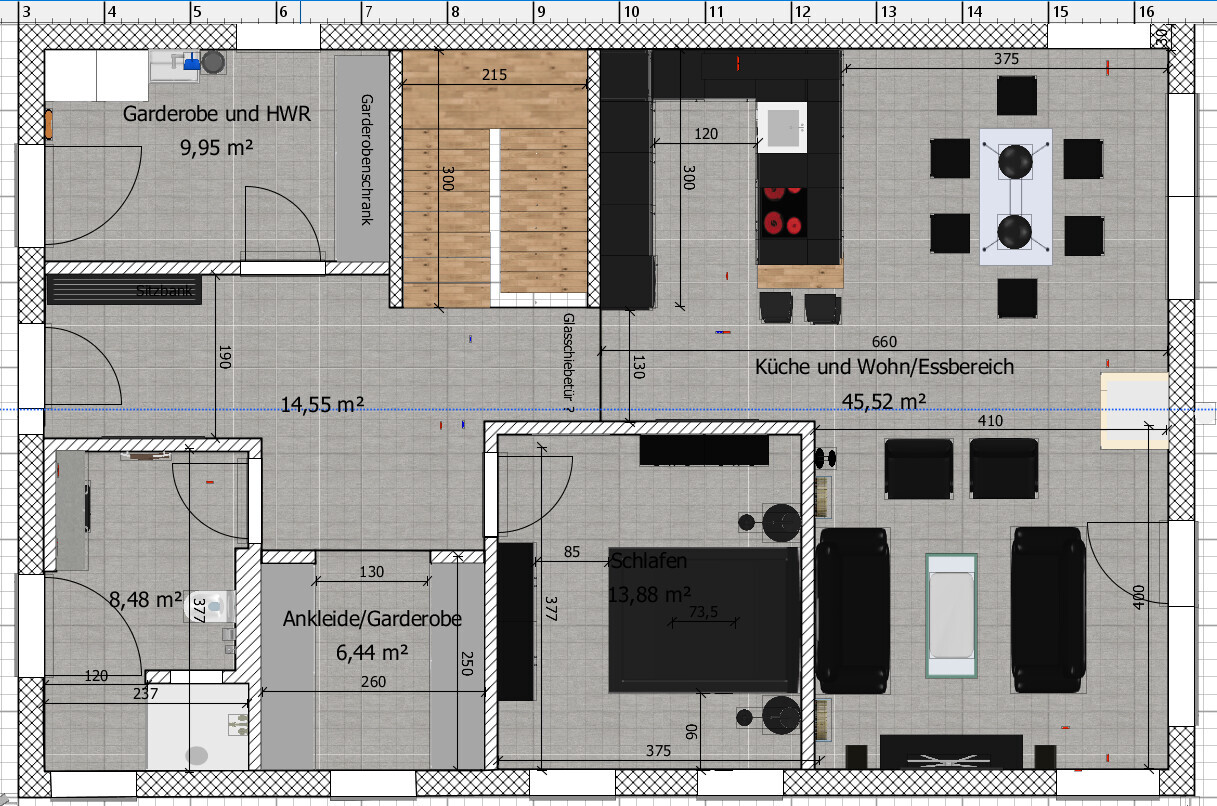
I initially did not recess the entrance area. If it were allowed to shift the house 1 meter (3 feet) backward, this might be useful (even though it reduces interior space) to create a 1-meter (3 feet) deep covered area that aligns flush with the garage.
In the relatively wide hallway, a wardrobe with a bench could be installed (which would make the utility room narrower). Alternatively, a wardrobe wall could be integrated into the utility room, as shown in the sketch.
Similar topics