
Hello fellow home builders,
we have constructed a new building with an external thermal insulation composite system (ETICS / EIFS). The exit steps to the terrace and front door were done as DIY work. Currently, it looks like in the photo: the insulation boards are glued to the exterior wall and extend up to the door frame. The site manager from the developer said at the time, "Cut the insulation boards so the step fits in and then insert it – this is how it’s done everywhere."
However, we absolutely cannot imagine that a simply glued (soft) insulation board could permanently support a several-kilogram heavy (hard) stone slab under constant foot traffic without breaking or sustaining other damage.
For support, we have now installed granite beams along the front side in front of the drainage membrane. On the backside (door frame side), however, I have no idea what else could be done there to preserve the insulation permanently and prevent it from breaking due to the load.
Is there perhaps anyone among us who has had a similar case and found a solution – or how would you approach this situation?
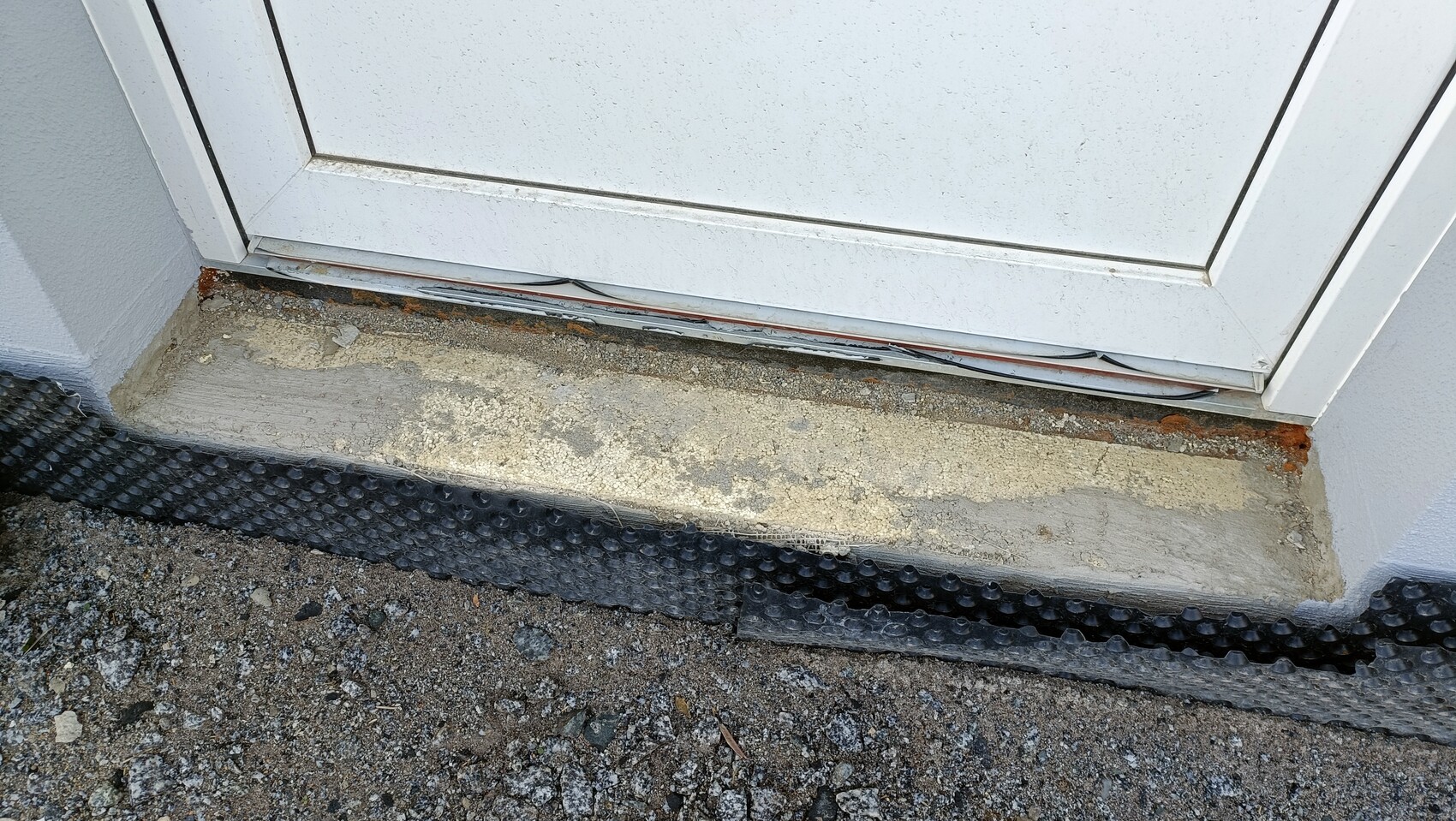
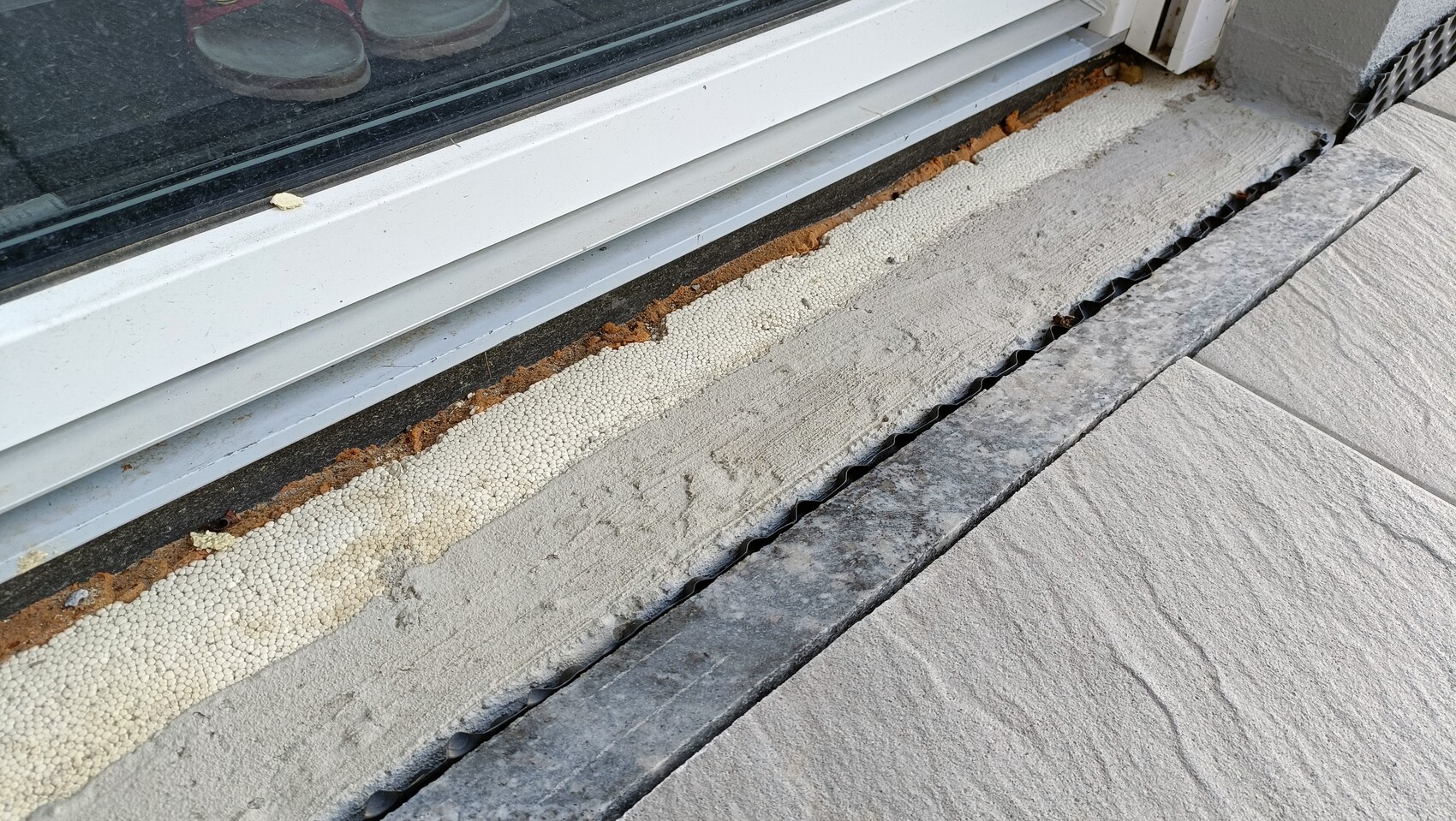
we have constructed a new building with an external thermal insulation composite system (ETICS / EIFS). The exit steps to the terrace and front door were done as DIY work. Currently, it looks like in the photo: the insulation boards are glued to the exterior wall and extend up to the door frame. The site manager from the developer said at the time, "Cut the insulation boards so the step fits in and then insert it – this is how it’s done everywhere."
However, we absolutely cannot imagine that a simply glued (soft) insulation board could permanently support a several-kilogram heavy (hard) stone slab under constant foot traffic without breaking or sustaining other damage.
For support, we have now installed granite beams along the front side in front of the drainage membrane. On the backside (door frame side), however, I have no idea what else could be done there to preserve the insulation permanently and prevent it from breaking due to the load.
Is there perhaps anyone among us who has had a similar case and found a solution – or how would you approach this situation?
N
nordanney20 Oct 2024 18:50There are various options depending on the type of exit you want.
One option is similar to a windowsill, usually installed with brackets (e.g., Sto step console PH) and fitted before the insulation and plaster. Almost every system supplier provides corresponding installation guidelines for this, which are all available online.
Another option is, for example, granite steps that are glued onto the insulation (I hope it's XPS - but it looks more like bead polystyrene insulation) or an XPS wedge. If you actually have "soft" insulation of a different kind, you have a problem. A big one that will require a lot of work because you’ll need to open everything up again.
How is the waterproofing planned?
One option is similar to a windowsill, usually installed with brackets (e.g., Sto step console PH) and fitted before the insulation and plaster. Almost every system supplier provides corresponding installation guidelines for this, which are all available online.
Another option is, for example, granite steps that are glued onto the insulation (I hope it's XPS - but it looks more like bead polystyrene insulation) or an XPS wedge. If you actually have "soft" insulation of a different kind, you have a problem. A big one that will require a lot of work because you’ll need to open everything up again.
How is the waterproofing planned?
D
derdietmar20 Oct 2024 21:03Hello,
this can be resolved using brackets that extend over the insulation from the outside. For this purpose, a sufficiently deep and solid concrete foundation must be installed in the ground in front of the insulation. Tread plates can then be mounted onto these brackets.
However, there is not enough height space for this, so the insulation must be cut accordingly. The waterproofing towards the building must not be damaged in the process. Afterwards, the cut surface and the transition to the external plaster must be resealed to prevent plaster damage, ideally up to the window frame.
An alternative, as mentioned by [USER=14669]@nordanney, depends on the ground construction. The area around the bracket must then be carefully resealed—this concerns the building’s waterproofing.
It’s nothing complicated but involves work and costs (removing patio slabs and granite blocks, excavation, cutting insulation, and concreting the base or installing brackets). Drainage also needs to be addressed, as water must be able to run off in front of the window.
Best regards
this can be resolved using brackets that extend over the insulation from the outside. For this purpose, a sufficiently deep and solid concrete foundation must be installed in the ground in front of the insulation. Tread plates can then be mounted onto these brackets.
However, there is not enough height space for this, so the insulation must be cut accordingly. The waterproofing towards the building must not be damaged in the process. Afterwards, the cut surface and the transition to the external plaster must be resealed to prevent plaster damage, ideally up to the window frame.
An alternative, as mentioned by [USER=14669]@nordanney, depends on the ground construction. The area around the bracket must then be carefully resealed—this concerns the building’s waterproofing.
It’s nothing complicated but involves work and costs (removing patio slabs and granite blocks, excavation, cutting insulation, and concreting the base or installing brackets). Drainage also needs to be addressed, as water must be able to run off in front of the window.
Best regards

Sven2617 schrieb:
We built a new house with external thermal insulation composite system (ETICS). The exit steps to the terrace and front door were done as self-performed work. Sorry, I have to quote Wolfgang Petry here: this is madness!
No one in their right mind would take such critical building damage risk items out of the package of details the contractor is supposed to provide.
nordanney schrieb:
How is the waterproofing planned? Exactly for that reason.
https://www.instagram.com/11antgmxde/
https://www.linkedin.com/company/bauen-jetzt/
First of all, many thanks to all of you for your opinions and suggestions. I somehow always had the impression that the insulation boards extend along the rear side directly down to the edge of the foundation slab. Thanks to you, I just looked through the photo archive again and noticed that there is actually a step below. This means the insulation board on the rear side rests about halfway on the foundation slab and is not just glued on the side. This somewhat relieves me, as it seems the board is supported on the rear side after all. Nevertheless, the issue of loading on the "soft" insulation board remains.

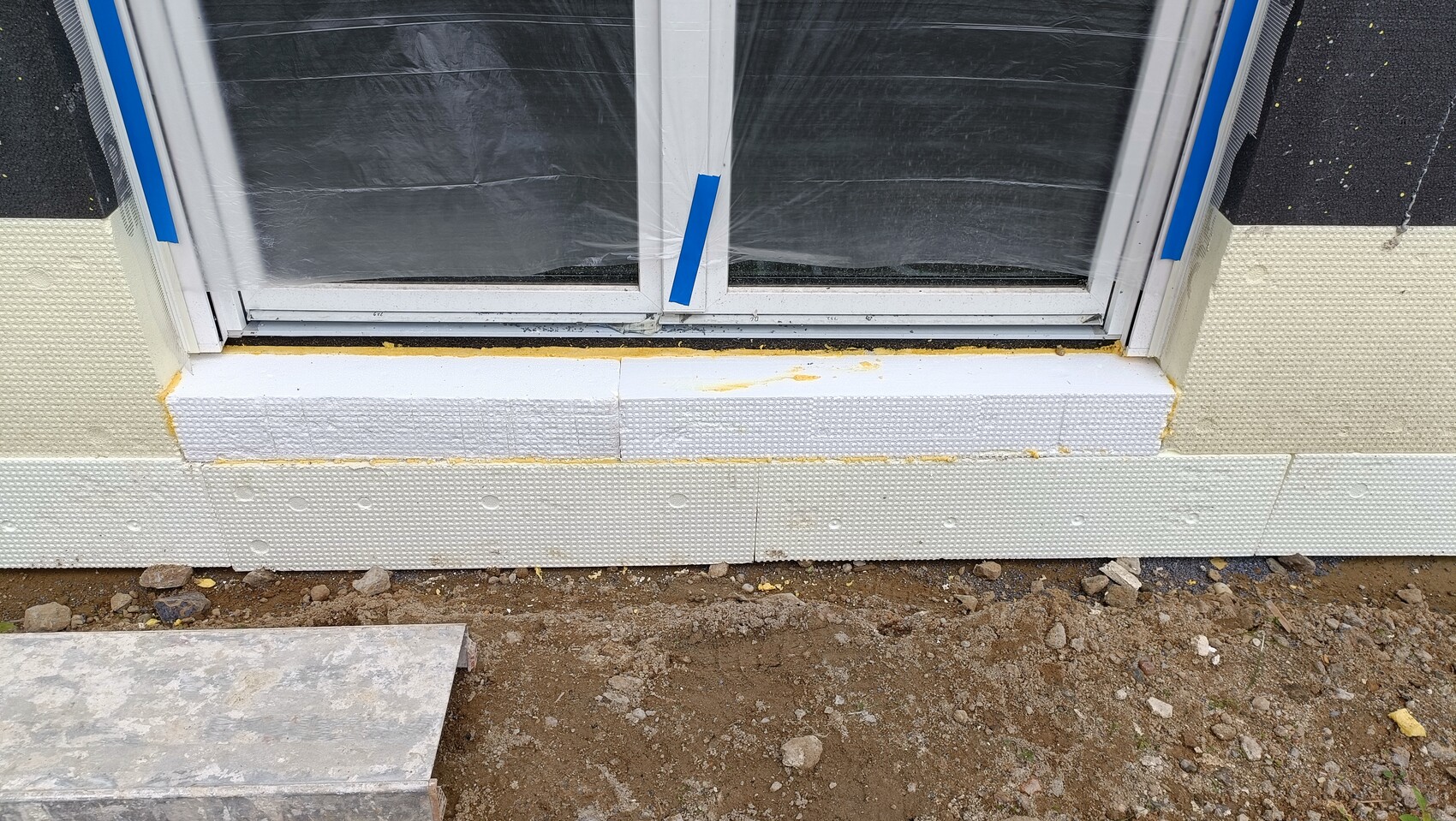
nordanney schrieb:We settled on granite steps, which are already ready.
Either something like a window sill ... or also, for example, granite steps,
nordanney schrieb:It doesn’t look like XPS (which are the rigid ones, right?). According to my current research, these seem to be some kind of base insulation boards from STO. I need to investigate that further... I haven't fully understood the XPS wedge part yet.
... which are glued onto the insulation (I hope it’s XPS – but I only see some kind of polystyrene bead insulation) or onto an XPS wedge. If there is really a "soft" type of insulation, you have a problem. A very big one that requires a lot of work, because you will have to open up a lot again.
nordanney schrieb:Admittedly, we haven’t got that far yet. I wanted to look for a possible solution first.
What is the waterproofing plan?
derdietmar schrieb:I hadn’t thought of something like that yet... What kind of brackets are those? I quickly couldn’t find any that could withstand such a load (granite slabs).
... this can be compensated by brackets that overlap the insulation from the outside. For this, a sufficiently deep and solid concrete footing must be installed in front of the insulation in the ground. Walking plates can then be mounted on these brackets.
derdietmar schrieb:The idea was to install the stepping stones with a slight slope towards the outside.
Drainage also needs to be clarified; water must be able to drain away in front of the window.
11ant schrieb:I agree with you, but we didn’t remove anything there. In hindsight, I rather think the developer consciously arranged it that way. It only came up in the end, after completion, through us. If you’re not a professional, you have absolutely no idea about such things beforehand (we had expert inspectors). Most of what you learn only comes during construction or painfully after completion.
Sorry, I have to quote Wolfgang Petry here: that’s madness! No sane person would remove such top-priority construction damage items from the package of details to be provided by the contractor.
Sven2617 schrieb:
I agree with you, but we didn’t remove anything. Looking back, I think the developer deliberately arranged it that way. It only came up at the very end when it was already completed. If you’re not an expert, you really have no idea about these things in advance (we did have experts). Most of it you only learn during construction or painfully after completion. Oh, so it wasn’t an intentional “self-performed work” but rather a gap in the scope of work caused by not questioning what the term “by the builder” meant in the plans. That means you as homeowners are now left to fix the consequences of your contracting oversight. But wouldn’t it usually be the general contractor’s responsibility to provide that during planning? Or does the drawing actually show “an open void, connection by improvisation or forum audience’s wildcard, counting rhyme, or coin toss” planned?
https://www.instagram.com/11antgmxde/
https://www.linkedin.com/company/bauen-jetzt/
Similar topics