
Hello everyone!
The photovoltaic topic has now caught up with me as well.
I have ordered 22 modules (10 kWp) plus a battery storage system (10 kW).
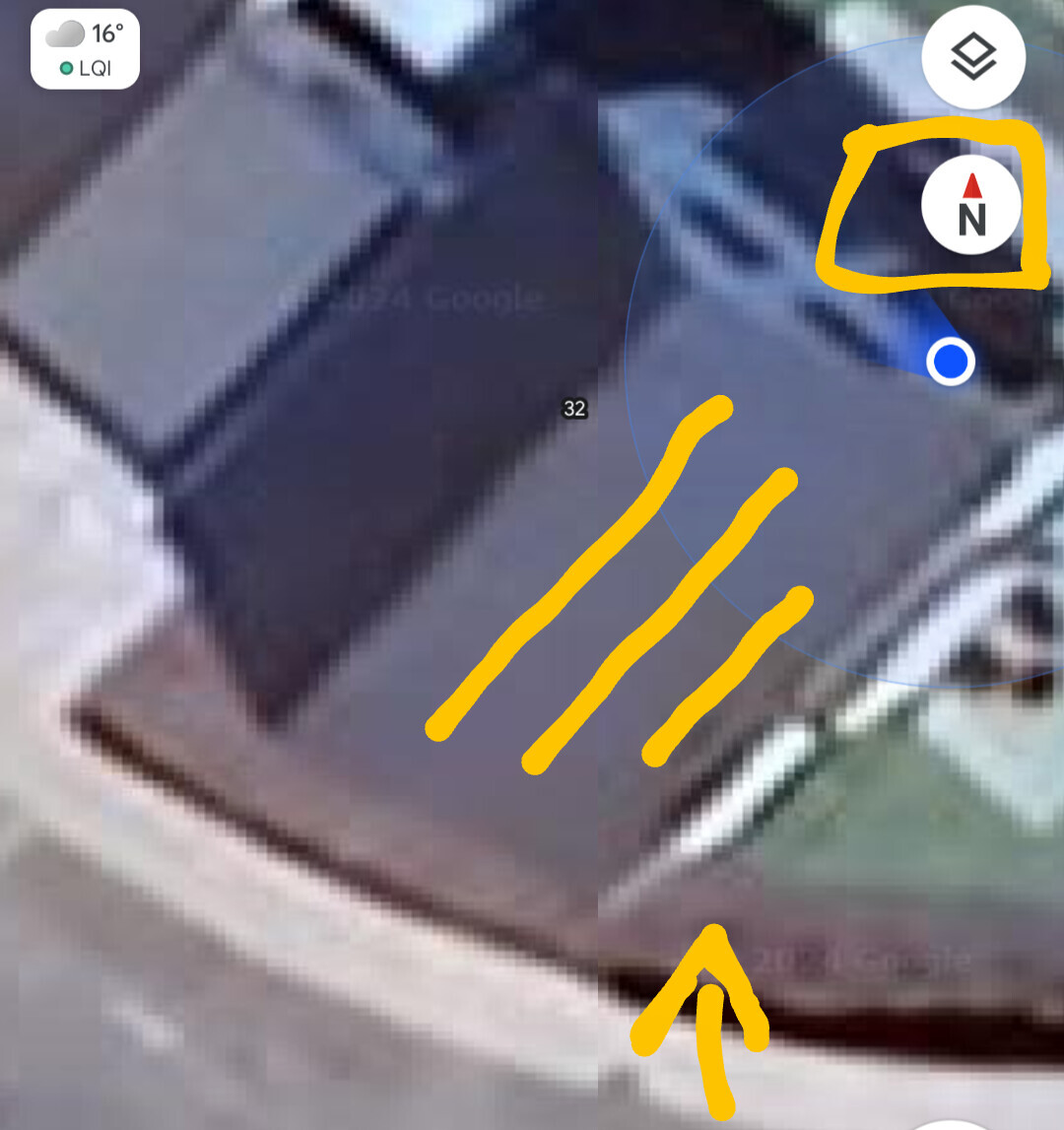
1) I would like to ask for your opinion on whether it makes sense to install modules on the back side of the house due to the roof orientation (see photo for orientation).
The sun only reaches that side in the afternoon; the planned roof gets a lot of sunlight from the south, so the battery should be well charged. Does it still make sense to capture the evening sun there? I’m not yet convinced about the added value and whether the gain justifies the effort, especially since the direct side irradiation only occurs in the afternoon to evening hours.
Our consumption is as follows:
Air-source heat pump (water + heating): 3,300 kWh
Household: 2,600 kWh
In the future, an electric car is also likely.
2) Currently, we have two meters (heat pump electricity at 22.67 cents/kWh with €8.15 basic fee; household electricity at 30.49 cents/kWh with €13.84 basic fee).
Does it still make sense to operate with two meters given our consumption? (Additional cost for cascade wiring by the electrician €250 plus annual extra basic fees of about €120)
How did you decide on this?
Thanks everyone!
The photovoltaic topic has now caught up with me as well.
I have ordered 22 modules (10 kWp) plus a battery storage system (10 kW).
1) I would like to ask for your opinion on whether it makes sense to install modules on the back side of the house due to the roof orientation (see photo for orientation).
The sun only reaches that side in the afternoon; the planned roof gets a lot of sunlight from the south, so the battery should be well charged. Does it still make sense to capture the evening sun there? I’m not yet convinced about the added value and whether the gain justifies the effort, especially since the direct side irradiation only occurs in the afternoon to evening hours.
Our consumption is as follows:
Air-source heat pump (water + heating): 3,300 kWh
Household: 2,600 kWh
In the future, an electric car is also likely.
2) Currently, we have two meters (heat pump electricity at 22.67 cents/kWh with €8.15 basic fee; household electricity at 30.49 cents/kWh with €13.84 basic fee).
Does it still make sense to operate with two meters given our consumption? (Additional cost for cascade wiring by the electrician €250 plus annual extra basic fees of about €120)
How did you decide on this?
Thanks everyone!
N
nordanney12 Sep 2024 10:44Pete1909 schrieb:
2) Currently, we still have two meters (heat pump electricity at 22.67 cents / €8.15 base fee / household electricity at 30.49 cents / €13.84 base fee).
Does it still make sense to operate with two meters at our consumption level? (Additional cost of the cascade connection by the electrician €250 + the additional monthly base fee of about €120 per year) So you are currently paying about 26 cents for your heat pump electricity. If you reduce your consumption—at least from spring to autumn, you will no longer buy electricity from the grid—the price per kWh rises to almost 28 cents when purchasing 2,000 kWh from the grid. You can run the numbers yourself.
If you sign a new electricity contract based on today’s rates, you will pay around 25 cents per kWh (I just arranged this effective November 1), so having a second meter no longer makes sense.

Hello,
A cascade connection with two meters combined with a photovoltaic system involves a considerable effort. And honestly, it usually isn’t really worth it. You would need your heat pump to consume at least 1200 kWh of electricity just to cover the basic fee of the second meter.
Regarding your question about the output: There are various yield calculators online that can estimate whether it’s worthwhile based on your roof’s orientation and tilt. Try searching for "PVGIS."
Since your roof faces northwest, it could actually make sense. The additional costs are also manageable because a standard inverter can handle two strings plus a battery. So, you don’t need an extra inverter. The one-time expenses such as grid connection, electrician, inspection, scaffolding, etc., remain the same.
A battery storage system only makes economic sense if you can get it for no more than 400–500 euros per kWh. However, it has the great advantage that you don’t have to adjust your behavior so strictly to the sunlight hours. For example, you can still run the washing machine, dishwasher, or dryer in the evening or early morning without worrying about paying 30 cents for grid electricity instead of only 8 cents during the day.
Kind regards,
Andreas
A cascade connection with two meters combined with a photovoltaic system involves a considerable effort. And honestly, it usually isn’t really worth it. You would need your heat pump to consume at least 1200 kWh of electricity just to cover the basic fee of the second meter.
Regarding your question about the output: There are various yield calculators online that can estimate whether it’s worthwhile based on your roof’s orientation and tilt. Try searching for "PVGIS."
Since your roof faces northwest, it could actually make sense. The additional costs are also manageable because a standard inverter can handle two strings plus a battery. So, you don’t need an extra inverter. The one-time expenses such as grid connection, electrician, inspection, scaffolding, etc., remain the same.
A battery storage system only makes economic sense if you can get it for no more than 400–500 euros per kWh. However, it has the great advantage that you don’t have to adjust your behavior so strictly to the sunlight hours. For example, you can still run the washing machine, dishwasher, or dryer in the evening or early morning without worrying about paying 30 cents for grid electricity instead of only 8 cents during the day.
Kind regards,
Andreas

Nida35a schrieb:
1. It makes sense to start with just the south side. 100% of the cost for 80% of the yield.
2. We have similar values and decided to reduce to one meter, so everything runs through the photovoltaic system and battery, including the heat pump. 1. So you mean it makes more sense to allocate 100% to the one "south side" because it produces significantly higher yield, rather than placing part on the northwest side with lower output?
2. The trend is leaning that way as well. While there’s no crystal ball to know if heat pump electricity will become significantly cheaper than regular electricity, for a remaining consumption of about 2000 kWh as mentioned here, operating two meters doesn’t pay off with the current price difference.
andimann schrieb:
Hello,
A cascade setup with two meters combined with a photovoltaic system probably involves quite a bit of effort. And it’s not exactly cost-effective either. Your heat pump would need to consume at least 1200 kWh of electricity just to cover the basic fee of the second meter.
Regarding your question about the yield: there are various yield calculators online that can estimate whether it’s worthwhile based on the roof orientation and pitch. Try searching for "PVGIS."
Since this is a northwest orientation, it might still make sense. The additional costs are manageable because a standard inverter can handle 2 strings plus a battery. So you don’t need an extra inverter. Also, the one-time costs such as connection fees, electrician, inspection, scaffolding, etc., remain the same.
A battery only makes economic sense if you can get it for no more than 400-500 euros per kWh. However, it has the major advantage that you don’t need to adjust your usage so much according to the sun’s availability. In other words, you can still run your washing machine, dishwasher, or dryer as usual in the evenings or early mornings without regretting paying 30 cents for grid electricity instead of 8 cents during the day...
Best regards,
Andreas Thank you very much, Andreas, for your detailed post :-)
I will try the yield calculator this evening! Thanks! But logically, the southeast side will probably have a higher yield and also charge the battery well.
Similar topics