
ᐅ Dynamic bearing pressure test failed even after additional compaction
Created on: 24 Jun 2024 21:34
L
LabMember001L
LabMember00124 Jun 2024 21:34Hello everyone,
we have recently started our construction project and are already facing the first problems. We are planning to build a single-family house and had an old barn building on the property demolished. This went smoothly.
To save costs, and in agreement with the general contractor (GC), we had the demolition company also carry out the earthworks and the sand slab. After the building was demolished, we commissioned a soil report. According to this report, a shallow foundation is possible. At both drilling locations, up to 1 meter (3.3 feet) had to be excavated (humus layers and construction debris). Afterwards, the area was to be backfilled with fill sand, a gravel-sand mix, or crushed stone material. On the prepared surface, a deformation modulus of at least 70 MN/m² (7,000 kPa or about 14,310 psi) with a ratio value of less than 2.5 should be demonstrated.
The earthworks contractor backfilled with fill sand and compacted it in layers. We then conducted a dynamic plate load test, which resulted in measured values at two locations of about 26 MN/m² (2,600 kPa / 377 psi) and 34 MN/m² (3,400 kPa / 493 psi). According to the soil expert, the dynamic test should have shown at least 35 MN/m² (3,500 kPa / 507 psi). We therefore asked the earthworks contractor to perform additional compaction. This was done and tested again with a dynamic plate load test. This time, values of 33.5 MN/m² (3,350 kPa / 485 psi) and 35.5 MN/m² (3,550 kPa / 515 psi) were recorded. One value now meets the minimum requirement, while the other is still too low. Right after receiving the results of the second test, the earthworks contractor reacted very irritably and stated that it should now be fine. He said the value was too high anyway and that he had been building houses for years without ever having to meet such high requirements.
Now it is a case of conflicting statements, and we are caught in the middle. To be honest, we tend to trust the soil report’s recommendation, as it took the soil structure into account, and we have read this 70 MN/m² (7,000 kPa / about 14,310 psi) requirement multiple times in other soil reports as well.
Our general contractor understandably requires proof before the foundation work that the soil report criteria are met.
Can you help us with this question? Are these values actually too high? It seems to us that the values can definitely be achieved if further improvement or additional compaction is carried out.
we have recently started our construction project and are already facing the first problems. We are planning to build a single-family house and had an old barn building on the property demolished. This went smoothly.
To save costs, and in agreement with the general contractor (GC), we had the demolition company also carry out the earthworks and the sand slab. After the building was demolished, we commissioned a soil report. According to this report, a shallow foundation is possible. At both drilling locations, up to 1 meter (3.3 feet) had to be excavated (humus layers and construction debris). Afterwards, the area was to be backfilled with fill sand, a gravel-sand mix, or crushed stone material. On the prepared surface, a deformation modulus of at least 70 MN/m² (7,000 kPa or about 14,310 psi) with a ratio value of less than 2.5 should be demonstrated.
The earthworks contractor backfilled with fill sand and compacted it in layers. We then conducted a dynamic plate load test, which resulted in measured values at two locations of about 26 MN/m² (2,600 kPa / 377 psi) and 34 MN/m² (3,400 kPa / 493 psi). According to the soil expert, the dynamic test should have shown at least 35 MN/m² (3,500 kPa / 507 psi). We therefore asked the earthworks contractor to perform additional compaction. This was done and tested again with a dynamic plate load test. This time, values of 33.5 MN/m² (3,350 kPa / 485 psi) and 35.5 MN/m² (3,550 kPa / 515 psi) were recorded. One value now meets the minimum requirement, while the other is still too low. Right after receiving the results of the second test, the earthworks contractor reacted very irritably and stated that it should now be fine. He said the value was too high anyway and that he had been building houses for years without ever having to meet such high requirements.
Now it is a case of conflicting statements, and we are caught in the middle. To be honest, we tend to trust the soil report’s recommendation, as it took the soil structure into account, and we have read this 70 MN/m² (7,000 kPa / about 14,310 psi) requirement multiple times in other soil reports as well.
Our general contractor understandably requires proof before the foundation work that the soil report criteria are met.
Can you help us with this question? Are these values actually too high? It seems to us that the values can definitely be achieved if further improvement or additional compaction is carried out.
 schubert7925 Jun 2024 06:52
Did the civil engineer know about the value you required? What was agreed upon?
Hello,
In my reports, I always require a resilient modulus (Ev2) of 80 MN/m² for single-family houses. In my opinion, this should be the minimum standard. We want to ensure that the installed material achieves a Proctor density of at least 97%. In our region, however, gravel (GW) is typically used, which usually allows values above 100 MN/m² without any problems. From what you describe, you seem to be building rather in the north with sand (SE, SW, SI).
If these values are not reached, proper compaction is not achieved, and settlements may occur. I suspect the earthworks contractor might be frustrated because he really gave his best, but the material is simply unsuitable or of poor quality.
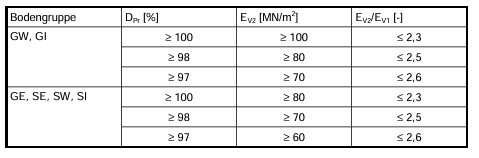
What can help is thoroughly moistening the material again and compacting it once more. There should be at least 24 hours of "rest" between compaction and the plate load test.
Ideally, a static plate load test should also be performed to determine the modulus ratio (Ev2/Ev1). This indicates how well the material has been compacted and whether there is still "room for improvement" due to the material itself. Unfortunately, this test is often omitted because it is more complex and therefore more expensive... Alternatively, a Proctor test can be conducted, but that also incurs costs...
For more advice, I would need photos, a soil report, and the delivery note of the installed material.
Good luck
In my reports, I always require a resilient modulus (Ev2) of 80 MN/m² for single-family houses. In my opinion, this should be the minimum standard. We want to ensure that the installed material achieves a Proctor density of at least 97%. In our region, however, gravel (GW) is typically used, which usually allows values above 100 MN/m² without any problems. From what you describe, you seem to be building rather in the north with sand (SE, SW, SI).
If these values are not reached, proper compaction is not achieved, and settlements may occur. I suspect the earthworks contractor might be frustrated because he really gave his best, but the material is simply unsuitable or of poor quality.
What can help is thoroughly moistening the material again and compacting it once more. There should be at least 24 hours of "rest" between compaction and the plate load test.
Ideally, a static plate load test should also be performed to determine the modulus ratio (Ev2/Ev1). This indicates how well the material has been compacted and whether there is still "room for improvement" due to the material itself. Unfortunately, this test is often omitted because it is more complex and therefore more expensive... Alternatively, a Proctor test can be conducted, but that also incurs costs...
For more advice, I would need photos, a soil report, and the delivery note of the installed material.
Good luck
L
LabMember00125 Jun 2024 17:14schubert79 schrieb:
Did the foundation contractor know about the value you requested? What was agreed? This is unfortunately a bit more complicated: The demolition quote was naturally prepared before the demolition. At that time, earthworks for backfilling and compaction were also requested (assuming a 0.5m (20 inches) depth for filling and compacting). We did not have soil reports yet because we couldn’t access the drilling points (corner points of the future house) due to the barn building. This was only possible during the demolition, once the roof truss was removed. As soon as we received the soil report, we immediately sent it to the foundation contractor. He then began the earthworks. We already made sure back then that the depth was carried out according to the soil report (at least 1m (3 feet 3 inches)). Afterwards, the area was backfilled and compacted in layers with filling sand (SE). At that time, we assumed the soil report had actually been reviewed. Looking back, we are unsure about this because the contractor complained about the dynamic load test he performed. If he had really examined the soil report, he would have known that the deformation modulus must be demonstrated on the base layer (planum) and that a load test must be factored in.
Cronos86 schrieb:
Hello,
In my reports, I always require an EV2 of 80 MN/m² for single-family houses. In my opinion, this should be the minimum standard. We want to ensure that the installed material achieves a Proctor density of at least 97%. In our region, gravel (GW) is typically used, which usually allows values above 100 MN/m² without problems. From what you describe, you are rather building in the North, using sand (SE, SW, SI).
If the required values are not reached, optimal compaction is not achieved and settlements may occur. I suspect the foundation contractor is frustrated because he really gave his best and that the material is simply unsuitable or poor in quality.
What can help is to wet the material properly again and compact it once more. There should be at least 24 hours of rest between compaction and the load plate test.
Normally, a static load plate test is also performed to determine the ratio (Ev2/Ev1). This indicates how well the material was compacted and whether there is potential for improvement due to the material itself. Unfortunately, this test is often skipped because it is more complex and therefore more expensive... Alternatively, a Proctor test can be done, but that also costs money...
For more advice, I would need pictures, the soil report, and delivery notes for the installed material.
Good luck Thank you very much for the detailed reply. This already helps us a lot to assess the value. As you suspected, the construction is taking place in the North. Honestly, we also believe that the value might no longer be achievable and that this is why the reaction was so frustrated. At no point have we been unfriendly; we are genuinely only interested in a reasonable solution to the problem. We would even be willing to contribute financially if necessary—as long as the issue can be resolved and progress is made. Understandably, the general contractor will not continue work under the current circumstances.
We only had a dynamic load test carried out because we did not want costs to skyrocket in case we needed to repeat it multiple times. Including travel, each (failed) test costs more than €200, so this can quickly become expensive if the target is not reached. Fortunately, we are only at two tests so far. As you suggested, we will now request a static load test to determine the ratio. At least that will provide clarity on whether there is still potential for further compaction.
The "annoying" part about a static load plate test is that it requires a counterweight of at least 7.5 tons (7.5 metric tons), meaning you need an excavator or something similar. The test itself takes about half an hour. It’s definitely different from just dropping the plate three times...
Unfortunately, I don’t have a perfect solution to this problem, and I know every euro spent on building a house is painful and needed elsewhere.
I would try the approach described with watering and recompacting. With a well-graded sand (SE sand), 80 MN/m² (megapascals) is basically the upper limit. So, reaching 35 MN/m² with the dynamic test and calling it good should be fine.
Unfortunately, I don’t have a perfect solution to this problem, and I know every euro spent on building a house is painful and needed elsewhere.
I would try the approach described with watering and recompacting. With a well-graded sand (SE sand), 80 MN/m² (megapascals) is basically the upper limit. So, reaching 35 MN/m² with the dynamic test and calling it good should be fine.
Similar topics