
ᐅ Heat pump on the flat roof is making a loud humming noise
Created on: 3 Apr 2024 07:32
N
Nik_Hamburg
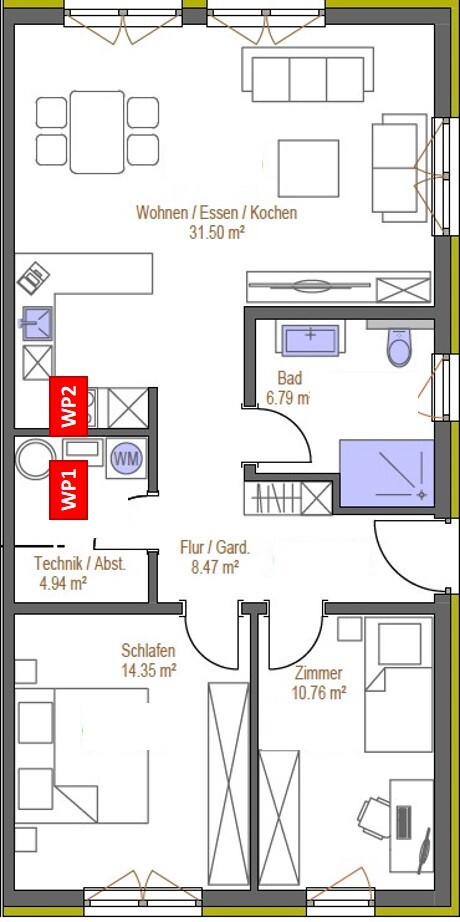
Hello everyone, we purchased a new apartment from a developer. The building has four units, two on the ground floor and two upstairs, with a flat roof timber structure featuring insulation above the rafters and a suspended hollow ceiling. Since there are no common rooms in the building, each apartment has its own heating system (heat pump) with one outdoor unit on the roof. Two of these units are located above our apartment, above the utility room (next to the bedroom) and the kitchen with living area. All interior walls of the apartment are lightweight construction walls. Since the electricity finally started working recently and the units are running, there is a loud humming and droning noise from above, as if a lawn mower is running on the roof. It is unbearable; we are relieved every time we leave the apartment.
Outdoor unit model: Daikin Altherma 3R (I believe, see photos in the link below), placed on small, round vibration isolation feet on vibration dampening beams, which are mounted on concrete beams that are reportedly (I cannot see, as there is green roof substrate on top) resting on vibration isolation mats.
Photos attached.
I am just surprised why the humming and droning noise is still so loud despite the vibration isolation measures. Of course, I also don’t know whether it is airborne noise or structure-borne noise (or both).
Does anyone have any idea what could be done technically here? We are really sad and desperate; it is impossible to move into this apartment.
The only thing I can think of as a layperson would be to place huge and very thick sound insulation mats under the outdoor units. But somehow they also need to be fixed securely, otherwise they could be blown away. Or open the ceiling again and insert thick insulation wool between the rafters. I am really at a loss. Unfortunately, the developer is incompetent and does not take care of the legal or cost issues; we will have to deal with that later.
Thanks for your help. Nik
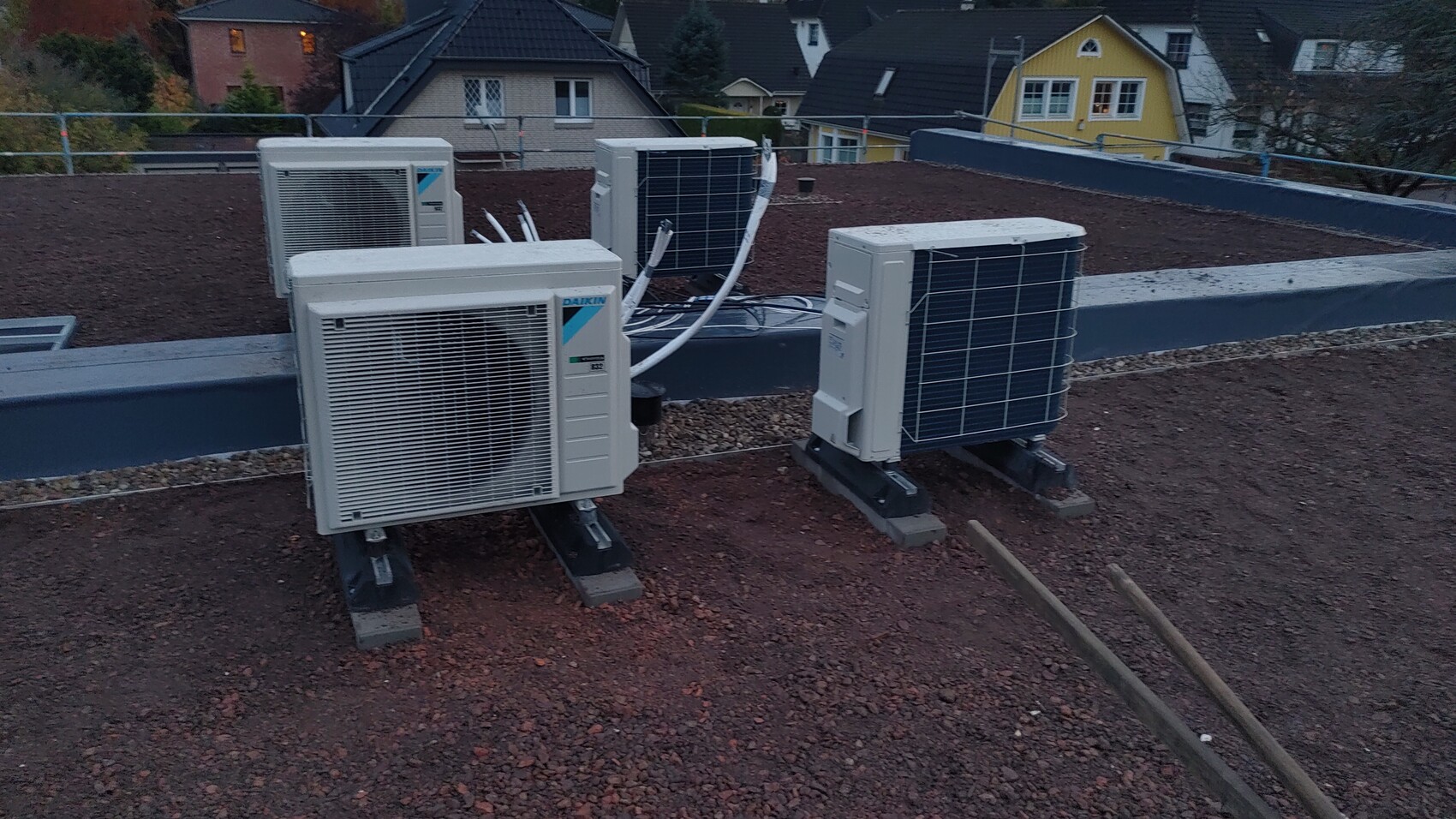
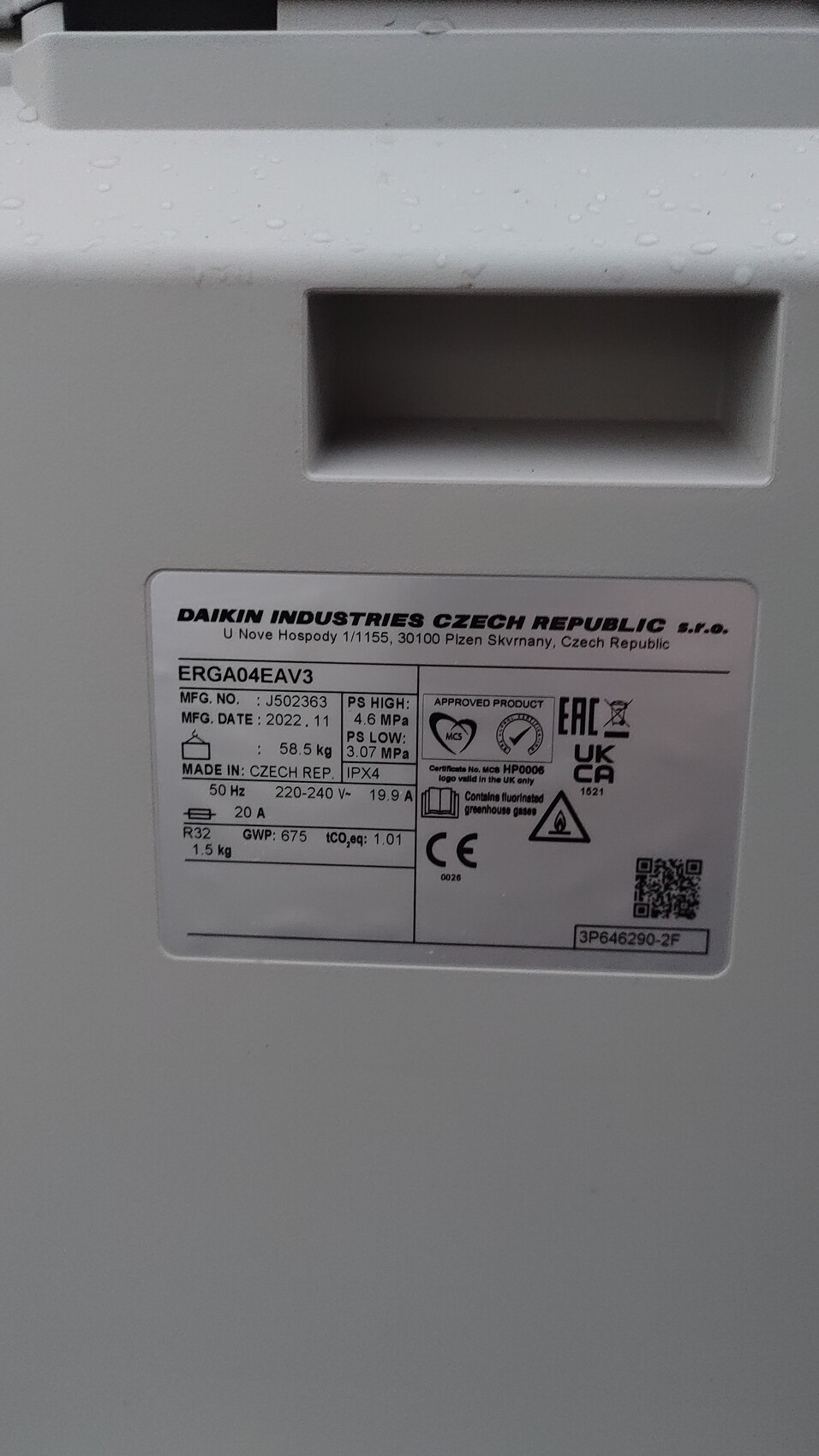
Outdoor unit model: Daikin Altherma 3R (I believe, see photos in the link below), placed on small, round vibration isolation feet on vibration dampening beams, which are mounted on concrete beams that are reportedly (I cannot see, as there is green roof substrate on top) resting on vibration isolation mats.
Photos attached.
I am just surprised why the humming and droning noise is still so loud despite the vibration isolation measures. Of course, I also don’t know whether it is airborne noise or structure-borne noise (or both).
Does anyone have any idea what could be done technically here? We are really sad and desperate; it is impossible to move into this apartment.
The only thing I can think of as a layperson would be to place huge and very thick sound insulation mats under the outdoor units. But somehow they also need to be fixed securely, otherwise they could be blown away. Or open the ceiling again and insert thick insulation wool between the rafters. I am really at a loss. Unfortunately, the developer is incompetent and does not take care of the legal or cost issues; we will have to deal with that later.
Thanks for your help. Nik
W
WilderSueden5 Apr 2024 10:04When it comes to noise issues, you will hardly get anywhere without an expert report. On top of that, you have the practical problem that the heating season is over and the humming will hardly occur for the next 8 months. Even if you run the heat pumps just for a noise assessment, they won’t be under the same load at an outside temperature of 20°C (68°F) as they would be in winter.
I would recommend consulting not only an expert but also a specialist lawyer to make sure you don’t miss any deadlines.
I would recommend consulting not only an expert but also a specialist lawyer to make sure you don’t miss any deadlines.
N
Nik_Hamburg5 Apr 2024 10:38Rübe1 schrieb:
If they were finally installed like that, there is another problem. One pump always ends up with the "cold" air forced onto it, which causes a significant loss of efficiency. How **** do you have to be...Oh yes, I hadn’t noticed that either (thanks also for Tolentino’s comment). They must have had some idea behind it, though I don’t know what. It makes sense (or not) that one device has to deliver more power because it gets the cooled air from the other. If you were to reposition them now, should two devices facing each other blow air towards one another or away from each other?
dertill schrieb:
These are split units, not monoblock systems. So those are insulated copper refrigerant lines. They are also flexible. Flexible lines look like the connection pieces under a sink from the angle valve to the faucet and are additionally insulated, not delivered pre-insulated. However, those are only used with water.
For refrigerant (split unit), a coupling piece for vibration isolation/damping must be used at the connection point, and the copper refrigerant line can also be routed in a loop.The heating installer said he can’t decouple the connection lines for the refrigerant; a coupling piece for vibration isolation/damping would inevitably be made of plastic, and that wouldn’t withstand the refrigerant temperatures. He says such a thing does not exist and isn’t possible. What do you think of this statement?
WilderSueden schrieb:
When it comes to noise, you won't get far without an expert report. On top of that, you have the practical problem that the heating season is over and the humming won’t occur much during the next 8 months. Even if you run the heat pumps specially for a noise assessment, they won’t have the same load in 20°C (68°F) outdoor temperatures as they would in winter.
I would not only consult an expert but also a specialized lawyer to make sure no deadlines are missed.Thanks for the tip! At least I’ve experienced that it hums noticeably when I turn the thermostats for the underfloor heating all the way up, drain the hot water tank, and then set it to high-performance mode. But since it will be over 20°C (68°F) for the next few days, probably not much will happen heating-wise for now, that’s true... Regarding a lawyer: We reported the defect to the builder immediately after discovering it, the handover was just last week, and we now have a 5-year warranty. I would also consider a lawyer to put some pressure on, but of course that’s also a matter of cost and could strain the business relationship with the builder. However, after everything they’ve put us through over the past months, that’s basically irrelevant ...
One more question: I accidentally noticed in a photo (attached) that the small, round, black feet under the unit were installed differently (once with a gap to the beam, once without). Could this be a problem?
Thanks for your committed comments! Regards, Nik
W
WilderSueden5 Apr 2024 10:48Nik_Hamburg schrieb:
They must have had some idea behind it, but I just don’t know what. It looks better. Otherwise, I wouldn’t assume anyone really thought this through. In my opinion, the correct setup would be to draw air in through the middle and have both heat pumps blow away from each other. Ideally, this should also be arranged so that the adjacent heat pump is not directly in the exhaust airflow.
Nik_Hamburg schrieb:
I also think involving a lawyer is a good idea to put pressure on them, but of course, it’s also a matter of cost and can strain the business relationship with the developer. An initial consultation is not particularly expensive, but it helps to assess the legal situation. Whether or not you then need to apply pressure through a lawyer is something to discuss, but it’s not necessarily the goal. I wouldn’t delay dealing with the issue just because of warranty coverage. Eventually, you want to enjoy your time in the new home instead of constantly arguing.
By the way, it’s not you who damages the business relationship—it’s the developer through shoddy work.
Nik_Hamburg schrieb:
Oh yes, I hadn’t noticed that either (thanks also for Tolentino’s comment). They must have had some idea behind it, but I just don’t know what.They didn’t think about it at all. They’re not paid to think ahead. If (as mentioned: if) there was a plan, then the planner is responsible and the pipe fitter just carries it out. But really, he should have raised concerns at least. This photo should be sent to Daikin as a warning example of the nonsense their specialist contractors sometimes do.Either they are all lined up, which of course looks bad and might cause other issues, or at least staggered so none get the direct cold air from the others. As it is, it definitely cannot stay. I also consider turning two of them around to be suboptimal. If one runs on low speed and the other suddenly goes full power for some reason, they will interfere with each other… But since Mr. Daikin cares about the quality of his installers, he should come up with a constructive suggestion…
Nik_Hamburg schrieb:
The heating engineer said he couldn’t decouple the refrigerant connection lines, because any coupling piece for vibration isolation/damping would inevitably be made of plastic, which wouldn’t withstand the refrigerant temperatures. He said such a thing doesn’t exist and isn’t possible. What do you think about this statement?I believe compensators are also available for refrigerants. Maybe check directly with Daikin.
Otherwise, the refrigerant copper pipes at the connection to the outdoor unit can be arranged in a loop, and the clamps used to fix the pipes to walls shouldn’t be tightened too much and should be installed above the insulation. This way, the copper and clamps remain separated—if clamps are used at all.
On the indoor unit, for the heating circuit, compensators or flexible hoses can be installed in any case. There you can check directly on the pipe whether vibrations are being transmitted.
Nik_Hamburg schrieb:
One more question: I accidentally noticed in a photo (see attached) that the small, round, black feet directly under the unit were installed differently (once with a gap to the beam, once without). Could this be a problem?No, they were simply leveled to make sure the unit stands straight. Just like with your washing machine.Similar topics