
ᐅ Planning a Single-Family Home with Four Children’s Bedrooms
Created on: 27 Mar 2024 21:02
B
Blaupause250B
Blaupause25027 Mar 2024 21:02Hello dear forum,
We are a family with currently 3 children, with a 4th on the way, and we want to build a house in Brandenburg (near Berlin).
We are complete beginners in the field of house building and often find it hard to make decisions simply because we lack deeper knowledge.
Maybe you can help us or give some tips—we would be very grateful.
Now, some basic information:
We have been promised a plot of land; the notary appointment is expected to take place in about 2 months.
The plot is approximately 1000 sqm (10,764 sq ft) and according to the development plan, has a floor area ratio of 0.2. Construction is allowed with one full storey, with an additional full storey permitted if it is built within a roof space.
A gable, hip, or half-hipped roof is mandatory, with a pitch between 30° and 50°.
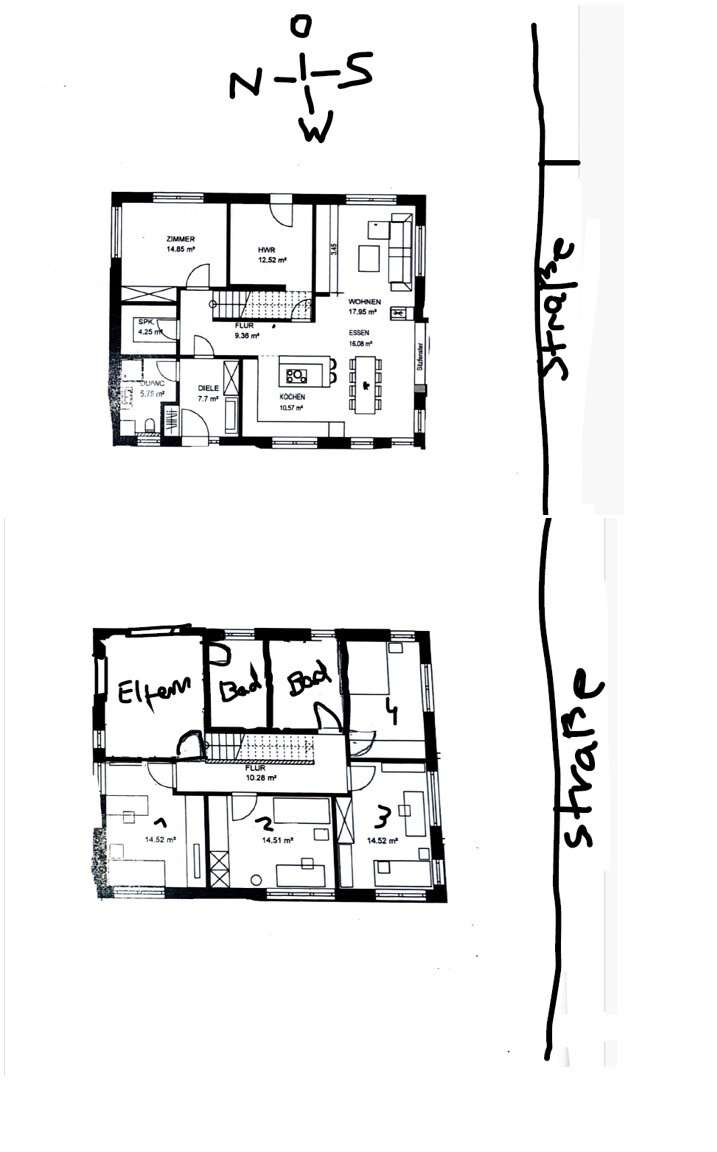
Our “dream floor plan,” which we have designed, is attached. The footprint here would be 12.85 x 9.89 m (42.2 x 32.4 ft) with a gable roof on top. Knee wall height (dwarf wall) is 1.80 m (5.9 ft).
Unfortunately, a townhouse-style villa is not possible due to the above restrictions, as the roof would then not be integrated into the second storey.
What is important to us:
The living area should be no less than 160 sqm (1,722 sq ft), ideally around 180–190 sqm (1,938–2,045 sq ft).
At least 3 children’s bedrooms should be available.
A home office must also be included (on the ground floor).
A knee wall height of at least 1.80 m (5.9 ft) is important because we have some very tall men in the family.
Windows on all four sides on the upper floor (no need for floor-to-ceiling windows).
A second bathroom upstairs. (We would supply sanitary fittings and tiles/floor coverings at our own cost.)
We have planned a budget of 450,000 € (excluding additional construction costs like fees and permits).
Since this is a very tight budget for such a house, our question is: is it even possible?
What can we cut to save money?
Basically, we see two possibilities: Either keep our floor plan and wishes and cut back on many things (insulation, ventilation system, etc.) or simply choose a smaller prefabricated house as specified, built to KfW standard. What would be the pros and cons of that?
A few related questions:
Should one build with a prefab house company or contract the trades separately? Which is cheaper or better?
Because we have some custom wishes (floor plan, knee wall, additional windows), prices from prefab companies quickly became notably more expensive. Also, they include many things that we might want to remove in order to fulfill our wishes (see below regarding heating, insulation, etc.).
We have already talked to several home builders and are now completely confused, as everyone insists their construction method is the best.
Solid construction or timber frame? If solid, which brick/block size? 24 cm, 36 cm?
EPS (expanded polystyrene) insulation, lime-based, or possibly no insulation at all?
Which is more prone to mold or algae? What costs the least?
Centralized/decentralized ventilation system or none at all (I like to ventilate myself)?
I tend towards none, my husband leans towards ventilation.
My purely subjective and absolutely non-professional opinion: I fear the ventilation noise might annoy me, the air might become too dry and overly “clean,” and the ducts might eventually develop mold or get damaged over the years, requiring opening walls and replacing parts.
Additionally, it is a significant cost item that we could save a lot on if we leave it out.
My husband says this technology has been around for a long time, there won’t be any mold or damage. On the contrary, the house would be reliably mold-free with perfectly filtered air, humidity, and temperature.
What would be your expert opinion on this?
We tend to choose underfloor heating because I always feel cold without it, so air/water heat pump rather than air/air.
Is it possible to save costs with the floor plan? Should we aim for as many straight walls as possible and avoid corners to make construction cheaper?
Is the house less expensive if the roof pitch is only 30° instead of, for example, 45°?
If you build according to KfW standard, can you save money by building without it?
We would only apply for KfW funding if we build a timber frame house with a prefab company, because the additional costs for analyses on solid houses are unfortunately too high for our wishes.
We would have liked to use ILB funding as well, but our plot is just outside the eligible zone.
Two companies told us that this means no chance, but two others said it would not be a problem and the architect could simply apply for an extension of the zone. It would just be a letter that the city would have to sign, so it wouldn’t be a problem.
Are some companies just too lazy to handle the applications, or are the others exaggerating?
So many questions—hopefully, they were at least somewhat understandable?
Thank you very much in advance and have a nice evening!
We are a family with currently 3 children, with a 4th on the way, and we want to build a house in Brandenburg (near Berlin).
We are complete beginners in the field of house building and often find it hard to make decisions simply because we lack deeper knowledge.
Maybe you can help us or give some tips—we would be very grateful.
Now, some basic information:
We have been promised a plot of land; the notary appointment is expected to take place in about 2 months.
The plot is approximately 1000 sqm (10,764 sq ft) and according to the development plan, has a floor area ratio of 0.2. Construction is allowed with one full storey, with an additional full storey permitted if it is built within a roof space.
A gable, hip, or half-hipped roof is mandatory, with a pitch between 30° and 50°.
Our “dream floor plan,” which we have designed, is attached. The footprint here would be 12.85 x 9.89 m (42.2 x 32.4 ft) with a gable roof on top. Knee wall height (dwarf wall) is 1.80 m (5.9 ft).
Unfortunately, a townhouse-style villa is not possible due to the above restrictions, as the roof would then not be integrated into the second storey.
What is important to us:
The living area should be no less than 160 sqm (1,722 sq ft), ideally around 180–190 sqm (1,938–2,045 sq ft).
At least 3 children’s bedrooms should be available.
A home office must also be included (on the ground floor).
A knee wall height of at least 1.80 m (5.9 ft) is important because we have some very tall men in the family.
Windows on all four sides on the upper floor (no need for floor-to-ceiling windows).
A second bathroom upstairs. (We would supply sanitary fittings and tiles/floor coverings at our own cost.)
We have planned a budget of 450,000 € (excluding additional construction costs like fees and permits).
Since this is a very tight budget for such a house, our question is: is it even possible?
What can we cut to save money?
Basically, we see two possibilities: Either keep our floor plan and wishes and cut back on many things (insulation, ventilation system, etc.) or simply choose a smaller prefabricated house as specified, built to KfW standard. What would be the pros and cons of that?
A few related questions:
Should one build with a prefab house company or contract the trades separately? Which is cheaper or better?
Because we have some custom wishes (floor plan, knee wall, additional windows), prices from prefab companies quickly became notably more expensive. Also, they include many things that we might want to remove in order to fulfill our wishes (see below regarding heating, insulation, etc.).
We have already talked to several home builders and are now completely confused, as everyone insists their construction method is the best.
Solid construction or timber frame? If solid, which brick/block size? 24 cm, 36 cm?
EPS (expanded polystyrene) insulation, lime-based, or possibly no insulation at all?
Which is more prone to mold or algae? What costs the least?
Centralized/decentralized ventilation system or none at all (I like to ventilate myself)?
I tend towards none, my husband leans towards ventilation.
My purely subjective and absolutely non-professional opinion: I fear the ventilation noise might annoy me, the air might become too dry and overly “clean,” and the ducts might eventually develop mold or get damaged over the years, requiring opening walls and replacing parts.
Additionally, it is a significant cost item that we could save a lot on if we leave it out.
My husband says this technology has been around for a long time, there won’t be any mold or damage. On the contrary, the house would be reliably mold-free with perfectly filtered air, humidity, and temperature.
What would be your expert opinion on this?
We tend to choose underfloor heating because I always feel cold without it, so air/water heat pump rather than air/air.
Is it possible to save costs with the floor plan? Should we aim for as many straight walls as possible and avoid corners to make construction cheaper?
Is the house less expensive if the roof pitch is only 30° instead of, for example, 45°?
If you build according to KfW standard, can you save money by building without it?
We would only apply for KfW funding if we build a timber frame house with a prefab company, because the additional costs for analyses on solid houses are unfortunately too high for our wishes.
We would have liked to use ILB funding as well, but our plot is just outside the eligible zone.
Two companies told us that this means no chance, but two others said it would not be a problem and the architect could simply apply for an extension of the zone. It would just be a letter that the city would have to sign, so it wouldn’t be a problem.
Are some companies just too lazy to handle the applications, or are the others exaggerating?
So many questions—hopefully, they were at least somewhat understandable?
Thank you very much in advance and have a nice evening!
Blaupause250 schrieb:
A knee wall of at least 1.80m (5 ft 11 in) would be important since we have very tall men in the family. Let’s start from the beginning: what does the zoning plan say? What is allowed? What are the maximum height limits?
Because planning the knee wall and roof pitch depends on that.
Also, men don’t have to walk right along the exterior wall. If they want to do that, I suggest a padded cell. Otherwise, you can easily use the space under sloped roofs for storage and cupboards.
Blaupause250 schrieb:
What can you do without to save money? Oh, quite a lot—but those are probably things you want to have.
Blaupause250 schrieb:
We have already talked to several home builders and are now completely confused because each thinks their own building method is the best. Honestly? You don’t really have a choice. In the end, it doesn’t matter how living space is created. What counts for you is the final number.
Blaupause250 schrieb:
Styrofoam insulation, lime insulation, or maybe no insulation at all?
Which is more prone to mold or algae? Which costs the least?
Centralized/decentralized ventilation system or better none at all (I like to ventilate manually)?
I tend to choose none, my husband prefers a ventilation system. Blaupause250 schrieb:
Since we have some extra wishes €450,000 divided by €3,000/sqm (about $3,000/sqft) equals 150 sqm (1,615 sqft) without too many extras or custom features. Period.
With gained living space in the attic as well as your own work, quite a bit more is possible.
Blaupause250 schrieb:
Can you save money on the floor plan? Yes, by avoiding complex structural engineering, skipping a second bathroom, using the attic space, reducing hallway areas, etc.
Blaupause250 schrieb:
My husband says He is right, too. He’s talking about comfort. But comfort costs money.
I am always in favor of controlled mechanical ventilation. But it’s expensive! And if you’re tied to the living space because of four children anyway, you probably have to do without it because it’s not within the budget.
Blaupause250 schrieb:
Will the house be cheaper if you aim for just a 30° roof pitch instead of, for example, 45°? No, that depends on how much living space you need, how much knee wall height is ultimately possible, and how much floor and attic space makes sense. You can’t answer that in general.
How much living area does your house design include?
B
Bertram10028 Mar 2024 06:07Blaupause250 schrieb:
The plot is about 1000 sqm (10,764 sq ft) in sizeI think that’s quite a large plot, especially if the budget is a bit tight. What do you plan to do with such a big plot, and how do you intend to maintain it?B
Blaupause25028 Mar 2024 08:34Good morning,
Thank you for the quick responses!
According to the zoning plan, the site has a floor area ratio of 0.2. Building is permitted with one full storey; however, an additional full storey is allowed if it is incorporated within the roof space.
Gable, hip, or half-hip roofs are mandatory, with a roof pitch between 30° and 50°.
There are no maximum height restrictions.
185 sqm (approximately 2,000 sq ft)
That’s true, but it was actually the best offer (the older gentleman is under time pressure and therefore significantly lowered the price). We originally wanted a plot of around 600 sqm (approximately 6,460 sq ft) nearby, but it costs about the same as the 1,000 sqm (approximately 10,760 sq ft) one, so we chose the larger plot. Subdividing is unfortunately not possible, we already checked.
Basically, we see only three options:
Either we build with an affordable prefab house supplier, with hardly any compromises on our wishes.
We were advised against that because apparently using expanded polystyrene (EPS) in the walls is not a good choice, and the heating system they install would be lower quality?
Or we build a smaller house with a somewhat more expensive prefab house company.
With supposedly better vapor-open construction and a reportedly better heating system?
Or we build a larger house with a local masonry construction company.
Using 36 cm (14 inches) thick brickwork, but without insulation and without a ventilation system.
Or we manage all trades ourselves, if that offers the best value for money?
Which option do you think would be best in the long run?
Thank you for the quick responses!
ypg schrieb:
Let’s start from the beginning: what does the zoning plan say? What is allowed? What are the maximum height limits?
Planning the knee wall height and roof pitch depends on that.
Also, men don’t need to walk along the exterior wall. If they want to, I’d recommend a padded cell. Otherwise, you can use the space under roof slopes well for storage and cabinets.
According to the zoning plan, the site has a floor area ratio of 0.2. Building is permitted with one full storey; however, an additional full storey is allowed if it is incorporated within the roof space.
Gable, hip, or half-hip roofs are mandatory, with a roof pitch between 30° and 50°.
There are no maximum height restrictions.
ypg schrieb:
What is the living area of your house design?
185 sqm (approximately 2,000 sq ft)
Bertram100 schrieb:
That sounds quite large, especially if the budget is a bit tight. What do you plan to do with such a large lot, and how will you maintain it?
That’s true, but it was actually the best offer (the older gentleman is under time pressure and therefore significantly lowered the price). We originally wanted a plot of around 600 sqm (approximately 6,460 sq ft) nearby, but it costs about the same as the 1,000 sqm (approximately 10,760 sq ft) one, so we chose the larger plot. Subdividing is unfortunately not possible, we already checked.
Basically, we see only three options:
Either we build with an affordable prefab house supplier, with hardly any compromises on our wishes.
We were advised against that because apparently using expanded polystyrene (EPS) in the walls is not a good choice, and the heating system they install would be lower quality?
Or we build a smaller house with a somewhat more expensive prefab house company.
With supposedly better vapor-open construction and a reportedly better heating system?
Or we build a larger house with a local masonry construction company.
Using 36 cm (14 inches) thick brickwork, but without insulation and without a ventilation system.
Or we manage all trades ourselves, if that offers the best value for money?
Which option do you think would be best in the long run?
B
Bertram10028 Mar 2024 08:52Blaupause250 schrieb:
Or we could build a smaller house with a slightly more expensive prefabricated house provider.I would definitely prefer a smaller house. They are often cozier, more livable, and avoid (modern) gimmicks. Things like a kitchen island, oversized L-shaped sofas, straight staircases, garages attached to the house (often with direct access), huge terraces (with large gray tiles). You don’t really need that.I don’t live in Germany, and here houses in urban areas tend to be quite small. Six people live comfortably in 140–160 square meters (1500–1720 square feet) without any issues. However, no one has a straight staircase in the center of the house.
I like these houses because they feel lived-in and not “trendy.”
A long kitchen counter with a cozy table in the room instead of an island in the middle of the room still works great for me.
You could even build small and affordable. That option is still open.
Blaupause250 schrieb:
We were advised against that because supposedly Styrofoam in the walls is not a good choice, and also the heating system they install would lose quality? Styrofoam in the walls? Usually, it’s more common to have sand-lime brick as the load-bearing masonry with an external thermal insulation composite system (ETICS) based on EPS (Styrofoam) over it. This is a standard building practice. It has advantages (cost-effective, quick to build, thermal bridges are easier to manage, insulation and structural functions of the exterior wall are separated) and disadvantages (north-facing sides tend to develop algae since EPS hardly retains heat and cools down quickly at night).
Which heating system? An exhaust air heat pump from Proxon / Zimmermann? -> Better avoid, in my personal opinion.
For air-to-water heat pumps, I wouldn’t insist on Viessmann / Vaillant / Bosch, i.e., German manufacturers only; other companies also offer good technology and are often more affordable—it depends on the individual case.
Blaupause250 schrieb:
Instead with the supposedly better vapor-permeable construction and a supposedly better heating system? Vapor-permeable construction and breathable walls are marketing buzzwords in modern construction in 99% of cases.
Either go all-in: clay plaster on timber framing with straw/flax/wood fiber insulation and a ventilated exterior cladding (all more expensive than standard) or disregard it. Your house “breathes” through open windows or a ventilation system, not through the walls.
KfW40 (energy standard) is generally more expensive to build than the standard required by the Building Energy Act 2024 (GEG2024). For standard catalog homes, it can be financially advantageous, but for individual projects, the additional planning and certification costs are usually too high.
Similar topics