
ᐅ Excavation/Foundation Construction in High Groundwater Areas – Experiences?
Created on: 19 Mar 2024 12:01
G
gregman22
Dear community,
We are facing a challenge as our earthworks were actually supposed to start since this/last week. However, our plot is located in a high groundwater area, and the earthworks are complicating things. I haven’t received clear statements from our earthworks contractor, so I would like to hear about your experiences.
Situation:
- Basement floor slab with overhangs needs to be poured
- Groundwater is currently about 1.85 m (6 feet) below the plot surface
- Excavation for the basement floor slab must reach 3.55 m (12 feet) deep → thus, the earthworks will be 1.70 m (5.5 feet) below the groundwater level
- Planned earthworks measures: 3 boreholes for dewatering; pipeline route to sewer 470 m (1,540 feet), diameter of sewer pipe into which we can discharge: 40 cm (16 inches)
- Additionally: We have installed a soakaway well on the property, reaching a depth of 8 m (26 feet), theoretically allowing further water discharge
- Weather forecast for the next two weeks looks rather positive (2-3 rainy days, otherwise mostly dry); on dry days, the water level drops about 1-2 cm (0.4–0.8 inches) per day
Further info: At the very beginning, sheet piling was considered. However, no clear necessity was explained to me, so I decided against it—mainly due to the risks of damaging neighboring houses.
Currently, our earthworks contractor is installing the pipes and planned to start pumping from Friday.
Now my main question to you: How do you see the situation? How optimistic can I be that it will work out, on a scale from 0 (very pessimistic) to 10 (very optimistic)?
Thank you all.
Best regards
We are facing a challenge as our earthworks were actually supposed to start since this/last week. However, our plot is located in a high groundwater area, and the earthworks are complicating things. I haven’t received clear statements from our earthworks contractor, so I would like to hear about your experiences.
Situation:
- Basement floor slab with overhangs needs to be poured
- Groundwater is currently about 1.85 m (6 feet) below the plot surface
- Excavation for the basement floor slab must reach 3.55 m (12 feet) deep → thus, the earthworks will be 1.70 m (5.5 feet) below the groundwater level
- Planned earthworks measures: 3 boreholes for dewatering; pipeline route to sewer 470 m (1,540 feet), diameter of sewer pipe into which we can discharge: 40 cm (16 inches)
- Additionally: We have installed a soakaway well on the property, reaching a depth of 8 m (26 feet), theoretically allowing further water discharge
- Weather forecast for the next two weeks looks rather positive (2-3 rainy days, otherwise mostly dry); on dry days, the water level drops about 1-2 cm (0.4–0.8 inches) per day
Further info: At the very beginning, sheet piling was considered. However, no clear necessity was explained to me, so I decided against it—mainly due to the risks of damaging neighboring houses.
Currently, our earthworks contractor is installing the pipes and planned to start pumping from Friday.
Now my main question to you: How do you see the situation? How optimistic can I be that it will work out, on a scale from 0 (very pessimistic) to 10 (very optimistic)?
Thank you all.
Best regards
A
Allthewayup19 Mar 2024 20:15Thank you @-LotteS-.
So, it’s urgent for you.
Do you have a soil report? If yes, what is the soil permeability coefficient (kf value)? What is the size of the excavation pit? What is the distance to neighboring buildings? Have you obtained permission for dewatering from the local water authority?
1.7m (5.6 ft) is quite a lot, but not impossible with well-draining soil. I would recommend using two extraction wells reaching a depth of 4.50m (15 ft). The discharge into the sewer system (liters per second) needs to be clarified, and you must know how much water to expect during pumping—mainly for correctly sizing the system. Someone needs to monitor the system around the clock (24/7). If it fails during the night, two days of pumping could be wasted, and if the basement walls are already in place and the load on the foundation slab is insufficient, the structure could potentially float. Are there any photos showing the current status?
*Edit:
470m (1,542 ft)??? Is there an incline or decline there? Even horizontally, that requires immense pumping capacity. Are you fully aware of the costs involved in this operation?
So, it’s urgent for you.
Do you have a soil report? If yes, what is the soil permeability coefficient (kf value)? What is the size of the excavation pit? What is the distance to neighboring buildings? Have you obtained permission for dewatering from the local water authority?
1.7m (5.6 ft) is quite a lot, but not impossible with well-draining soil. I would recommend using two extraction wells reaching a depth of 4.50m (15 ft). The discharge into the sewer system (liters per second) needs to be clarified, and you must know how much water to expect during pumping—mainly for correctly sizing the system. Someone needs to monitor the system around the clock (24/7). If it fails during the night, two days of pumping could be wasted, and if the basement walls are already in place and the load on the foundation slab is insufficient, the structure could potentially float. Are there any photos showing the current status?
*Edit:
470m (1,542 ft)??? Is there an incline or decline there? Even horizontally, that requires immense pumping capacity. Are you fully aware of the costs involved in this operation?
G
gregman2219 Mar 2024 20:32@Allthewayup
Yes, unfortunately, time is tight for me. Those were a lot of technical questions. I will try to answer them to the best of my knowledge.
- Soil report available; Kf value – I searched for it and came across this table
- Dimensions of the foundation slab (including overhang): approximately 13.10 m x 18.10 m (43 ft x 59 ft)
- Distance to adjacent building: Only on one side is there a double garage directly next to the site. On other sides, there are several meters to neighboring buildings (estimated 4–7 m (13–23 ft))
- Water rights approval and water retention permits: Yes, all are in place – we are already in the process of laying the pipes
- Extraction well: Could you explain this differently for a layperson? Currently, I refer to 3 boreholes for water retention, with pipes leading to the drainage system; additionally, we have installed a deep infiltration well on the property. What further measures would you recommend?
- Water volumes during pumping: Good question – no idea
- Monitoring the system 24/7: We have an emergency power generator. But how should the pipes be monitored additionally? I can’t really hire a security guard. At best, I could ask the neighbors to keep an eye on things
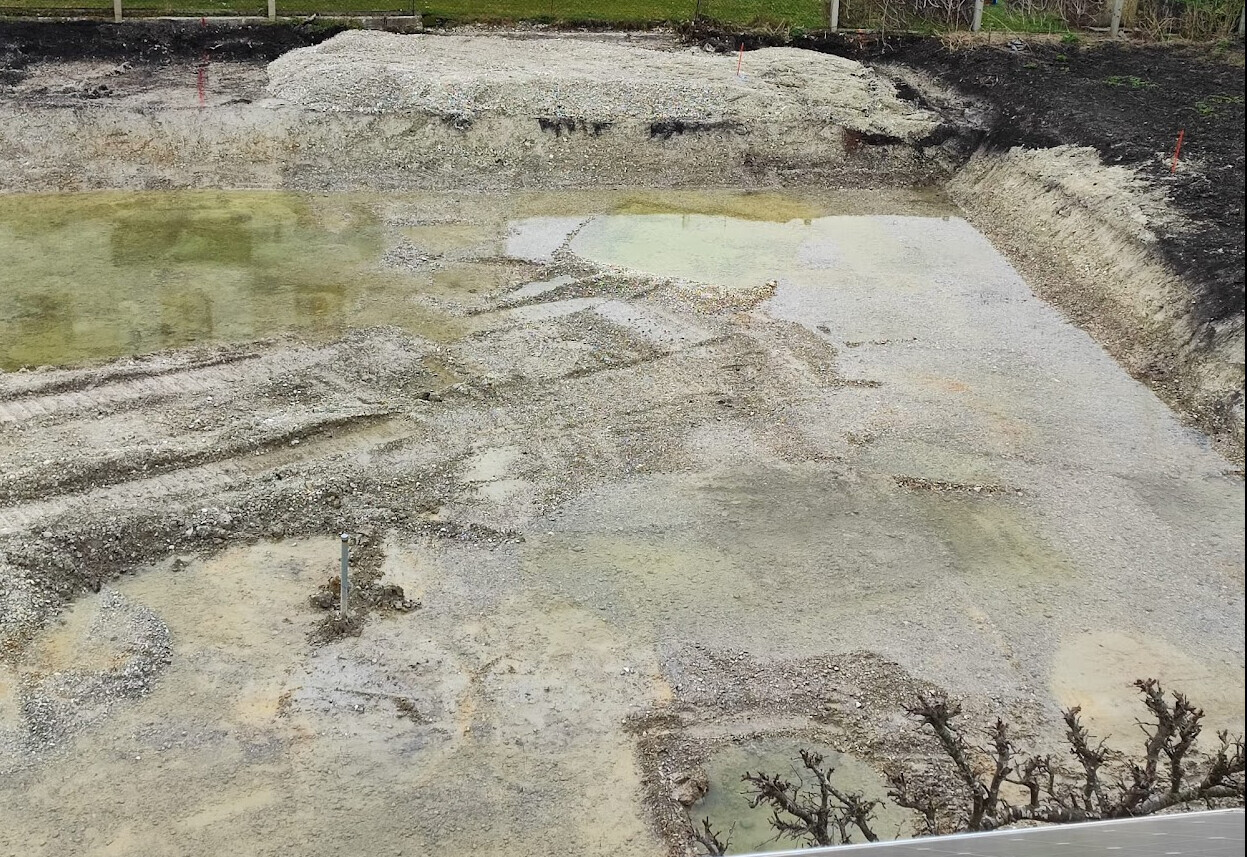
- Photo status quo – see below
Thank you!


Yes, unfortunately, time is tight for me. Those were a lot of technical questions. I will try to answer them to the best of my knowledge.
- Soil report available; Kf value – I searched for it and came across this table
- Dimensions of the foundation slab (including overhang): approximately 13.10 m x 18.10 m (43 ft x 59 ft)
- Distance to adjacent building: Only on one side is there a double garage directly next to the site. On other sides, there are several meters to neighboring buildings (estimated 4–7 m (13–23 ft))
- Water rights approval and water retention permits: Yes, all are in place – we are already in the process of laying the pipes
- Extraction well: Could you explain this differently for a layperson? Currently, I refer to 3 boreholes for water retention, with pipes leading to the drainage system; additionally, we have installed a deep infiltration well on the property. What further measures would you recommend?
- Water volumes during pumping: Good question – no idea
- Monitoring the system 24/7: We have an emergency power generator. But how should the pipes be monitored additionally? I can’t really hire a security guard. At best, I could ask the neighbors to keep an eye on things
- Photo status quo – see below
Thank you!
A
Allthewayup19 Mar 2024 22:19Are you managing the excavation yourselves? Who submitted the application to the authorities? They usually require all technical details about the project, including the water volume.
So the drainage well is your extraction point? It’s deep enough, then. The pump will need to be correspondingly powerful. But what do you mean by the other three boreholes? What is inserted into the borehole? A metal pipe with holes or slots?
An extraction well is relatively simple: these are concrete shaft rings that are excavated with a special excavator (cable excavator, shaft grabber) and sink gradually deeper into the ground. Essentially, these are also used to create access shafts, but they are not as deep.
The measures depend on the framework conditions. For example, the distance to neighboring buildings of 4 to 7 meters (13 to 23 feet) is critically small. Settlement damage cannot be excluded at 1.7 meters (5.5 feet). And it will not remain at 1.7 meters. Then the excavation pit is just dry enough, but you need about 30 cm (12 inches) of dry soil beneath the foundation slab. Technical literature even suggests 50 cm (20 inches), but no one really applies this in practice. I need to check my calculations tomorrow regarding the kf value. It seems to be well permeable.
From the photos, I see gravelly soil, which works in your favor for gravity drainage but at the same time means a lot of water flows in, increasing your effort (energy, system design, etc.). Your neighbors can only be partially made aware of this. So you currently don’t live nearby to check on things regularly? I designed my system with redundancy: two wells, two pumps, different power sources, and drained from the settlement basin purely by gravity into two separate channels via two independent outlets. A failure of one pump or disruption at one extraction point would have no impact on the second.
So the drainage well is your extraction point? It’s deep enough, then. The pump will need to be correspondingly powerful. But what do you mean by the other three boreholes? What is inserted into the borehole? A metal pipe with holes or slots?
An extraction well is relatively simple: these are concrete shaft rings that are excavated with a special excavator (cable excavator, shaft grabber) and sink gradually deeper into the ground. Essentially, these are also used to create access shafts, but they are not as deep.
The measures depend on the framework conditions. For example, the distance to neighboring buildings of 4 to 7 meters (13 to 23 feet) is critically small. Settlement damage cannot be excluded at 1.7 meters (5.5 feet). And it will not remain at 1.7 meters. Then the excavation pit is just dry enough, but you need about 30 cm (12 inches) of dry soil beneath the foundation slab. Technical literature even suggests 50 cm (20 inches), but no one really applies this in practice. I need to check my calculations tomorrow regarding the kf value. It seems to be well permeable.
From the photos, I see gravelly soil, which works in your favor for gravity drainage but at the same time means a lot of water flows in, increasing your effort (energy, system design, etc.). Your neighbors can only be partially made aware of this. So you currently don’t live nearby to check on things regularly? I designed my system with redundancy: two wells, two pumps, different power sources, and drained from the settlement basin purely by gravity into two separate channels via two independent outlets. A failure of one pump or disruption at one extraction point would have no impact on the second.
A
Allthewayup19 Mar 2024 22:23By the way, this is how it should not look.
G
gregman2220 Mar 2024 07:09@Allthewayup
The measures are being carried out by a specialist company, an earthworks contractor experienced in groundwater management. However, the owner (managing director) has been very emotional in recent weeks and has not clearly stated whether we will be able to achieve the water lowering as planned.
The applications to the authorities (including the water use permit) were organized by the earthworks contractor in coordination with our general contractor. The general contractor, on the other hand, since they did not subcontract the earthworks contractor directly, is holding back somewhat in this matter.
I’m really sorry to respond with such layman’s knowledge, but I think I need to adjust your summary a bit.
The first installed soakaway well is not intended for water extraction but for additional infiltration.
To my knowledge, boreholes are drilled at three different locations, and pumps are connected to these boreholes. The water is then broadly lowered and pumped through pipes into the sewer system.
The soakaway well is meant to serve as an additional infiltration point (besides the sewer) possibly to lay a fourth pipe. I was also wondering whether a second soakaway well at another location might make sense.
Leaving aside my other questions about whether this will actually get us to our goal.
I can definitely check on things daily (travel time 30-40 minutes), but I cannot provide 24/7 monitoring 🙂
The measures are being carried out by a specialist company, an earthworks contractor experienced in groundwater management. However, the owner (managing director) has been very emotional in recent weeks and has not clearly stated whether we will be able to achieve the water lowering as planned.
The applications to the authorities (including the water use permit) were organized by the earthworks contractor in coordination with our general contractor. The general contractor, on the other hand, since they did not subcontract the earthworks contractor directly, is holding back somewhat in this matter.
I’m really sorry to respond with such layman’s knowledge, but I think I need to adjust your summary a bit.
The first installed soakaway well is not intended for water extraction but for additional infiltration.
To my knowledge, boreholes are drilled at three different locations, and pumps are connected to these boreholes. The water is then broadly lowered and pumped through pipes into the sewer system.
The soakaway well is meant to serve as an additional infiltration point (besides the sewer) possibly to lay a fourth pipe. I was also wondering whether a second soakaway well at another location might make sense.
Leaving aside my other questions about whether this will actually get us to our goal.
I can definitely check on things daily (travel time 30-40 minutes), but I cannot provide 24/7 monitoring 🙂
G
gregman2220 Mar 2024 07:23Allthewayup schrieb:
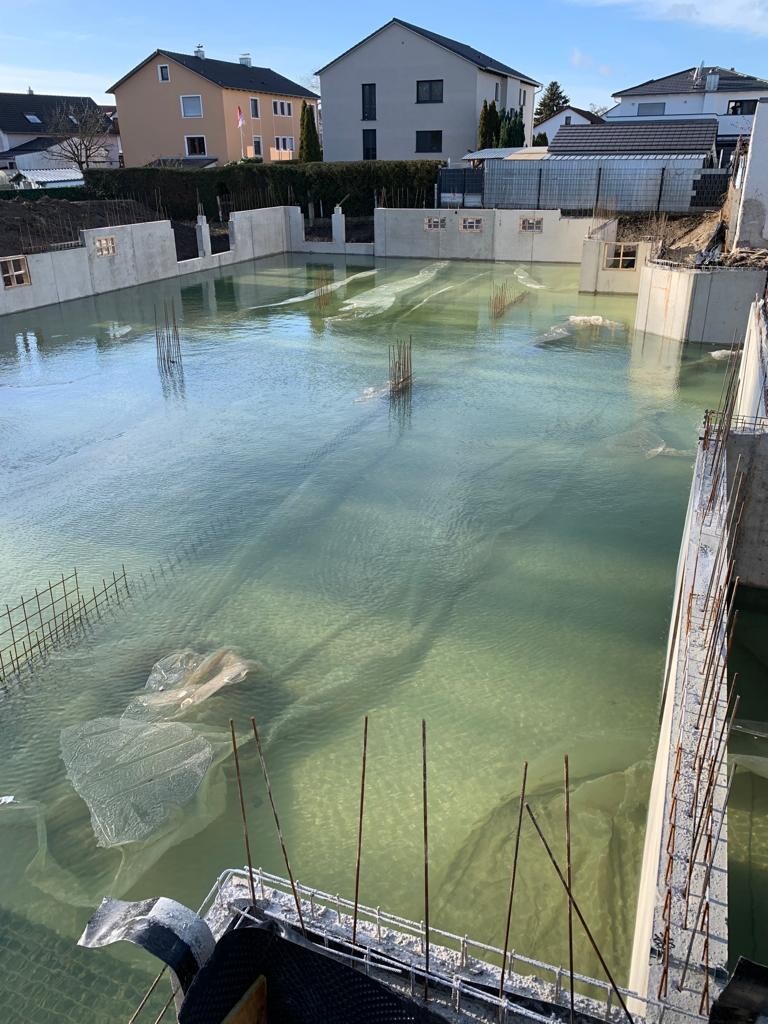
By the way, this is not how it should look.That’s really awful. It definitely shouldn’t look like that, and hopefully never will.Similar topics