
ᐅ Inlet pipe for water flush to the toilet is completely clogged with limescale buildup!
Created on: 10 Mar 2024 16:36
L
Luise MüllerL
Luise Müller10 Mar 2024 16:36Hello everyone,
I am looking for an affordable and neat solution to repair a new concealed (in-wall) toilet cistern.
… and first, a bit about the building conditions.
We moved into our detached house almost 25 years ago. Water hardness is 24 dH. During 2023, the water flow when flushing the toilet gradually decreased. In late autumn, I spoke to the plumber, who said the problem was with the toilet, as it was heavily scaled under the toilet rim and needed to be replaced. However, the toilet had already been replaced once before. I insisted that he should first check the concealed cistern.
Since now almost no water is flowing for flushing, the plumber finally checked the setup last Friday. He removed the toilet (which is only slightly scaled).
Cause: the water supply pipe to the cistern behind the wall is completely scaled, with fresh water only passing through a tiny opening to flush the toilet.
Removing the limescale from the pipe was not possible – it is rock solid.
We want to apply descaling agent through the cistern into the pipe tomorrow and let it work for several days.
What should we do if the limescale does not dissolve?
Are there any solutions available?
The supply pipe and the concealed cistern are entirely installed inside a stud wall, similar to what is shown in the attached file.
Does any expert know a clean, inexpensive solution?
Thanks in advance.
Best regards,
Luise Müller
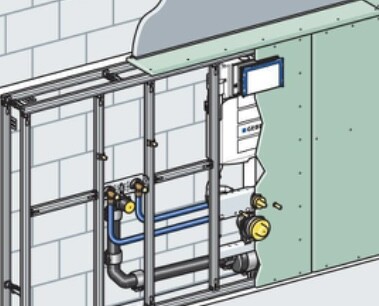
I am looking for an affordable and neat solution to repair a new concealed (in-wall) toilet cistern.
… and first, a bit about the building conditions.
We moved into our detached house almost 25 years ago. Water hardness is 24 dH. During 2023, the water flow when flushing the toilet gradually decreased. In late autumn, I spoke to the plumber, who said the problem was with the toilet, as it was heavily scaled under the toilet rim and needed to be replaced. However, the toilet had already been replaced once before. I insisted that he should first check the concealed cistern.
Since now almost no water is flowing for flushing, the plumber finally checked the setup last Friday. He removed the toilet (which is only slightly scaled).
Cause: the water supply pipe to the cistern behind the wall is completely scaled, with fresh water only passing through a tiny opening to flush the toilet.
Removing the limescale from the pipe was not possible – it is rock solid.
We want to apply descaling agent through the cistern into the pipe tomorrow and let it work for several days.
What should we do if the limescale does not dissolve?
Are there any solutions available?
The supply pipe and the concealed cistern are entirely installed inside a stud wall, similar to what is shown in the attached file.
Does any expert know a clean, inexpensive solution?
Thanks in advance.
Best regards,
Luise Müller
N
nordanney10 Mar 2024 18:08Luise Müller schrieb:
What can I do if the lime scale doesn’t dissolve?
What solutions are there?
The supply pipe and the concealed flush tank are completely installed inside a drywall partition, similar to what is shown in the attached file.
Does anyone know a clean, affordable solution? Sorry, but honestly, the only thing I can think of is to redo it. If the water is that hard, you should be prepared that this will happen everywhere sooner or later—and only if it’s just the last section of the supply pipe, try using acid. Preferably vinegar essence, otherwise diluted hydrochloric acid.
Apart from that, you might want to consider a water softening system. More precisely, choose and install (or have installed) a water softener.
J
Jesse Custer11 Mar 2024 07:41@Luise Müller
Sounds worse than it is – I’d say: welcome to the club...
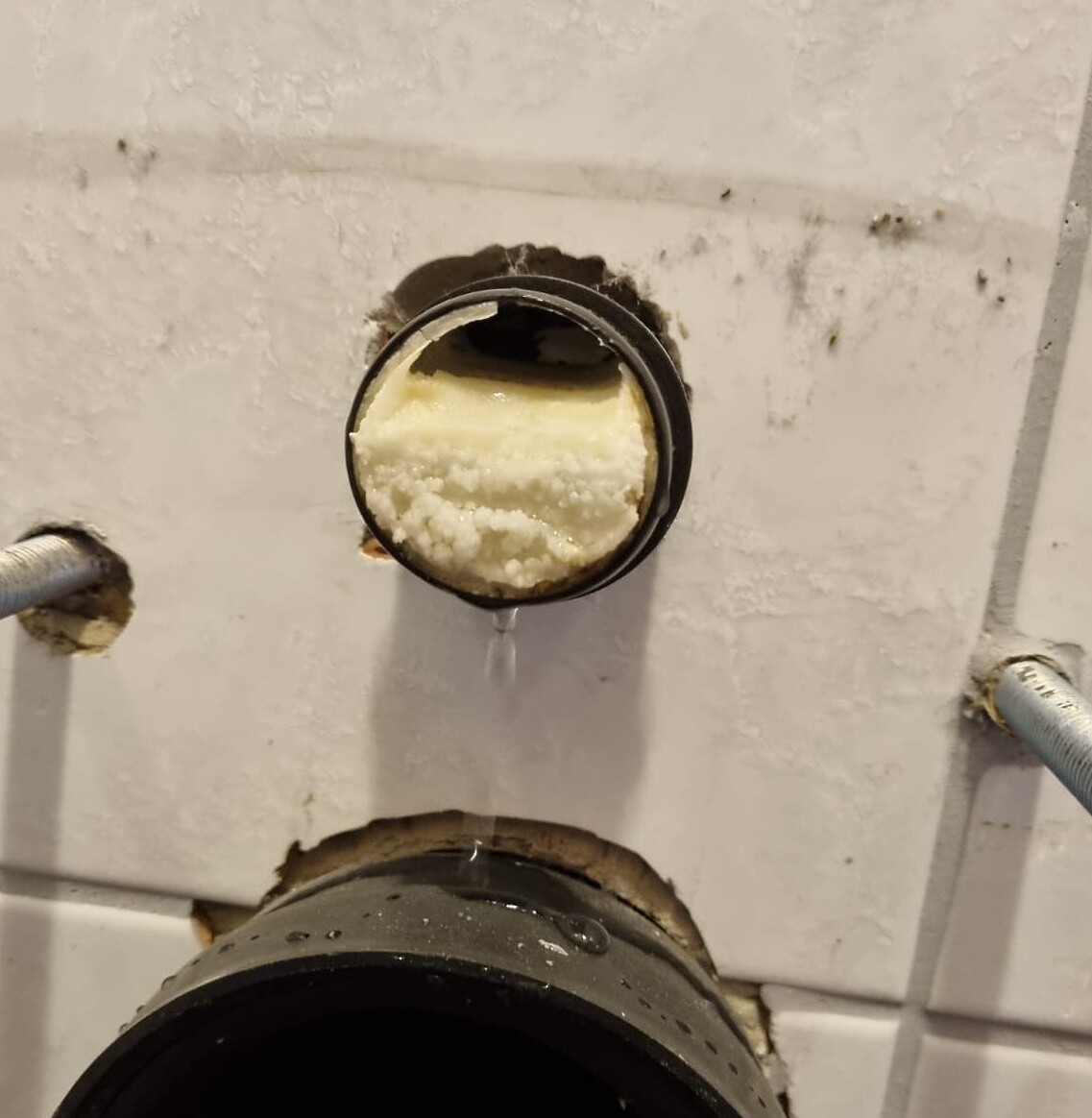
We were lucky that the plug came out almost without any force – otherwise, our plumber would have first used a small drill and then started working with acids. From his point of view, a complete replacement of the flush system (obviously similar to yours) was never an option.
Regarding water hardness, I assume you live nearby – the effect was identical for us, only it appeared after 23 years. This leads me to suspect that, as with us, something triggered the buildup – in our case, it was an old pop rivet likely left over from the construction phase, which then got flushed through and got stuck in the right spot. Nothing you can do about it...
About water softeners: no way they’re coming into my house – neither salt-based nor anything else. For many years we’ve had a strong magnet on the water inlet; since then, the deposits don’t stick and are flushed away. I do have to replace the aerators more often because of this, but it’s worth it (there’s really a lot of “grit” caught there).
Sounds worse than it is – I’d say: welcome to the club...
We were lucky that the plug came out almost without any force – otherwise, our plumber would have first used a small drill and then started working with acids. From his point of view, a complete replacement of the flush system (obviously similar to yours) was never an option.
Regarding water hardness, I assume you live nearby – the effect was identical for us, only it appeared after 23 years. This leads me to suspect that, as with us, something triggered the buildup – in our case, it was an old pop rivet likely left over from the construction phase, which then got flushed through and got stuck in the right spot. Nothing you can do about it...
About water softeners: no way they’re coming into my house – neither salt-based nor anything else. For many years we’ve had a strong magnet on the water inlet; since then, the deposits don’t stick and are flushed away. I do have to replace the aerators more often because of this, but it’s worth it (there’s really a lot of “grit” caught there).
L
Luise Müller11 Mar 2024 10:12@Jesse Custer
Hello,
The plumber’s option is completely new installation, chipping open the wall, or a new installation in front of the outer wall—I don’t even want to think about the mess and the costs.
The lime buildup isn’t loosening at all; he tried with a small chisel and hammer.
Now we will first try a descaler and let it sit for 2 to 3 days. I absolutely don’t want hydrochloric acid in the bathroom. I had some very negative experiences with that a few years ago.
What kind of magnet is this? What does it do? Where is it installed? And which aerators should be used?
Best regards
Hello,
The plumber’s option is completely new installation, chipping open the wall, or a new installation in front of the outer wall—I don’t even want to think about the mess and the costs.
The lime buildup isn’t loosening at all; he tried with a small chisel and hammer.
Now we will first try a descaler and let it sit for 2 to 3 days. I absolutely don’t want hydrochloric acid in the bathroom. I had some very negative experiences with that a few years ago.
What kind of magnet is this? What does it do? Where is it installed? And which aerators should be used?
Best regards
N
nordanney11 Mar 2024 10:18Luise Müller schrieb:
What kind of magnet is that? What does it do? Where is it installed? And which aerators are used?It does exactly what magnets do. It attracts magnetic particles.Besides that, there are also so-called miracle magnets that ionize the water clockwise or counterclockwise and, thanks to quantum entanglement, make it scale-free...
J
Jesse Custer11 Mar 2024 11:40We use a magnetic water descaler for lime buildup and have been satisfied with it since installation – opinions on this can vary, so it’s up to each individual.
Just google the device; the website provides a lot of useful information.
A “perlator” refers to the small mesh screen on the faucet aerator that creates a smooth water flow. If it gets clogged with lime scale, the water sprays in all directions.
Just google the device; the website provides a lot of useful information.
A “perlator” refers to the small mesh screen on the faucet aerator that creates a smooth water flow. If it gets clogged with lime scale, the water sprays in all directions.
Similar topics