
J
JKHandler10 Mar 2024 12:18Hello everyone,
I am currently planning a single-family house with a basement and an attached garage. The entire house including the basement is considered as the thermal envelope. The garage is directly connected to the house and is also planned to be fully basemented. My question is: what is the best way to create thermal separation here without constructing two separate buildings? My initial idea was to thermally decouple the slab and the two ceilings using XPS insulation and connect them with stainless steel (e.g. stainless steel) ties (similar to thermal break baskets) to prevent settlement.
What are your thoughts? How would this be best realized technically? I would really appreciate any constructive help!
Best regards
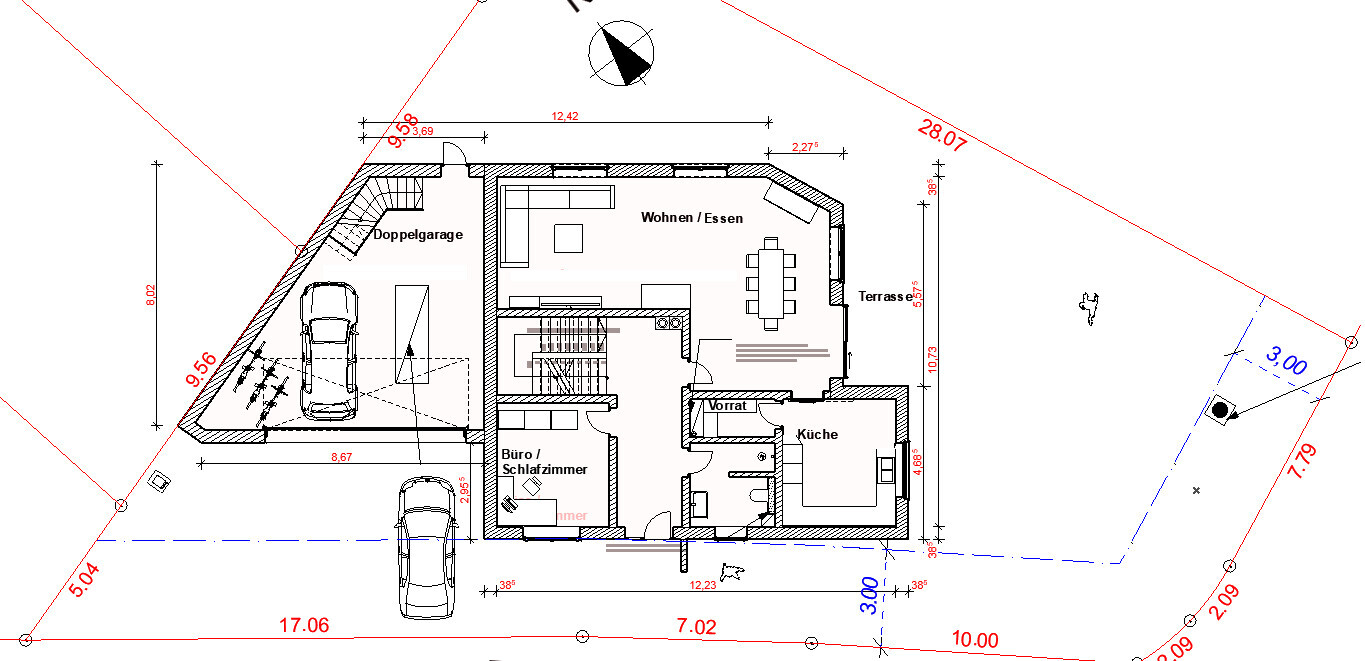
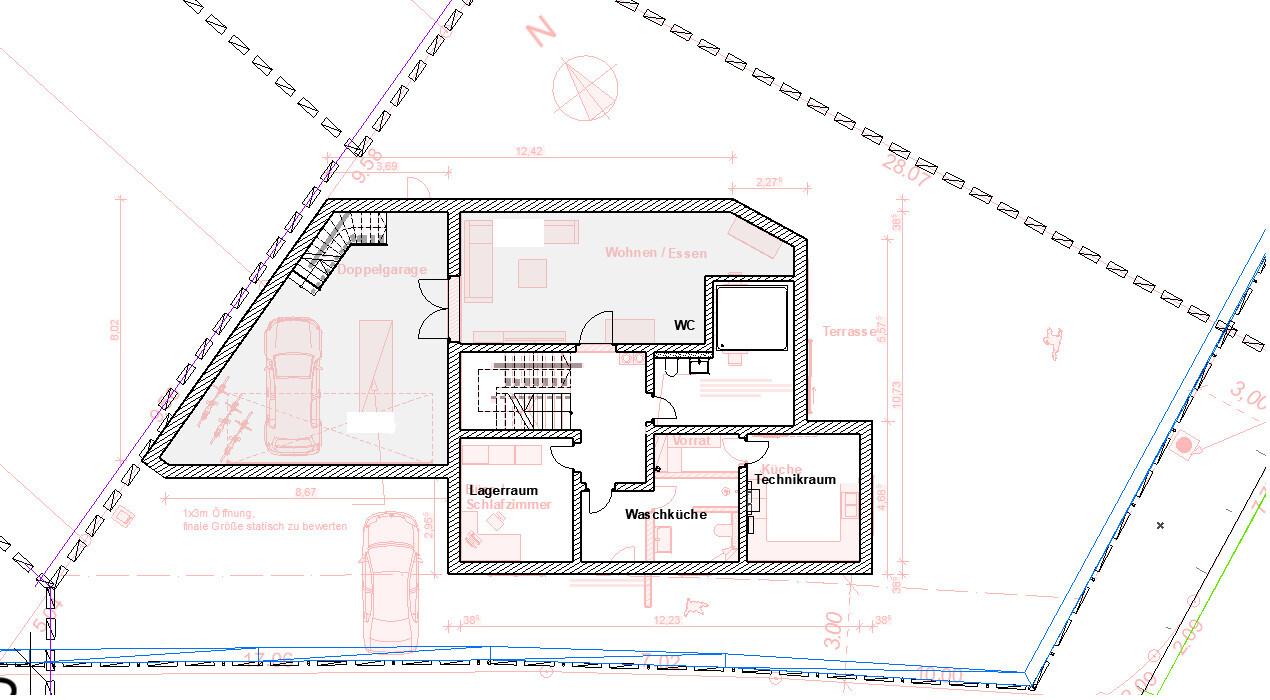
I am currently planning a single-family house with a basement and an attached garage. The entire house including the basement is considered as the thermal envelope. The garage is directly connected to the house and is also planned to be fully basemented. My question is: what is the best way to create thermal separation here without constructing two separate buildings? My initial idea was to thermally decouple the slab and the two ceilings using XPS insulation and connect them with stainless steel (e.g. stainless steel) ties (similar to thermal break baskets) to prevent settlement.
What are your thoughts? How would this be best realized technically? I would really appreciate any constructive help!
Best regards
I also thought about it for a long time, but the simplest and cleanest options are:
We chose option 2 – I was also “worried” about settling, but so far there are no signs of it (I don’t expect any either – though this naturally depends on your soil conditions). The challenging part is sealing (for components in contact with the ground), because you don’t want water getting in between. In our case, this was solved by embedding joint tapes into the slab and walls to create a continuous barrier. However, this must also be carried up on the upper side, meaning a proper seal at the roof transition is necessary.
In theory, you could insert EPS or PUR foam between the two building parts to possibly reduce the required insulation thickness, but it must be sealed perfectly during construction, otherwise water will find its way. That’s why I stuck with XPS.
- You include the garage completely within the building’s thermal envelope
- You separate the two parts completely, without any (rigid) connection
We chose option 2 – I was also “worried” about settling, but so far there are no signs of it (I don’t expect any either – though this naturally depends on your soil conditions). The challenging part is sealing (for components in contact with the ground), because you don’t want water getting in between. In our case, this was solved by embedding joint tapes into the slab and walls to create a continuous barrier. However, this must also be carried up on the upper side, meaning a proper seal at the roof transition is necessary.
In theory, you could insert EPS or PUR foam between the two building parts to possibly reduce the required insulation thickness, but it must be sealed perfectly during construction, otherwise water will find its way. That’s why I stuck with XPS.
However, in your case, it might be worth considering including the basement part of the garage within the thermal envelope and using XPS boards as formwork for the garage slab ceiling (if height allows).
The sealing issues remain the same, but you wouldn't have to worry about settlement at all, since the garage would ultimately rest on the main foundation.
The staircase, however, would make this more complicated...
The sealing issues remain the same, but you wouldn't have to worry about settlement at all, since the garage would ultimately rest on the main foundation.
The staircase, however, would make this more complicated...
J
JKHandler10 Mar 2024 18:01Harakiri schrieb:
Although, in your case, it might also be worth considering including the basement part of the garage within the thermal envelope and constructing the ceiling (if possible in terms of height) with XPS boards as formwork for the garage’s floor slab.
The issues with waterproofing remain largely the same, but you wouldn’t have any concerns about settlement, since the garage would still ultimately rest on the main foundation.
The staircase, however, would then become more complicated... I was thinking exactly that too, but as you said, the staircase is a problem... Do you have any practical experience with thermal separation using XPS?
JKHandler schrieb:
I was thinking exactly the same, but as you said, there’s an issue with the stairs... In my opinion, it depends on whether you want to use it as a garage basement or rather as a house basement with an additional access to the garage. If you expect to frequently move items back and forth between the garage and the garage basement, then having a door between them doesn’t make sense and can actually be quite inconvenient. It’s better to treat the house and house basement, and the garage and garage basement as two separate units.
Otherwise, the “stairwell” can also be insulated. It’s a bit fiddly and you have to watch out for potential thermal bridges, but it’s not uncommon.
However, it’s important to clarify the fire protection requirements – depending on the federal state or region, you might need to equip all connections to the house with fire-rated doors. Also, consider service shafts or penetrations; for such constructions (wall-insulation-wall), there are fewer ready-made solutions available and some custom work might be necessary. Depending on the fire protection requirements, professional advice may be needed.
JKHandler schrieb:
Do you have experience with thermal separation using XPS?What exactly do you want to know? As a “partition wall” solution, it works perfectly – at least with precast concrete elements, everything was implemented almost exactly to the millimeter. As formwork/insulation for the floor slab, it has already become standard.
Definitely pay attention to the door reveals in the detailed planning and make sure there’s enough space to properly insulate them; otherwise, you might have thermal bridges there.
Similar topics