
Hello,
we have a bathroom (built in 2005) that we would like to renovate. After a lot of research (vinyl, concrete, epoxy), we are practically back at the beginning, meaning the tiles will be replaced.
We thought it would be a good idea to relocate the drain at the same time. This would allow us to use slightly larger tiles, since the slope would only go in one direction. Instead of having the drain in the middle, we would like to install a channel drain along the front wall (there is an installation shaft at the front).
Is this even possible, and what kind of construction can we expect here?
Thank you.
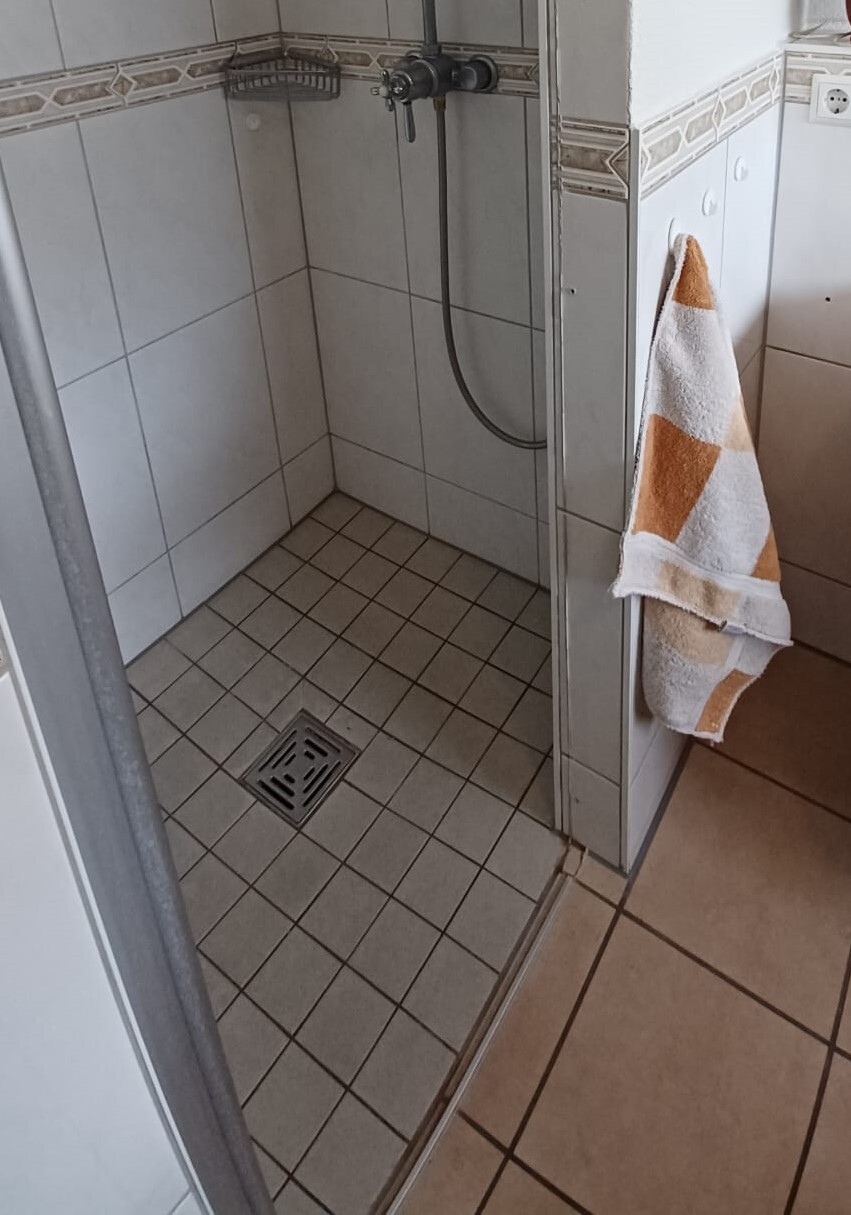
we have a bathroom (built in 2005) that we would like to renovate. After a lot of research (vinyl, concrete, epoxy), we are practically back at the beginning, meaning the tiles will be replaced.
We thought it would be a good idea to relocate the drain at the same time. This would allow us to use slightly larger tiles, since the slope would only go in one direction. Instead of having the drain in the middle, we would like to install a channel drain along the front wall (there is an installation shaft at the front).
Is this even possible, and what kind of construction can we expect here?
Thank you.
Nida35a schrieb:
We have 60x60cm (24x24 inches) tiles in the bathroom and 10x10cm (4x4 inches) tiles under the shower area due to slip hazard. This should definitely be checked carefully. I have seen shower tile areas in several hotels with tile sizes ranging from 30x60cm (12x24 inches) up to 60x60cm (24x24 inches), which personally felt too smooth and risky to me.
I have mosaic tiles in my own shower area, but we also have very soft water and no issues with lime scale, etc. However, they are always nice and grippy for bare feet.

kbt09 schrieb:
which I personally found too smooth and too dangerous.us too, despite soft waterW
WilderSueden6 Mar 2024 21:58We are quite satisfied with our 30x60cm (12x24 inches) tiles in the shower. We have hard water. After showering, we push the remaining water away once, and when mopping the floor, of course, we also do this in the shower.
However, I also know of other showers with large tiles that were very slippery.
However, I also know of other showers with large tiles that were very slippery.
X
xMisterDx6 Mar 2024 22:18It could be that the size of the tiles has nothing to do with slip resistance. On a 60cm x 60cm (24in x 24in) R13 tile, you’re more likely to wear down your calluses than to slip, whereas with a 10cm x 10cm (4in x 4in) R9 tile, it’s better to install two grab bars in the shower.
However, walking barefoot is rather uncomfortable on R12 and higher.
However, walking barefoot is rather uncomfortable on R12 and higher.
W
WilderSueden6 Mar 2024 22:24That is not correct. Due to the many grout lines, mosaic tiles do not form a continuous water film and are therefore significantly more slip-resistant. Even if the tile surface shows the same value in laboratory tests as a large tile

WilderSueden schrieb:
That’s not really correct. Because of the many grout lines, mosaic tiles don’t have a continuous water film and are therefore much more slip-resistant. Even if the tile surface tests the same in the lab as a large tile,But who wants so many grout lines in the shower? That’s where lime scale, soap, and skin residues really tend to build up. I would never want mosaic tiles.
Similar topics