
ᐅ Floor Plan for a Single-Family Home, 240 m², with Partially Built-Over Garage
Created on: 3 Dec 2023 13:51
H
Haus 42
Hello everyone,
My wife and I are currently favoring the attached design for our house project. It is our own concept, inspired by forum discussions, catalogs, and model homes, but also discussed with architects and now unrecognizable compared to the first drafts.
A first detailed drawing is in progress (which may include structural and building services adjustments), so general criticism is welcome, but especially suggestions on potential problem areas or ways to achieve essential improvements through small changes: After all, we don’t want to build an expensive house only to regret it later, but rather invest in meaningful improvements (e.g., bay windows). At the bottom, I have listed some specific concerns.
Framework conditions:
Design:
Notes on the floor plans:
Development:
We had several designs, including with a basement, without construction over the garage (which was recently confirmed as possible), with open space, guest rooms on different sides, a 180° half-landing staircase, etc. – the current approach now seems quite logical to us and despite the naturally high costs, not extravagant. I grew up in a house with a full basement and converted attic, and the plan tries to provide similar spaces over two floors.
Ground floor details:
Upper floor details:
Concerns / Questions
We look forward to your comments!
My wife and I are currently favoring the attached design for our house project. It is our own concept, inspired by forum discussions, catalogs, and model homes, but also discussed with architects and now unrecognizable compared to the first drafts.
A first detailed drawing is in progress (which may include structural and building services adjustments), so general criticism is welcome, but especially suggestions on potential problem areas or ways to achieve essential improvements through small changes: After all, we don’t want to build an expensive house only to regret it later, but rather invest in meaningful improvements (e.g., bay windows). At the bottom, I have listed some specific concerns.
Framework conditions:
- Planned residents: two adults (working days home/office: 2/3 and 3/2), two (initially small) children, two cats, guests staying several weeks per year.
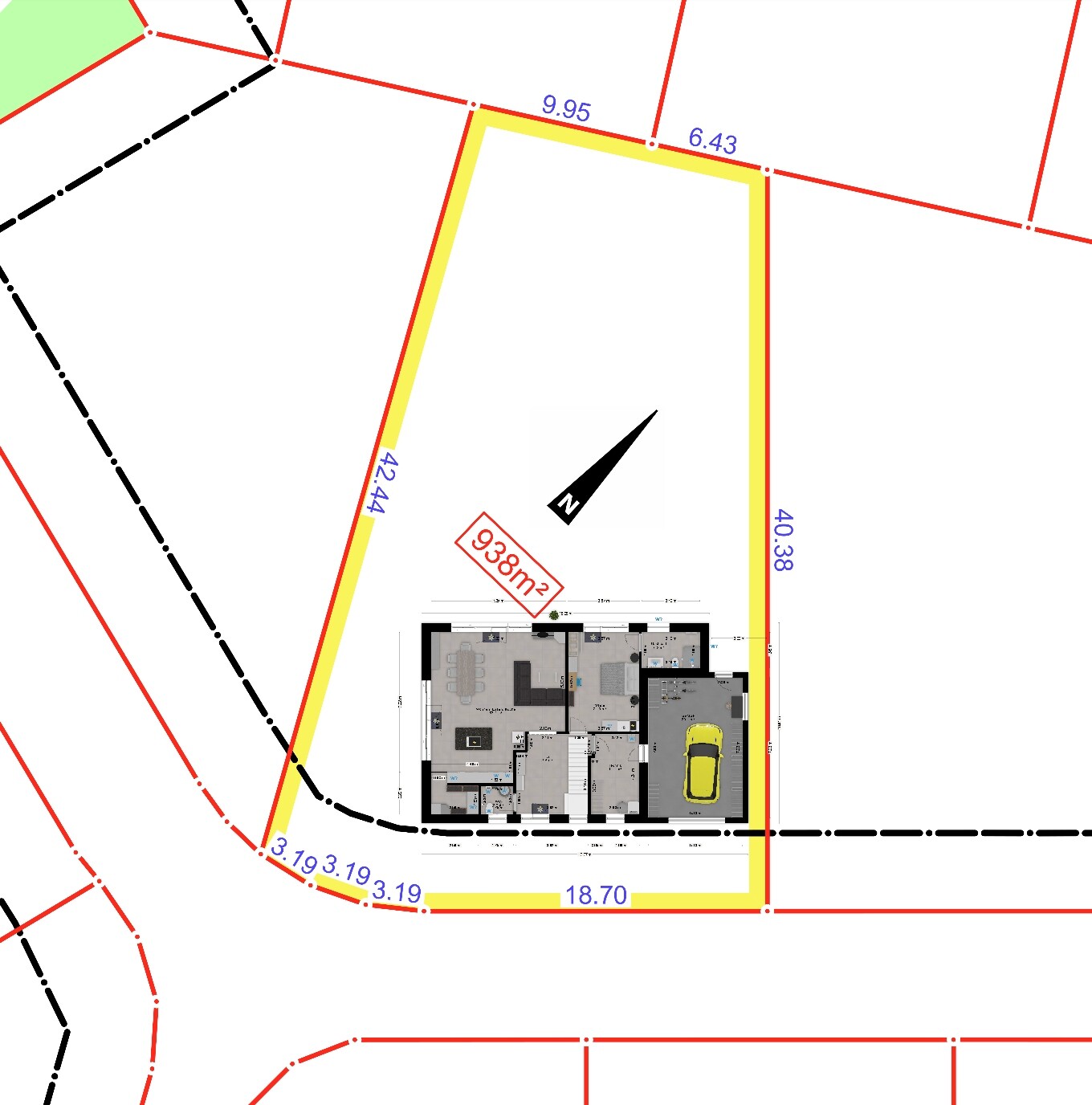
- Conditions: Small-town new development area in Mecklenburg-Vorpommern, site coverage ratio 0.35, maximum one full story, eaves height max. 5m (16 ft 5 in), gable or half-hipped roof with 20°–50° pitch, minimum distance to street 5m (16 ft 5 in), to neighbors 3m (10 ft).
- Plot: 938 m² (10,094 sq ft), essentially flat, with utility garden and play lawn.
- Neighboring plots: Northeast (“right”) already developed (close to road and at distance from us, since their garage is on the side facing away from us), southwest (“left”) not yet sold.
Design:
- Footprint: approx. 15.5m×11m (51 ft × 36 ft) + garage overhang 2m×8m (6 ft 7 in × 26 ft), garage-boundary distance 1m (3 ft 3 in)
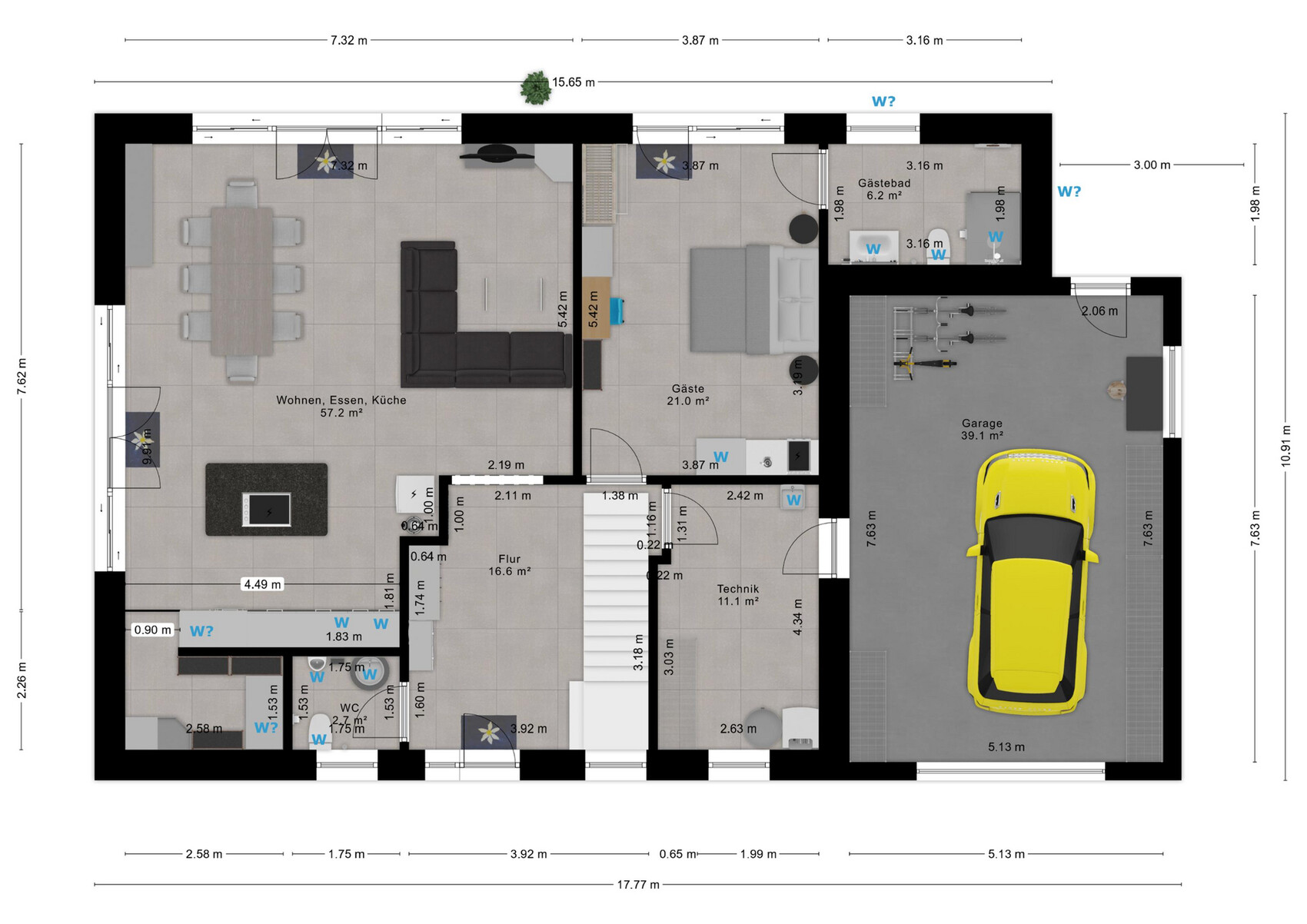
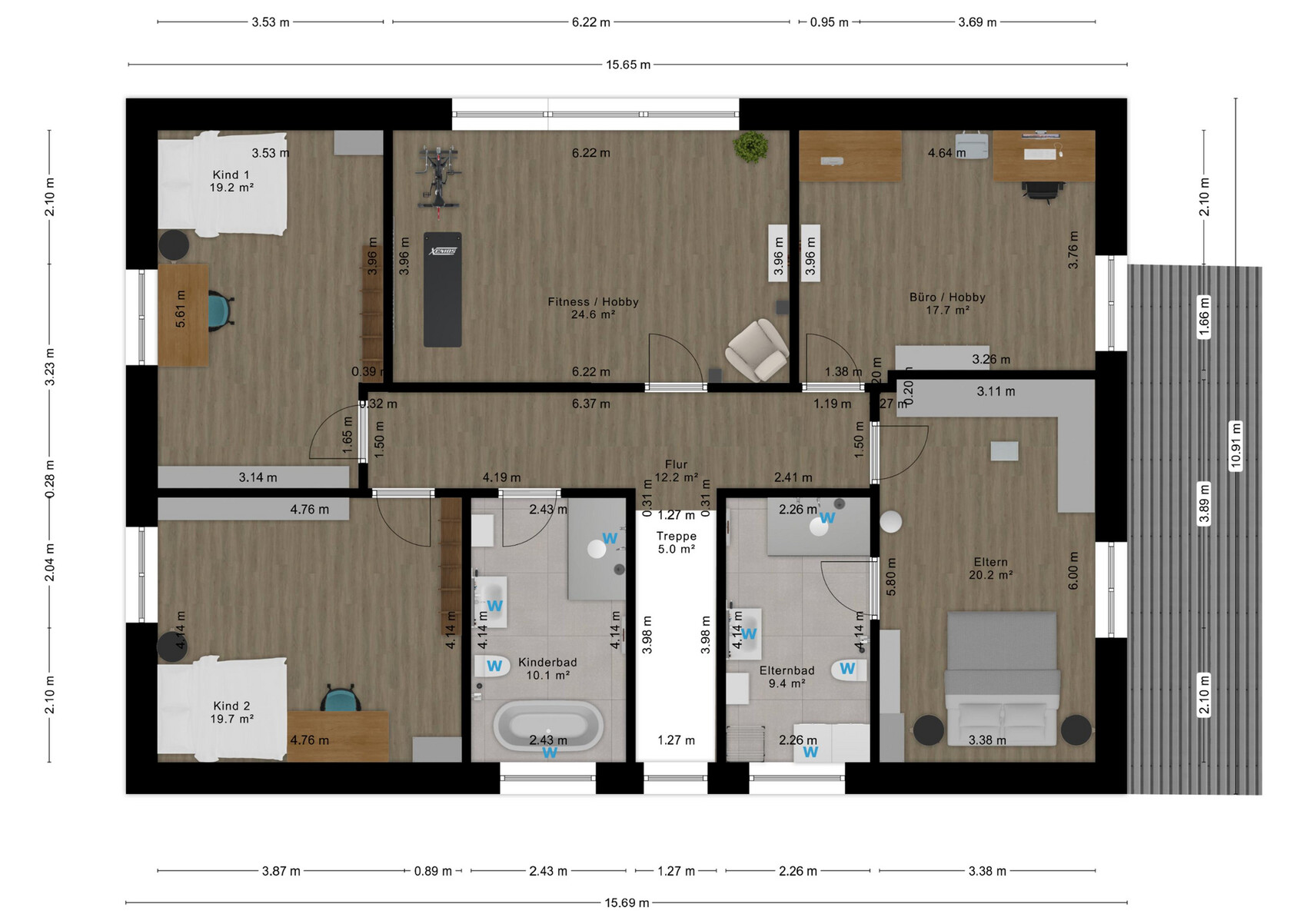
- Living and utility space: ground floor approx. 115 m² (1,238 sq ft), upper floor approx. 125 m² (1,345 sq ft), garage approx. 40 m² (430 sq ft)
- Ceiling height: ground floor approx. 2.60m (8 ft 6 in), upper floor approx. 2.50m (8 ft 2 in)
- Building services: ventilation system, photovoltaic panels on southeast roof, underfloor heating powered by air-source heat pump everywhere except garage/attic.
- Location: the house should be as close to the street as possible (see plan) with the main entrance facing it (southeast), to maximize garden space.
- Gable roof: rather flat (25°) to allow for a high knee wall (>1.20m (3 ft 11 in)), attic therefore only used for storage.
- We are foregoing a basement in favor of a larger footprint, which also enables a barrier-free guest area.
- Ground floor: the living area should get both sunlight and garden views, so it must be on the west side.
- Upper floor: usability of space is the priority, so we accept the narrow corridor (approx. 1.5m×8m (4 ft 11 in × 26 ft)). Still, generous dormers, including in the stairwell, should provide enough daylight.
- Exterior walls are brick-clad, interior rather modern: white walls/kitchen fronts, tiled floors on the ground floor, PVC on the upper floor.
Notes on the floor plans:
- Area measurements do not account for sloping ceilings on the upper floor.
- ⚡ means high-voltage electricity, W (waste) water
Development:
We had several designs, including with a basement, without construction over the garage (which was recently confirmed as possible), with open space, guest rooms on different sides, a 180° half-landing staircase, etc. – the current approach now seems quite logical to us and despite the naturally high costs, not extravagant. I grew up in a house with a full basement and converted attic, and the plan tries to provide similar spaces over two floors.
- What we like: the bright living room, purely functional generous sizing everywhere, especially for guests and thanks to the large room upstairs, the access from the garage.
- What we don’t like: see also the “Concerns” listed at the bottom. Otherwise, the “very generous” house (architect’s comment) might have few ‘eye-catchers’ for its price, e.g., no gallery or two bathrooms upstairs instead of one large. Therefore, general suggestions are welcome on how to enhance the design beyond the floor plan, for instance through lighting, mirrors, windows, external design.
Ground floor details:
- Living room with window fronts each with a door leading to terraces in the southwest (for sunlight) and northwest (toward the garden).
- Kitchen open to the living area; appliances located in a central niche—therefore, to minimize noise, the oven/microwave are there instead of the refrigerator.
- Room behind kitchen (separated by a slightly hidden door) serves as storage and a place for some kitchen appliances and an additional worktop.
- From the hallway, a doorless passage to the living room, doors to guest room, guest toilet, and utility room, also from there access to the garage.
- Large guest room with barrier-free bathroom and external access, potentially a one-room separate apartment.
- Garage for one car, e-scooter/bicycles and as a workshop/storage room, for example for garden tools.
Upper floor details:
- Children’s rooms on the sunnier gable side.
- Children’s bathroom with bathtub, master bathroom with washing machine/dryer (but space in utility room to allow for changes).
- Long dormers above bathrooms/stairwell and fitness/hobby room; no other roof windows.
- Access to attic via fitness/hobby room.
Concerns / Questions
- The (currently half-landing) staircase may need to be spiral to allow doors to fit under its end. Is preserving the half-landing for climbing safety worth a bay window?
- Prefabricated houses often have bay windows, although they might be energetically disadvantageous. Are they mainly for aesthetics, or have we missed practical opportunities by not including any?
- Is the staircase too close to the entrance, e.g., regarding dirt distribution?
- We would like remote/central control for roller shutters on all burglary-relevant windows. Would narrow windows be acceptable in the utility room, guest bathroom, and ground floor toilet, to prevent break-ins? Does anyone have experience with this?
- With a 25° pitch and 1.20m (3 ft 11 in) knee wall, is an overhanging roof suitable as a cover for the entrance and/or terrace without causing too much shading? What other canopy options would make sense, especially since the terrace is on the exposure-prone side?
- To prevent bicycles from scratching the car in the garage, should it be widened? This would reduce the remaining strip on the southwest side, where the tightest boundary distance (at the west corner, “top left”) is currently about 5m (16 ft 5 in).
- Is a TV placed directly next to the window front a problem due to the northwest orientation?
- Should the pantry behind the kitchen have a second sink?
- Would it be better to fill the garden-facing dormer entirely with windows rather than leaving corners open as planned?
- Which windows should be included in the bathroom dormer considering there are houses on the opposite side of the street?
We look forward to your comments!
K a t j a schrieb:
The consequence will be that two years after moving in, you’re already thinking about where to extend, because even with 240 m² (2,583 sq ft) there is nowhere enough space.I don’t really believe that... there is space after all. But in my opinion, there was some improvisation during planning, and that causes dissatisfaction.What I completely forgot to mention: Thanks for the revised sketch! In fact, a similar version had already been the favorite twice before, but it lost out each time to the other option: better separation of the kitchen and direct access to the living room won against the numerically better distribution of space, the lighting axis, and the shorter route when carrying groceries.
I am not entirely convinced with this one either, but it’s always a gradual matter, as the bathroom shows: throughout my childhood, the main bathroom for our family of four was less than 2m wide (6.5 feet), and parallel usage was only marginally inconvenient—which is eased here by having a second bathroom. A less corridor-like room might feel more like a bathing area, but this seems acceptable, especially since I will probably spend more time in the generous hallways, where an elaborate design could compensate by creating a sense of openness.
But the 240m² (2,583 sq ft) is not about luxurious space for its own sake; it’s because a small guest apartment on the ground floor and this multipurpose room upstairs were desired, plus all the layout preferences considering the location. What is considered relevant comfort is subjective, of course. The idea that the design “misses common basic human needs a bit” is probably only compatible with a high standard of expectation that would render many existing apartments in this country similarly unacceptable—I read it as: “if you have 240m², then XYZ.”
A utility room would definitely be a nice feature—there were designs including one, but they didn’t convince overall. But if there really is an absolute washing emergency, then every ten years or so, the coincidentally started bubble bath can be put on hold.
The doors “at the head” are probably not Feng Shui-compliant, but after extensive consideration of the disadvantages of the direct alternatives, I came to terms with it. As they say in Cologne, “Everyone is different,” and some people even put the bathtub in the bedroom...
If resale is considered, a more widely acceptable prioritization might be financially wiser, but for me, it’s a certain luxury to pay less attention to that. Of course, I might also be wrong in my assessment of my own reaction to living in the house in the future, but until you can build it out of Lego first and test live in it, some residual risk is unavoidable. This applies all the more if you choose someone else’s design that is praised professionally but doesn’t personally appeal to you right now.
And yes, maybe a nth external design would be more to my liking, but especially after wasting so much time myself now, I would first try to submit the application along the lines shown. If the authority rejects the floor area calculation because of the dormers, I will have to take a step back anyway.
However, I admit that hiring an architect’s effort at the very beginning of the process would have been worthwhile—or better yet, several architects, each for a fixed price below the scale of fees for architects (HOAI), just for the basic floor plan, at least if you want to try out 3D software yourself anyway.
I am not entirely convinced with this one either, but it’s always a gradual matter, as the bathroom shows: throughout my childhood, the main bathroom for our family of four was less than 2m wide (6.5 feet), and parallel usage was only marginally inconvenient—which is eased here by having a second bathroom. A less corridor-like room might feel more like a bathing area, but this seems acceptable, especially since I will probably spend more time in the generous hallways, where an elaborate design could compensate by creating a sense of openness.
But the 240m² (2,583 sq ft) is not about luxurious space for its own sake; it’s because a small guest apartment on the ground floor and this multipurpose room upstairs were desired, plus all the layout preferences considering the location. What is considered relevant comfort is subjective, of course. The idea that the design “misses common basic human needs a bit” is probably only compatible with a high standard of expectation that would render many existing apartments in this country similarly unacceptable—I read it as: “if you have 240m², then XYZ.”
A utility room would definitely be a nice feature—there were designs including one, but they didn’t convince overall. But if there really is an absolute washing emergency, then every ten years or so, the coincidentally started bubble bath can be put on hold.
The doors “at the head” are probably not Feng Shui-compliant, but after extensive consideration of the disadvantages of the direct alternatives, I came to terms with it. As they say in Cologne, “Everyone is different,” and some people even put the bathtub in the bedroom...
If resale is considered, a more widely acceptable prioritization might be financially wiser, but for me, it’s a certain luxury to pay less attention to that. Of course, I might also be wrong in my assessment of my own reaction to living in the house in the future, but until you can build it out of Lego first and test live in it, some residual risk is unavoidable. This applies all the more if you choose someone else’s design that is praised professionally but doesn’t personally appeal to you right now.
And yes, maybe a nth external design would be more to my liking, but especially after wasting so much time myself now, I would first try to submit the application along the lines shown. If the authority rejects the floor area calculation because of the dormers, I will have to take a step back anyway.
However, I admit that hiring an architect’s effort at the very beginning of the process would have been worthwhile—or better yet, several architects, each for a fixed price below the scale of fees for architects (HOAI), just for the basic floor plan, at least if you want to try out 3D software yourself anyway.

Haus 42 schrieb:
I admit that hiring an architect right at the start of the process would have been worth it — or better yet, several architects, each offering a fixed price below the HOAI fee scale for the basic floor plan, especially if you plan to experiment yourself later using 3D software. The misconception of the architect as an "experienced floor plan drawer" is unfortunately hard to eliminate and is causally linked to the perception that their fees are excessively high. Trial and error and “unlimited monkey” approaches are, in my strong opinion, unsuitable alternatives to a methodical design process.
Haus 42 schrieb:
And yes, maybe an N-th external design would be more appealing, but especially after wasting so much time myself, I would first try to proceed in the direction shown. If the authorities reject the floor area calculation because of the dormers, we will have to go back and revise anyway. A late “call to reverse course” is a complete waste of time and the best argument in favor of preliminary building inquiries (building permit consultations/planning previews).
Haus 42 schrieb:
It might be that I am already misjudging my own reaction to future life in the house, but unless you can build and live-test it beforehand with something like Lego, that residual risk is unavoidable. This applies even more if you decide on a design by a third party, which might be praised professionally but does not currently appeal to you personally. There are options to test your plan at full scale or through 1:1 projections or VR. Such methods should definitely be explored even with professional designs, particularly given that the current generation of prospective homeowners increasingly struggles with spatial imagination.
https://www.instagram.com/11antgmxde/
https://www.linkedin.com/company/bauen-jetzt/
This misconception may exist, but I did not intend to express it here. My point was simply that even those who choose to design their own plans, against local recommendations, can benefit from competent inspiration and advice—especially when it comes from multiple sources rather than just one. Using other services is ultimately independent of this, as long as the chosen architect is willing to work with such a client.
Regarding the preliminary building inquiry (building permit / planning permission pre-application), I am relying on the contractor’s experience but will probably bring up the option again.
I am familiar with the concept of a full-scale floor plan, and it certainly has its users. However, any possible discomfort caused by sleeping near the bathroom door is unlikely to be better assessed this way—I could just as easily place a cardboard door next to my bed.
Regarding the preliminary building inquiry (building permit / planning permission pre-application), I am relying on the contractor’s experience but will probably bring up the option again.
I am familiar with the concept of a full-scale floor plan, and it certainly has its users. However, any possible discomfort caused by sleeping near the bathroom door is unlikely to be better assessed this way—I could just as easily place a cardboard door next to my bed.

K
Kreisrund29 Feb 2024 09:05I believe that, like many homeowners, you may not fully recognize the difference between good and bad architecture. By architecture, I am not primarily referring to the exterior appearance but rather the quality of the spatial design. It is possible to live happily in the most unconventional floor plans. Sometimes, especially in older buildings, unusual details can even add a special charm and showcase individuality.
Although many non-experts may not consciously understand the difference, they can still feel it. Well-designed spaces are truly something special. My mother lives in an apartment complex from the 1920s designed by a well-known architect. The apartment is not particularly large, but it is exceptionally well planned. Room size, shape, windows—everything is seamlessly integrated. You simply sense this, even if you can’t quite put it into words. Visitors consistently find the apartment very cozy; it feels comfortable without needing an extraordinary talent for interior decoration.
Although many non-experts may not consciously understand the difference, they can still feel it. Well-designed spaces are truly something special. My mother lives in an apartment complex from the 1920s designed by a well-known architect. The apartment is not particularly large, but it is exceptionally well planned. Room size, shape, windows—everything is seamlessly integrated. You simply sense this, even if you can’t quite put it into words. Visitors consistently find the apartment very cozy; it feels comfortable without needing an extraordinary talent for interior decoration.
Similar topics