
Hello everyone,
I hope someone can help me here.
Recently, our concrete slab was poured – we don’t have a basement. Around the slab, a frost protection edge with a depth of 93 cm (37 inches) was installed. Three empty conduits were routed outside under the slab. Two of these are KG2000 pipes, and one is a Kabuflex pipe.
For the KG2000 pipes, collar sleeves were installed before the slab was poured. Unfortunately, this was forgotten for the Kabuflex pipe.
Here is a picture showing the situation before pouring:
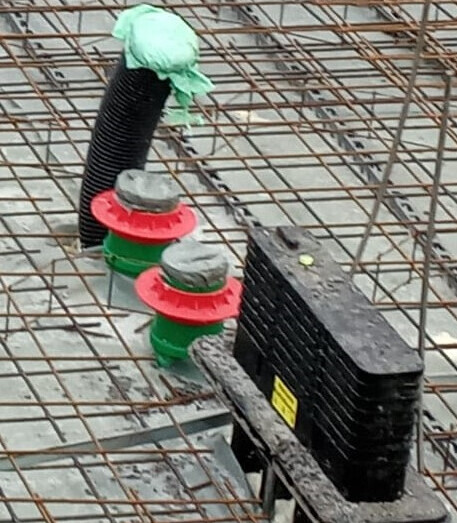
And here is a picture of how it looks now:
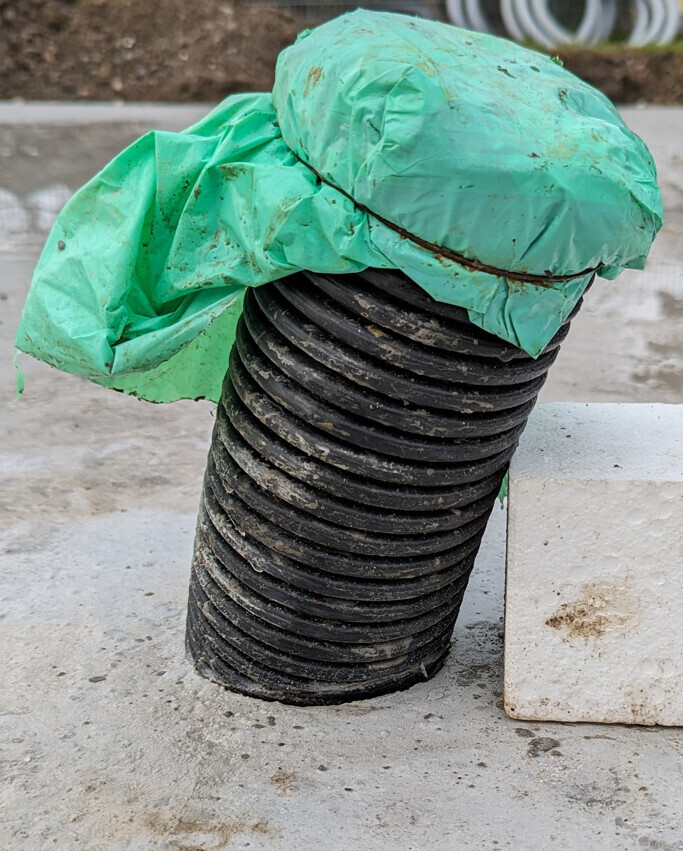
The empty conduit exits the building about 20 cm (8 inches) below ground level.
Because the collar sleeve is missing, we are concerned that water might later enter the house at this point.
My understanding is that, due to the frost protection edge, water cannot accumulate under the slab, so water from beneath the slab cannot enter the building at the edge of the conduit.
Is that correct?
Therefore, the only potential source of water ingress would be at the point where the conduit passes through the edge of the slab.
Is there a way to seal this conduit exit afterwards?
Around the house, a 30 cm (12 inches) wide and 10 cm (4 inches) deep layer of gravel will be laid.
Would it help to make this gravel layer 20 cm (8 inches) deeper at the point where the conduit exits, so that the conduit would exit within the gravel layer?
I hope someone can help me here.
Recently, our concrete slab was poured – we don’t have a basement. Around the slab, a frost protection edge with a depth of 93 cm (37 inches) was installed. Three empty conduits were routed outside under the slab. Two of these are KG2000 pipes, and one is a Kabuflex pipe.
For the KG2000 pipes, collar sleeves were installed before the slab was poured. Unfortunately, this was forgotten for the Kabuflex pipe.
Here is a picture showing the situation before pouring:
And here is a picture of how it looks now:
The empty conduit exits the building about 20 cm (8 inches) below ground level.
Because the collar sleeve is missing, we are concerned that water might later enter the house at this point.
My understanding is that, due to the frost protection edge, water cannot accumulate under the slab, so water from beneath the slab cannot enter the building at the edge of the conduit.
Is that correct?
Therefore, the only potential source of water ingress would be at the point where the conduit passes through the edge of the slab.
Is there a way to seal this conduit exit afterwards?
Around the house, a 30 cm (12 inches) wide and 10 cm (4 inches) deep layer of gravel will be laid.
Would it help to make this gravel layer 20 cm (8 inches) deeper at the point where the conduit exits, so that the conduit would exit within the gravel layer?
Were all the basements constructed with collar joints, including the bathroom, kitchen, and everything else?
In our case, no groundwater pressure is expected, and no collar joint was installed.
Only our roofer sealed the pipes with liquid bitumen on the bitumen waterproofing of the slab.
In our case, no groundwater pressure is expected, and no collar joint was installed.
Only our roofer sealed the pipes with liquid bitumen on the bitumen waterproofing of the slab.
Yes, all the crawl spaces were constructed with collars – at least as far as I can tell from the photos.
Only the Kabuflex wasn’t done that way – for whatever reason.
Now we are wondering what kind of problems this might cause.
Is it possible for hydrostatic pressure to occur at a depth of 20cm (8 inches)?
I couldn’t find anything about hydrostatic or non-hydrostatic water in the soil report.
By the way, bitumen waterproofing membranes were also installed in our case, but no liquid bitumen was applied.
How exactly was it done with you, and what materials were used?
Only the Kabuflex wasn’t done that way – for whatever reason.
Now we are wondering what kind of problems this might cause.
Is it possible for hydrostatic pressure to occur at a depth of 20cm (8 inches)?
I couldn’t find anything about hydrostatic or non-hydrostatic water in the soil report.
By the way, bitumen waterproofing membranes were also installed in our case, but no liquid bitumen was applied.
How exactly was it done with you, and what materials were used?

BoPaDi24 schrieb:
Can pressurized water build up at a depth of 20 cm (8 inches)?Yes, if there is flooding around the house up to 1 meter (3.3 feet), you won’t have to worry about the foundation slab, since the house will already be filled with water up to 1 meter (3.3 feet).A
Allthewayup13 Feb 2024 23:15A masonry collar around a Kabuflex pipe makes little sense because 1) masonry collars are secured with stainless steel clamps and are therefore only suitable for rigid pipes. 2) KG pipes have a special coating that makes them very smooth, whereas the Kabuflex, due to its shape, has significantly more surface contact with the concrete and thus functions much more as a sheath surface than as a sealing surface. However, it is still not truly watertight against pressure water. If your soil report does not indicate any stagnant, pressing, or groundwater, there is no need to seal specially within the concrete layer. Most likely, a membrane will be applied later on the slab or, as in our case, a multifunctional flange plate will be installed.
From the manufacturer of Kabuflex, we received information that the pipe is made of polyethylene and that this material does not bond with concrete. This could allow water to run along the pipe into the building.
There are also special wall collars available for Kabuflex – both from the manufacturer and third-party suppliers.
That is why we feel uncertain.
Are we correct in understanding that, due to the frost skirt, water cannot accumulate beneath the slab?
What do you mean by membrane?
We only had a bitumen sheet membrane applied.
Would it be a good idea to simply fill the opening of the empty conduit with expanding foam?
There are also special wall collars available for Kabuflex – both from the manufacturer and third-party suppliers.
That is why we feel uncertain.
Are we correct in understanding that, due to the frost skirt, water cannot accumulate beneath the slab?
What do you mean by membrane?
We only had a bitumen sheet membrane applied.
Would it be a good idea to simply fill the opening of the empty conduit with expanding foam?
Similar topics