
ᐅ Peat in the Soil – Pile Foundations, Well Foundations, or Vibro-Concrete Columns?
Created on: 5 Feb 2024 12:04
N
NordlichterN
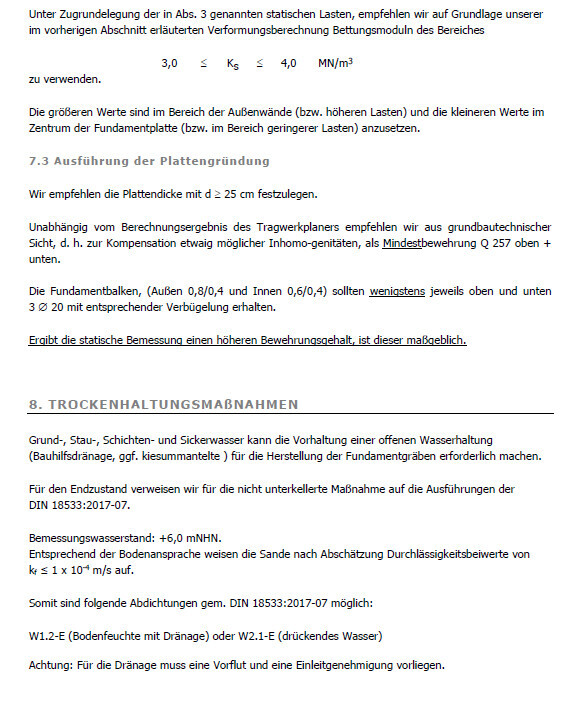
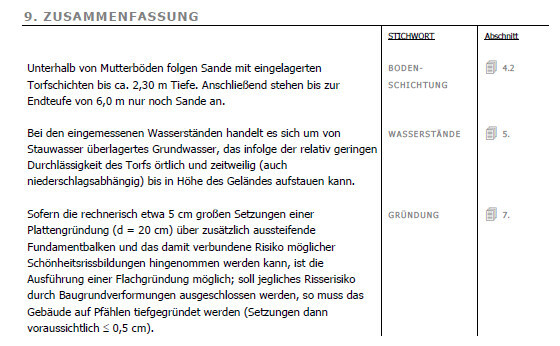
Nordlichter5 Feb 2024 12:04Hello! We were fortunate to be able to reserve a plot of land that really appeals to us again. Unfortunately, the soil report we commissioned revealed peat in the ground. Since the peat layer isn’t very deep, the potential general contractor suggested that soil replacement might be the most financially attractive option for a safe and stable foundation. We contacted every company that came up in our online search for a quote, but only received one offer, which amounted to nearly 75,000 euros. Because the groundwater level is relatively high, soil replacement might not actually be a sensible option. We are now looking at alternatives; we have found various methods such as pile foundations, drilled foundations, and vibro stone columns, but we are completely overwhelmed in trying to assess which methods might be feasible, which would be the most reasonable option, and we have so far only relied on browser searches to find a suitable company. Through this post, we hope to get some information that will help us understand the situation better and take the right steps. I have attached the soil report and would like to thank anyone who takes the time to have a look! A slab foundation with reinforced concrete might be possible, but everything we have read so far sounds like "just don’t do it." Are we correct in thinking that?
Honestly, I would be inclined to say unfortunate luck, peat in the soil means expensive costs, so we should look for another plot. That is what we have been doing over the past few weeks—we are on every waiting list we found, have visited various plots, and the search area of "Schleswig-Holstein" was not exactly small. However, mentally and in conversation, we keep coming back to this plot; this new development is exactly in the area where we most want to live, and we really like the town and the surroundings. It’s just uncertain whether we can get the foundation work on a reasonable financial footing, so we would be very grateful for any help!
Best regards,
Kerstin

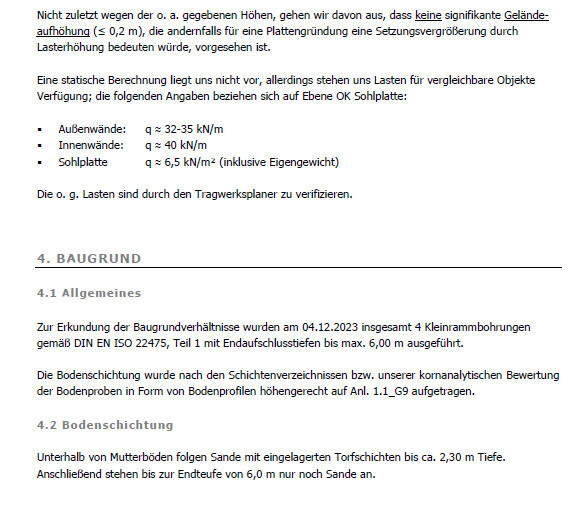
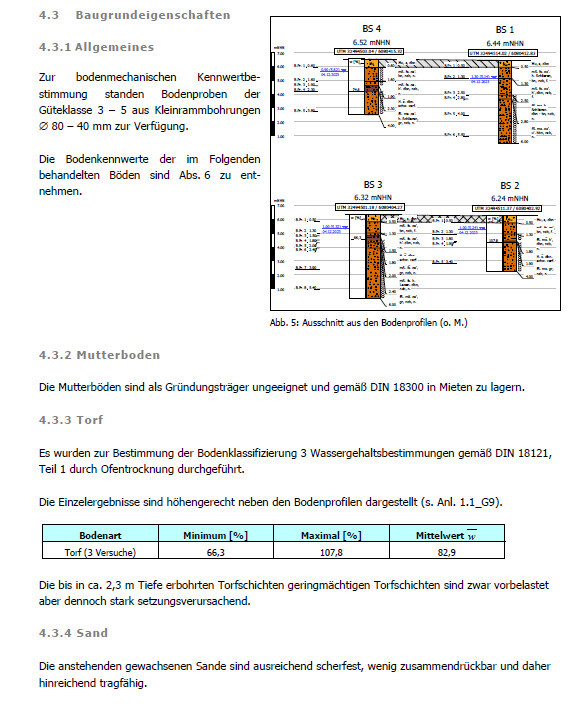
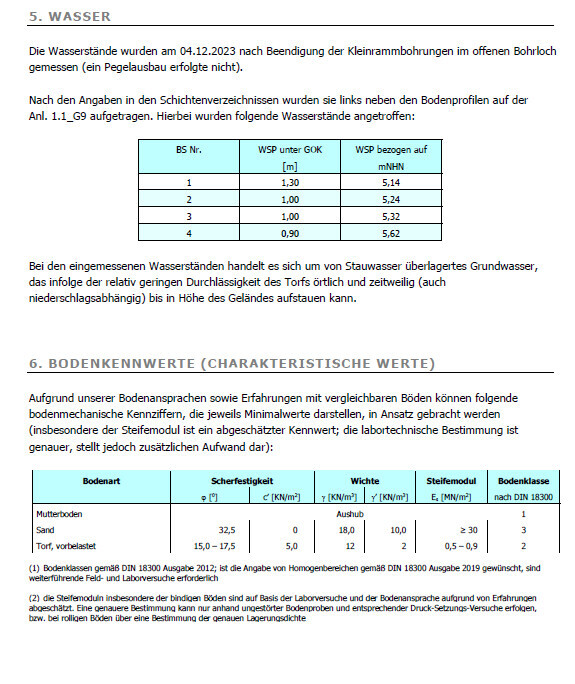
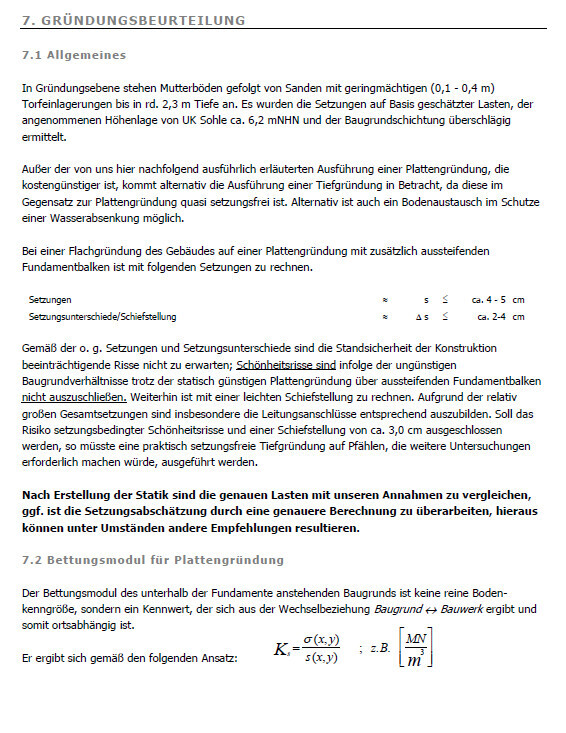
Honestly, I would be inclined to say unfortunate luck, peat in the soil means expensive costs, so we should look for another plot. That is what we have been doing over the past few weeks—we are on every waiting list we found, have visited various plots, and the search area of "Schleswig-Holstein" was not exactly small. However, mentally and in conversation, we keep coming back to this plot; this new development is exactly in the area where we most want to live, and we really like the town and the surroundings. It’s just uncertain whether we can get the foundation work on a reasonable financial footing, so we would be very grateful for any help!
Best regards,
Kerstin
Hello,
unfortunately, I agree with you—the high groundwater level makes soil replacement uneconomical. In this case, some form of temporary support (preferably sheet piling) and a fully enclosed water management system would be necessary, along with excavation and backfilling.
You have basically identified the alternatives correctly, and they are "mentioned" in the report. You either accept cracks or you choose a deep foundation. If I were to build a modern house today, I would definitely avoid taking any risks, especially since all further damage during construction tends to be blamed on the foundation...
A deep foundation is somewhat more expensive (I estimate over 30,000 € for a single-family house; however, my data is a few years old), but it definitely provides security.
The alternatives:
Pile foundation: reinforced concrete piles are driven into the sand. I estimate a depth of 5–6 meters (16–20 feet)... The exact values must be provided by the geotechnical engineer, and the structural engineer calculates the required number of piles. Additional investigations may be necessary, such as water analysis (concrete aggressiveness) and possibly a cone penetration test to determine shaft friction and end-bearing resistance (costs around 1,000 €).
The expensive part of all deep foundations usually lies in site setup, often already costing around 15,000 €.
Personally, I am a fan of vibro-compaction columns (vibro stone columns). Here, a "hole" is driven into the ground, and then gravel or crushed stone is added and compacted from top to bottom. If needed, a binder can be added (CMC columns). When the entire building area is effectively filled with these, a gravel cushion is placed on top to distribute the loads.
Concrete rings: concrete rings are lowered to the target depth and, if necessary, concreted in place. This depends on the earthworks contractor.
All three options will achieve the goal and, in my opinion, are feasible for your site.
I would recommend consulting the geotechnical engineer again to see if they can provide foundation recommendations for the other options.
Then gather quotes. Known companies are Menard (CMC columns) and Keller Grundbau.
Good luck!
unfortunately, I agree with you—the high groundwater level makes soil replacement uneconomical. In this case, some form of temporary support (preferably sheet piling) and a fully enclosed water management system would be necessary, along with excavation and backfilling.
You have basically identified the alternatives correctly, and they are "mentioned" in the report. You either accept cracks or you choose a deep foundation. If I were to build a modern house today, I would definitely avoid taking any risks, especially since all further damage during construction tends to be blamed on the foundation...
A deep foundation is somewhat more expensive (I estimate over 30,000 € for a single-family house; however, my data is a few years old), but it definitely provides security.
The alternatives:
Pile foundation: reinforced concrete piles are driven into the sand. I estimate a depth of 5–6 meters (16–20 feet)... The exact values must be provided by the geotechnical engineer, and the structural engineer calculates the required number of piles. Additional investigations may be necessary, such as water analysis (concrete aggressiveness) and possibly a cone penetration test to determine shaft friction and end-bearing resistance (costs around 1,000 €).
The expensive part of all deep foundations usually lies in site setup, often already costing around 15,000 €.
Personally, I am a fan of vibro-compaction columns (vibro stone columns). Here, a "hole" is driven into the ground, and then gravel or crushed stone is added and compacted from top to bottom. If needed, a binder can be added (CMC columns). When the entire building area is effectively filled with these, a gravel cushion is placed on top to distribute the loads.
Concrete rings: concrete rings are lowered to the target depth and, if necessary, concreted in place. This depends on the earthworks contractor.
All three options will achieve the goal and, in my opinion, are feasible for your site.
I would recommend consulting the geotechnical engineer again to see if they can provide foundation recommendations for the other options.
Then gather quotes. Known companies are Menard (CMC columns) and Keller Grundbau.
Good luck!
Then your potential general contractor should get moving and have the structural engineer do the calculations. Of course, the effort has to be paid for, naturally. But since the engineer knows what kind of house you want, they will calculate the loads, and then(!!) you will also receive a detailed offer from the foundation specialist, for example. After that, you contact them, and things start moving. If the general contractor is not willing to do this upfront, I would look for someone else...
N
Nordlichter7 Feb 2024 11:15Thank you all for your responses and the information!
Cronos, that was really helpful, thank you! We have now received several quotes for different types of piles. Comparing these is impossible for us, at least. The details vary greatly, and of course, all costs are only estimates. On top of that, there is the reinforced concrete in the foundation slab. At this point, I would say we have no idea what the price range is. One quote for the pile foundation is under 10,000 euros and another is almost 40,000 euros, with the other quotes falling somewhere in between.
There is another meeting this week with the potential general contractor (thanks, Rübe!). Well, we’ll see if we can at least get some information about the structural engineering of the house so the quotes can be more accurate. By the way, is it possible to create a thread here in the forum to get quotes reviewed?
Without signing the general contractor’s contract, we won’t get the floor plans. However, the size of the house would be adjusted based on the floor plans (half a meter more here, a meter less there). For the soil survey, we had to fix the position of the house so the drilling could be done correctly, and that was already very frustrating without knowing the actual dimensions of the house. If the house turns out to be smaller, larger, or differently shaped, the soil could show a peat lens deeper down at a different spot, and the foundation work might have to change — or is that a misconception? The structural engineering of the actual house would provide the foundation contractors with the right information. But the structural calculations only happen after the contract is signed and the floor plans are finalized. Without at least a rough estimate of the foundation costs, we can’t accurately calculate financing (more precisely than we have so far) or decide whether to buy the plot. It’s driving us a bit crazy. If we had unlimited finances, that wouldn’t be a problem — a big budget cushion and done. But for that, we really would have had to buy a lottery ticket.
We also contacted the soil surveyor again and asked if it would be possible to get foundation recommendations for other foundation options as well. Now we’re waiting for a response!
Cronos, that was really helpful, thank you! We have now received several quotes for different types of piles. Comparing these is impossible for us, at least. The details vary greatly, and of course, all costs are only estimates. On top of that, there is the reinforced concrete in the foundation slab. At this point, I would say we have no idea what the price range is. One quote for the pile foundation is under 10,000 euros and another is almost 40,000 euros, with the other quotes falling somewhere in between.
There is another meeting this week with the potential general contractor (thanks, Rübe!). Well, we’ll see if we can at least get some information about the structural engineering of the house so the quotes can be more accurate. By the way, is it possible to create a thread here in the forum to get quotes reviewed?
Without signing the general contractor’s contract, we won’t get the floor plans. However, the size of the house would be adjusted based on the floor plans (half a meter more here, a meter less there). For the soil survey, we had to fix the position of the house so the drilling could be done correctly, and that was already very frustrating without knowing the actual dimensions of the house. If the house turns out to be smaller, larger, or differently shaped, the soil could show a peat lens deeper down at a different spot, and the foundation work might have to change — or is that a misconception? The structural engineering of the actual house would provide the foundation contractors with the right information. But the structural calculations only happen after the contract is signed and the floor plans are finalized. Without at least a rough estimate of the foundation costs, we can’t accurately calculate financing (more precisely than we have so far) or decide whether to buy the plot. It’s driving us a bit crazy. If we had unlimited finances, that wouldn’t be a problem — a big budget cushion and done. But for that, we really would have had to buy a lottery ticket.
We also contacted the soil surveyor again and asked if it would be possible to get foundation recommendations for other foundation options as well. Now we’re waiting for a response!
Nordlichter schrieb:
Without signing the general contractor’s contract, we won’t receive any floor plans. However, the house size would be adjusted according to the floor plan (half a meter more here, one meter less there). For the geotechnical survey, we had to fix the positioning of the house so drilling could be done appropriately, and that was already very frustrating without knowing the actual dimensions of the house.
It’s actually quite simple: there is a planning contract, and that’s that. Currently, as the client dealing with a general contractor, you are in the stronger position, and I would make that very clear to them. You are currently guessing blindly; it has even happened that peat lenses change size, and the geotechnical engineer only samples the edge. I also had a case where three points were absolutely fine, but at the fourth, peat extended up to 6 meters (20 feet). Ultimately, everything must be clearly stated for the house financing as well. By signing a house building contract, you are essentially handing over a blank check without knowing what the costs, etc., will be.
N
Nordlichter29 Feb 2024 15:15Yes, that’s true—just signing without thorough planning beforehand can lead to serious problems... Ideally, we would like to know the exact costs down to the last cent before construction starts, but that’s just wishful thinking.
What exactly is a planning contract? I’ve never heard of that; it wasn’t offered to us.
An update... we have received an offer for foundation work using vibro-compaction columns that sounds really great! According to the company, this allows for a standard slab foundation without additional reinforcement, essentially building as if the ground were perfect. The settlement is supposed to be uniform, which prevents damage to the house and significantly reduces overall settlement. Another advantage is that the columns also function as drainage. And the cherry on top: the dynamic probing test that would have been necessary for piles is not required for the foundation with vibro-compaction columns, as confirmed by our geotechnical engineer.
We are now including this offer in our financing plans.
What exactly is a planning contract? I’ve never heard of that; it wasn’t offered to us.
An update... we have received an offer for foundation work using vibro-compaction columns that sounds really great! According to the company, this allows for a standard slab foundation without additional reinforcement, essentially building as if the ground were perfect. The settlement is supposed to be uniform, which prevents damage to the house and significantly reduces overall settlement. Another advantage is that the columns also function as drainage. And the cherry on top: the dynamic probing test that would have been necessary for piles is not required for the foundation with vibro-compaction columns, as confirmed by our geotechnical engineer.
We are now including this offer in our financing plans.
Similar topics