
ᐅ Which is more suitable for the site conditions: a basement or a slab foundation?
Created on: 28 Jan 2024 19:38
T
TobsBAU
Hello everyone,
I am new to the forum and have purchased a plot of land from the municipality in a new development area, where a single-family house is planned to be built within the next 1.5 years (1 or 2 stories).
For some time now, I have been struggling with the site conditions (slight slope and below street level) and the associated question of whether a basement might actually be the smarter/more cost-effective (or at least cost-neutral) solution in this situation. To answer this question properly, I will probably need quotes from civil contractors and, above all, a geotechnical soil report. Regarding the soil report, I seem to be going in circles because all geotechnical engineers want very precise information about the planned construction, which in turn depends on the decision between a basement or slab-on-grade foundation.
I am hoping to get advice on the following questions:
All prefab house suppliers, etc., I have contacted so far have really not addressed these conditions. They just ask for a budget range and then assume a flat fee of €25,000 for earthworks, etc. I suspect this will not be enough, and I want to make these costs tangible for my financial planning! When the basement topic comes up, even architects generally say a basement is always expensive. If the budget is tight, better to do without a basement...
Here are some details and premises I want to share with you:
Thank you very much, and I look forward to your suggestions and advice!
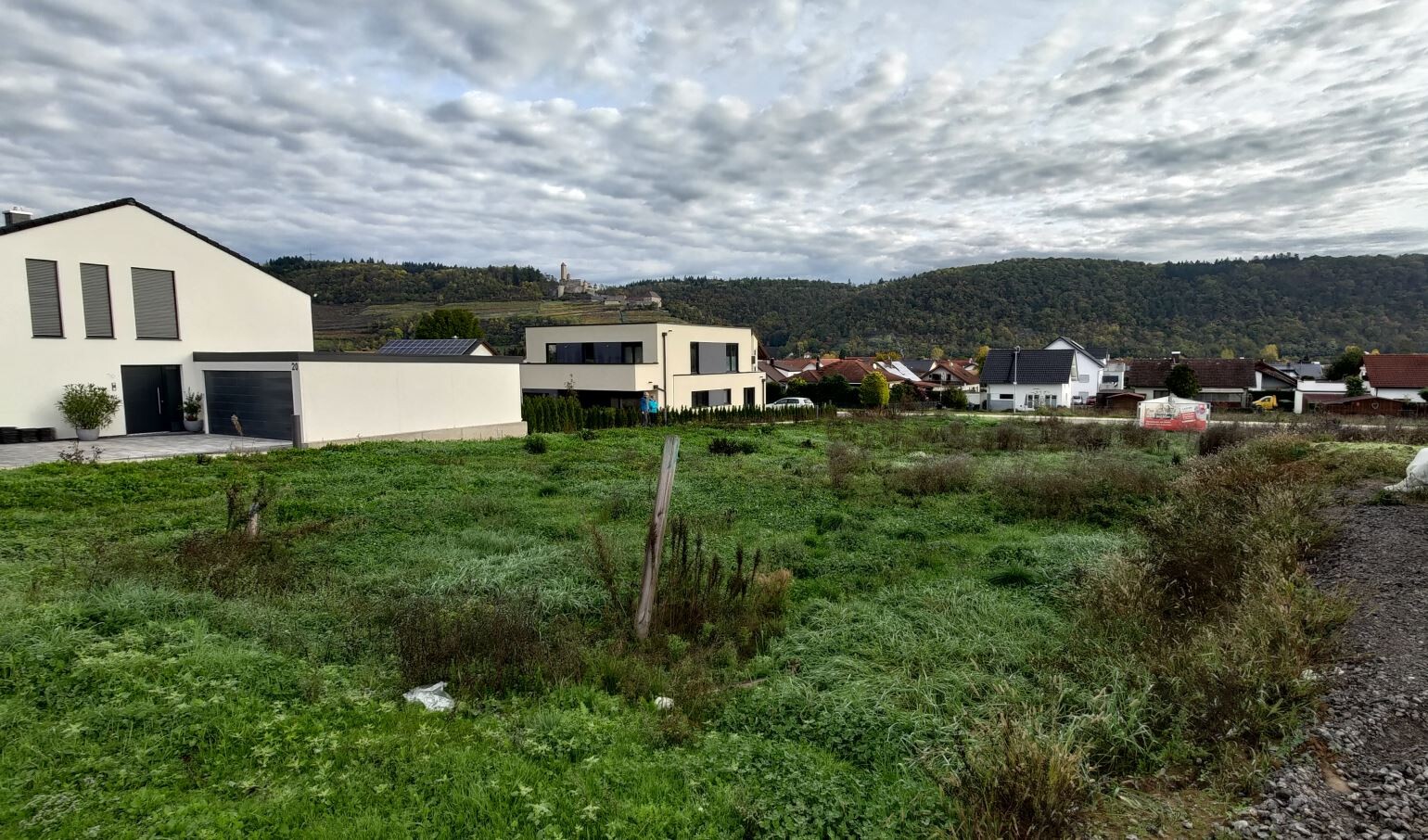

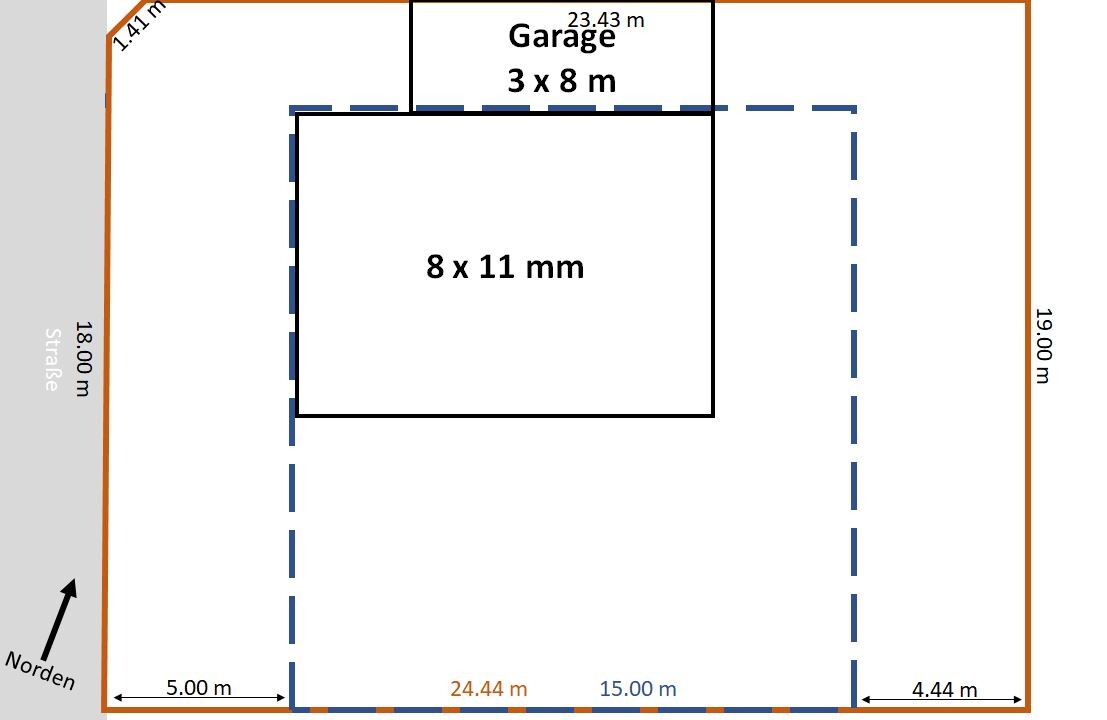

I am new to the forum and have purchased a plot of land from the municipality in a new development area, where a single-family house is planned to be built within the next 1.5 years (1 or 2 stories).
For some time now, I have been struggling with the site conditions (slight slope and below street level) and the associated question of whether a basement might actually be the smarter/more cost-effective (or at least cost-neutral) solution in this situation. To answer this question properly, I will probably need quotes from civil contractors and, above all, a geotechnical soil report. Regarding the soil report, I seem to be going in circles because all geotechnical engineers want very precise information about the planned construction, which in turn depends on the decision between a basement or slab-on-grade foundation.
I am hoping to get advice on the following questions:
- Is it possible, when building with a basement, to use the excavated soil to fill the plot up to street level (no costly disposal required)?
- What advice can you give me about the soil report (the exact future construction is not yet fixed)?
- I am torn between the following options (which do you think is more sensible?):
- Build with a basement and fill the plot to street level using the excavated soil (hold back the northeast property boundary with a 1 m high retaining wall). Allow a partial slope to create a daylight basement room facing northeast, which could possibly be used as an office. The utility room would naturally also be in the basement, but I would prefer to avoid a sump pump system if possible.
- Fill the plot (up to street level or slightly below) and build with a slab-on-grade foundation (hold back the northeast property boundary with a 1 m high retaining wall). However, I am concerned about the costs for fill material and necessary compaction. The utility room would be on the ground floor or upper floor, no sump pump system, but probably with a backwater valve.
All prefab house suppliers, etc., I have contacted so far have really not addressed these conditions. They just ask for a budget range and then assume a flat fee of €25,000 for earthworks, etc. I suspect this will not be enough, and I want to make these costs tangible for my financial planning! When the basement topic comes up, even architects generally say a basement is always expensive. If the budget is tight, better to do without a basement...
Here are some details and premises I want to share with you:
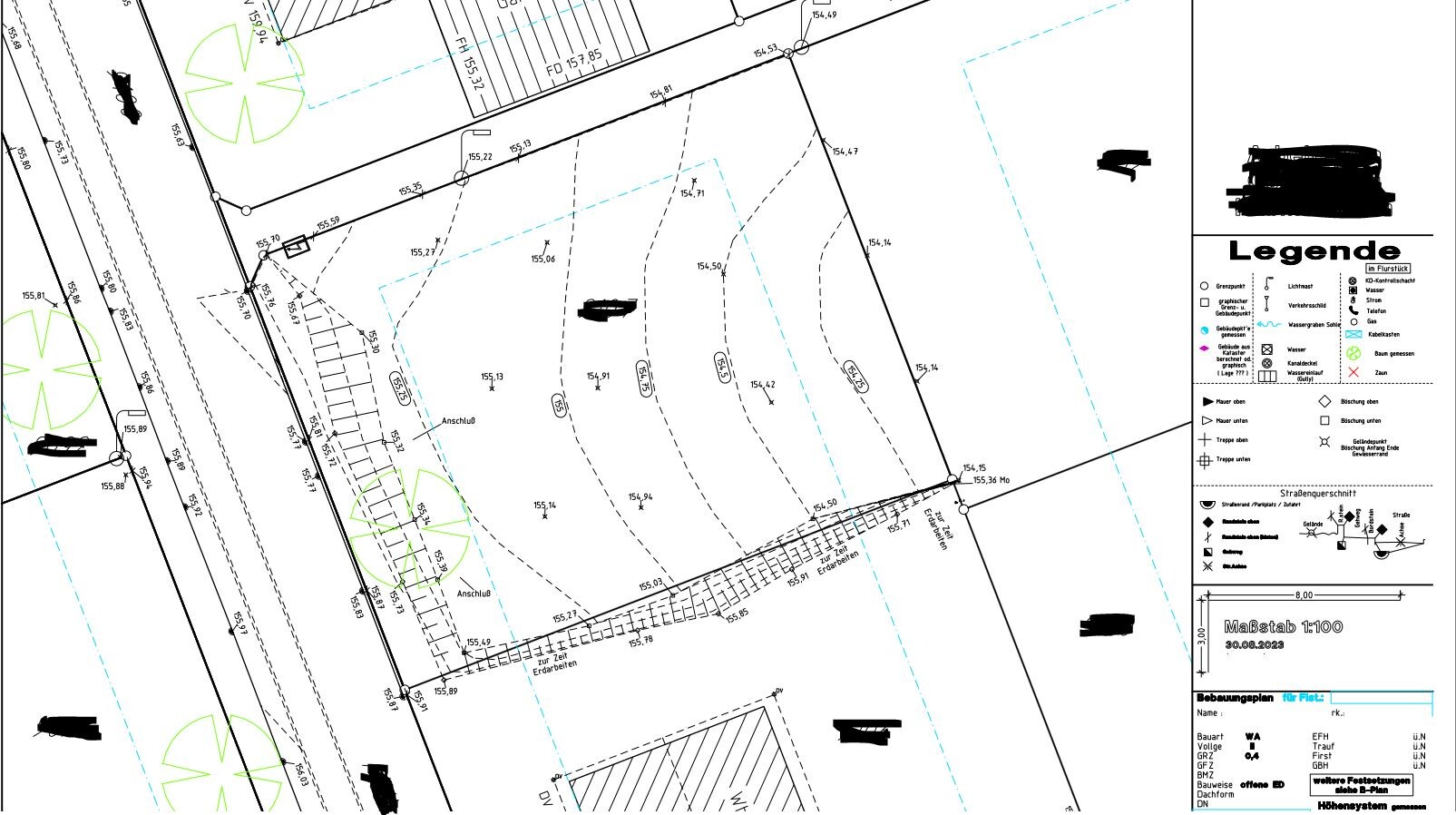
- The plot is below street level. The adjacent neighboring plot (southeast) has been raised up to street level (top of finished floor level +156.14 m).
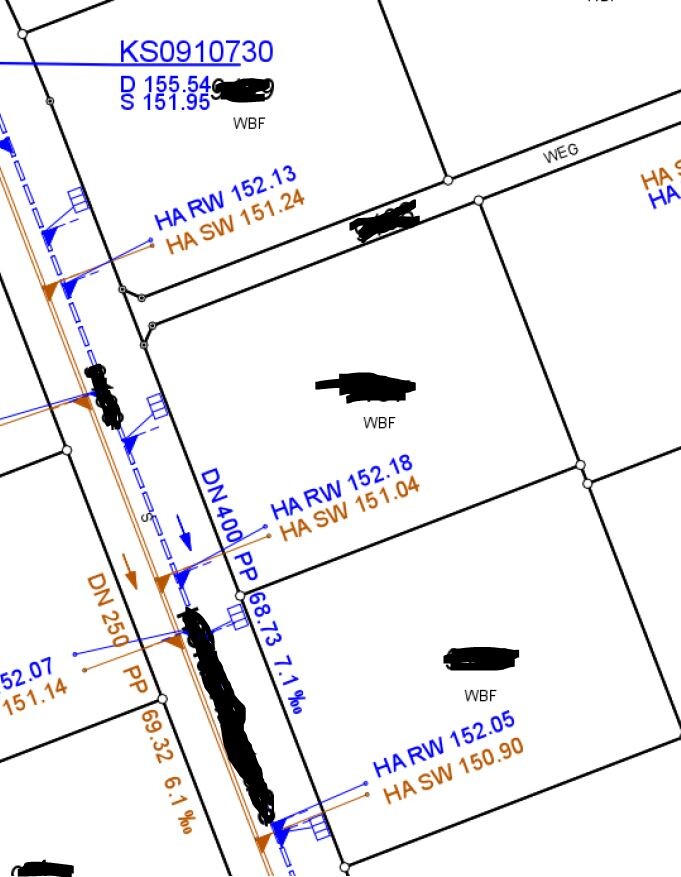
- Because of the filling up to street level, no backwater valve was needed there. On the opposite plot (northwest, behind the sidewalk), the fill was not raised as high, so a backwater valve was required. If I build with a basement, I would probably have to plan for a sump pump system even if I fill up to street level.
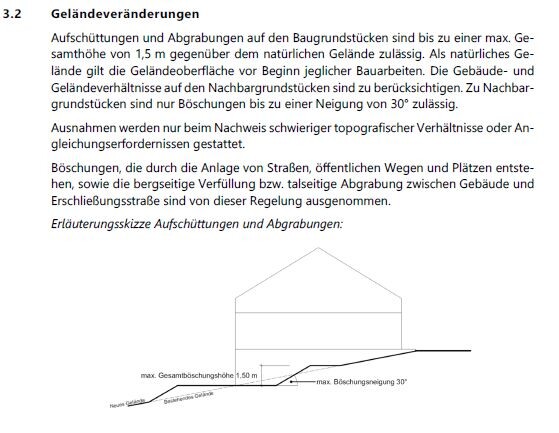
- According to the development plan, a retaining wall up to one meter high may be built to compensate for the slope; beyond that, slopes with an angle of 30° must be used (see attachment). Of course, both neighboring properties have taken advantage of this and installed suitable L-shaped retaining walls on the northeast side.
- Basically, I would not have necessarily filled the plot, but since the southeast side was raised and that is where most of the natural light comes from, I feel almost compelled to at least partially fill.
- Unlike the neighboring development, I am considering positioning the house (gable roof) with the gable perpendicular to the street (see sketch). This would improve lighting and usability of the plot.
- There is a castle to the northeast at some distance, which should also be taken into account when planning the house (view connection).
- The plot is 464 m² (about 5,000 sq ft) and located 800 m (0.5 miles) from a river (about 15 m (50 feet) above the water surface, no flood risk). Additional waterproofing measures for a basement are to be expected (most likely a waterproof concrete shell). A neighbor who built with a basement had to seal it from the outside (apparently afterwards).
- The development plan is generally quite generous: 2 full floors allowed, max ridge height = 6.5 m (21 ft 4 in), max eaves height = 10.5 m (34 ft 5 in), floor area ratio: 0.4
- Surveying has been done (see attachment)
Thank you very much, and I look forward to your suggestions and advice!

TobsBAU schrieb:
What do you mean by "handling the terrain à la Nordlys"? A kind of embankment around the yard; so far I can only find these pictures, but there should be more of his garden in the same thread: https://www.hausbau-forum.de/threads/haus-bilder-austausch-zeigt-her-eure-hausbilder.14011/page-111#post-216081 and https://www.hausbau-forum.de/threads/haus-bilder-austausch-zeigt-her-eure-hausbilder.14011/page-121#post-218487
TobsBAU schrieb:
Would you then design the partial basement solely as a utility cellar at the front (street-facing) side?
I could hardly find any information about split-level (additional costs, etc.). It would make sense in the northeast corner of the floor plan or (see attachment)? No, I was referring to either a partial basement or a moderate split-level, in which case the basement would be under the "valley side half" of the ground floor; but you can also combine both, meaning a basement on the "hill side" (street side) and the lower part of the split-level ground floor on the yard side.
https://www.instagram.com/11antgmxde/
https://www.linkedin.com/company/bauen-jetzt/
TobsBAU schrieb:
It would make sense to place this in the northeast corner of the floor plan or (see attachment)?P.S.: of course, NOT with a gable-end oriented floor plan.https://www.instagram.com/11antgmxde/
https://www.linkedin.com/company/bauen-jetzt/
H
hanghaus202331 Jan 2024 09:14The ridge directions are marked in the garage attachment. Are these mandatory? At least the neighbors have followed them.
H
hanghaus202331 Jan 2024 10:10In my opinion, the garage layout complies with the development plan. The house is as tall as necessary to allow the slope to lead towards the street. I have already mentioned this.
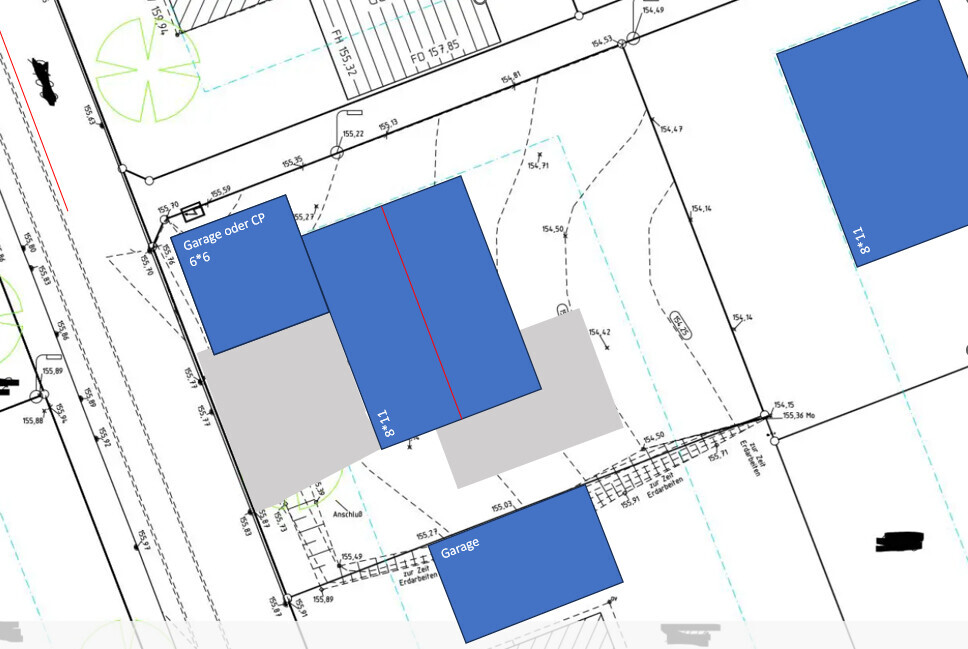

I tried placing the 11 x 8 m (36 x 26 ft) house as requested by the original poster on the plot for better visualization. Of course, this is not 100% accurate. Here, the house is positioned 5 m (16 ft) from the street and 20 cm (8 inches) below street level—so the street-facing front is roughly at natural ground level. This would be the option if you don’t want to add or level anything in the front yard.
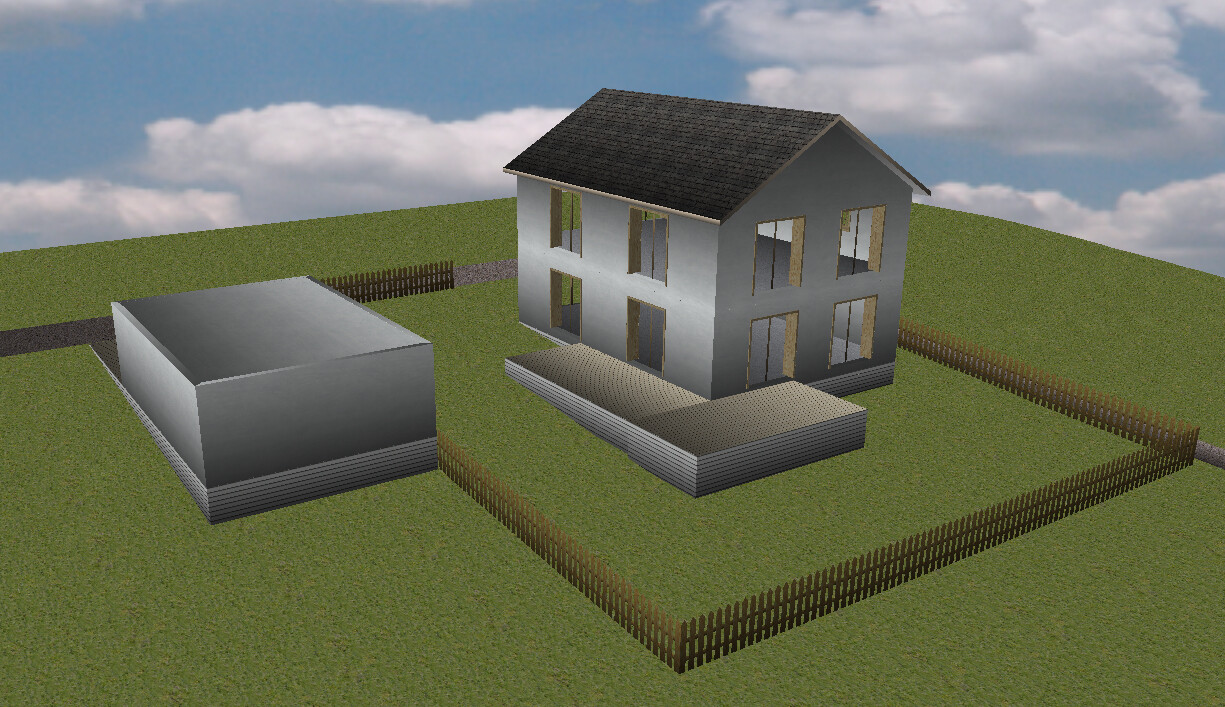
The neighbor probably added around 1 m (3 ft) of fill at the rear edge of their theoretical 9 m (30 ft) garage. In this example, the original poster’s terrace, which is 3 m (10 ft) wide at the rear edge, would already be about 1.20 m (4 ft) above natural ground level when aligned flush with the terrace doors (including the base slab). The base slab supporting structure at the rear edge would be about 80 cm (31 inches) high. If you want to bring everything up to street level, you’d need to add another 20 cm (8 inches) throughout. That is quite a substantial volume of material.
In contrast, here is the rotated option that the neighbors also chose:
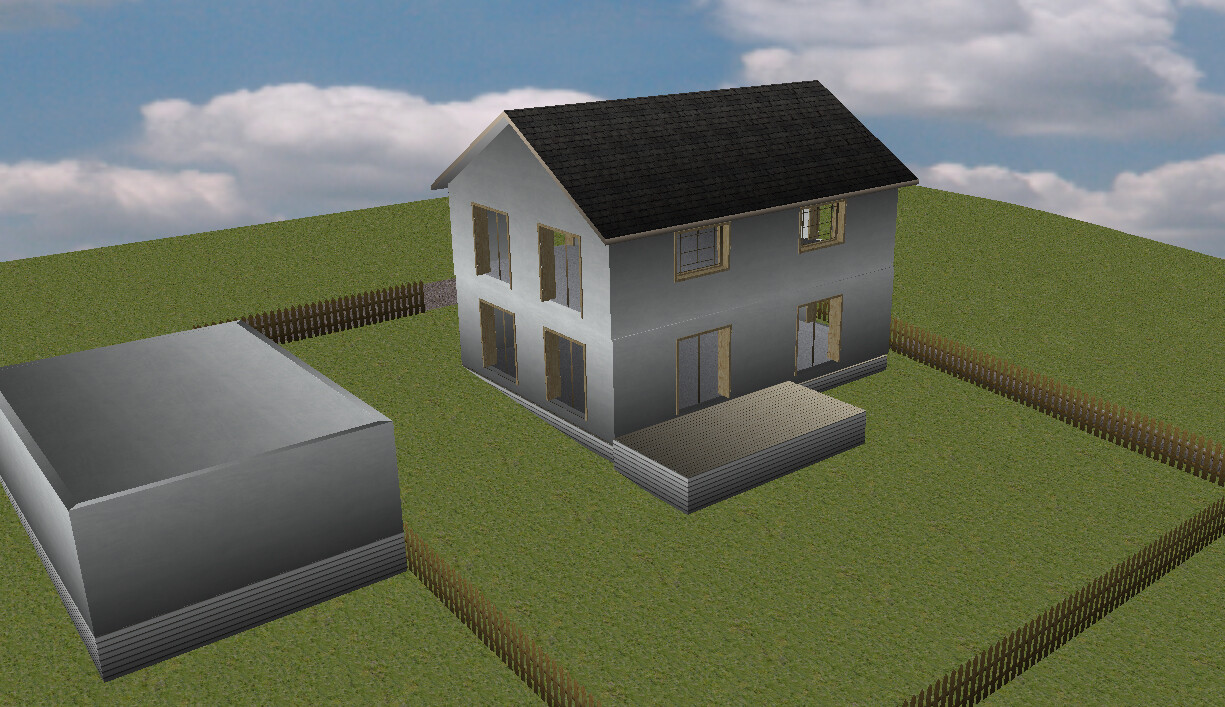
Here, the base slab support at the rear edge is about 50 cm (20 inches) with the same starting parameters. Of course, the cost difference may not be huge in the end. The more important factor is the height difference between the terrace and the natural ground level.
You can also plan to position the front door on the side with a slightly recessed front elevation:
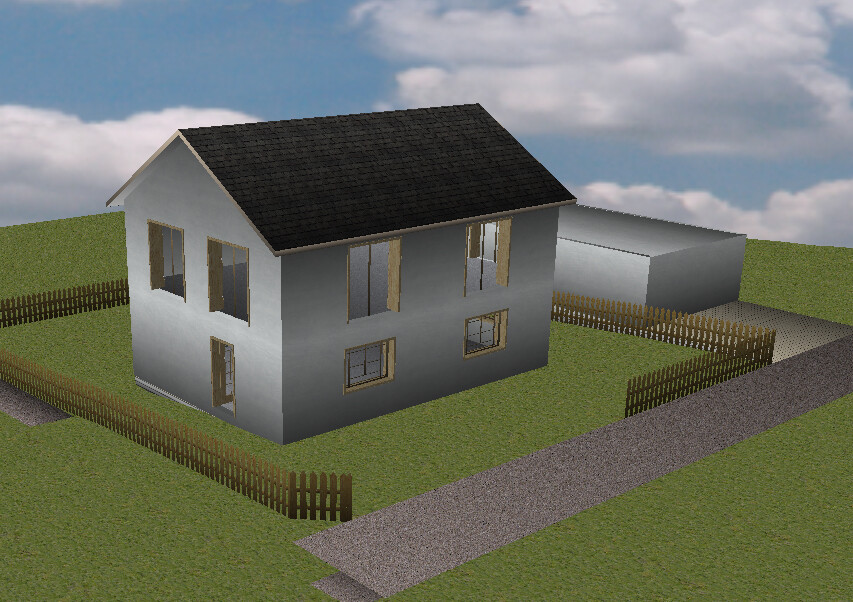
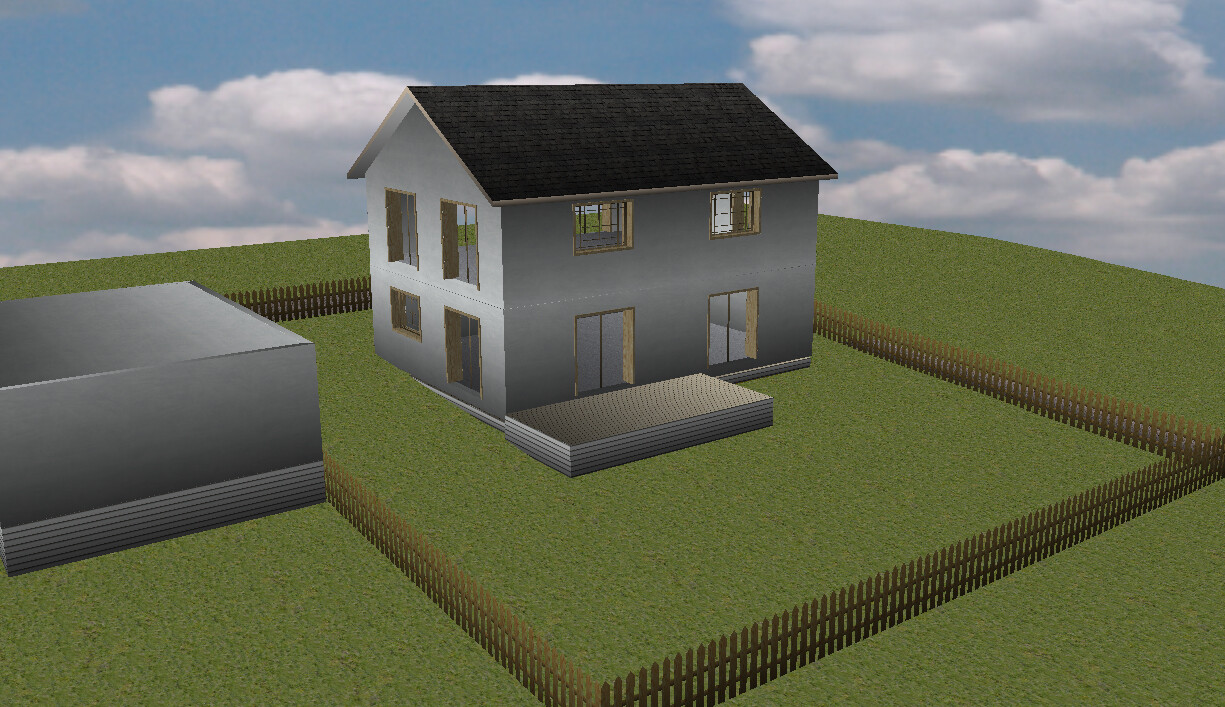
This requires digging 20 cm (8 inches) deeper in the front but less filling at the back, resulting in less adjustment to the terrain overall. If it were mine, I would probably lower the street-facing side even more to have just a few steps to overcome the garden exit at the rear. With these options, careful planning for heavy rainwater runoff and proper waterproofing against the ground is essential.
A split-level design could also be sketched out. However, that only makes sense once you find a contractor who has done this many times before. In my opinion, working with a standard general contractor who “might give it a try” wouldn’t be advisable.
The neighbor probably added around 1 m (3 ft) of fill at the rear edge of their theoretical 9 m (30 ft) garage. In this example, the original poster’s terrace, which is 3 m (10 ft) wide at the rear edge, would already be about 1.20 m (4 ft) above natural ground level when aligned flush with the terrace doors (including the base slab). The base slab supporting structure at the rear edge would be about 80 cm (31 inches) high. If you want to bring everything up to street level, you’d need to add another 20 cm (8 inches) throughout. That is quite a substantial volume of material.
In contrast, here is the rotated option that the neighbors also chose:
Here, the base slab support at the rear edge is about 50 cm (20 inches) with the same starting parameters. Of course, the cost difference may not be huge in the end. The more important factor is the height difference between the terrace and the natural ground level.
You can also plan to position the front door on the side with a slightly recessed front elevation:
This requires digging 20 cm (8 inches) deeper in the front but less filling at the back, resulting in less adjustment to the terrain overall. If it were mine, I would probably lower the street-facing side even more to have just a few steps to overcome the garden exit at the rear. With these options, careful planning for heavy rainwater runoff and proper waterproofing against the ground is essential.
A split-level design could also be sketched out. However, that only makes sense once you find a contractor who has done this many times before. In my opinion, working with a standard general contractor who “might give it a try” wouldn’t be advisable.
K a t j a schrieb:
You could also sketch the split again. However, it only makes sense once you actually find a company that has done it many times. With a standard general contractor who "would try it," in my opinion, that wouldn’t be an option. Exactly – it’s not common enough for everyone to be experienced with it.
https://www.instagram.com/11antgmxde/
https://www.linkedin.com/company/bauen-jetzt/
Similar topics