
M
Messerjoe6 Jan 2024 08:42Happy New Year!
My concern: I want to convert a workshop into a residential building. The roof is made of free-spanning steel trusses and is currently covered with asbestos corrugated sheets from the former East Germany and insulated underneath the trusses with unhealthy slag wool.
I would like to discuss my ideas with you:
I personally like the trusses themselves (14 trusses span 14 x 8 meters (46 x 26 feet) free-spanning) and would like to make them visible.
So a conversion to a warm roof.
I do not want to use plastics or mineral wool products to keep conscience, ecology, and indoor air quality good.
The construction should still be as simple, inexpensive, and sensible as possible, and I intend to do as much of the work myself as possible.
The roof has an eave height of 3.5 meters (11.5 feet) and a 15-degree slope, so it is not very dangerous to work on.
I imagine the following roof build-up:
OSB 3/4 directly on the steel trusses as bracing and vapor retarder.
Rigid wood fiber insulation board 10 to 16 cm (4 to 6 inches) (Steico Therm?)
Waterproof membrane or underlay board.
Counter battens
Standing seam metal roofing.
Do you agree with these considerations?
Are there simpler or cheaper alternatives?
Thanks for your feedback,
Wolfgang
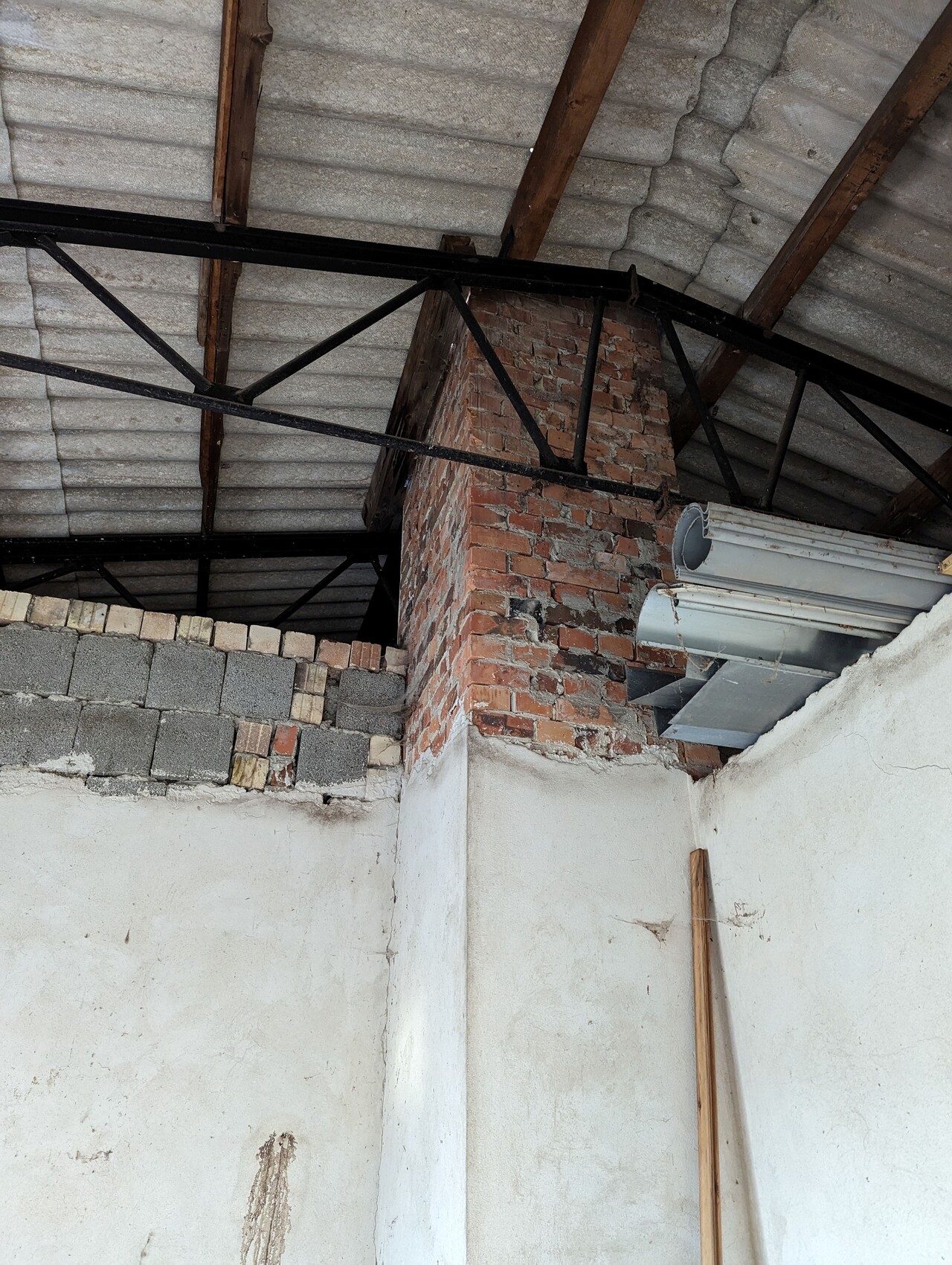
My concern: I want to convert a workshop into a residential building. The roof is made of free-spanning steel trusses and is currently covered with asbestos corrugated sheets from the former East Germany and insulated underneath the trusses with unhealthy slag wool.
I would like to discuss my ideas with you:
I personally like the trusses themselves (14 trusses span 14 x 8 meters (46 x 26 feet) free-spanning) and would like to make them visible.
So a conversion to a warm roof.
I do not want to use plastics or mineral wool products to keep conscience, ecology, and indoor air quality good.
The construction should still be as simple, inexpensive, and sensible as possible, and I intend to do as much of the work myself as possible.
The roof has an eave height of 3.5 meters (11.5 feet) and a 15-degree slope, so it is not very dangerous to work on.
I imagine the following roof build-up:
OSB 3/4 directly on the steel trusses as bracing and vapor retarder.
Rigid wood fiber insulation board 10 to 16 cm (4 to 6 inches) (Steico Therm?)
Waterproof membrane or underlay board.
Counter battens
Standing seam metal roofing.
Do you agree with these considerations?
Are there simpler or cheaper alternatives?
Thanks for your feedback,
Wolfgang
So you want to reroof the roof as part of the conversion and have the trusses exposed?
Using OSB as the bottom layer is possible, though it doesn’t look finished, so you would need plasterboard or something similar underneath. In terms of cost and effort, this is probably the best solution.
If the appearance is important, you could also use rough-sawn boarding with a vapor barrier foil on top.
In both cases, airtightness is crucial! Especially at junctions with the eaves and gable, and around any penetrations (which should be avoided as much as possible). If you want to install lighting or pull cables there, you could add a 5cm (2 inch) battening layer to create an installation space with attached plasterboard panels to avoid penetrations through the airtight layer (OSB boards).
For the roof assembly, without additional layers, I would definitely recommend insulation materials with mass. From that perspective, even without considering ecological factors, wood fiber or jute-based materials are the preferred choice. According to the Building Energy Act (annex 1), you must meet a U-value of 0.20.
Using WLG039 wood fiber insulation with 60cm (24 inch) stud spacing, you need two layers of 120mm (5 inch) set crosswise, followed by a windproof / underlay membrane, battens and counter-battens, and metal roofing. This adds up to significant overall build-up height and mass.
The assembly must also be documented and calculated in the thermal insulation proof beforehand — so it cannot be chosen arbitrarily.
You also need to have the static (structural) safety checked, as this adds considerably more mass compared to fiber cement roofing panels.
Using OSB as the bottom layer is possible, though it doesn’t look finished, so you would need plasterboard or something similar underneath. In terms of cost and effort, this is probably the best solution.
If the appearance is important, you could also use rough-sawn boarding with a vapor barrier foil on top.
In both cases, airtightness is crucial! Especially at junctions with the eaves and gable, and around any penetrations (which should be avoided as much as possible). If you want to install lighting or pull cables there, you could add a 5cm (2 inch) battening layer to create an installation space with attached plasterboard panels to avoid penetrations through the airtight layer (OSB boards).
For the roof assembly, without additional layers, I would definitely recommend insulation materials with mass. From that perspective, even without considering ecological factors, wood fiber or jute-based materials are the preferred choice. According to the Building Energy Act (annex 1), you must meet a U-value of 0.20.
Using WLG039 wood fiber insulation with 60cm (24 inch) stud spacing, you need two layers of 120mm (5 inch) set crosswise, followed by a windproof / underlay membrane, battens and counter-battens, and metal roofing. This adds up to significant overall build-up height and mass.
The assembly must also be documented and calculated in the thermal insulation proof beforehand — so it cannot be chosen arbitrarily.
You also need to have the static (structural) safety checked, as this adds considerably more mass compared to fiber cement roofing panels.
M
Messerjoe6 Jan 2024 19:29Thanks for the information 🙂
Exactly
After reading about emissions and odors from OSB, that’s no longer an option.
I don’t like the look of tongue-and-groove boards, so I would add a visual panel underneath as well.
What are the moisture properties of drywall? Is it vapor tight?
Thankfully, I don’t need any penetrations. I’ll heat the workshop with an air-to-air heat pump, so the old chimney can be removed. I hope to build the roof structure as a true “thermal barrier” without thermal bridges extending over the eaves and gable walls all the way to the outside.
Oh dear 😱
I had actually hoped to refer to the existing structural calculations in the building permit application because I am not adding extra weight to the roof (metal sheets are lighter than fiber cement). I hadn’t considered heavy insulation.
Is there no exemption rule for thermal protection with existing buildings?
Assuming I use “lighter” wood fiber insulation.. then in summer I could cool against the heat with solar and the air heat pumps, since they’re split air conditioners, right?
dertill schrieb:
So you want to reroof the roof as part of the conversion and have the trusses exposed?
Exactly
dertill schrieb:
OSB as the bottom layer works, but it’s not visually finished, so you would still need drywall or something similar underneath. Probably the best solution in terms of cost and effort.
You could also use tongue-and-groove boards if you want the look, with a vapor barrier foil on top.
After reading about emissions and odors from OSB, that’s no longer an option.
I don’t like the look of tongue-and-groove boards, so I would add a visual panel underneath as well.
What are the moisture properties of drywall? Is it vapor tight?
dertill schrieb:
Air tightness is crucial in both cases—especially at the connections to the eaves and gable, and at any penetrations (which should be avoided if possible). If you want to install lighting or run cables there, you could add a 5cm (2 inch) framework to create an installation cavity with drywall panels applied, avoiding penetrations through the airtight layer (OSB panels).
Thankfully, I don’t need any penetrations. I’ll heat the workshop with an air-to-air heat pump, so the old chimney can be removed. I hope to build the roof structure as a true “thermal barrier” without thermal bridges extending over the eaves and gable walls all the way to the outside.
dertill schrieb:
Without adding extra mass in the roof assembly, I would definitely use insulation with some density. For that reason, even without an ecological approach, wood fiber or jute insulation would be the preferred choice. According to the building energy regulations (Annex 1), you must meet a U-value of 0.20.
With WLG039 wood fiber and a 60cm (24 inch) rafter spacing, you need two layers of 120mm (4.7 inch) installed crosswise, topped by a wind-tight underlay membrane, battens + counter battens, and metal roofing. Altogether, this results in a fairly tall and heavy roof assembly.
The assembly must also be declared and calculated in the thermal performance calculation—it cannot be selected arbitrarily.
You also need to have the static load checked, as this adds a lot more weight than the fiber cement roofing sheets.
Oh dear 😱
I had actually hoped to refer to the existing structural calculations in the building permit application because I am not adding extra weight to the roof (metal sheets are lighter than fiber cement). I hadn’t considered heavy insulation.
Is there no exemption rule for thermal protection with existing buildings?
Assuming I use “lighter” wood fiber insulation.. then in summer I could cool against the heat with solar and the air heat pumps, since they’re split air conditioners, right?
J
jens.knoedel6 Jan 2024 19:33Messerjoe schrieb:
Is there no exemption rule for thermal insulation in existing buildings?There is for existing buildings. But since you are renovating (or rebuilding), you have to comply with the currently valid regulations. You will also need a building permit / planning permission. What does the designer say, who also has to carry out the energy calculations?
M
Messerjoe6 Jan 2024 20:06jens.knoedel schrieb:
It applies to existing buildings. But since you are modifying (renovating) it, you have to comply with the currently valid regulations. You will also need a building permit / planning permission.
What does the planner say, who also has to carry out the energy calculations? Regarding thermal insulation, I rely on the following:
Gebäudeenergiegesetz schrieb:
In the case of a major renovation, a certain primary energy demand must not be exceeded. However, this value is not as strict as for a new building. For comparison: the maximum allowed energy demand for new construction is 65% lower. The corresponding overall energy balance is usually prepared by the energy consultant. So I am not implementing isolated measures and hopefully don’t need to comply with U-values... 🙂
...I can easily reduce the primary heating demand with photovoltaic and a heat pump.
I am planning everything myself until I am certain about what I want. I won’t involve an energy expert before that.
phew ... a lot to consider ...
If previously unheated: Section 51 of the Building Energy Act states that the transmission heat loss for the entire building envelope (!) must not exceed 1.25 times the value according to Annex 3 (U-values for non-residential buildings). Alternatively, the reference building method can be used, which considers not only U-values or transmission losses but also the primary energy demand.
If the newly converted area exceeds 100% of the existing previously heated floor area of the non-residential building, it is considered a new building, not an extension! This will most likely apply here. So you have to do whole-building assessment using the reference building method with maximum transmission heat losses (U-values) and primary energy demand.
If already heated: U-values according to Annex 7 of the Building Energy Act apply, without the obligation to assess the entire building. For non-residential buildings, lower U-values can be used for low-heated rooms according to Annex 7.
Messerjoe schrieb:No. You can find the sd-values for vapor tightness in the datasheet. OSB ranges from 50-100, which is sufficient for a ventilated metal roof. For drywall, you should install a vapor retarder with at least 10m (33 feet) equivalent air layer thickness.
What moisture properties does drywall have? Is it vapor tight?
Messerjoe schrieb:There is, but if you replace more than 10% of an area (roof, wall, window, etc.), U-values according to Annex 7 of the Building Energy Act must be met. And as far as I see, this is not considered existing building work. See below.
Is there no exception rule in the existing building for thermal insulation?
Messerjoe schrieb:Yes, wood fiber insulation isn’t actually “light” but is well suited both in terms of mass and its thermal storage capacity for phase shift, thereby smoothing out temperature peaks.
Assuming I insulate with "light" wood fiber.. then I could cool against the heat in summer using solar and air-source heat pumps (which are split air conditioners), right?
Messerjoe schrieb:You are converting a previously unheated space, so specific requirements apply and submitting a change of use application (similar to a building permit/planning permission application) is mandatory. The situation is treated either as an extension of a non-residential building (because it is a workshop) or as a new non-residential building. Only if the space was already used—and approved—as a heated area do the Building Energy Act rules for individual components apply, without considering the other building elements.
So I’m not carrying out individual measures and don’t have to comply with U-values... hopefully 🙂
If previously unheated: Section 51 of the Building Energy Act states that the transmission heat loss for the entire building envelope (!) must not exceed 1.25 times the value according to Annex 3 (U-values for non-residential buildings). Alternatively, the reference building method can be used, which considers not only U-values or transmission losses but also the primary energy demand.
If the newly converted area exceeds 100% of the existing previously heated floor area of the non-residential building, it is considered a new building, not an extension! This will most likely apply here. So you have to do whole-building assessment using the reference building method with maximum transmission heat losses (U-values) and primary energy demand.
If already heated: U-values according to Annex 7 of the Building Energy Act apply, without the obligation to assess the entire building. For non-residential buildings, lower U-values can be used for low-heated rooms according to Annex 7.
Messerjoe schrieb:The expert will tell you what you ARE ALLOWED to do before you decide what you want.
I’m planning it myself until I’m sure what I want. I won’t involve an energy expert beforehand.
Similar topics