
ᐅ Significant Water Damage in a New Build – But What Caused It?
Created on: 6 Jan 2024 03:09
S
Simon-LGood evening!
After living in our new house for almost two years without any significant problems or defects, we unexpectedly discovered water damage in the basement the day before yesterday.
It "started" with a small wet spot near the heating room door. By now, we know that water must be standing on the entire slab, meaning under the screed, and it has already risen slightly into almost all the walls. I will try to describe the situation as concisely as possible, but with enough detail where needed.
First, a few key points:
- A soil test in summer 2020 showed no groundwater or water pressure present
- The slab was made from 25cm (10 inches) waterproof concrete. Since this is a basement used as living space, the entire floor was additionally sealed from the inside
- Because the basement is below the sewer level, we have a sewage lifting system that pumps wastewater from a small bathroom (currently unused) and the basement hallway
- The drain pipes run below the slab and are routed through it. The same applies to the ventilation line for the lifting system
- This consists of a sealed chamber also below the slab, plus a second, top-accessible chamber. Normally, there should be no water in the second chamber as everything flows into and is pumped from the lower chamber. For us, it is basically just an inspection opening
- The small bathroom in the basement is still in its rough construction phase since it is currently not needed. The shower area, roughly 1x1m (3x3 ft), is completely open, so you can see the slab and roofing felt
- Furthermore, the heating room and corridor are not tiled yet, so the screed is visible
Now, a brief summary of events:
- After noticing the spot on the screed and confirming it was not leaking “from above,” I opened the lifting system, which was about half full of water. Water was dripping in from the side. After ruling out a defective pipe (underfloor heating and wastewater from the water softener run nearby), we concluded that water must be coming from inside the screed or insulation layers
- Then we noticed that moisture had risen along ALL walls, both interior and exterior, but only slightly above the screed level
- Bad enough, but the shocking sight was in the non-existent shower area of the bathroom, where water was almost 10cm (4 inches) deep
- We pumped out everything, initially into buckets, removing at least 150–180 liters (40–48 gallons) of water
- More water kept coming in; at first, it was flowing visibly, but thankfully less now. Overall, I estimate about 250 liters (66 gallons) of pumped water so far
- Both the plumbing company and the shell contractor have inspected the site, but so far we have not found the source of the problem. A leak detector is scheduled to come early this week
The following causes can be ruled out:
- Potable water -> The water pipes for the basement apartment are not connected, and the meter does not run if no appliances are on. Other water pipes in the heating room are visible and not leaking or damaged
- Heating water -> Probably not enough to cause this much water on the floor; the underfloor heating system maintains pressure perfectly
- Lifting system -> Works flawlessly. Pumping reliably about half full, and in case of failure, it would sound alarms and log everything precisely. No error entries in recent months
- Defective wastewater pipes -> We first added a large volume of water abruptly, then turned off the lifting system and allowed the pipe system to fill up. This took a long time, but when filled, we monitored the water level through a wastewater pipe, and the level did not drop. So, no leaks
- Sewer backup -> Would have been noticed elsewhere and the water does not smell foul or similar
Sorry, it could not be much shorter...
Gradually, it seems to me that only groundwater pushing up from beneath the slab remains as an explanation, which actually should not happen given the double waterproofing. Since the walls are not wet except at the very bottom near the floor, a defect there seems unlikely.
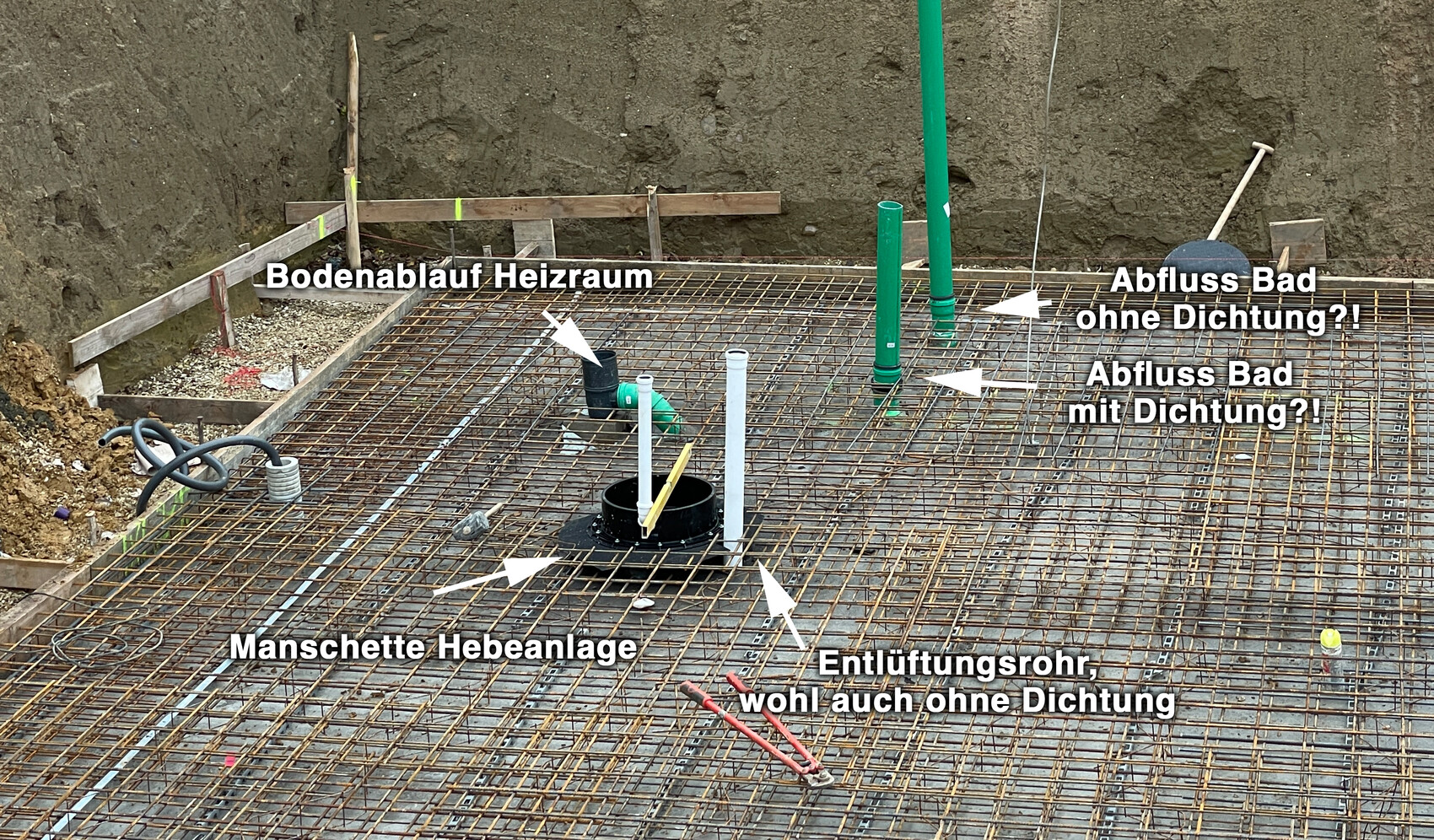
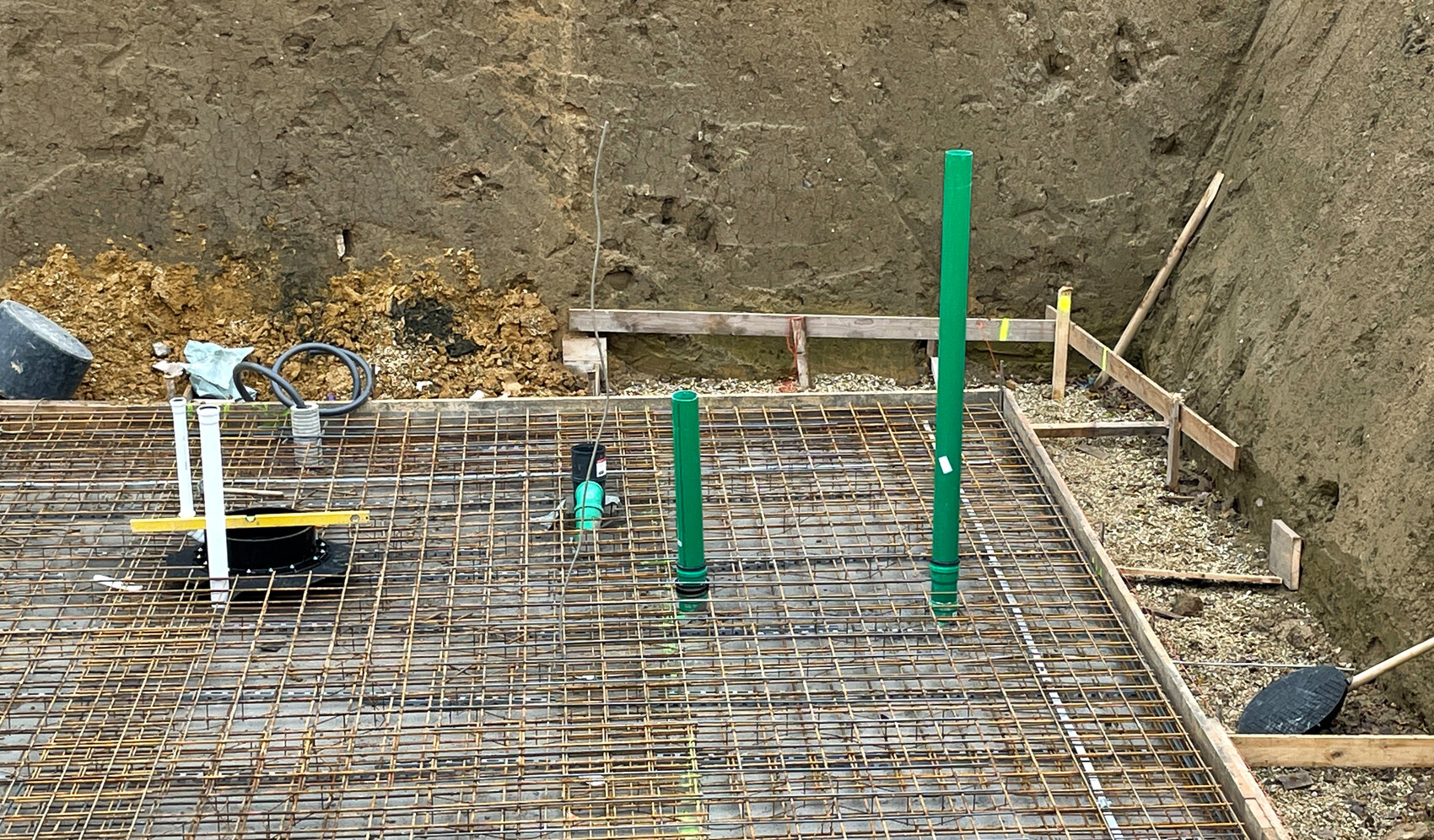
After reviewing some photos from the construction phase, we noticed that the pipes installed, except for one, apparently lack any seals. One pipe has some kind of black collar, but the other two do not show any sealing.
Do you think it is possible that water is pushing up past the pipes? And can this really cause such large amounts of water and spread across the entire slab? Since all walls are wet, the water must have reached everywhere.
It’s also questionable whether all the water was really STANDING ON the slab or if we pumped out additional groundwater from the soil along with it. At the moment, this is impossible to say.
By the way, the lifting system also has a rubber collar embedded in the concrete. However, a corner was cut out here for the ventilation pipe.
We are aware that it has rained extremely heavily in recent months, probably causing the groundwater level to rise significantly. But as a layperson, I just cannot explain this situation. Is it really possible that 250 liters (66 gallons) of water could fit between the slab and the screed?! Simply incredible.
Thanks in advance for reading and any tips. Best regards!
After living in our new house for almost two years without any significant problems or defects, we unexpectedly discovered water damage in the basement the day before yesterday.
It "started" with a small wet spot near the heating room door. By now, we know that water must be standing on the entire slab, meaning under the screed, and it has already risen slightly into almost all the walls. I will try to describe the situation as concisely as possible, but with enough detail where needed.
First, a few key points:
- A soil test in summer 2020 showed no groundwater or water pressure present
- The slab was made from 25cm (10 inches) waterproof concrete. Since this is a basement used as living space, the entire floor was additionally sealed from the inside
- Because the basement is below the sewer level, we have a sewage lifting system that pumps wastewater from a small bathroom (currently unused) and the basement hallway
- The drain pipes run below the slab and are routed through it. The same applies to the ventilation line for the lifting system
- This consists of a sealed chamber also below the slab, plus a second, top-accessible chamber. Normally, there should be no water in the second chamber as everything flows into and is pumped from the lower chamber. For us, it is basically just an inspection opening
- The small bathroom in the basement is still in its rough construction phase since it is currently not needed. The shower area, roughly 1x1m (3x3 ft), is completely open, so you can see the slab and roofing felt
- Furthermore, the heating room and corridor are not tiled yet, so the screed is visible
Now, a brief summary of events:
- After noticing the spot on the screed and confirming it was not leaking “from above,” I opened the lifting system, which was about half full of water. Water was dripping in from the side. After ruling out a defective pipe (underfloor heating and wastewater from the water softener run nearby), we concluded that water must be coming from inside the screed or insulation layers
- Then we noticed that moisture had risen along ALL walls, both interior and exterior, but only slightly above the screed level
- Bad enough, but the shocking sight was in the non-existent shower area of the bathroom, where water was almost 10cm (4 inches) deep
- We pumped out everything, initially into buckets, removing at least 150–180 liters (40–48 gallons) of water
- More water kept coming in; at first, it was flowing visibly, but thankfully less now. Overall, I estimate about 250 liters (66 gallons) of pumped water so far
- Both the plumbing company and the shell contractor have inspected the site, but so far we have not found the source of the problem. A leak detector is scheduled to come early this week
The following causes can be ruled out:
- Potable water -> The water pipes for the basement apartment are not connected, and the meter does not run if no appliances are on. Other water pipes in the heating room are visible and not leaking or damaged
- Heating water -> Probably not enough to cause this much water on the floor; the underfloor heating system maintains pressure perfectly
- Lifting system -> Works flawlessly. Pumping reliably about half full, and in case of failure, it would sound alarms and log everything precisely. No error entries in recent months
- Defective wastewater pipes -> We first added a large volume of water abruptly, then turned off the lifting system and allowed the pipe system to fill up. This took a long time, but when filled, we monitored the water level through a wastewater pipe, and the level did not drop. So, no leaks
- Sewer backup -> Would have been noticed elsewhere and the water does not smell foul or similar
Sorry, it could not be much shorter...
Gradually, it seems to me that only groundwater pushing up from beneath the slab remains as an explanation, which actually should not happen given the double waterproofing. Since the walls are not wet except at the very bottom near the floor, a defect there seems unlikely.
After reviewing some photos from the construction phase, we noticed that the pipes installed, except for one, apparently lack any seals. One pipe has some kind of black collar, but the other two do not show any sealing.
Do you think it is possible that water is pushing up past the pipes? And can this really cause such large amounts of water and spread across the entire slab? Since all walls are wet, the water must have reached everywhere.
It’s also questionable whether all the water was really STANDING ON the slab or if we pumped out additional groundwater from the soil along with it. At the moment, this is impossible to say.
By the way, the lifting system also has a rubber collar embedded in the concrete. However, a corner was cut out here for the ventilation pipe.
We are aware that it has rained extremely heavily in recent months, probably causing the groundwater level to rise significantly. But as a layperson, I just cannot explain this situation. Is it really possible that 250 liters (66 gallons) of water could fit between the slab and the screed?! Simply incredible.
Thanks in advance for reading and any tips. Best regards!
H
HilfeHilfe6 Jan 2024 07:01Without leak detection, it will be difficult
A
Allthewayup6 Jan 2024 08:07Wow, how similar our stories are…
In my case, the sleeve pipe of the pressure hose for the lifting system was not installed, which allowed groundwater to push into the basement there. Fortunately, they installed that sleeve pipe in your case.
It actually looks like the wall collar (that’s what this sealing collar is called) is missing on the right (longer) green KG pipe. I’m not sure though because they also come in the same green color as the KG 2000 pipe, so it’s easy to overlook.
The water can theoretically only come through one of the floor slab penetrations. What about the white pipes—how deep do they extend into the floor slab?
The one pipe where you suspect the missing seal—where is that located today? I’m guessing the screed is blocking the view of the raw slab there? I would have that area opened up first. If that turns out to be the cause, then you can start thinking about a repair method. We ended up using three different methods.
In my case, the sleeve pipe of the pressure hose for the lifting system was not installed, which allowed groundwater to push into the basement there. Fortunately, they installed that sleeve pipe in your case.
It actually looks like the wall collar (that’s what this sealing collar is called) is missing on the right (longer) green KG pipe. I’m not sure though because they also come in the same green color as the KG 2000 pipe, so it’s easy to overlook.
The water can theoretically only come through one of the floor slab penetrations. What about the white pipes—how deep do they extend into the floor slab?
The one pipe where you suspect the missing seal—where is that located today? I’m guessing the screed is blocking the view of the raw slab there? I would have that area opened up first. If that turns out to be the cause, then you can start thinking about a repair method. We ended up using three different methods.
J
jens.knoedel6 Jan 2024 08:43Base slab made of waterproof concrete. How are the walls connected? Could the recent rainfalls from last week have caused water to penetrate through the wall-to-slab connection?


Hello!
Wow, you have a really serious problem... but still, happy and prosperous New Year!
Yes, without a doubt. Groundwater can build up considerable pressure and will find its way through even the smallest crack. At my parents' house, I’ve seen water come through basement walls several times, like it was flowing through a small pipe! That was the reason I decided to build with a fully waterproof concrete shell ("white tank") without compromise—I’m done with pumping out basements.
At first glance, I can’t understand the idea of routing the connections through the slab foundation in a basement. But the planner must have had some reasons...
If you have already pumped out 250 liters (66 gallons) of water, I assume there is at least several times that amount trapped in the screed insulation. Getting that dry again will be a major challenge.
What kind of screed do you have? Cement or anhydrite? The latter will probably need to be completely removed anyway. With cement screed, you will most likely have no choice but to expose all slab penetrations and reseal them. If you have underfloor heating in the basement, this ultimately means replacing the entire basement screed. In other words, be prepared to return the basement to its basic unfinished shell state.
Those were the bad news, here’s the good news:
Since you have only lived in the house for 2 years, this is not your problem but your general contractor’s responsibility. It should be covered under warranty. Insist on a full renovation, even if that initially seems worse and more daunting to you (i.e., basement returned to shell condition and the house possibly uninhabitable for several weeks).
They will likely resist with all their might (without knowing more details, I would estimate the damage cost somewhere between €25,000 and €50,000, but it could be significantly higher), but that fight is yours to take on.
If the basement isn’t perfectly dried out and resealed, you will have severe moisture and mold problems sooner or later. And that will appear after the warranty has expired.
Good luck!
Andreas
Wow, you have a really serious problem... but still, happy and prosperous New Year!
Simon-L schrieb:
Do you think it’s possible that the water is being pushed up past the pipes? And can that really lead to such large amounts of water and spread across the entire slab foundation? Since all the walls are wet, the water must have reached everywhere.
Yes, without a doubt. Groundwater can build up considerable pressure and will find its way through even the smallest crack. At my parents' house, I’ve seen water come through basement walls several times, like it was flowing through a small pipe! That was the reason I decided to build with a fully waterproof concrete shell ("white tank") without compromise—I’m done with pumping out basements.
At first glance, I can’t understand the idea of routing the connections through the slab foundation in a basement. But the planner must have had some reasons...
If you have already pumped out 250 liters (66 gallons) of water, I assume there is at least several times that amount trapped in the screed insulation. Getting that dry again will be a major challenge.
What kind of screed do you have? Cement or anhydrite? The latter will probably need to be completely removed anyway. With cement screed, you will most likely have no choice but to expose all slab penetrations and reseal them. If you have underfloor heating in the basement, this ultimately means replacing the entire basement screed. In other words, be prepared to return the basement to its basic unfinished shell state.
Those were the bad news, here’s the good news:
Since you have only lived in the house for 2 years, this is not your problem but your general contractor’s responsibility. It should be covered under warranty. Insist on a full renovation, even if that initially seems worse and more daunting to you (i.e., basement returned to shell condition and the house possibly uninhabitable for several weeks).
They will likely resist with all their might (without knowing more details, I would estimate the damage cost somewhere between €25,000 and €50,000, but it could be significantly higher), but that fight is yours to take on.
If the basement isn’t perfectly dried out and resealed, you will have severe moisture and mold problems sooner or later. And that will appear after the warranty has expired.
Good luck!
Andreas
Similar topics