
ᐅ Affordable Building Without Compromising Quality, Architect-Designed Home
Created on: 2 Jan 2024 12:33
I
IIIIIIIIIIIIII
Hello everyone!
I have been quietly following this forum for some time, and our house-building project (single-family home) will probably start in Q1/Q2.
I am wondering how to build a house in 2024 cost-effectively without compromising quality.
We have a budget of about 500,000-600,000 euros for the entire construction (excluding the land).
That is a lot of money, but not unlimited – I want to get the best out of it.
A brief overview of our project:
~120m2 (two floors), steep slope, no basement (not possible), 2 adults (maybe one child max in the future), undeveloped plot.
I assume that land development, slope work, and foundation slab will cost around 100,000 euros.
That leaves around 400,000 euros for a move-in ready house.
We have already looked at prefab house providers, but none of their offers matched what we wanted – customizing prefab houses is about as expensive as working directly with an architect.
The plan is to have the house built "ready for finishing" (shell and core) and carry out most of the interior work ourselves (walls, floors, tiles, bathrooms—only the tiling!—and outdoor terraces). We have sufficient craftsmanship skills for this!
Where is the best place to save costs?
What features are often installed without real benefit? (e.g., laundry chute, central vacuum system, automatic blinds, etc.)
Where should you definitely not save?
Should an independent expert inspect the work? Or is that a waste of money for a general contractor/architect-led build?
Should the construction contract be reviewed by a lawyer?
My current thoughts are:
* Simple building shape (rectangle), straightforward pitched roof construction
* No unnecessary home technology (ventilation system, smart home, etc.)
* Minimize large window areas
* Only a carport, no double garage
* The building method (timber frame, solid wood construction like Holz100, masonry) is still open – I prefer timber frame/solid wood.
* Good planning once is cheaper than planning two or three times
* Double checking is cheaper than fixing poorly done work afterwards
* A wood stove is nice, but a fireplace is also expensive.
Where else can you save? What unnecessarily drives construction costs up?
Our idea is:
If we skip things like a double garage, we have more budget for high-quality interior finishes.
We prefer to invest in interior finishing rather than, for example, a laundry chute, central vacuum system, automatic blinds, and so on.
I understand that features like a laundry chute can be subjective when it comes to being "unnecessary" or not.
The goal is to figure out what is essential for a house build, where one should definitely not save, and which elements can be omitted.
There are also significant price ranges for stairs, windows, doors, facades, and roof coverings.
Does it have to be an expensive branded roof? Will a cheaper option suffice?
With this "pre-planning," I also want to minimize the cost of architectural planning. If we come to the architect with a realistic, well-thought-out plan, it probably saves a few thousand euros... Also, an independent building surveyor can save money by detecting issues early on – once the progress payment is made, it is hard to get the money back.
Thanks in advance for your tips and opinions.
I have been quietly following this forum for some time, and our house-building project (single-family home) will probably start in Q1/Q2.
I am wondering how to build a house in 2024 cost-effectively without compromising quality.
We have a budget of about 500,000-600,000 euros for the entire construction (excluding the land).
That is a lot of money, but not unlimited – I want to get the best out of it.
A brief overview of our project:
~120m2 (two floors), steep slope, no basement (not possible), 2 adults (maybe one child max in the future), undeveloped plot.
I assume that land development, slope work, and foundation slab will cost around 100,000 euros.
That leaves around 400,000 euros for a move-in ready house.
We have already looked at prefab house providers, but none of their offers matched what we wanted – customizing prefab houses is about as expensive as working directly with an architect.
The plan is to have the house built "ready for finishing" (shell and core) and carry out most of the interior work ourselves (walls, floors, tiles, bathrooms—only the tiling!—and outdoor terraces). We have sufficient craftsmanship skills for this!
Where is the best place to save costs?
What features are often installed without real benefit? (e.g., laundry chute, central vacuum system, automatic blinds, etc.)
Where should you definitely not save?
Should an independent expert inspect the work? Or is that a waste of money for a general contractor/architect-led build?
Should the construction contract be reviewed by a lawyer?
My current thoughts are:
* Simple building shape (rectangle), straightforward pitched roof construction
* No unnecessary home technology (ventilation system, smart home, etc.)
* Minimize large window areas
* Only a carport, no double garage
* The building method (timber frame, solid wood construction like Holz100, masonry) is still open – I prefer timber frame/solid wood.
* Good planning once is cheaper than planning two or three times
* Double checking is cheaper than fixing poorly done work afterwards
* A wood stove is nice, but a fireplace is also expensive.
Where else can you save? What unnecessarily drives construction costs up?
Our idea is:
If we skip things like a double garage, we have more budget for high-quality interior finishes.
We prefer to invest in interior finishing rather than, for example, a laundry chute, central vacuum system, automatic blinds, and so on.
I understand that features like a laundry chute can be subjective when it comes to being "unnecessary" or not.
The goal is to figure out what is essential for a house build, where one should definitely not save, and which elements can be omitted.
There are also significant price ranges for stairs, windows, doors, facades, and roof coverings.
Does it have to be an expensive branded roof? Will a cheaper option suffice?
With this "pre-planning," I also want to minimize the cost of architectural planning. If we come to the architect with a realistic, well-thought-out plan, it probably saves a few thousand euros... Also, an independent building surveyor can save money by detecting issues early on – once the progress payment is made, it is hard to get the money back.
Thanks in advance for your tips and opinions.
X
xMisterDx4 Jan 2024 02:55The neighbor’s house isn't necessarily a good example. Even in direct conversations, few admit that the companies involved did a really poor job... besides, a company that did good work 15 years ago might produce complete rubbish today.
Over time, it’s a tricky situation. Usually, you pay rent, then after a year, interest on the construction loan. This makes it difficult to take your time, compare quotes, and so on.
The biggest problem in the end is that many small costs add up to a large sum. Here 1,000 EUR, there 500 EUR, another 750 EUR. Everyone thinks, “If I’m already building, another 1,000 EUR won’t make much difference...” And that’s how every tradesperson manages to squeeze out a few thousand EUR more—you’re only building once after all...
Over time, it’s a tricky situation. Usually, you pay rent, then after a year, interest on the construction loan. This makes it difficult to take your time, compare quotes, and so on.
The biggest problem in the end is that many small costs add up to a large sum. Here 1,000 EUR, there 500 EUR, another 750 EUR. Everyone thinks, “If I’m already building, another 1,000 EUR won’t make much difference...” And that’s how every tradesperson manages to squeeze out a few thousand EUR more—you’re only building once after all...

xMisterDx schrieb:
The neighbor’s house isn’t necessarily a good example. Even in direct conversations, very few admit that the companies messed up badly... besides, a company that did good work 15 years ago can be doing a complete disaster today. It was exactly the opposite for us. The builders openly talked about problems, and it would also be unclear to me why a tradesperson suddenly wouldn’t be skilled anymore.
X
xMisterDx4 Jan 2024 08:29Since a craftsman rarely works alone, they usually employ journeymen or skilled workers. Some of these occasionally retire, others quit because they find better opportunities elsewhere, some fall ill (craftsmanship is a physically demanding job) and have to leave, and so on.
It really depends on how long the experience with the company goes back. That’s what I meant to say.
Some companies also seem to rest on their good reputation, or so it feels. Our civil engineer supposedly had a very good reputation here but is now bankrupt... he installed our cistern so poorly that it can hardly be used properly (set too high, the inlet had to be connected in a way that only about 4m³ (141 cubic feet) of the 7m³ (247 cubic feet) can actually be used, overflow goes in the wrong direction, and it’s also somewhat crooked) and it’s not sealed properly either... that’s one way to do it 😉
The second civil engineer who installed the rainwater pipes has an even better reputation in this neighborhood... but left me with leaking pipes that now pour into the cistern when the groundwater level is high. Apparently, the workers were people who usually only build foundations (their own statement), and we were just “squeezed in quickly”...
Reputation is no guarantee for good work.
It really depends on how long the experience with the company goes back. That’s what I meant to say.
Some companies also seem to rest on their good reputation, or so it feels. Our civil engineer supposedly had a very good reputation here but is now bankrupt... he installed our cistern so poorly that it can hardly be used properly (set too high, the inlet had to be connected in a way that only about 4m³ (141 cubic feet) of the 7m³ (247 cubic feet) can actually be used, overflow goes in the wrong direction, and it’s also somewhat crooked) and it’s not sealed properly either... that’s one way to do it 😉
The second civil engineer who installed the rainwater pipes has an even better reputation in this neighborhood... but left me with leaking pipes that now pour into the cistern when the groundwater level is high. Apparently, the workers were people who usually only build foundations (their own statement), and we were just “squeezed in quickly”...
Reputation is no guarantee for good work.
IIIIIIIIIIIIII schrieb:
I’m not looking for advice on how to save costs because of the sloped site – I want to save costs everywhere else and get ideas and tips on the best places to do that. The thing is, you save costs most effectively—or at all—when you look at the project holistically. There are features considered luxury in a standard house that cause little or no extra effort in a house on a slope, or vice versa (which is more likely, since a sloped site usually complicates things rather than simplifies them). Conversely, skipping certain details saves a different amount in a standard house compared to a house on a slope.
That’s why questions about the plot and related conditions come up.
That’s also why there’s the option to steer the conversation elsewhere… Then you won’t get additional answers, or you’ll only get the standard responses you can find with five minutes of Google.
Or you can sit down and try to get a contour or elevation plan (like the one you could get from Bayernatlas, for example—other regions generally have similar portals! Bayernatlas is probably just the best known).
The illustration you showed as an example includes a basement floor, etc.
If I understand correctly, I think there might be a difference in definition between “basement” and “ground floor” between you and other members, but I’m not entirely sure.
So my advice: Accept that you need to look at the project as a whole. Only then will you find more than the usual generic Google savings tips.
A good architect and an open mind toward their suggestions will help you more than leaving out a laundry chute (which normally isn’t included in a standard house anyway, for 2800€/sq m).
Now you can decide whether you want to fully commit, seriously address the details you want, research and share them, or if you prefer to discuss them only with an architect or the general contractor.
This might sound harsher than intended…
I
IIIIIIIIIIIIII4 Jan 2024 11:27Thank you very much for the tips! Even more general recommendations are helpful to me, since this is my first house.
Regarding asking the “neighbors”… that’s not so easy. Everything built in the last ~15 years has been developed by the same local construction company. These are mostly small (luxury) residential complexes with 4–15 apartments, sold as investments to wealthy buyers… I’m not sure if it’s even possible to build a cost-effective single-family home here.
Dear everyone, miracles happen. I might have something that could help you. It took me about 2 hours of Googling, but maybe it works. Before anyone accuses me of keeping secrets again – I really created this myself today and did not know until now that this kind of information is publicly available. Because of the criticism here, I went searching and finally found it.
The elevation map has been slightly pixelated, but not the plot itself. Paranoid to some eyes, but whatever 😀
If you need other profiles or maps, just let me know.
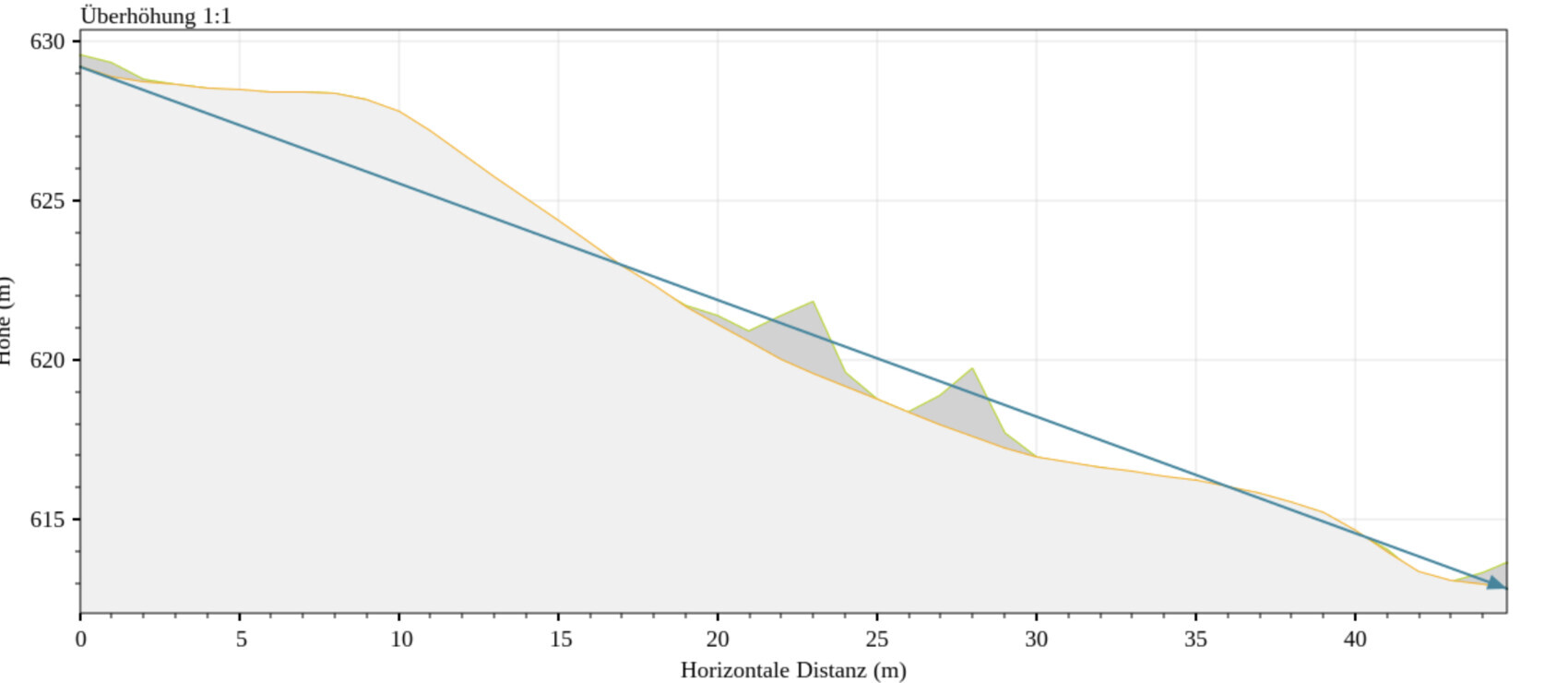
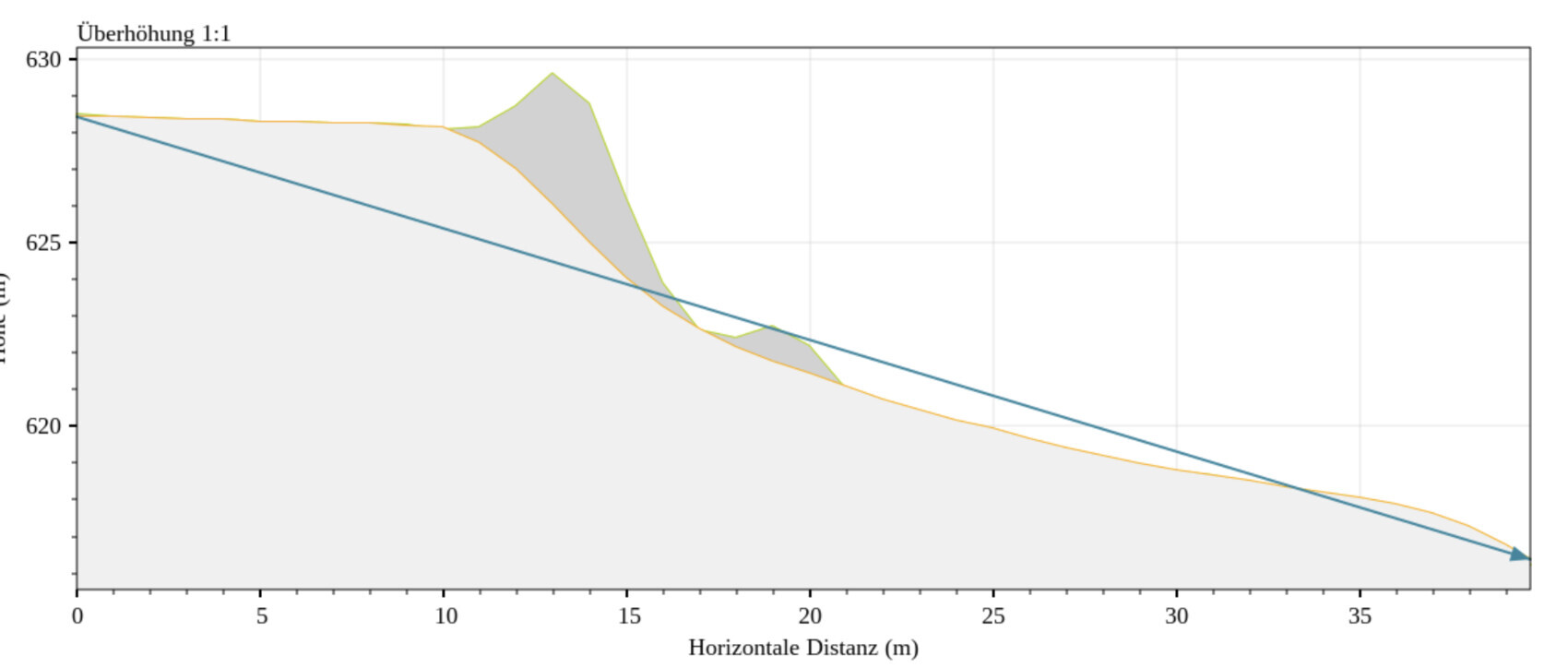
Elevation profile + elevation map.
The black box is my plot of land (roughly marked, about 950m2 (10226 sq ft)).
The gray box in the middle of the plot is the hut from the well-known photo!

Explanation of the lines from left to right:
1. Black horizontal line = approximately northern boundary of the plot
2. Red vertical line = where I think the house should go; this line is 7m (23 ft) wide/long
3. Black vertical line = approximately southern boundary of the plot
4. The gray vertical lines are added to help read the map more clearly
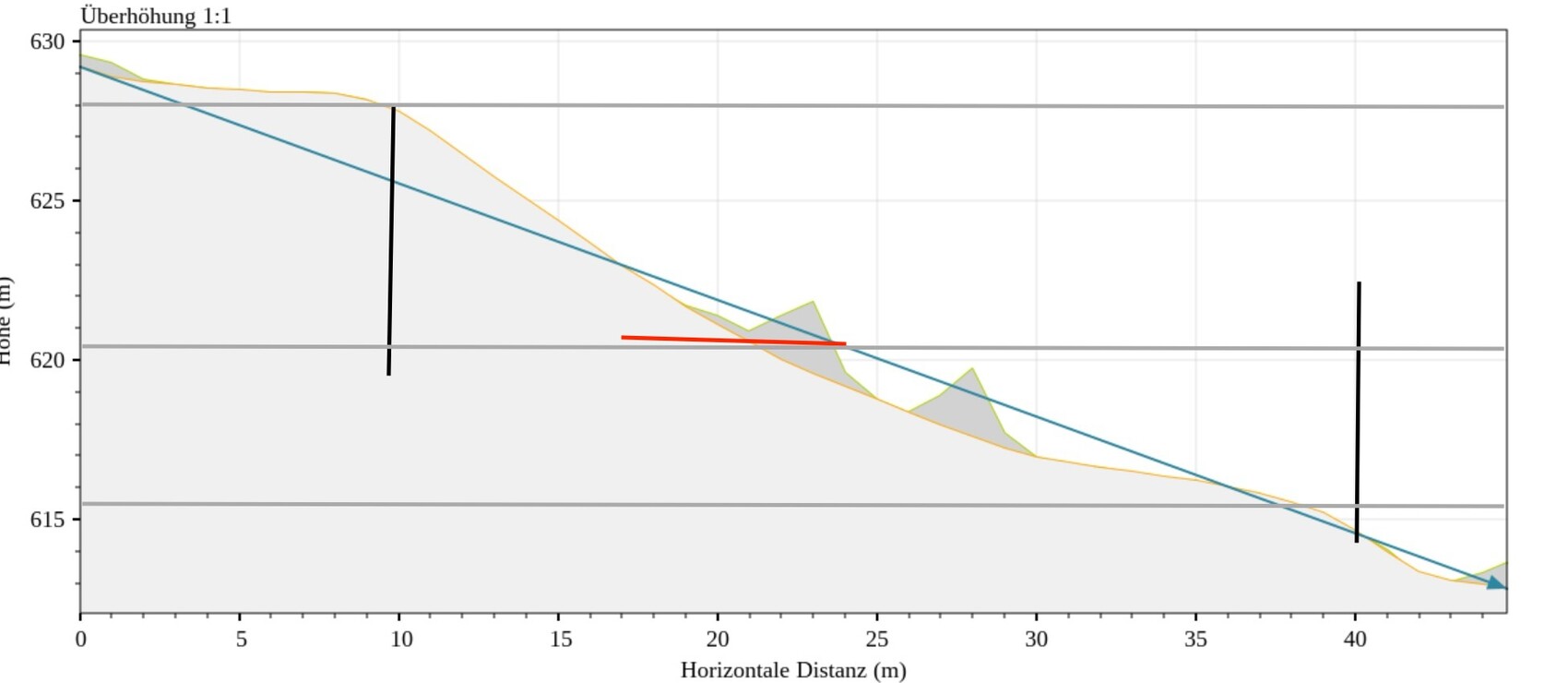
The elevation profile was created along the right edge of the marked hut, which I think better shows the slope. I believe the small dark gray hill (around meter 18–20 (59-66 ft)) could be the hut… This is where the house is also supposed to be located. However, the slope does indeed flatten somewhat toward the west.
Regarding asking the “neighbors”… that’s not so easy. Everything built in the last ~15 years has been developed by the same local construction company. These are mostly small (luxury) residential complexes with 4–15 apartments, sold as investments to wealthy buyers… I’m not sure if it’s even possible to build a cost-effective single-family home here.
Dear everyone, miracles happen. I might have something that could help you. It took me about 2 hours of Googling, but maybe it works. Before anyone accuses me of keeping secrets again – I really created this myself today and did not know until now that this kind of information is publicly available. Because of the criticism here, I went searching and finally found it.
The elevation map has been slightly pixelated, but not the plot itself. Paranoid to some eyes, but whatever 😀
If you need other profiles or maps, just let me know.
Elevation profile + elevation map.
The black box is my plot of land (roughly marked, about 950m2 (10226 sq ft)).
The gray box in the middle of the plot is the hut from the well-known photo!
Explanation of the lines from left to right:
1. Black horizontal line = approximately northern boundary of the plot
2. Red vertical line = where I think the house should go; this line is 7m (23 ft) wide/long
3. Black vertical line = approximately southern boundary of the plot
4. The gray vertical lines are added to help read the map more clearly
The elevation profile was created along the right edge of the marked hut, which I think better shows the slope. I believe the small dark gray hill (around meter 18–20 (59-66 ft)) could be the hut… This is where the house is also supposed to be located. However, the slope does indeed flatten somewhat toward the west.
Similar topics