
ᐅ Single-family house floor plan, 2 full stories, approximately 170 square meters, slight slope site
Created on: 12 Dec 2023 20:04
H
Huhuhu7
Hello,
I would appreciate some feedback on the current status of my architect’s design. The draft is by no means final, and we are supposed to provide the architect with feedback now, so some help would be great...
A few notes:
Here are some answers to the questions (although not complete):
Style, roof shape, building type, basement, number of floors: 2 full stories, pitched roof, no basement
Number of people, age: 2, mid-40s, no children
Office: family use or home office? Home office
Number of overnight guests per year: 5
Open or closed architecture: open
Open kitchen, kitchen island: yes
Fireplace: yes, desired
Balcony, roof terrace: no
Garage, carport: single garage, with an option for a second single garage on the south side adjacent to the neighboring plot. A double garage is not preferred by local planning authorities.
Other wishes / special features / daily routine, including reasons why certain things are wanted or not: The house should comfortably fit two adults, allowing them to have some privacy when needed. The first floor is designed accordingly.
House design
Who created the design: architect
What do you like most? Why?
What do you dislike? Why?
Cost estimate according to architect/planner: 600k
Personal price limit for house including fittings: 650k
Preferred heating technology: heat pump
If you have to compromise, which details / features could you do without: the large window, windows in general. Possibly the entrance area without a canopy, if that helps to stay within budget.
Images:
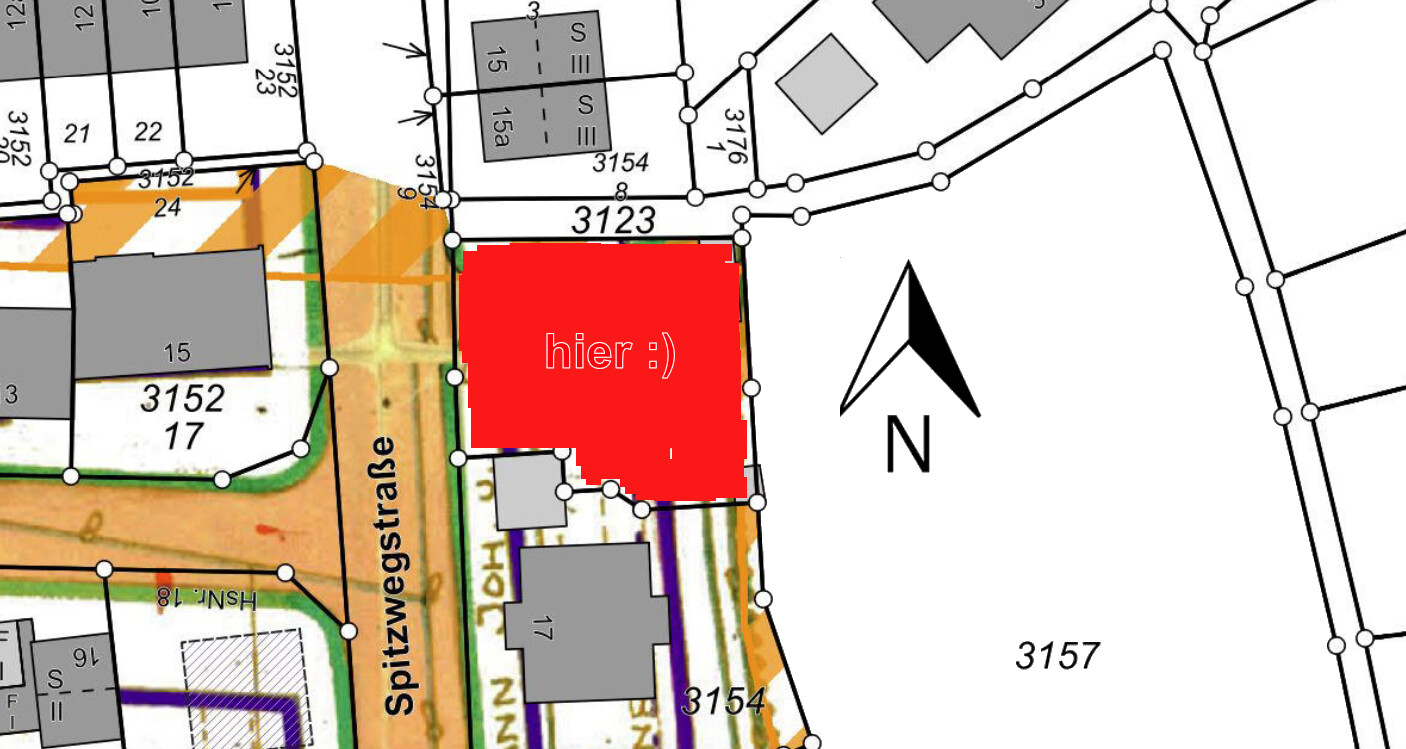
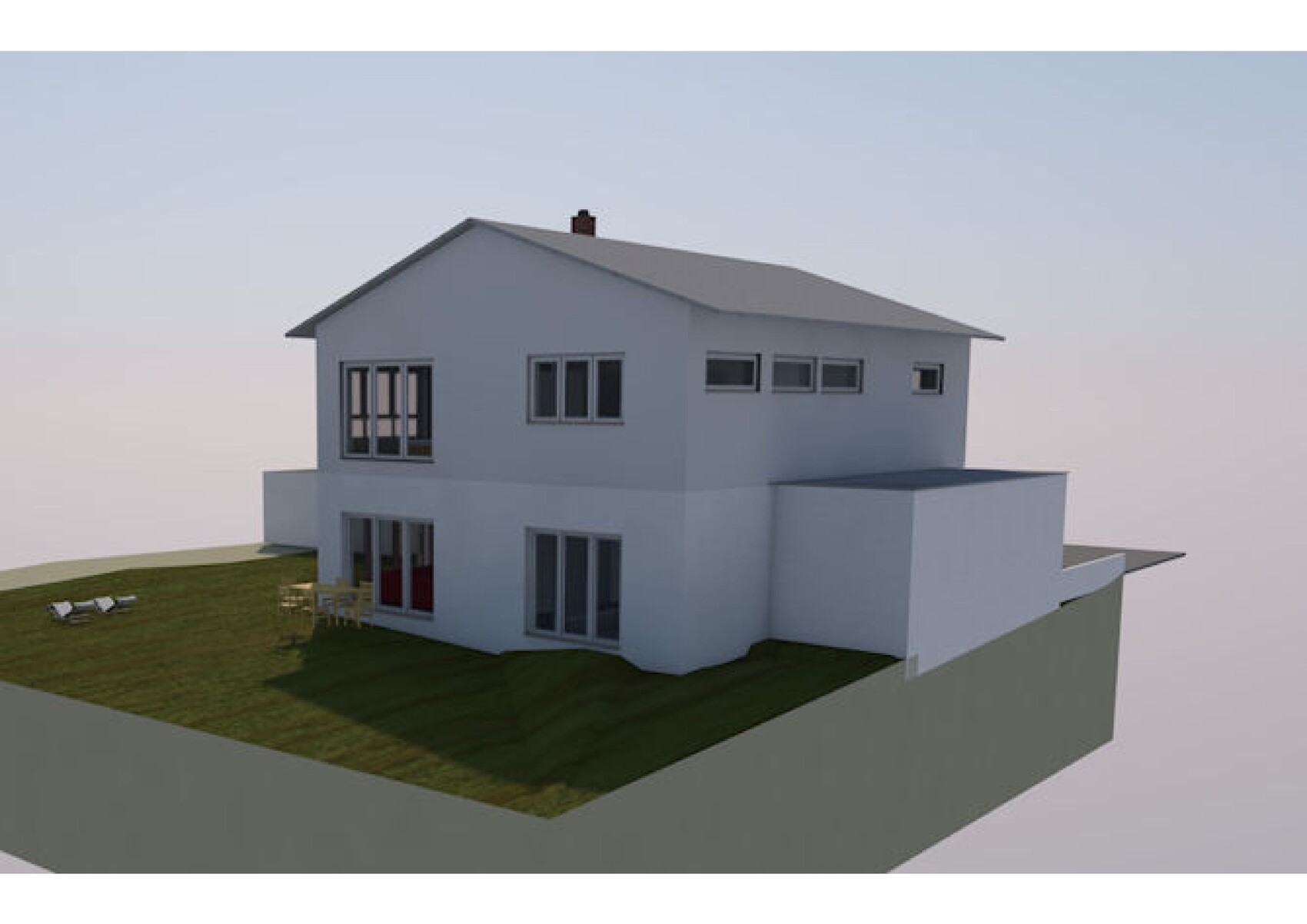
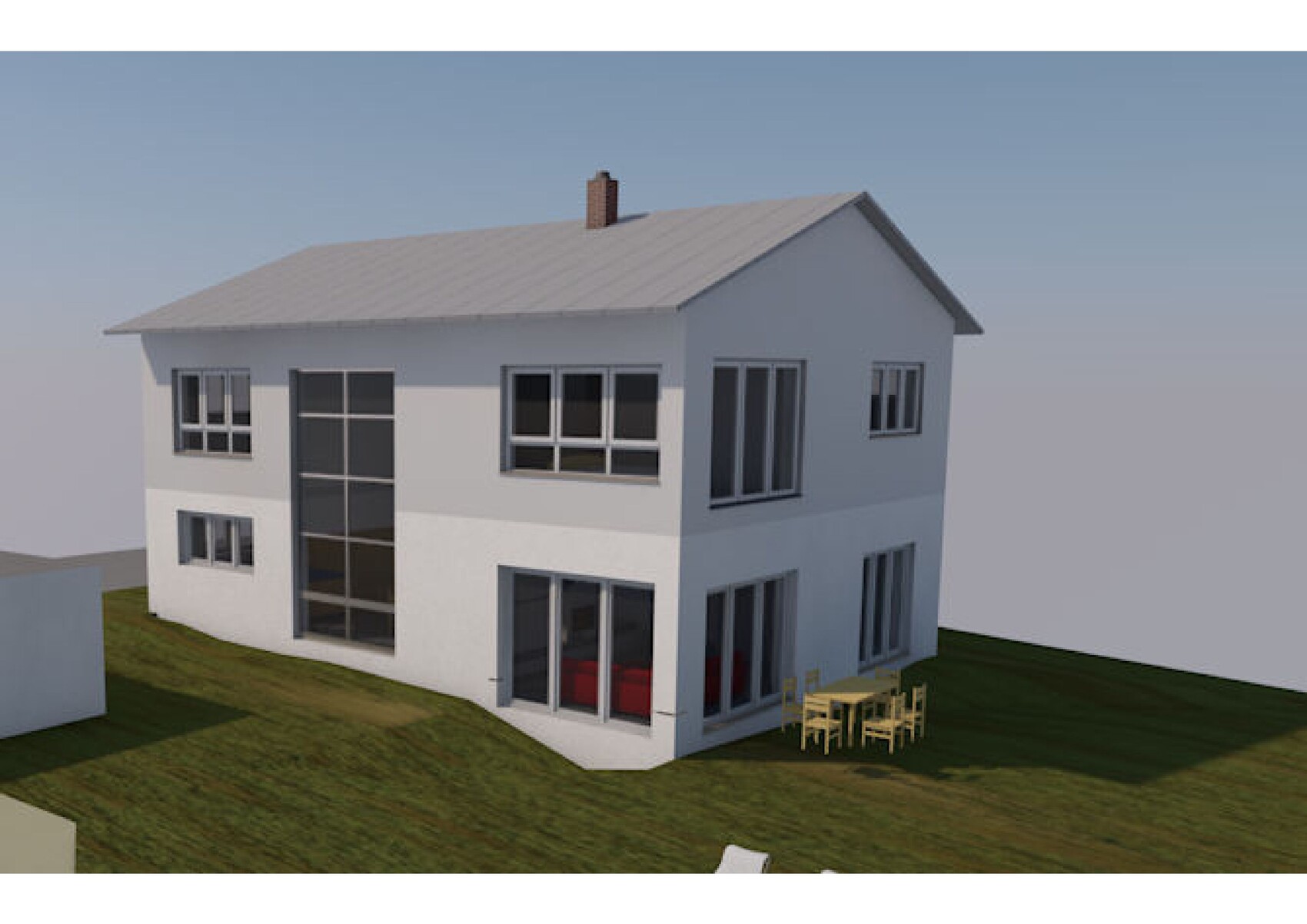
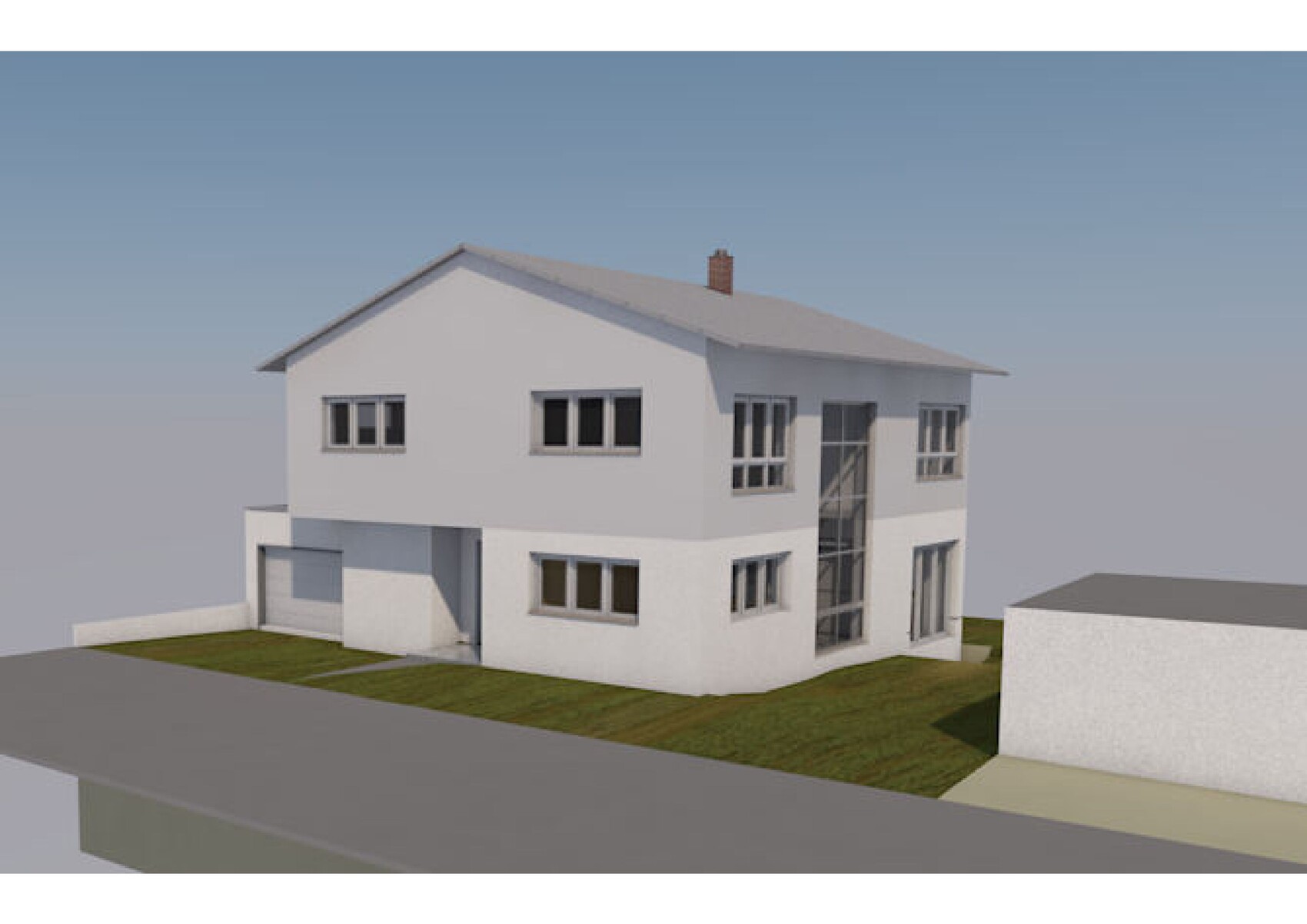
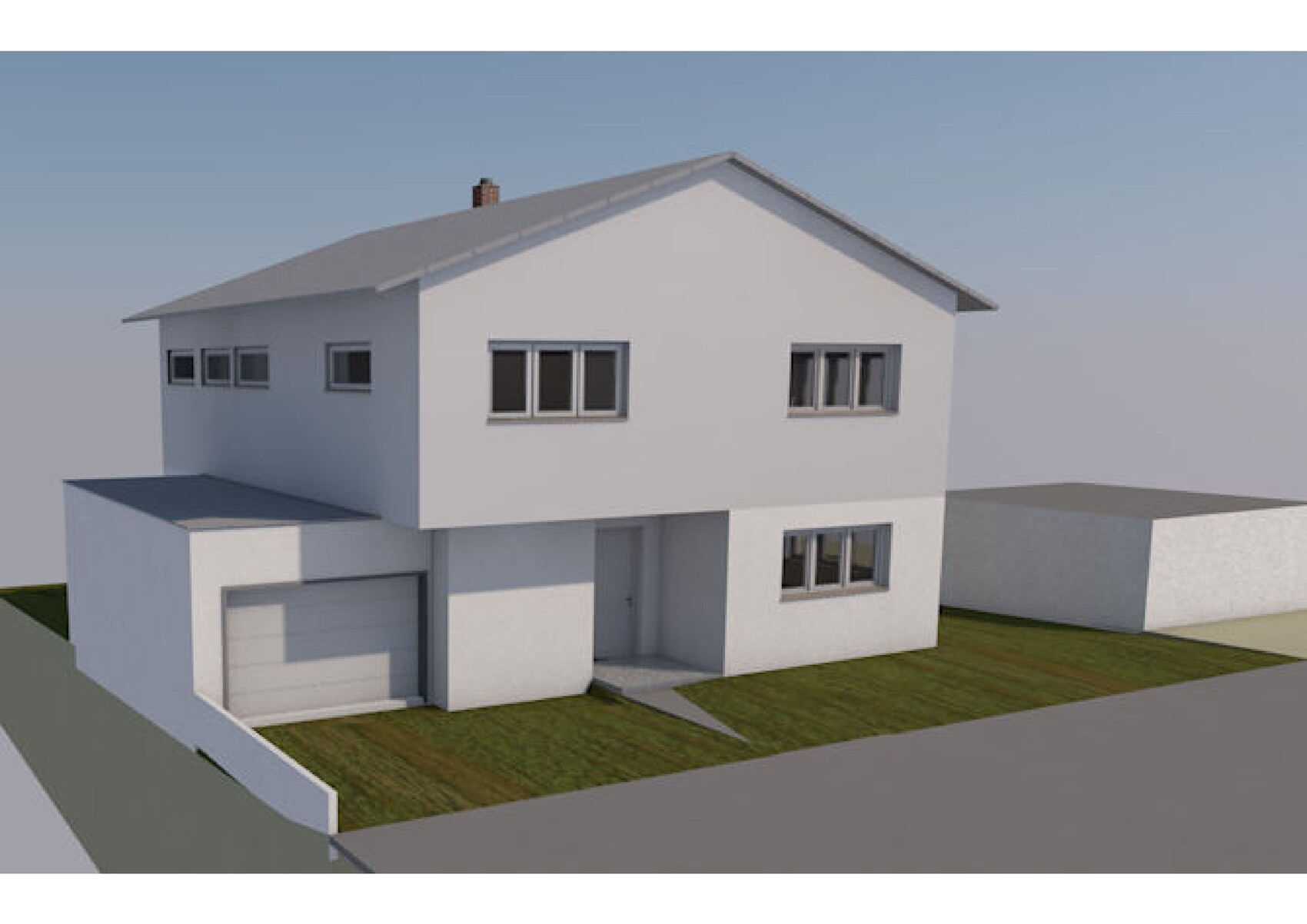
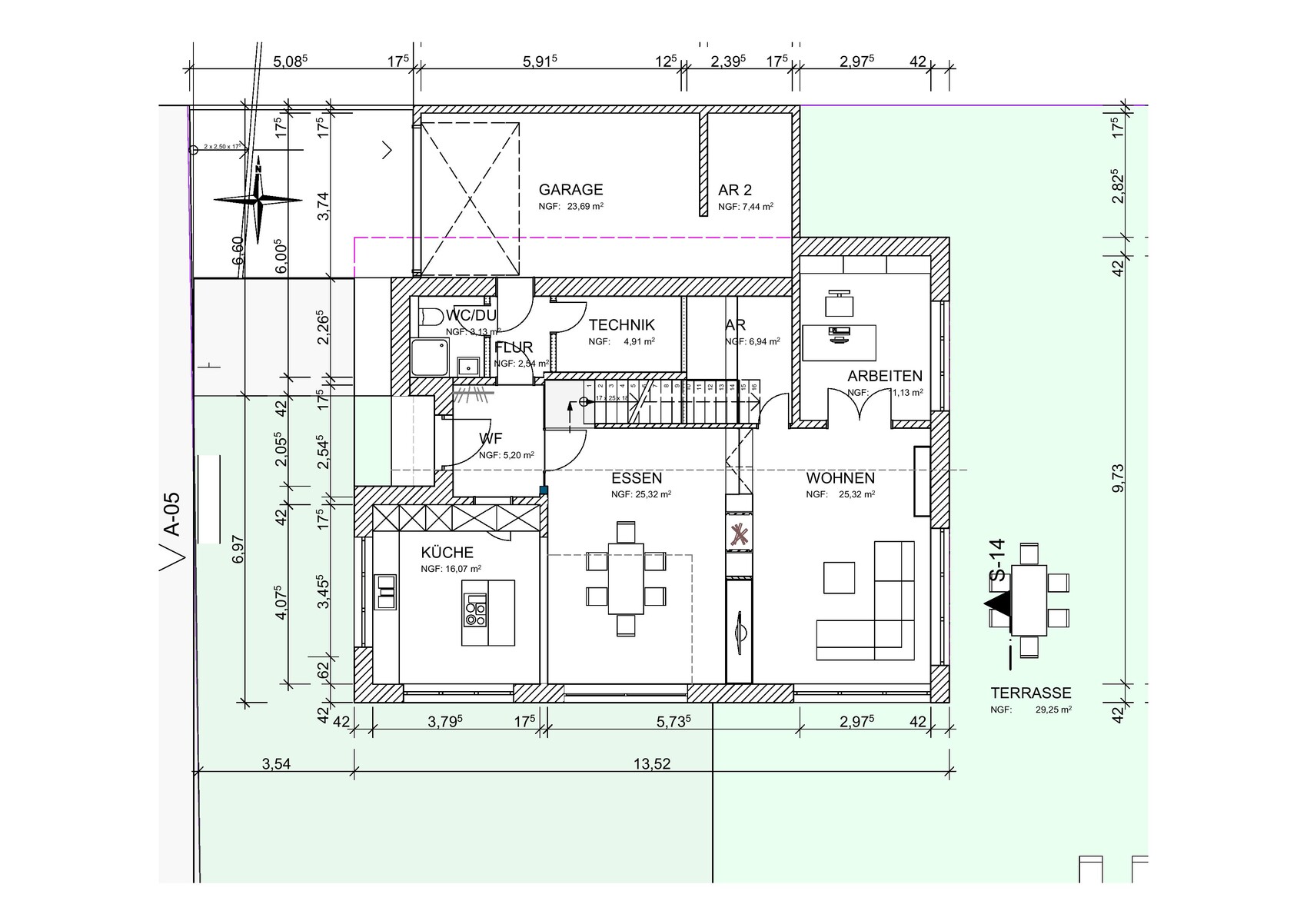
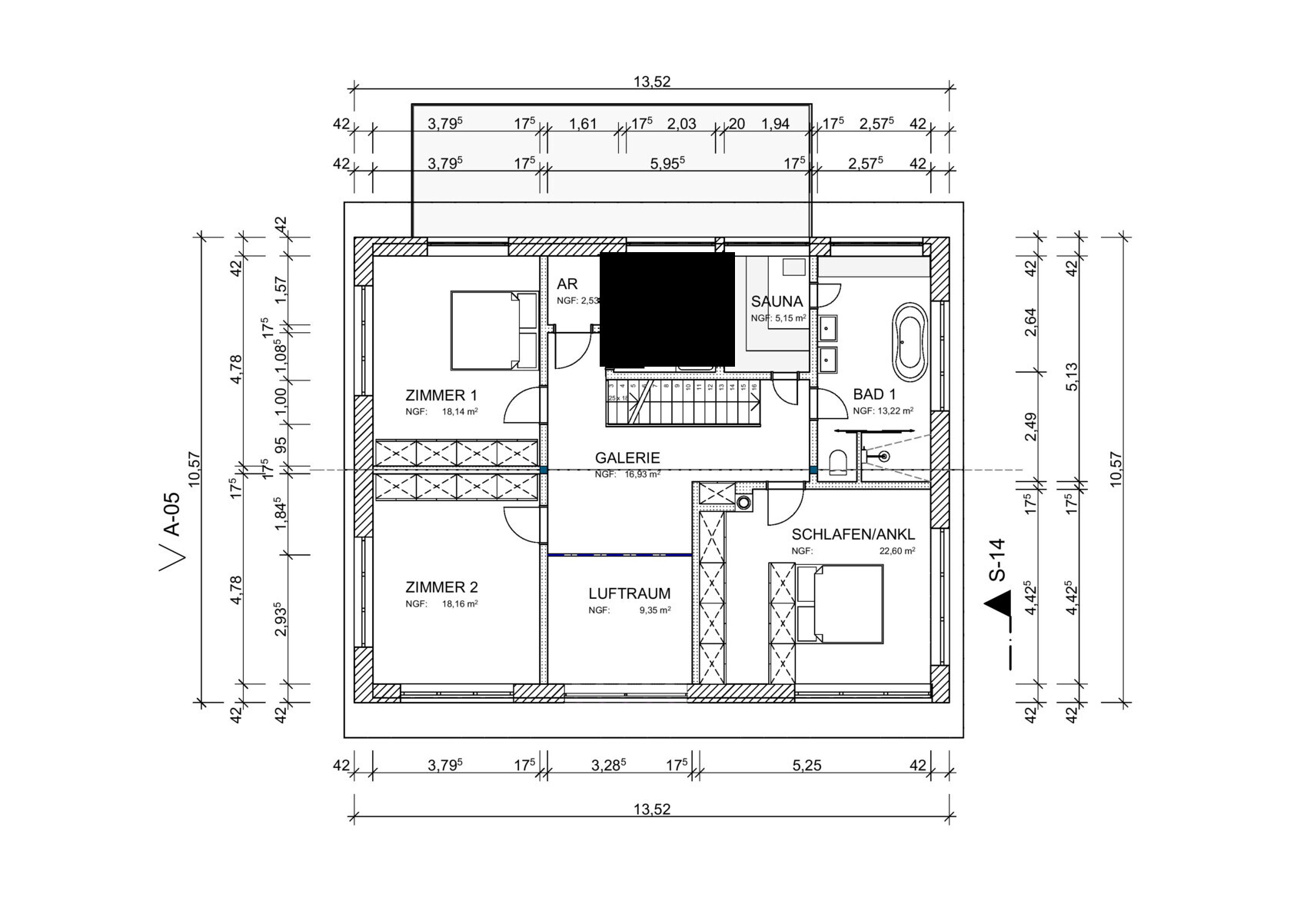
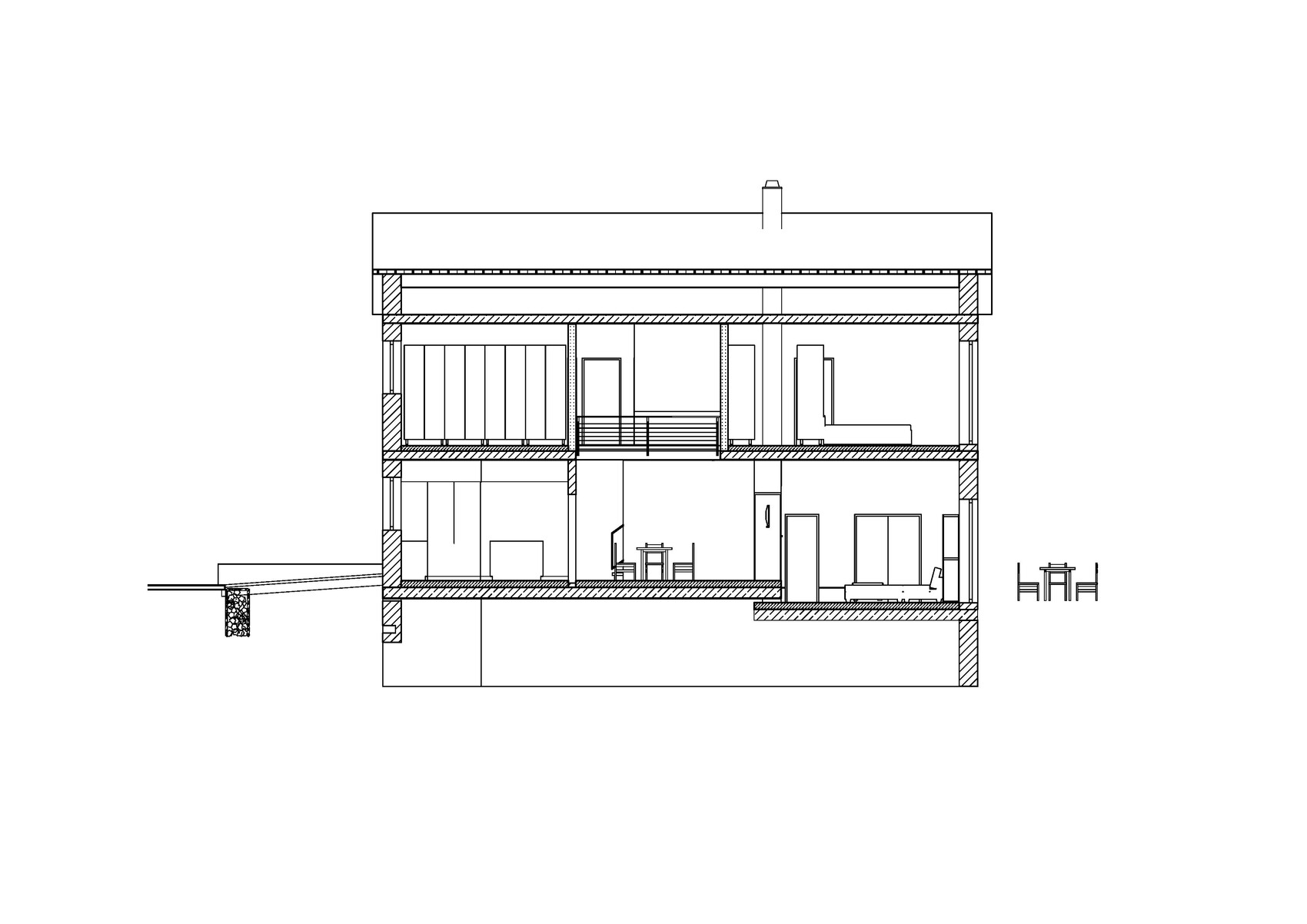
I would appreciate some feedback on the current status of my architect’s design. The draft is by no means final, and we are supposed to provide the architect with feedback now, so some help would be great...
A few notes:
- Location: a smaller city in northern Bavaria
- The plot is located within a water protection area. The groundwater must not be disturbed and is unfortunately about 2 meters (6.5 feet) below the surface. For this reason, a basement is only possible with disadvantages: the house would have to be raised quite a bit above ground level (there would then be a staircase about 1 meter (3.3 feet) high at the front door, making terrace design difficult). Therefore, no basement. It took some time to reach this conclusion... There was a more detailed previous design with a basement. This is the first new design without a basement.
- In general, there is no formal zoning plan. A preliminary inquiry with the city showed that the house must fit into the neighborhood. Two full stories with a pitched roof would be acceptable.
- Windows: windows are still a very open topic. The large south-facing window is controversial (difficult to clean, etc.). Also, the window in the ground-floor office is far too large. On the first floor, I would prefer somewhat larger windows on the west side and a more uniform look overall.
- What I am still struggling with: the living area is intended to be bright and open. But on the other hand, the sofa should not be placed in front of a (floor-to-ceiling) window as shown in the design. I would be especially interested in ideas for this.
- The living area also has a small split-level, adapting the building somewhat to the slight slope of the land. The drawbacks, such as reduced accessibility, are known and this is not decided yet. I would particularly welcome opinions on this...
- Regarding the entrance area: we told the architect that we would like a covered entrance. I have gotten used to the design now and probably am a bit too accustomed to it.
- The staircase is 1 meter (3.3 feet) wide but feels almost a bit narrow to me.
- In the first-floor plan I inserted a greyed-out area at one point, which somehow felt better to me (this area is definitely going to be changed).
Here are some answers to the questions (although not complete):
Style, roof shape, building type, basement, number of floors: 2 full stories, pitched roof, no basement
Number of people, age: 2, mid-40s, no children
Office: family use or home office? Home office
Number of overnight guests per year: 5
Open or closed architecture: open
Open kitchen, kitchen island: yes
Fireplace: yes, desired
Balcony, roof terrace: no
Garage, carport: single garage, with an option for a second single garage on the south side adjacent to the neighboring plot. A double garage is not preferred by local planning authorities.
Other wishes / special features / daily routine, including reasons why certain things are wanted or not: The house should comfortably fit two adults, allowing them to have some privacy when needed. The first floor is designed accordingly.
House design
Who created the design: architect
What do you like most? Why?
What do you dislike? Why?
Cost estimate according to architect/planner: 600k
Personal price limit for house including fittings: 650k
Preferred heating technology: heat pump
If you have to compromise, which details / features could you do without: the large window, windows in general. Possibly the entrance area without a canopy, if that helps to stay within budget.
Images:
11ant schrieb:
Unfortunately, you have once again largely covered the existing structure. But at least we can see further now. However, the aerial photo is not very suitable for estimating heights. Why is the existing structure important?
11ant schrieb:
Unfortunately, you have once again largely covered the existing structure. But at least we can see further now. However, the aerial photo is not very suitable for estimating heights.
... but ? – I wouldn’t have expected this from a former practitioner, and I’m all the more amazed by these imaginative measurements.
Just looking doesn’t help much; listening and smelling are more useful. Yes, leaving it out is not the worst option.
I suggested a professional approach and am still missing your response on that. Feedback from family usually comes from laypersons – apart from them wishing you well with your own home and liking this or that detail, I don’t expect much. How many people who can read blueprints do you expect visiting over Christmas? Sorry, your logic seemed a bit strange to me, that if I talk to the architect on the phone, I don’t actually know him in person. That’s why I initially ignored the professional approach.
If I understand you correctly, you suggested throwing the design away and looking for a new architect. But how do I find one then? Recommendations from laypeople are also not an option (I don’t even dare to consider Google reviews right now). And as a layperson myself, I can’t tell after a first meeting whether someone is truly capable. I could go through the Yellow Pages for architects, maybe alphabetically, and ask each one to create a design (which would cost thousands of dollars each time), but unfortunately, I don’t have a money printing machine or anything like that. So what is the recommended approach?

Huhuhu7 schrieb:
Why is the existing building important?You want assessments and here you’ll find people who can interpret the relevant information. Some of it actually turns out to be irrelevant even for professionals. But that can only be judged once you know the details. Building ground after demolition behaves differently compared to untouched land. Huhuhu7 schrieb:
Sorry, but your logic seemed a bit odd to me: if I talk to the architect by phone, I don’t really know him.You mentioned a possible on-site meeting in a way that made it reasonable to assume the planner might have developed the ideas with you so far only through remote consultation. Every future homeowner finds their planner differently, and we’ve come across quite a few strange types here already. The internet is full of draftsmen and architecture students offering their services through classified ads. Huhuhu7 schrieb:
At first, I ignored the professional procedure.From your descriptions, I got the impression that the planner also ignored the proper procedure (and I have not been able to shake this impression so far). Huhuhu7 schrieb:
If I understand you correctly, you suggested throwing the design in the bin and finding a new architect.No. I suggested developing the design properly (site analysis, creation of a room program, qualification of the room program, concept development, building mass design) to arrive at a preliminary design. From the design shown, I don’t get the impression this process was followed. Rather, it looks like they started straightaway with the design and then adjusted it until the client’s satisfaction gradually increased. Just like many young architects from the Digital Native generation do with “ego shooter” house design software. Your planner, from my perspective as an independent building consultant and that of several discussion participants (among them many interested non-professionals who have already become experienced homeowners), has not yet left a competent impression, and this cannot be denied. Huhuhu7 schrieb:
I could look through the Yellow Pages for architects, perhaps alphabetically, and have a design created each time (which costs four-figure sums every time), but unfortunately I don’t have a money printing machine or anything like that.Are you seriously investing four-figure sums for what I’d call “applications” from your planner candidates each time? Huhuhu7 schrieb:
What is then the recommended procedure?See “A housebuilding roadmap, also for you: the HOAI phase model!”: Contact an architect; if they convince you by being a good listener, commission phases 1 and 2 (with the option to continue working with them after the rest period); then have the rest period and set the direction and depending on the result continue step by step to phases 3, or 5, or 8 as applicable. The workflow diagram is effectively interactive.https://www.instagram.com/11antgmxde/
https://www.linkedin.com/company/bauen-jetzt/
T
thangorodrim18 Dec 2023 21:1111ant schrieb:
Do you seriously invest four-figure amounts each time in what I would call "applications" from your planner candidates?Sorry, I think you’re suggesting that you get a free initial consultation with an architect and can then assess the situation well enough to decide on a "candidate," but this statement triggers me a bit. The original poster was talking about design, and I can understand that you gain high confidence whether the architect is a good fit only after receiving a preliminary design. And to see that preliminary design, you have to commission service phases 1-2. Given current construction costs, that’s roughly around 1000 euros (about $1100) as far as I know, which is not cheap. If you have commissioned phases 1-2, then it’s a matter of goodwill or legal proceedings whether you can walk away paying less than the full fee for phases 1-2 (and according to the HOAI fee schedule, that can easily be around 5000 euros (about $5500) for a typical single-family house). If you realize it’s not a good fit and only escape with a partial fee for phases 1-2, the whole process—and the money spent—starts all over again next time, since no architect will take over from phase 3 onwards.
With an architect I had the chance to meet (who only billed by the hour and said “she usually charged less than HOAI fees but could only offer phases 1-4 because she was currently very busy”), the initial appointment alone, where I spent about 2 hours mainly explaining my situation and barely received enough input from the architect’s side to even roughly assess her, cost about 450 euros gross (roughly $500). Unfortunately, I didn’t refuse the unnecessary suggestion to include the co-owner (an energy consultant) for half an hour to discuss the passive house topic—only to be told by both that they had never actually built a passive house (this was mentioned on their website because their retired father—an established local eco-architect—had experience in that). The first architect I had an initial conversation with also wanted immediate payment (although at about half the hourly rate) and practically snapped at me on the phone right after “hello” because I didn’t immediately provide an exact building budget. Only the third architect didn’t want to be paid from minute one and even showed us one of his houses.
Alternatively, you can of course pay by the hour, but I don’t think you’d get away with less than a four-figure amount.
Perhaps architects are more generous with their valuable acquisition time during the current economic phase, but those were my experiences at the start of 2022.
And yes (to get ahead of that), of course there are building coaches or experts who can help you find the right architect. Ideally, you should also hire a specialist lawyer to review the architect contract. But where does that leave you if you follow this "Quis custodiet ipsos custodes?" logic? Also usually in the four-figure price range.
Personally, I also think it’s fair to be paid for my work time... but how much money you can already lose in this preliminary service phase (-1) just adds to the gallery of many absurdities related to "building" (most of which I only know theoretically).

I can’t quite understand your approach. When looking for the right architect, the first thing I ask is whether they have previously built a house similar to what I want. If the answer is yes, I ask to see their references. In my opinion, there’s no point in having a conversation before that. Only if the references convince me would I be willing to spend money. Until then, you’ve already filtered out several mismatches.
thangorodrim schrieb:
I can understand that you only gain high confidence about whether things will work out with the architect after the first preliminary design. And to see the preliminary design, you need to commission service phases 1-2. This exact "Module A" (as I call it in my "House Building Roadmap for You: the HOAI Phase Model!") should also provide clarity on whether the architect is the right person to continue working together with — but not whether you will even come together at all. That usually works more like this...
K a t j a schrieb:
When looking for the right architect [...] I ask to see references. ... but not like this...
thangorodrim schrieb:
Just the first appointment, where I mostly spent about 2 hours explaining my own setup and hardly got enough input from the architect’s side to even roughly assess the person, already cost me roughly 450 euros gross. thangorodrim schrieb:
Sorry, I think you mean that you expect a free initial consultation from the architect and that afterwards you can adequately assess the situation to decide on a “candidate,” but that statement triggers me a bit. The original poster was talking about a design. ... and apparently assumes that only after a design (which is multiple times more than the tuition fee you’ve spent) can you see whether the architect is suitable for the task. That doesn’t have to be the case, because...
thangorodrim schrieb:
And yes (to get ahead of this), of course, there are construction coaches or experts who can help you find the right architect. I know, I am one. So, an independent client advisor and finder of architects, construction companies, and experts. Before that, you can thoroughly find out for free whether you even want that kind of advice and which specialists I should look for — not everyone needs or wants the full “menu.”
What really shocked me, however, was that the original poster apparently — both with the one they chose and with those they preferred not to try out — ended up with representatives of the “let’s see” type, who start with designs right away instead of first working methodically through a classic preliminary design phase before design development. So not basics – concept – preliminary design – design, but quarter-final drafts à la Infinite Monkey and so on (basically learning to design with the client coaching the junior architect). In other words, deciphering designs instead of designing. Ouch.
https://www.instagram.com/11antgmxde/
https://www.linkedin.com/company/bauen-jetzt/
T
thangorodrim20 Dec 2023 00:05Yes, that’s certainly true—if you already commission design phases 1-2, then you should have met in person, which helps keep costs under control even if every candidate charges the same fee. But I maintain my point: such an initial meeting only provides low confidence. You can’t tell from the finished reference house whether it was created following the proper professional approach mentioned above or by trial and error until the client gave up (at least I couldn’t tell). Of course, you can ask how the architect would proceed... but then you quickly end up in an interview mode like job interviews (which are only somewhat meaningful—although, considering how often you hear about failed cost estimates, it wouldn’t hurt if the architect could easily answer a question like how many piano tuners there are in Chicago).
In my defense: it was a bit more complicated. It was the architectural firm with the most experience in energy efficiency in the area, and their website mentioned “Passive House.” So I assumed something there. Sure, I will be more cautious with assumptions in the future, but that firm was still a strong candidate based on fit, and it could have worked with other acquisition/fee conditions.
The first two architects framed it as “you pay because you also get some information upfront” (well, a little), so it was natural to try to test their competence and suitability against my requirements and setting, hoping to take something away from the meeting. But of course, that overloads the initial 1-2 hour consultation (even at maximum talking speed).
If you already have a certain level of competence and taste, references are definitely a very good indicator. You can research some basic knowledge online, but taste develops very slowly (or maybe it’s just me). You might only be able to distinguish a solid, practical single-family house from a refined BDA-type design. Of course, if you specifically want a modern timber-frame house, it’s interesting to know whether such a project has been done before. But for a standard single-family home—with a triple gable, walkway, or hip roof—you can only trust that an architect can handle that if they also have references for it.
I hope this answer is accepted. I basically just want to share my only somewhat relevant experiences with the original poster in this thread.
K a t j a schrieb:
I can’t really follow your approach. When looking for the right architect, the first thing I ask is whether they have ever built a house similar to what I want. If the answer is yes, I ask to see their references. In my opinion, a conversation beforehand doesn’t make sense. Only if the references convince me would I be willing to spend money. By then, many of your mismatches would already have been filtered out.
In my defense: it was a bit more complicated. It was the architectural firm with the most experience in energy efficiency in the area, and their website mentioned “Passive House.” So I assumed something there. Sure, I will be more cautious with assumptions in the future, but that firm was still a strong candidate based on fit, and it could have worked with other acquisition/fee conditions.
The first two architects framed it as “you pay because you also get some information upfront” (well, a little), so it was natural to try to test their competence and suitability against my requirements and setting, hoping to take something away from the meeting. But of course, that overloads the initial 1-2 hour consultation (even at maximum talking speed).
If you already have a certain level of competence and taste, references are definitely a very good indicator. You can research some basic knowledge online, but taste develops very slowly (or maybe it’s just me). You might only be able to distinguish a solid, practical single-family house from a refined BDA-type design. Of course, if you specifically want a modern timber-frame house, it’s interesting to know whether such a project has been done before. But for a standard single-family home—with a triple gable, walkway, or hip roof—you can only trust that an architect can handle that if they also have references for it.
I hope this answer is accepted. I basically just want to share my only somewhat relevant experiences with the original poster in this thread.
Similar topics