
ᐅ Floor Plan of Semi-Detached House – Bathroom and Laundry Room Layout Planning
Created on: 12 Dec 2023 22:36
K
Klinkerhof86
Hello,
we have a plot of land adjoining a neighboring house, where we plan to build a semi-detached house.
I am currently focusing on the bathrooms and would appreciate any feedback. I have explained the specific questions further below. In the attached floor plans, the latest changes are shown in red, which is why there is a gap in the upper floor where the old bathtub used to be.
Development Plan / Restrictions
Plot size: approx. 450sqm (4844 sq ft)
Slope: no
Site coverage ratio
Floor area ratio
Building envelope, building line and boundary
Edge development: carport/garage
Number of parking spaces
Number of floors: 2.5
Roof style: gable roof, 45 degrees
Design style
Orientation
Maximum heights / limits
Additional requirements: extension attached to an existing semi-detached house; total plot width: 11m (36 ft); therefore maximum house width 8m (26 ft) & building depth 10m (33 ft)
Client Requirements
Design style, roof shape, building type: roof form and size follow the neighbor’s
Basement, floors: no basement, 2 full floors, 1 attic floor
Number of occupants, ages: 4 (37, 36, 3, 0 years)
Space requirements on ground floor: dining/living/kitchen, utility room, guest bathroom, cloakroom
Upper floor (1st floor): 2 children’s bedrooms, office 1, bathroom plus laundry room
Attic floor: master bedroom, bathroom, office 2/guest room/second living area
Office: family use or home office? Both, 2x home offices needed
Number of overnight guests annually: various, 8–10
Open or closed architecture: mixed
Traditional or modern construction
Open kitchen, kitchen island: preferably a semi-detached island, even if the kitchen space is a bit tight
Number of dining seats: 6–8
Fireplace: no
Music/sound system wall
Balcony, roof terrace: terrace
Garage, carport: yes, also serving as basement substitute
Kitchen garden, greenhouse: no
Other wishes/special features/daily routine, including reasons for preferences or restrictions
House Design
Who designed it:
- Planner from a construction company: yes
What do you particularly like? Why?
Implementation of the ground floor, equally sized children’s rooms, the attic floor is also okay. -> Comments still welcome.
What don’t you like? Why?
The bathrooms on the upper and attic floors are still a work in progress.
Laundry should be done on the upper floor, so a laundry area with privacy connected to the main bathroom is desired. Washer/dryer should be elevated, so preferably not placed under a window.
Several drafts have been made with passages at top and bottom of the plan. Current idea: move the bathtub to the attic floor, and use the gained space to widen the laundry room to 1.6m (5.2 ft) to allow some storage.
A separate DIY sketch from me is attached (without technical elements/pipes etc.).
In the attic floor the bathtub is planned under the sloped ceiling. Does this work from a spatial design perspective? Any other ideas for arranging the sanitary fixtures? Would you build the shower as drywall with a glass door or fully as a glass enclosure (more light but more cleaning)?
Another topic: What do you think about the kitchen and possible layout of furniture/semi-island?
If you had to give up, which details/features
- Could you give up:
- Could you not give up: completely omitting a bathtub is not preferred
Why did the design end up as it is now?
Our wishes were implemented by the planner over several iterations.
What do you think makes it especially good or bad:
For the relatively narrow plot and semi-detached house format, many fixed constraints leave little room to maneuver, but I still hope for creative solutions.
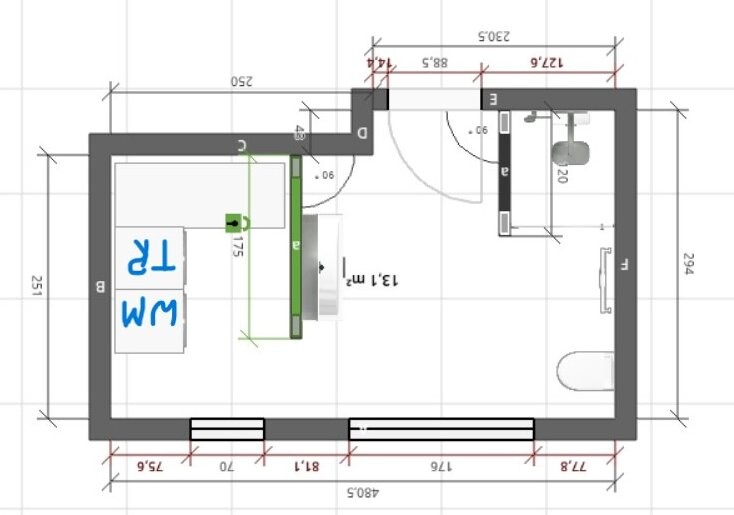
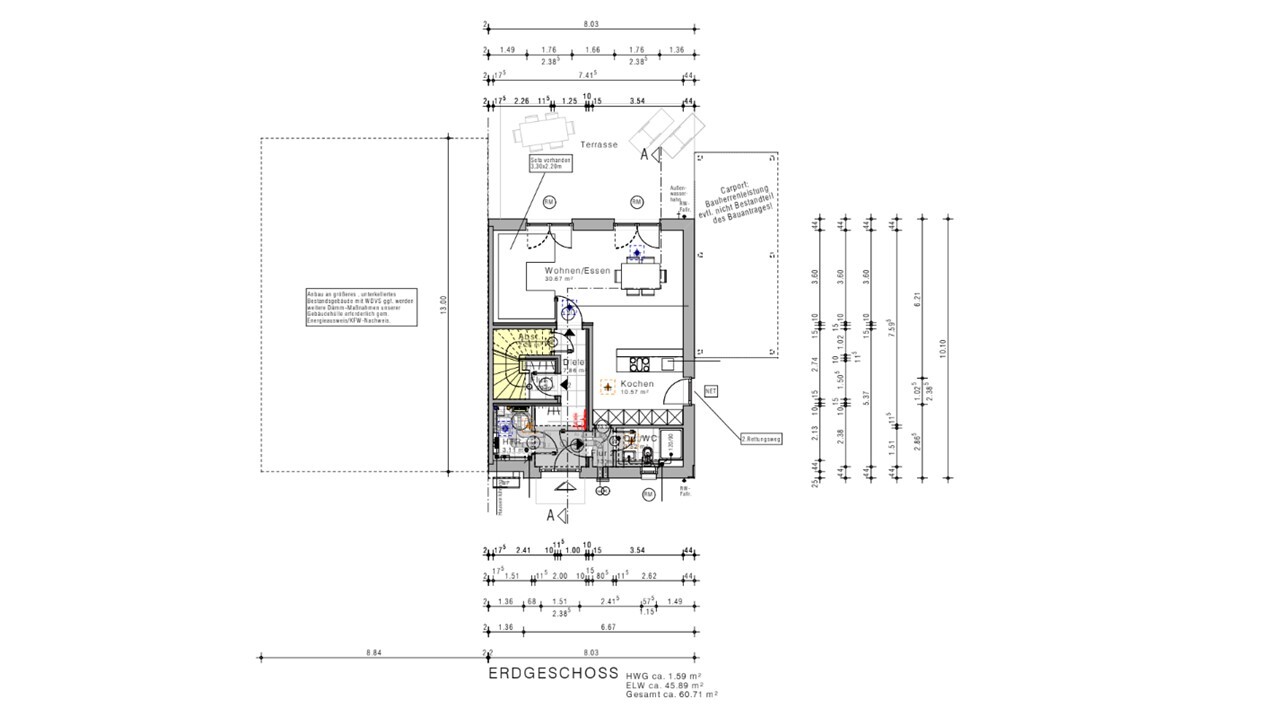
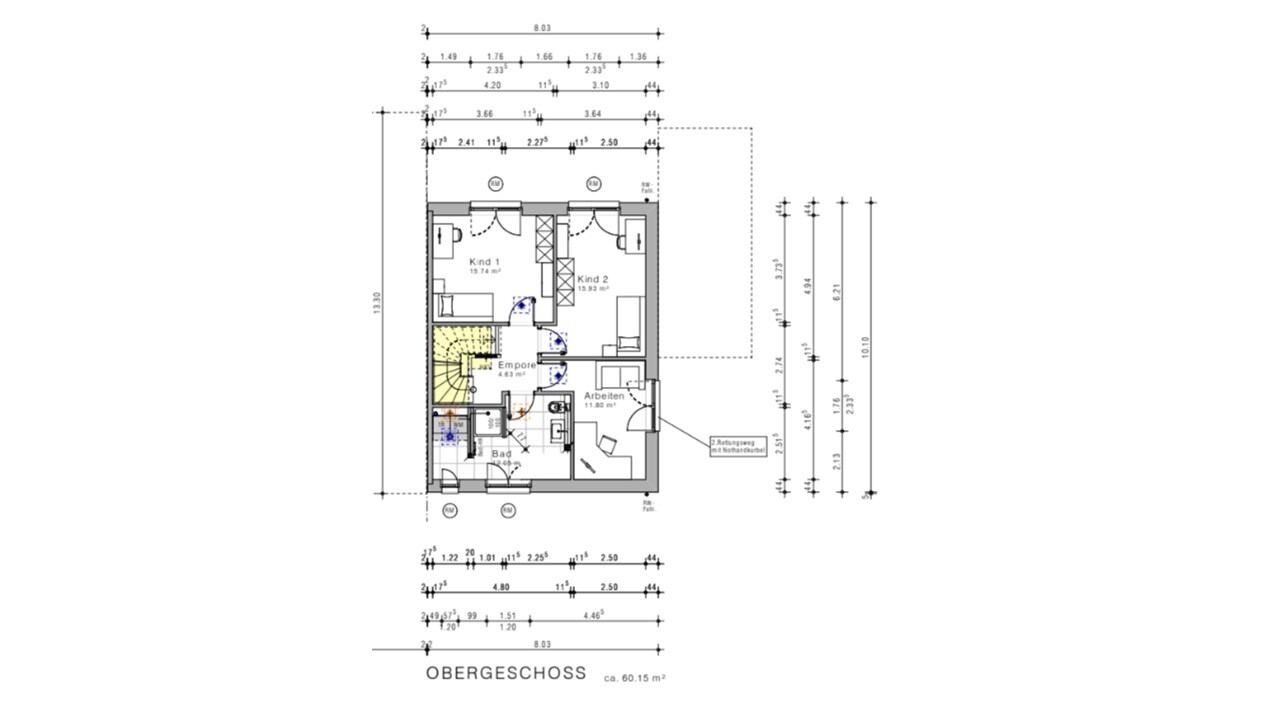
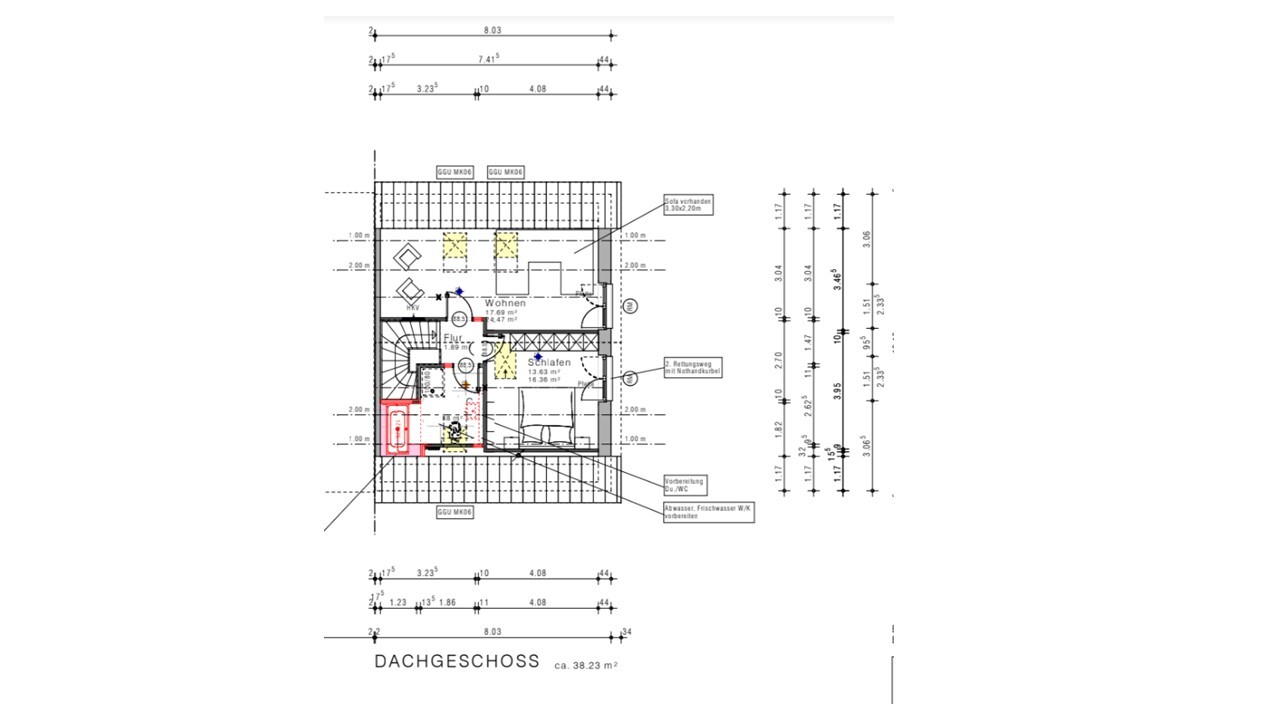
we have a plot of land adjoining a neighboring house, where we plan to build a semi-detached house.
I am currently focusing on the bathrooms and would appreciate any feedback. I have explained the specific questions further below. In the attached floor plans, the latest changes are shown in red, which is why there is a gap in the upper floor where the old bathtub used to be.
Development Plan / Restrictions
Plot size: approx. 450sqm (4844 sq ft)
Slope: no
Site coverage ratio
Floor area ratio
Building envelope, building line and boundary
Edge development: carport/garage
Number of parking spaces
Number of floors: 2.5
Roof style: gable roof, 45 degrees
Design style
Orientation
Maximum heights / limits
Additional requirements: extension attached to an existing semi-detached house; total plot width: 11m (36 ft); therefore maximum house width 8m (26 ft) & building depth 10m (33 ft)
Client Requirements
Design style, roof shape, building type: roof form and size follow the neighbor’s
Basement, floors: no basement, 2 full floors, 1 attic floor
Number of occupants, ages: 4 (37, 36, 3, 0 years)
Space requirements on ground floor: dining/living/kitchen, utility room, guest bathroom, cloakroom
Upper floor (1st floor): 2 children’s bedrooms, office 1, bathroom plus laundry room
Attic floor: master bedroom, bathroom, office 2/guest room/second living area
Office: family use or home office? Both, 2x home offices needed
Number of overnight guests annually: various, 8–10
Open or closed architecture: mixed
Traditional or modern construction
Open kitchen, kitchen island: preferably a semi-detached island, even if the kitchen space is a bit tight
Number of dining seats: 6–8
Fireplace: no
Music/sound system wall
Balcony, roof terrace: terrace
Garage, carport: yes, also serving as basement substitute
Kitchen garden, greenhouse: no
Other wishes/special features/daily routine, including reasons for preferences or restrictions
House Design
Who designed it:
- Planner from a construction company: yes
What do you particularly like? Why?
Implementation of the ground floor, equally sized children’s rooms, the attic floor is also okay. -> Comments still welcome.
What don’t you like? Why?
The bathrooms on the upper and attic floors are still a work in progress.
Laundry should be done on the upper floor, so a laundry area with privacy connected to the main bathroom is desired. Washer/dryer should be elevated, so preferably not placed under a window.
Several drafts have been made with passages at top and bottom of the plan. Current idea: move the bathtub to the attic floor, and use the gained space to widen the laundry room to 1.6m (5.2 ft) to allow some storage.
A separate DIY sketch from me is attached (without technical elements/pipes etc.).
In the attic floor the bathtub is planned under the sloped ceiling. Does this work from a spatial design perspective? Any other ideas for arranging the sanitary fixtures? Would you build the shower as drywall with a glass door or fully as a glass enclosure (more light but more cleaning)?
Another topic: What do you think about the kitchen and possible layout of furniture/semi-island?
If you had to give up, which details/features
- Could you give up:
- Could you not give up: completely omitting a bathtub is not preferred
Why did the design end up as it is now?
Our wishes were implemented by the planner over several iterations.
What do you think makes it especially good or bad:
For the relatively narrow plot and semi-detached house format, many fixed constraints leave little room to maneuver, but I still hope for creative solutions.
H
HeimatBauer14 Dec 2023 08:57My approach to the topic of "separability" was as follows:
1. Basic consideration of the goal I want to achieve. For me: In old age, I want to live on the ground floor and rent out the upper floor. This meant not only adding extra outlets here and there but also designing the ground floor to be age-appropriate.
2. Discussion of the first preliminary draft with a very experienced building planner who has designed many age- and disability-friendly homes. When I asked if the plan was disability-friendly, he first laughed out loud and immediately got himself another beer. Since then, I only refer to "as age-appropriate as possible" because "disability-friendly" is a whole different league. He also forbade me from using the word "wheelchair accessible," but for non-technical people, it’s the most fitting term.
3. Age-appropriate optimization of the ground floor, from the property boundary through the entire house and all rooms to the garden. After all, what good is a low threshold at the patio door if you can’t even get into the house? That’s why my entrance platform is unusually large, with open space next to it for a wheelchair-accessible ramp. To fit the ramp, there couldn’t be a basement window there. But the basement window houses the ventilation, and the devices connected to it supply all the house connections... so this sets off a chain of changes. And this is just one example of many — from door widths to turning radii and even the very tricky bathroom.
4. Once the plan had taken shape, I printed out all floor plans (yes, on paper, like in the 1980s) and then, on all floors and while considering the load-bearing walls, marked the potential separate use (yes! really! with colored pencils! on paper!) and thought through all the traffic flows — how do I get from outside to the kitchen, how do guests get to the living room, how do I get from the bedroom to the bathroom, etc.
5. Many iterations and considerations about whether I want to accept disadvantages now for a possible later change of use or how to avoid them. Just one example among many: A future kitchen needs a water connection. Of course, I could just run the pipes behind the wall — but then water would stand there for years, which is not good. Electrical installations are easier; I’ve already installed a thick cable run invisibly under the wall at the future second entrance door. That way, you only need to open the wall, and the wiring harness for the door opener, intercom, lighting, etc., is ready to go.
6. When the rooms for both the first and second setups were planned, the connection planning began. Wow, that was fun — and not only did I drive all the trades but also the site manager to the brink of madness. For example, I have the stove connection box in my walk-in closet (future upstairs kitchen), and between the walk-in closet and bedroom, there is a precisely measured strip without underfloor heating so an extra wall can be anchored in the floor there without puncturing the floor heating.
7. Today, you actually can’t see any of this. The male guests are probably most impressed that we have a urinal in the ground floor bathroom. This already offers advantages and uses both space and water connections that will later be used for a washing machine in this spot.
That was a very brief summary with just a few specific examples.
So, to say, "separability" is not something you can just sketch on as casually as a window.
1. Basic consideration of the goal I want to achieve. For me: In old age, I want to live on the ground floor and rent out the upper floor. This meant not only adding extra outlets here and there but also designing the ground floor to be age-appropriate.
2. Discussion of the first preliminary draft with a very experienced building planner who has designed many age- and disability-friendly homes. When I asked if the plan was disability-friendly, he first laughed out loud and immediately got himself another beer. Since then, I only refer to "as age-appropriate as possible" because "disability-friendly" is a whole different league. He also forbade me from using the word "wheelchair accessible," but for non-technical people, it’s the most fitting term.
3. Age-appropriate optimization of the ground floor, from the property boundary through the entire house and all rooms to the garden. After all, what good is a low threshold at the patio door if you can’t even get into the house? That’s why my entrance platform is unusually large, with open space next to it for a wheelchair-accessible ramp. To fit the ramp, there couldn’t be a basement window there. But the basement window houses the ventilation, and the devices connected to it supply all the house connections... so this sets off a chain of changes. And this is just one example of many — from door widths to turning radii and even the very tricky bathroom.
4. Once the plan had taken shape, I printed out all floor plans (yes, on paper, like in the 1980s) and then, on all floors and while considering the load-bearing walls, marked the potential separate use (yes! really! with colored pencils! on paper!) and thought through all the traffic flows — how do I get from outside to the kitchen, how do guests get to the living room, how do I get from the bedroom to the bathroom, etc.
5. Many iterations and considerations about whether I want to accept disadvantages now for a possible later change of use or how to avoid them. Just one example among many: A future kitchen needs a water connection. Of course, I could just run the pipes behind the wall — but then water would stand there for years, which is not good. Electrical installations are easier; I’ve already installed a thick cable run invisibly under the wall at the future second entrance door. That way, you only need to open the wall, and the wiring harness for the door opener, intercom, lighting, etc., is ready to go.
6. When the rooms for both the first and second setups were planned, the connection planning began. Wow, that was fun — and not only did I drive all the trades but also the site manager to the brink of madness. For example, I have the stove connection box in my walk-in closet (future upstairs kitchen), and between the walk-in closet and bedroom, there is a precisely measured strip without underfloor heating so an extra wall can be anchored in the floor there without puncturing the floor heating.
7. Today, you actually can’t see any of this. The male guests are probably most impressed that we have a urinal in the ground floor bathroom. This already offers advantages and uses both space and water connections that will later be used for a washing machine in this spot.
That was a very brief summary with just a few specific examples.
So, to say, "separability" is not something you can just sketch on as casually as a window.
@Klinkerhof86
Are there any bigger plans coming up? Screenshots are obviously too small.
Age-appropriate also means building in a practical and straightforward way. This has advantages even when you are young and healthy, rather than having complicated self-drawn plans like a labyrinth.
@HeimatBauer What are the chances that you will ever be dependent on a wheelchair? I find this approach a bit like using a sledgehammer to crack a nut.
And what about your wife? Does she still have enough space in the ground floor apartment? Will she need to be co-disabled?
If you have the money, you can certainly invest a lot in your house and install half-apartments within the walls. Others are just glad if they can afford a few extra electrical outlets beyond the basic standard.
Are there any bigger plans coming up? Screenshots are obviously too small.
Age-appropriate also means building in a practical and straightforward way. This has advantages even when you are young and healthy, rather than having complicated self-drawn plans like a labyrinth.
@HeimatBauer What are the chances that you will ever be dependent on a wheelchair? I find this approach a bit like using a sledgehammer to crack a nut.
And what about your wife? Does she still have enough space in the ground floor apartment? Will she need to be co-disabled?
If you have the money, you can certainly invest a lot in your house and install half-apartments within the walls. Others are just glad if they can afford a few extra electrical outlets beyond the basic standard.
H
HeimatBauer14 Dec 2023 11:08I feared that responses like these would come, and compared to the effort I put into the planning, I truly regret taking the time to explain everything here.
I find it unfortunate to have to justify forward-looking planning.
In this thread, my intention was simply to show that "separability" is not something you casually see in a design magazine and then just copy and paste into a building plan. If at least that was understood, then that’s already something.
No one plans to become disabled (I also thought I had clearly stated that this was only about age-appropriate design, not disability-accessibility) or to grow old or to develop impairments. I have experienced with my parents and in-laws what it’s like when a home isn’t built to accommodate that – I apologize for those who have had that experience and have taken it into account.
I didn’t build my house just for the next five years, but for much longer. I don’t find it unreasonable to think ahead a bit and consider things more thoroughly here and there. I also thought I had mentioned that what’s installed as preparation can of course be used immediately, like a urinal, for example. I installed many pipes in my house as a reserve and was already extremely happy about this before moving in because I had the pipes my general contractor forgot. Without them, the exterior wall would have had to be cut open again for the photovoltaics. Many things have not proven to be a limitation at all but rather a stroke of luck – for example, the shower in the ground floor bathroom is frequently used and is by no means a ridiculous idea but actually very practical, especially in summer. I don’t at all see the fact that not everything is cramped as a shame.
So go ahead and laugh about my age-appropriate planning or my extensive wiring – I laugh too, because I’ve already been glad about it several times and I don’t regret anything.
I find it unfortunate to have to justify forward-looking planning.
In this thread, my intention was simply to show that "separability" is not something you casually see in a design magazine and then just copy and paste into a building plan. If at least that was understood, then that’s already something.
No one plans to become disabled (I also thought I had clearly stated that this was only about age-appropriate design, not disability-accessibility) or to grow old or to develop impairments. I have experienced with my parents and in-laws what it’s like when a home isn’t built to accommodate that – I apologize for those who have had that experience and have taken it into account.
I didn’t build my house just for the next five years, but for much longer. I don’t find it unreasonable to think ahead a bit and consider things more thoroughly here and there. I also thought I had mentioned that what’s installed as preparation can of course be used immediately, like a urinal, for example. I installed many pipes in my house as a reserve and was already extremely happy about this before moving in because I had the pipes my general contractor forgot. Without them, the exterior wall would have had to be cut open again for the photovoltaics. Many things have not proven to be a limitation at all but rather a stroke of luck – for example, the shower in the ground floor bathroom is frequently used and is by no means a ridiculous idea but actually very practical, especially in summer. I don’t at all see the fact that not everything is cramped as a shame.
So go ahead and laugh about my age-appropriate planning or my extensive wiring – I laugh too, because I’ve already been glad about it several times and I don’t regret anything.
H
HeimatBauer14 Dec 2023 11:19ypg schrieb:
And what about your wife? Does she still have space in the ground floor apartment? Will she have to be co-disabled? Sorry, but I find that really intrusive.
@HeimatBauer
You misunderstood something, and I hope my private message clears it up.
Regarding the topic: of course, it’s great if you can build large enough so that the house can later be divided or made suitable for aging in place, as you envision.
We’ve also had several discussions here where the original poster either has a child in a wheelchair or will themselves need a wheelchair later due to an illness. In those cases, the planning requirements are very different because you know exactly what you need.
Basically, though, your planning is limited if you try at an early age, like in your mid-20s, to cover everything—from a household with children, couple life, accessibility for aging or reduced mobility, and if possible, also divisibility. In the long run, you won’t be happy with that.
But to get back to this thread, I feel it’s being hijacked:
we have a space of 8 by 10 meters, so just under 70 square meters (750 square feet) on one level. This space is to be thoughtfully divided for a four-person household. Whether that’s been successful here is debatable (I’m still waiting for better photos with readable dimensions).
The fact that the ground-floor level is to be separated later means roughly 15 square meters (160 square feet) will be lost. And you have to ask yourself if it’s worth taking away the “space” the townhouse currently has. Because small bathrooms are not comfortable to use in old age—you ideally want a bit more comfort there.
But I get the feeling the original poster found the digression a bit irritating?!
You misunderstood something, and I hope my private message clears it up.
Regarding the topic: of course, it’s great if you can build large enough so that the house can later be divided or made suitable for aging in place, as you envision.
We’ve also had several discussions here where the original poster either has a child in a wheelchair or will themselves need a wheelchair later due to an illness. In those cases, the planning requirements are very different because you know exactly what you need.
Basically, though, your planning is limited if you try at an early age, like in your mid-20s, to cover everything—from a household with children, couple life, accessibility for aging or reduced mobility, and if possible, also divisibility. In the long run, you won’t be happy with that.
But to get back to this thread, I feel it’s being hijacked:
we have a space of 8 by 10 meters, so just under 70 square meters (750 square feet) on one level. This space is to be thoughtfully divided for a four-person household. Whether that’s been successful here is debatable (I’m still waiting for better photos with readable dimensions).
The fact that the ground-floor level is to be separated later means roughly 15 square meters (160 square feet) will be lost. And you have to ask yourself if it’s worth taking away the “space” the townhouse currently has. Because small bathrooms are not comfortable to use in old age—you ideally want a bit more comfort there.
But I get the feeling the original poster found the digression a bit irritating?!
Similar topics