
ᐅ Floor plan: New construction on an existing bungalow basement, one-and-a-half stories
Created on: 19 Dec 2022 01:12
M
Mal Bauen
Hello to all forum members,
We are still relatively early in our building project and have many fundamental questions to clarify. Nevertheless, I would like to introduce the project here.
We recently became owners of a prefabricated bungalow from Streif Haus, built in 1987. It has a full concrete basement (by Betonkemmler).
Our plan is to demolish the bungalow down to the top edge of the basement and build a new house for our family (currently four, eventually five) on top. The existing basement (very solid construction) is to be integrated as a utility basement including a technical room. At the same time, the heating system will be modernized from oil heating to a heat pump.
Currently, we are in contact with both prefabricated house suppliers (Weberhaus, Danwood) and solid construction companies (Denkinger). The property is located in Baden-Württemberg (southern Baden).
Even though the floor plan is only a first draft, I would like to present it here for feedback (summary below).
In particular, I hope to get some thoughts on the following basic questions:
Here is the summary sheet (key points).
Many thanks in advance for your input, comments, and critiques. I will gladly report further developments here in the thread.
Development Plan / Restrictions
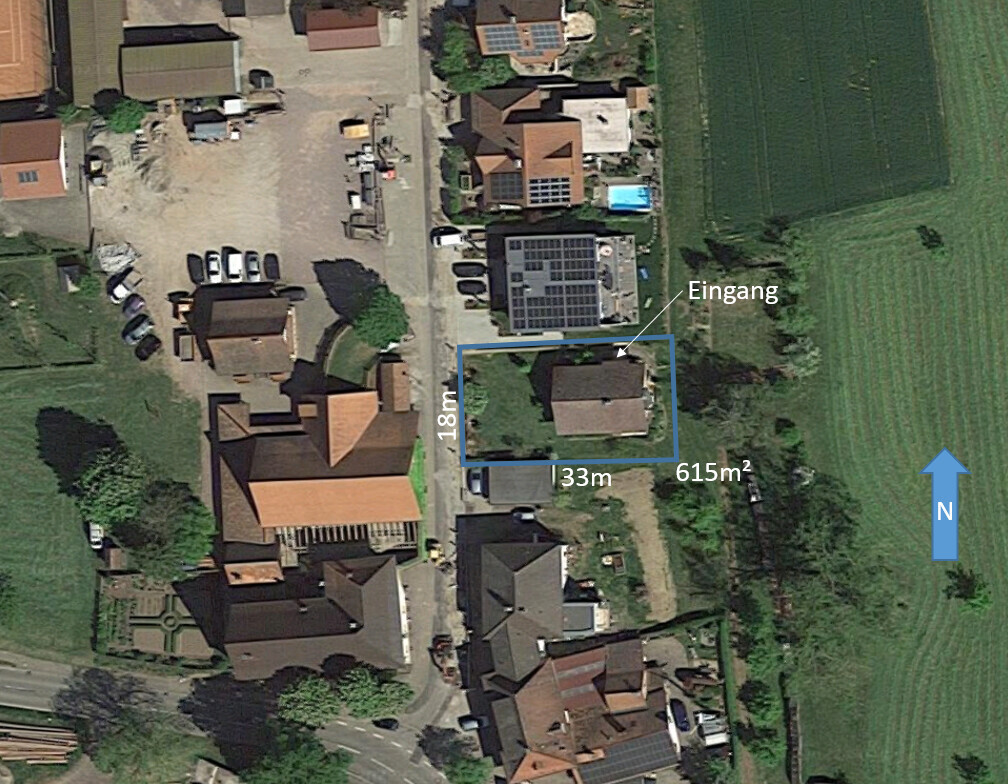
Size of the plot: 615m² (6620 sq ft)
Slope: North/South: <0.5m (1.6 ft) over 18m (59 ft), West-East: approx. 2m (6.6 ft) over 33m (108 ft) (see elevation profile)
Site coverage ratio: No development plan (Section 34 of German Building Code). The immediate neighborhood contains some generously built plots. We do not want to change the building footprint of the existing house but want to add a double garage (not currently present).
Floor area ratio: No development plan (Section 34 of German Building Code)
Building envelope, building line and boundary: No development plan (Section 34 of German Building Code). Property boundaries and existing building shown in aerial photo attached
Edge development: None
Number of parking spaces: None
Number of floors: 1.5 stories
Roof type: Gable roof
Architectural style: Modern detached family house
Orientation: see aerial photo. Entrance (currently): north
Maximum height/limits: No development plan
Immediate neighbors: Northern neighbor: 2 stories with flat roof. Southern: 1.5 stories with hipped roof. Western: 1.5 stories with gable roof.
Client Requirements
Style, roof form, building type: We want to transform the existing bungalow into a classic 1.5-story detached house with a gable roof and possibly shed dormers.
Basement, floors: Utility basement (existing, concrete basement), ground floor (living), upper floor (sleeping)
Number of persons, ages: Our family currently has four members (ages: 32, 30, 2, 0), with another child planned
Space requirements on ground and upper floor:
Ground floor: living room, kitchen (possibly with pantry), room for home office or guest room, guest WC with shower, cloakroom
Upper floor: master bedroom, 3 children’s bedrooms, bathroom
Office: family use or home office: Home office (100% for me)
Overnight guests per year: Few, less than 5 guests/nights
Open or closed architecture: Rather closed. Ability to separate kitchen and living room would be desirable.
Conservative or modern design: Modern
Open kitchen, kitchen island: Kitchen island not mandatory. Partly open kitchen: separation from living room would be good.
Number of dining seats: 5-8
Fireplace: Only if budget allows, not mandatory
Music/ stereo wall: No
Balcony, roof terrace: No
Garage, carport: Double garage
Utility garden, greenhouse: No
Further wishes/special features/daily routine, including reasons for preferences or exclusions: The technical room should be located in the existing basement (e.g., in the former oil heating room). A sensible circulation concept is very important: front door/upper floor stairs/basement stairs. Ideally, short distances between garage and house as well as good accessibility of rooms within the house.
House Design
Designed by: Initial draft from the prefab house supplier after first meeting
What do you especially like? Why?: (Almost) all room requests fulfilled. Good accessibility of upper floor rooms via centrally located landing. Short distances from garage to house thanks to new front door position (west instead of north). Spacious cloakroom area. Living room oriented south/east with a nice view.
What do you not like? Why?: The draft was created after an initial discussion of the project. Some ideas and preferences developed or changed later on by us:
- Existing concrete stairs in the basement will not be used, causing extra costs for upgrading the basement (new stairs, new room layout).
- (Small) pantry for food/storage on the ground floor would be great
- Better separation of kitchen and living room is desirable
Price estimate according to architect/planner: 520,000 € (approx. $560,000), turnkey (including 10kWp photovoltaic system with 10kW storage, fresh air heating with air-to-air heat pump), excluding demolition of existing bungalow, double garage, incidental building costs
Personal price limit for house including fittings: 700,000 € (rough estimate: demolition down to top of basement: 30,000 €, house: 530,000 €, incidental costs including basement statics: 50,000 €, double garage: 30,000 €, kitchen/furniture: 40,000 €, landscaping: 20,000 €)
Preferred heating technology: Heat pump with underfloor heating. If budget allows: ground-source heat pump with deep geothermal drilling. The prefab house supplier prefers fresh air heating.
If you had to give up something, which details or add-ons could you do without: Fireplace, new basement stairs
What can you absolutely not do without: Home office
Why is the design like it is now?
Individualized draft by the prefab supplier adapted to the existing basement footprint after discussing our rough (space) requirements.
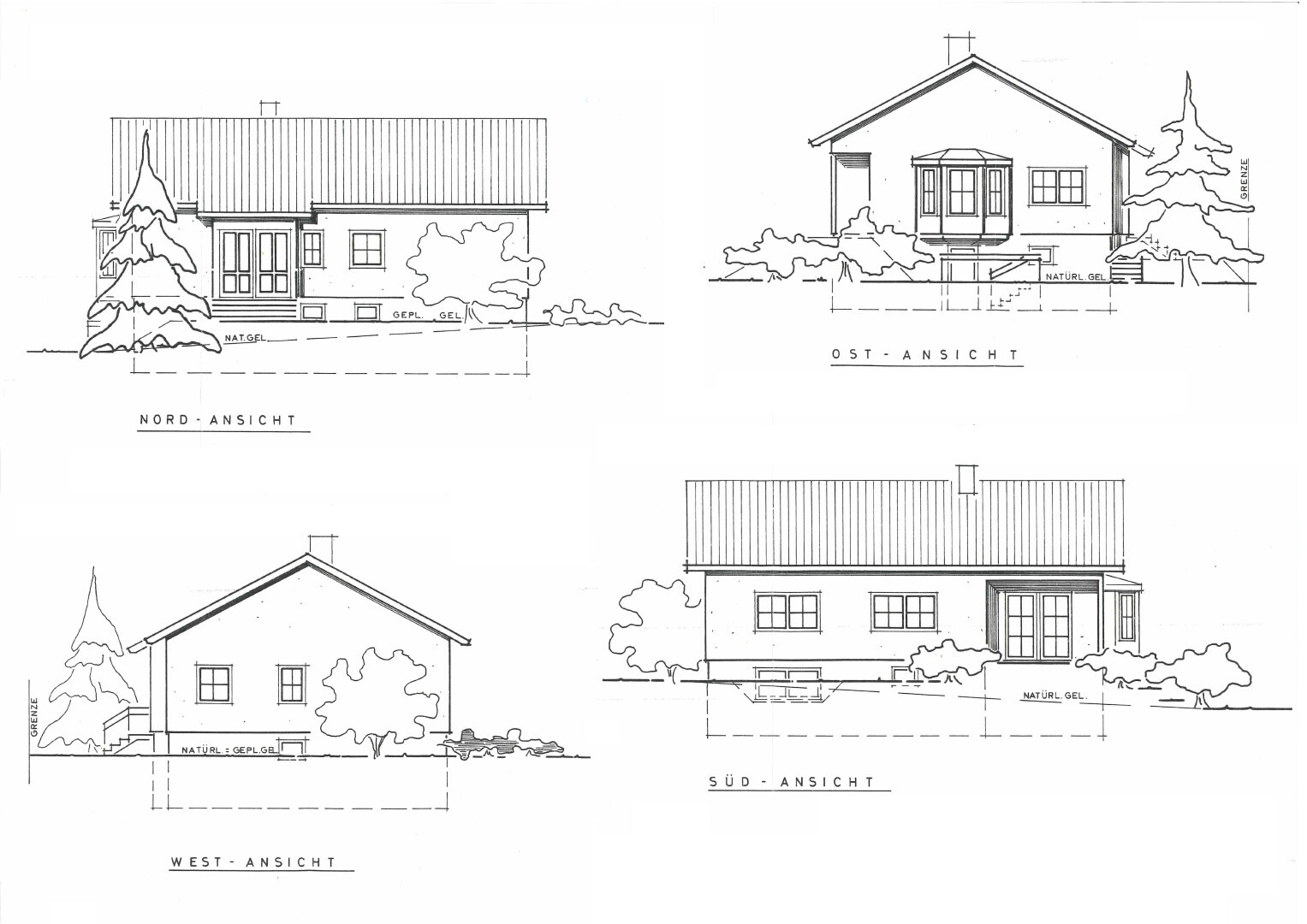
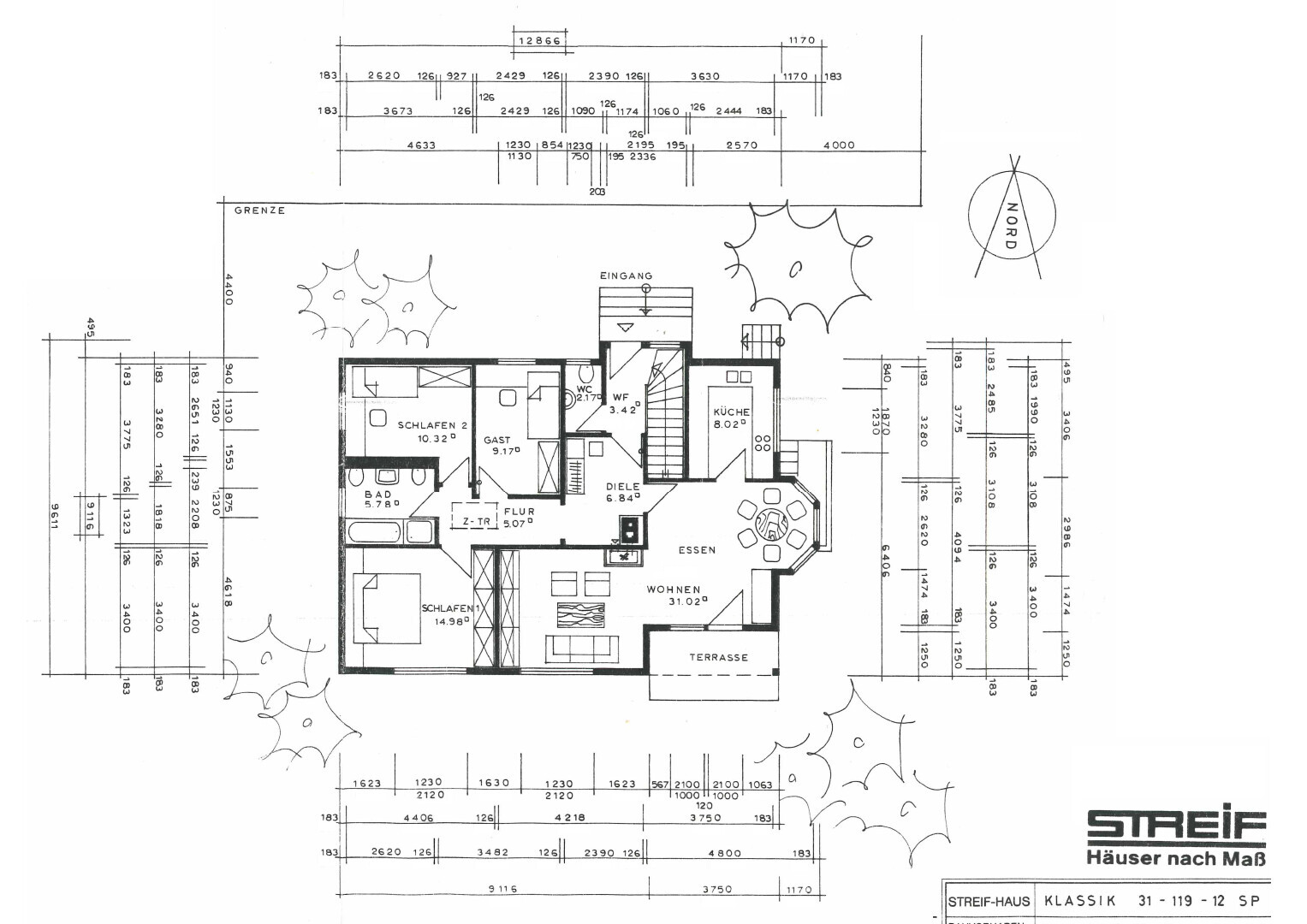
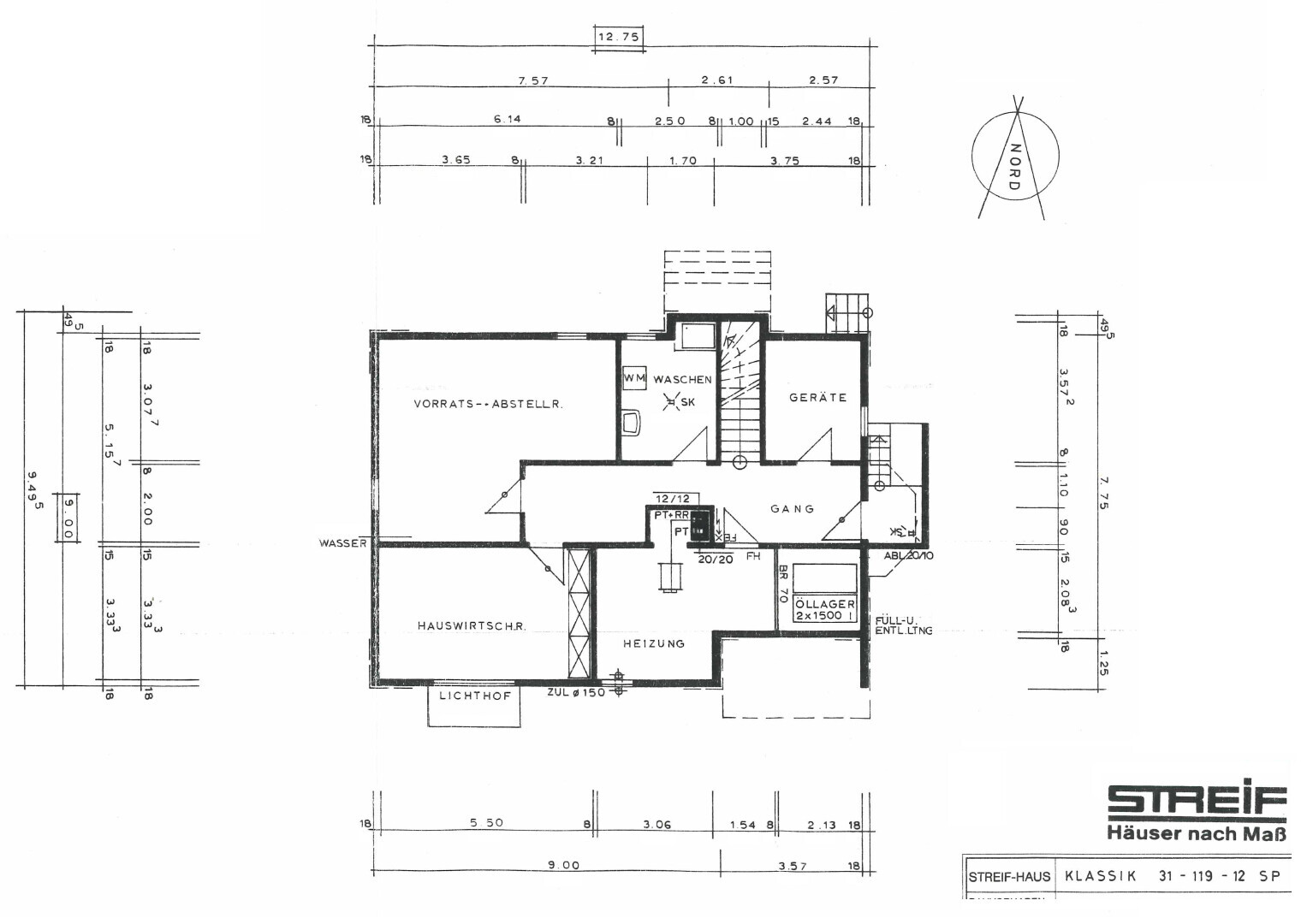
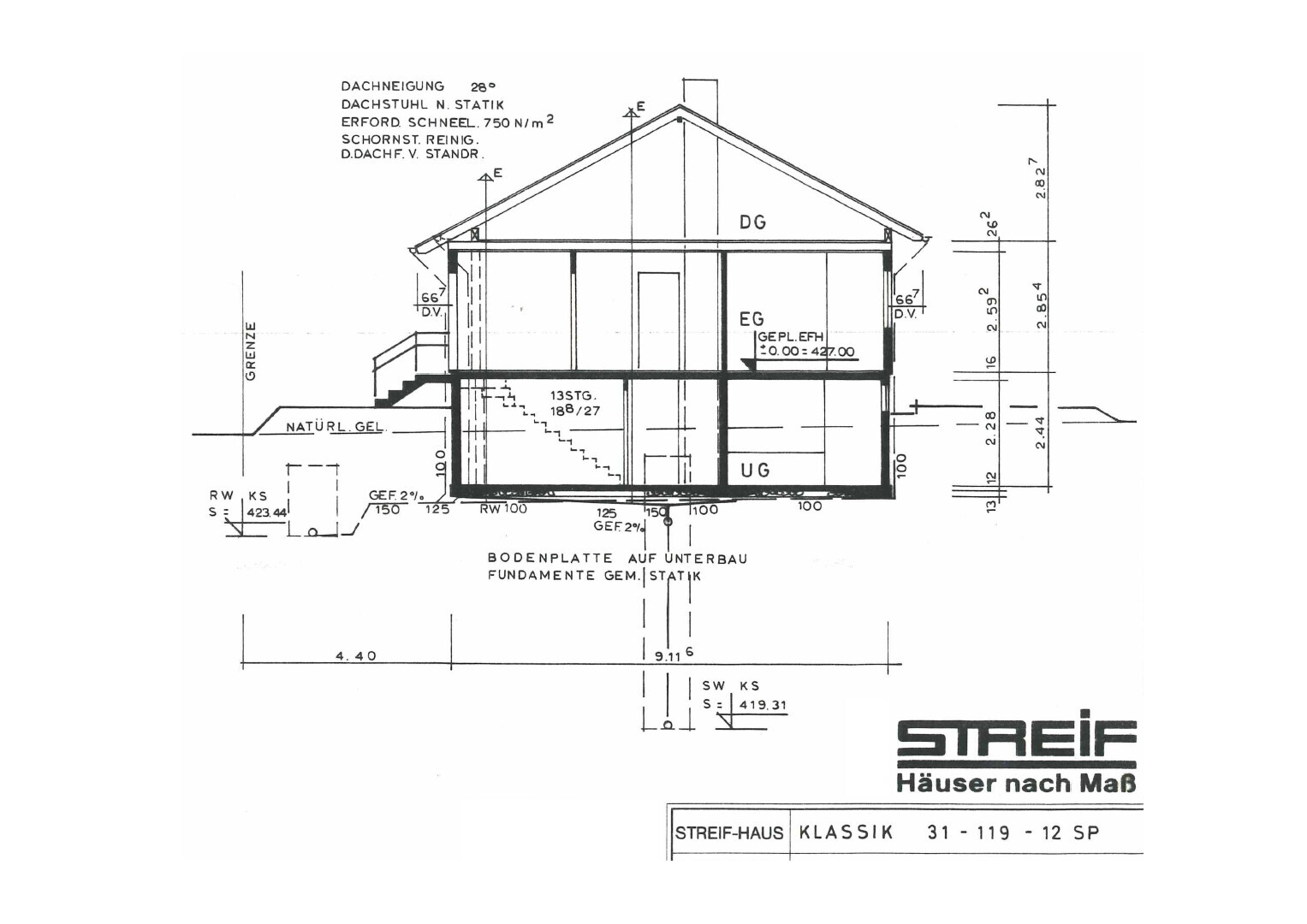
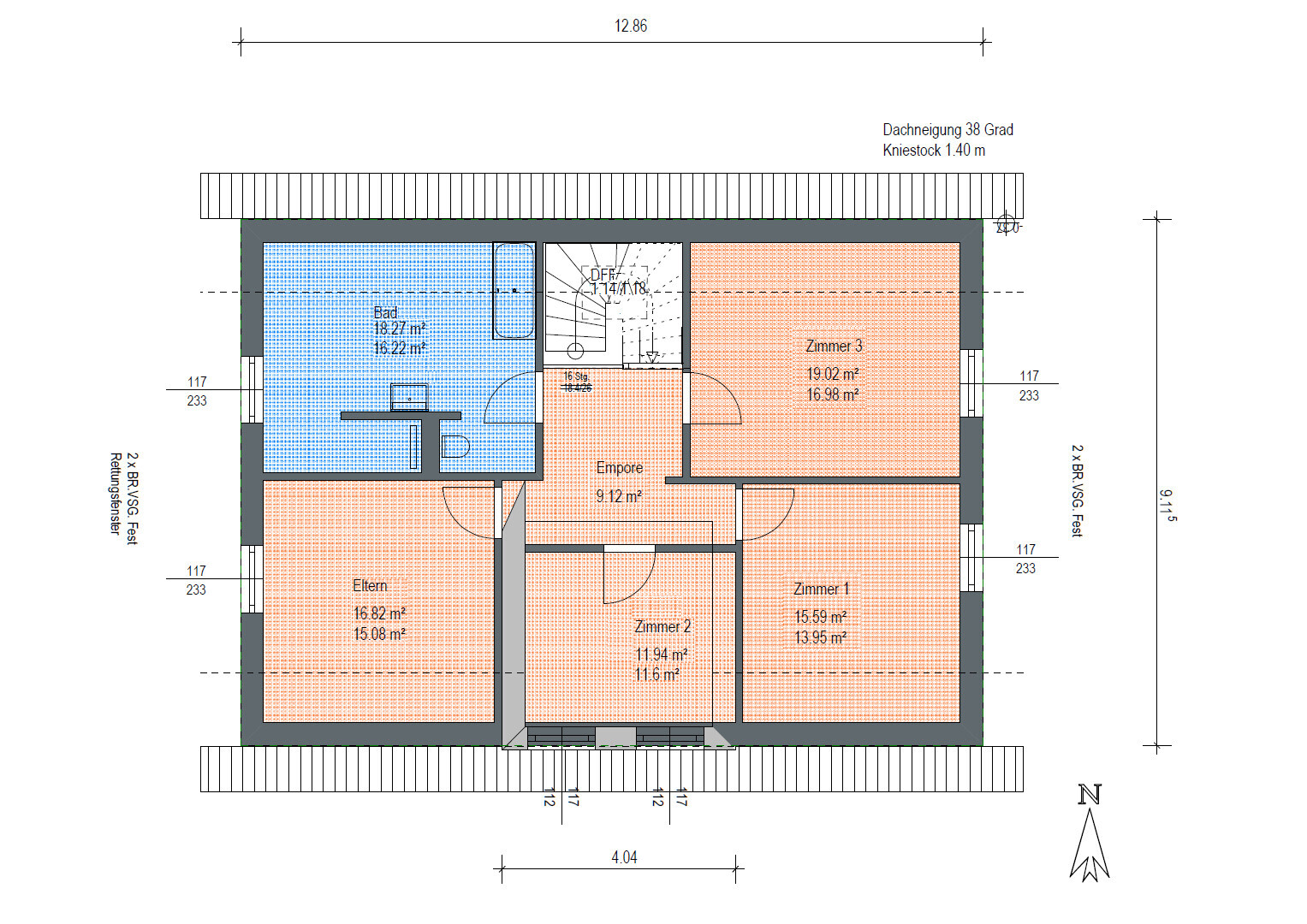
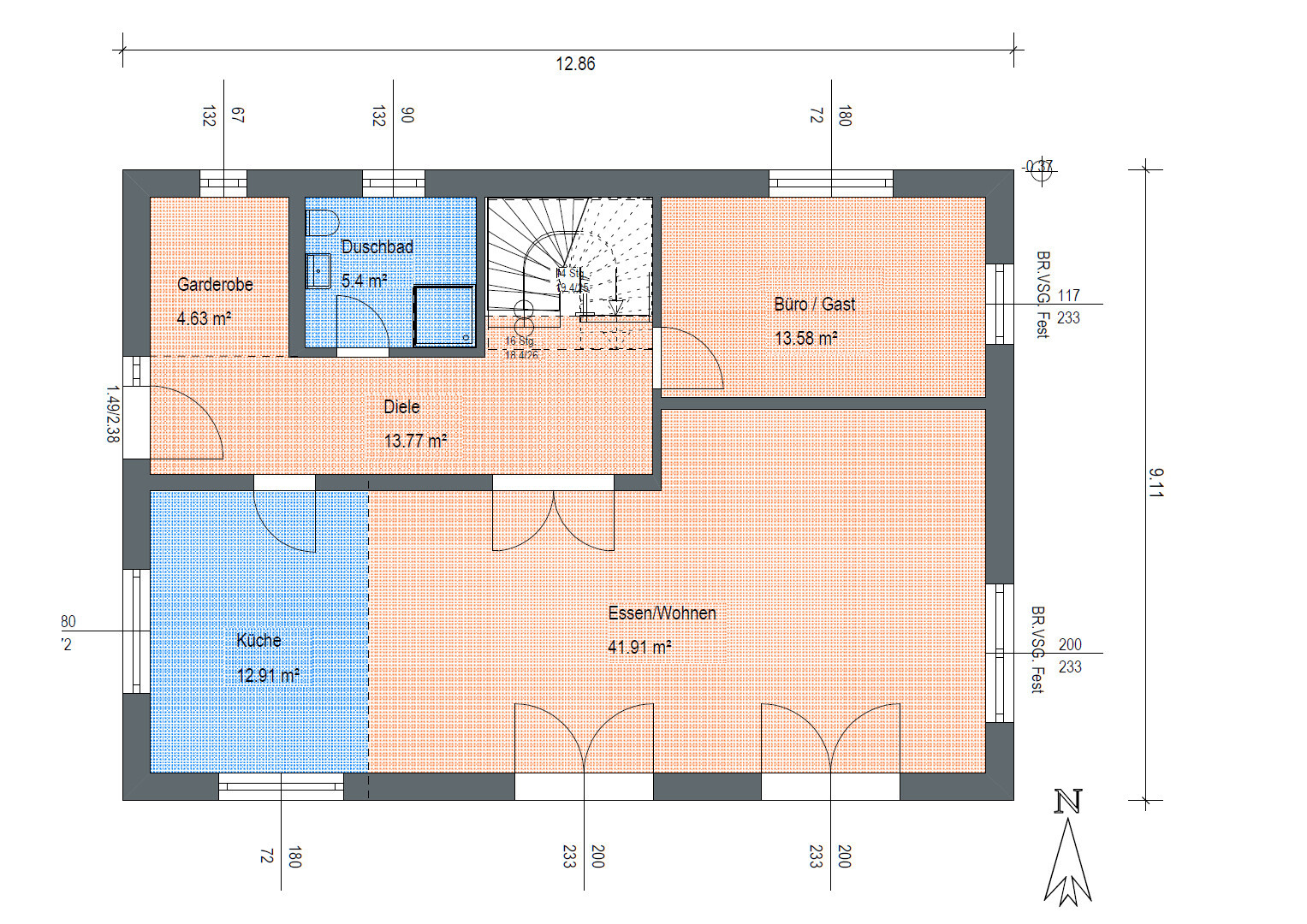
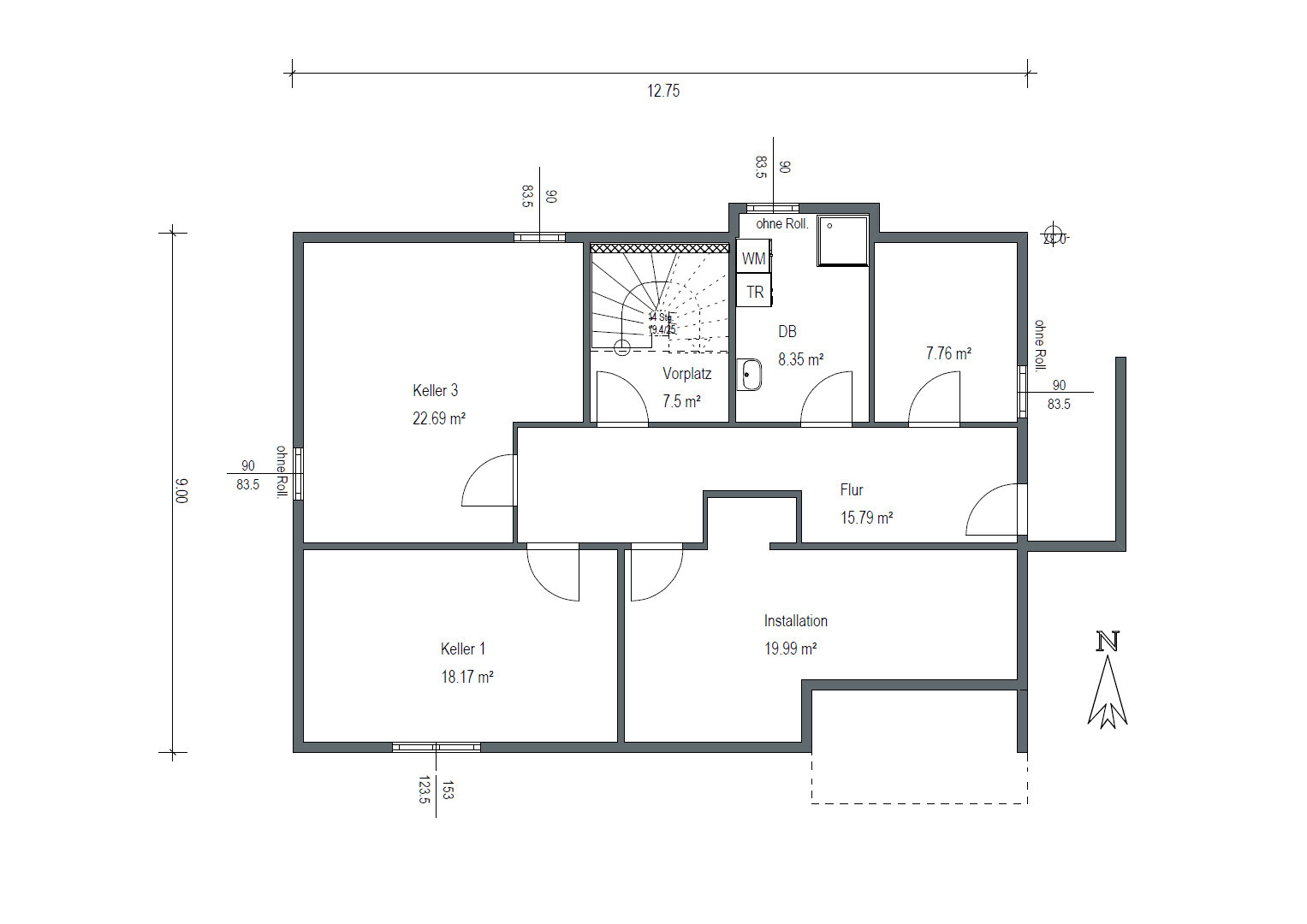
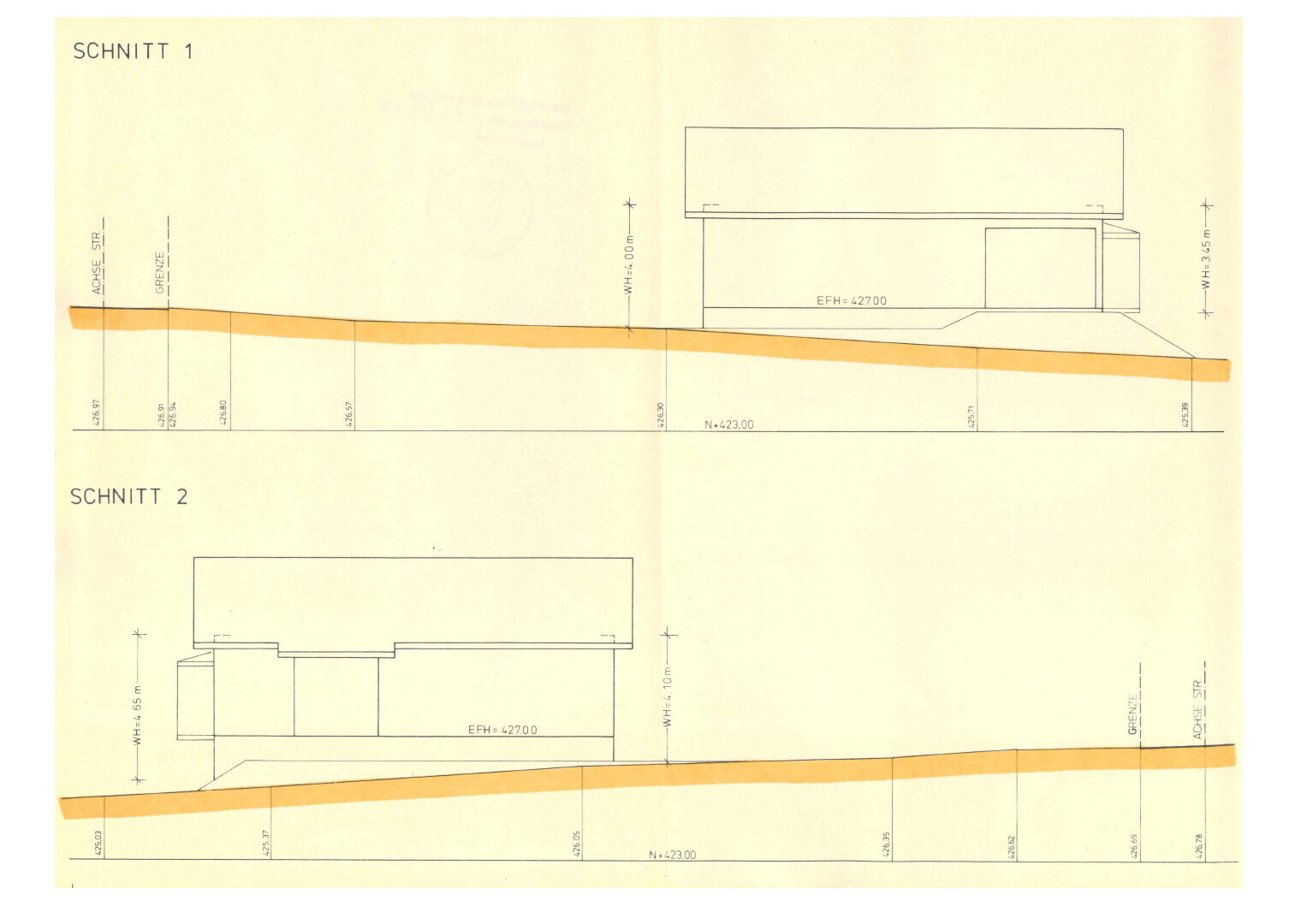
We are still relatively early in our building project and have many fundamental questions to clarify. Nevertheless, I would like to introduce the project here.
We recently became owners of a prefabricated bungalow from Streif Haus, built in 1987. It has a full concrete basement (by Betonkemmler).
Our plan is to demolish the bungalow down to the top edge of the basement and build a new house for our family (currently four, eventually five) on top. The existing basement (very solid construction) is to be integrated as a utility basement including a technical room. At the same time, the heating system will be modernized from oil heating to a heat pump.
Currently, we are in contact with both prefabricated house suppliers (Weberhaus, Danwood) and solid construction companies (Denkinger). The property is located in Baden-Württemberg (southern Baden).
Even though the floor plan is only a first draft, I would like to present it here for feedback (summary below).
In particular, I hope to get some thoughts on the following basic questions:
- Has any forum member gained experience with building on an existing basement?
- Is there generally a preferred construction method for our project? We are still undecided whether to go for a prefab timber frame house or a masonry (brick or block) solid construction.
- So far, we have not discussed a double garage with the builders, but it will be needed. Where does it make more sense: northwest or southwest (directly next to the neighbor’s garage)?
- To what extent can the project be treated as a renovation with partial demolition in terms of building regulations? Background: Are there any possibilities for funding (still) available?
- What we want to achieve with the floor plan is short walking distances inside and around the house. Therefore, the main entrance was moved from the north side to the west side. However, since it is on the short side of the house, this results in more corridor space and longer routes inside (e.g., from the front door to the stairs to the upper floor). But as the saying goes, you have to accept some drawbacks — what is your opinion: front door facing north or west?
Here is the summary sheet (key points).
Many thanks in advance for your input, comments, and critiques. I will gladly report further developments here in the thread.
Development Plan / Restrictions
Size of the plot: 615m² (6620 sq ft)
Slope: North/South: <0.5m (1.6 ft) over 18m (59 ft), West-East: approx. 2m (6.6 ft) over 33m (108 ft) (see elevation profile)
Site coverage ratio: No development plan (Section 34 of German Building Code). The immediate neighborhood contains some generously built plots. We do not want to change the building footprint of the existing house but want to add a double garage (not currently present).
Floor area ratio: No development plan (Section 34 of German Building Code)
Building envelope, building line and boundary: No development plan (Section 34 of German Building Code). Property boundaries and existing building shown in aerial photo attached
Edge development: None
Number of parking spaces: None
Number of floors: 1.5 stories
Roof type: Gable roof
Architectural style: Modern detached family house
Orientation: see aerial photo. Entrance (currently): north
Maximum height/limits: No development plan
Immediate neighbors: Northern neighbor: 2 stories with flat roof. Southern: 1.5 stories with hipped roof. Western: 1.5 stories with gable roof.
Client Requirements
Style, roof form, building type: We want to transform the existing bungalow into a classic 1.5-story detached house with a gable roof and possibly shed dormers.
Basement, floors: Utility basement (existing, concrete basement), ground floor (living), upper floor (sleeping)
Number of persons, ages: Our family currently has four members (ages: 32, 30, 2, 0), with another child planned
Space requirements on ground and upper floor:
Ground floor: living room, kitchen (possibly with pantry), room for home office or guest room, guest WC with shower, cloakroom
Upper floor: master bedroom, 3 children’s bedrooms, bathroom
Office: family use or home office: Home office (100% for me)
Overnight guests per year: Few, less than 5 guests/nights
Open or closed architecture: Rather closed. Ability to separate kitchen and living room would be desirable.
Conservative or modern design: Modern
Open kitchen, kitchen island: Kitchen island not mandatory. Partly open kitchen: separation from living room would be good.
Number of dining seats: 5-8
Fireplace: Only if budget allows, not mandatory
Music/ stereo wall: No
Balcony, roof terrace: No
Garage, carport: Double garage
Utility garden, greenhouse: No
Further wishes/special features/daily routine, including reasons for preferences or exclusions: The technical room should be located in the existing basement (e.g., in the former oil heating room). A sensible circulation concept is very important: front door/upper floor stairs/basement stairs. Ideally, short distances between garage and house as well as good accessibility of rooms within the house.
House Design
Designed by: Initial draft from the prefab house supplier after first meeting
What do you especially like? Why?: (Almost) all room requests fulfilled. Good accessibility of upper floor rooms via centrally located landing. Short distances from garage to house thanks to new front door position (west instead of north). Spacious cloakroom area. Living room oriented south/east with a nice view.
What do you not like? Why?: The draft was created after an initial discussion of the project. Some ideas and preferences developed or changed later on by us:
- Existing concrete stairs in the basement will not be used, causing extra costs for upgrading the basement (new stairs, new room layout).
- (Small) pantry for food/storage on the ground floor would be great
- Better separation of kitchen and living room is desirable
Price estimate according to architect/planner: 520,000 € (approx. $560,000), turnkey (including 10kWp photovoltaic system with 10kW storage, fresh air heating with air-to-air heat pump), excluding demolition of existing bungalow, double garage, incidental building costs
Personal price limit for house including fittings: 700,000 € (rough estimate: demolition down to top of basement: 30,000 €, house: 530,000 €, incidental costs including basement statics: 50,000 €, double garage: 30,000 €, kitchen/furniture: 40,000 €, landscaping: 20,000 €)
Preferred heating technology: Heat pump with underfloor heating. If budget allows: ground-source heat pump with deep geothermal drilling. The prefab house supplier prefers fresh air heating.
If you had to give up something, which details or add-ons could you do without: Fireplace, new basement stairs
What can you absolutely not do without: Home office
Why is the design like it is now?
Individualized draft by the prefab supplier adapted to the existing basement footprint after discussing our rough (space) requirements.
M
Mal Bauen9 Dec 2023 00:17K a t j a schrieb:
Well, if you’re working with lightweight construction on the upper floor, I have this optionThat looks great and conveniently includes a larger ground floor bathroom and a separate utility room on the upper floor. Despite using wooden interior walls on the upper floor, our architect insisted that the ground floor walls rest on the load-bearing basement walls. Therefore, we never discussed proposals like yours. Now, I’m not sure if we want to completely rethink our plans. We actually just want to solve the critical areas in our current floor plan but are a bit annoyed that we didn’t think more “outside the box” earlier.Regarding the knee wall height:
That was a tricky issue as well. We’re glad to have at least 1 meter (3 feet 3 inches); in the first draft, it was only 65 cm (26 inches). The main challenge is the dormer windows on the south side, where the sill height increases with the knee wall. I’ve discussed this in a separate thread: https://www.hausbau-forum.de/threads/kniestockhoehe-bei-schleppdachgaube.45203/

Mal Bauen schrieb:
Even though there are wooden interior walls on the upper floor, our architect always insisted that the ground floor walls be supported by the load-bearing basement walls.Hopefully, this is a simplified summary, but fundamentally it is advisable.https://www.instagram.com/11antgmxde/
https://www.linkedin.com/company/bauen-jetzt/

Mal Bauen schrieb:
That looks great and conveniently adds a larger ground floor bathroom and a separate utility room on the upper floor.
Despite having wooden interior walls upstairs, our architect always insisted that the ground floor walls rest on the load-bearing cellar walls. That’s why we never discussed proposals like yours. Now I’m not sure if we want to completely rethink our plans. We just want to solve the critical points in our current floor plan but are a bit frustrated that we didn’t think “outside the box” sooner. I’ll put it this way: for me, having the access to the guest toilet right next to the dining table would be a deal-breaker. If I’m spending such a huge amount, that compromise would be too big. If the cellar walls can’t “support” all the walls, then maybe rotating the cellar staircase is a feasible alternative. That way, the cellar layout stays almost the same, except for a new passage at the top of the stairs and blocking up the old stair opening. The current washroom would become the stairwell—which I think is manageable. If necessary, the plumbing could be moved to the neighboring room, which would be on the same wall. But the laundry is moving upstairs anyway—maybe something like this:
Mal Bauen schrieb:
Regarding the knee wall (kniestock):
That was also a waiting game. We’re glad to have 1 meter (3 feet 3 inches); the first draft had only 65cm (26 inches). The sticking point is the dormer windows on the south side—there, the parapet height increases together with the knee wall. I discussed this in a separate thread: https://www.hausbau-forum.de/threads/kniestockhoehe-bei-schleppdachgaube.45203/ No matter what you’ve convinced yourselves of, that’s complete nonsense. You’re building a new house! The zoning plan or building code does not stop you from choosing the knee wall height freely. Just do it! The aesthetics of the dormer come far behind knee wall height, probably around rank 250. First, the rooms have to work. Then you can worry about how they look. If I can’t place the bed against a wall, in my opinion, the room simply doesn’t work.
M
Mal Bauen9 Dec 2023 15:53K a t j a schrieb:
I would say this: for me, having the entrance to the guest bathroom right next to the dining table would be a deal breaker. If I’m spending this huge amount, that compromise would be too much for me. At first, the inconvenience of the guest bathroom entrance seemed small and acceptable to us. The longer we think about it, the bigger it now seems.
Thank you for this additional creative suggestion. One of the dogmas of our previous planning was also not to alter the basement; in hindsight, we should have allowed ourselves more flexibility there as well. Considering the short time until construction starts in March, we will stick to our floor plan and implement your solution for the guest bathroom from post #57.
K a t j a schrieb:
Whatever you told yourselves, that’s complete nonsense. You’re building a new house! The zoning/building regulations don’t restrict you from freely choosing the knee wall height. So just do it! The appearance of the dormer is priority 250 compared to the knee wall height, which is somewhere around 10. For the dormer, it was less about appearance and more about the concern of having the window frame right in front of the kids’ rooms on the south side. This has since proven to be unfounded. The parapet height is approximately 94cm (37 inches) above the finished floor height at a knee wall height of 1m (39 inches). We could actually raise this by 25cm (10 inches) to a parapet height of 119cm (47 inches) at a knee wall height of 1.25m (49 inches). I’m not sure how strictly deviations from the eaves and ridge heights specified in the building permit/planning permission are handled. Ideally, I should adhere to those measurements.
So perhaps it could also be considered to separate the toilet in the bathroom by placing it under the staircase (if there is enough headroom).
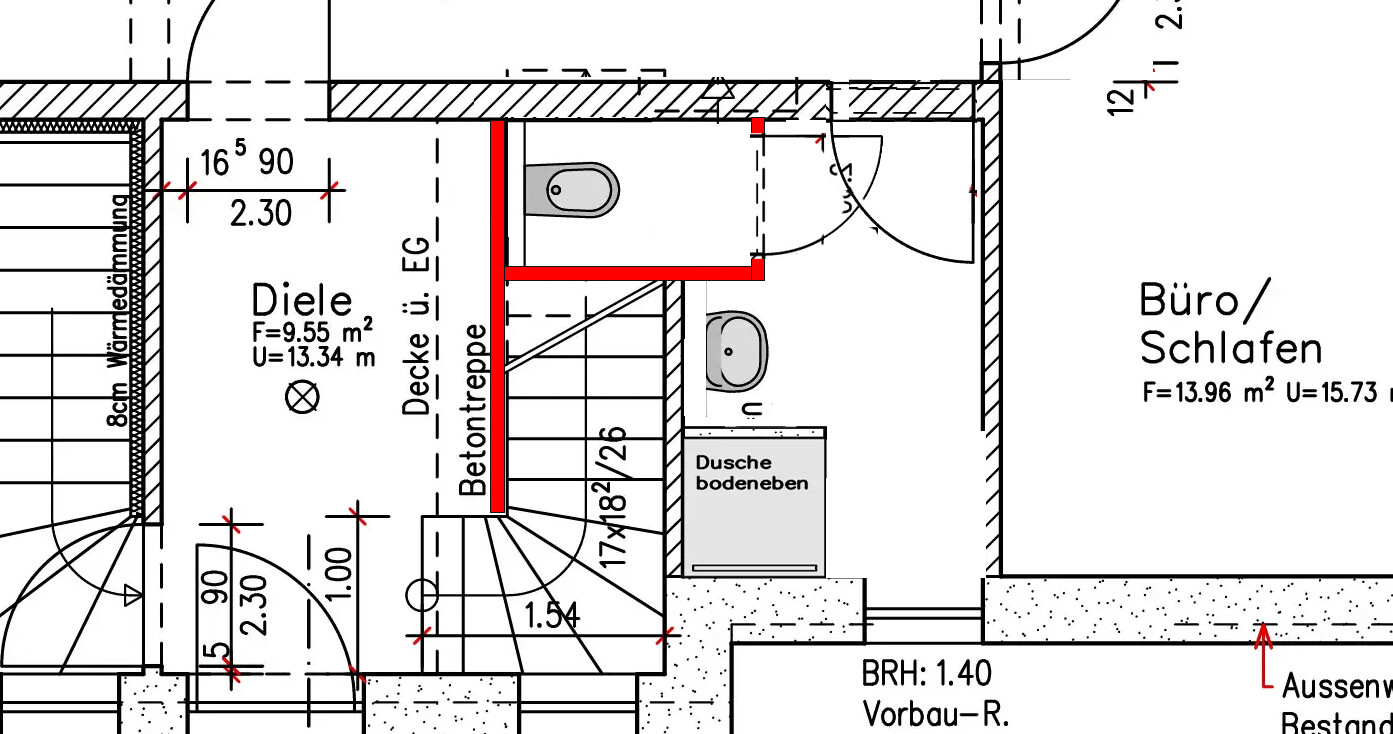
Then use an effective exhaust system to vent odors outside. With custom-fit furniture and a standard corner shower, it can even look quite nice. It would of course be nicer if the toilet door could open inward, but I cannot assess that with Photoshop.
Then use an effective exhaust system to vent odors outside. With custom-fit furniture and a standard corner shower, it can even look quite nice. It would of course be nicer if the toilet door could open inward, but I cannot assess that with Photoshop.
M
Mal Bauen3 Jan 2024 10:22Thank you for the additional suggestion @K a t j a.
The clear headroom would be between 2.58m (8 ft 6 in) at the top and about 1.90m (6 ft 3 in), 1m (3 ft 3 in) further along the staircase slope. That would be quite tight.
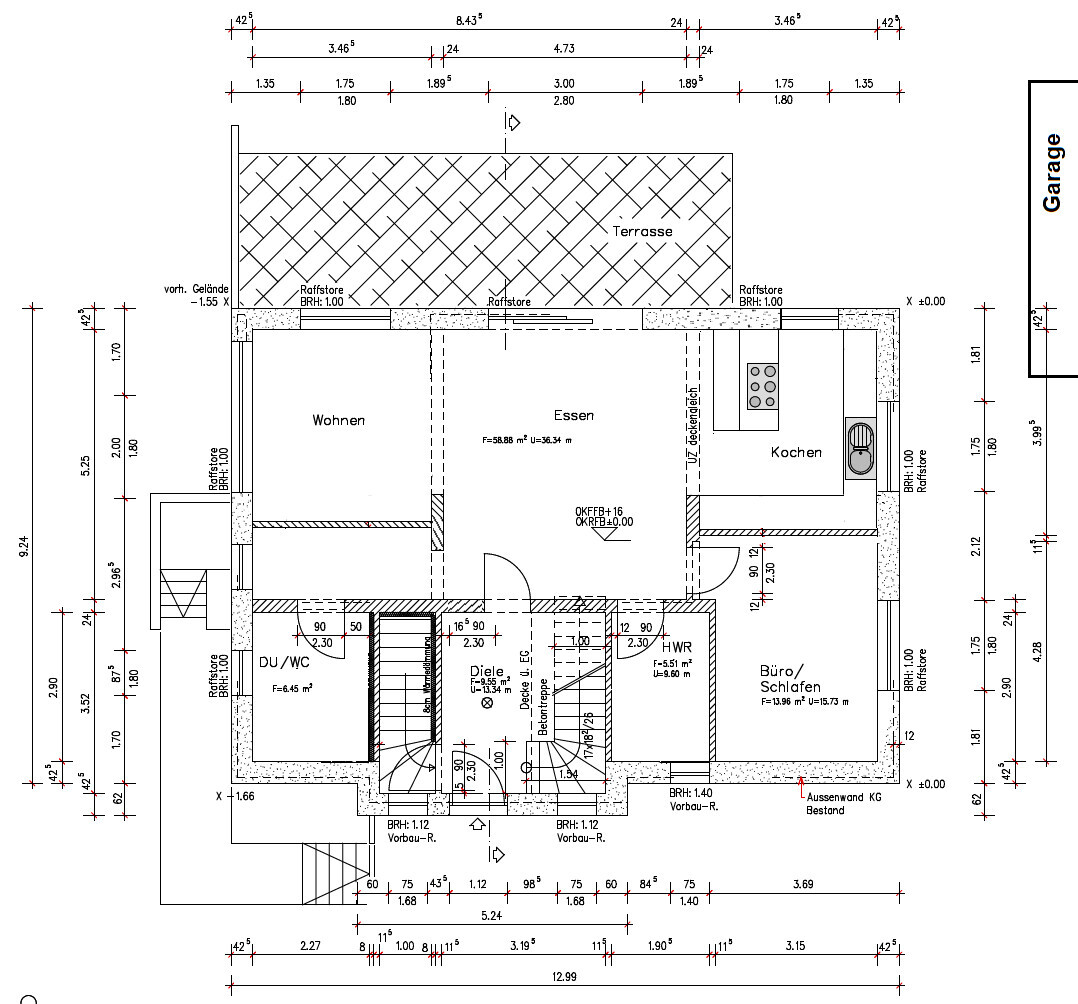
Over the holidays, we took another good look at this floor plan. We like the upper floor as it is, so we won’t be changing the staircase. However, we are still uncertain about the ground floor, especially regarding the placement of the WC (privacy) and the kitchen, also inspired by input from @K a t j a and @ypg (post #67). Our architect planned the kitchen to face the quiet east with a view, and the living room towards the garden, street, and property entrance. If we rotate the layout, it could look like this:
Disadvantages: The large open-plan living space would be divided, resulting in a long, narrow corridor leading to the WC/shower.
Of course, this is a last-minute spontaneous idea from us. Construction is scheduled to start in March and the quotes for the shell are already in. The structural engineer is probably already calculating (I can’t reach him right now). Drainage including ventilation still needs to be checked but seems feasible. It’s not cost-neutral: larger WC/shower, more kitchen cabinets, more walls.
What do you think? Is this a meaningful improvement over the current plan?
The clear headroom would be between 2.58m (8 ft 6 in) at the top and about 1.90m (6 ft 3 in), 1m (3 ft 3 in) further along the staircase slope. That would be quite tight.
Over the holidays, we took another good look at this floor plan. We like the upper floor as it is, so we won’t be changing the staircase. However, we are still uncertain about the ground floor, especially regarding the placement of the WC (privacy) and the kitchen, also inspired by input from @K a t j a and @ypg (post #67). Our architect planned the kitchen to face the quiet east with a view, and the living room towards the garden, street, and property entrance. If we rotate the layout, it could look like this:
- The living room would be on the quiet east side, with a nice view (large floor-to-ceiling window or window seat instead of a narrow kitchen window)
- The kitchen would be closer to the garden/garage/property entrance and could have its own house entrance (directly from the garage for groceries)
- By swapping with the utility room, the WC/shower would be more secluded from the dining area and a bit larger. The utility room can be smaller since the freezer would move into the kitchen (there is slightly more space there with the L-shaped layout plus a half island than before)
Disadvantages: The large open-plan living space would be divided, resulting in a long, narrow corridor leading to the WC/shower.
Of course, this is a last-minute spontaneous idea from us. Construction is scheduled to start in March and the quotes for the shell are already in. The structural engineer is probably already calculating (I can’t reach him right now). Drainage including ventilation still needs to be checked but seems feasible. It’s not cost-neutral: larger WC/shower, more kitchen cabinets, more walls.
What do you think? Is this a meaningful improvement over the current plan?
Similar topics