
ᐅ Floor Plan for a Single-Family Home, 240 m², with Partially Built-Over Garage
Created on: 3 Dec 2023 13:51
H
Haus 42
Hello everyone,
My wife and I are currently favoring the attached design for our house project. It is our own concept, inspired by forum discussions, catalogs, and model homes, but also discussed with architects and now unrecognizable compared to the first drafts.
A first detailed drawing is in progress (which may include structural and building services adjustments), so general criticism is welcome, but especially suggestions on potential problem areas or ways to achieve essential improvements through small changes: After all, we don’t want to build an expensive house only to regret it later, but rather invest in meaningful improvements (e.g., bay windows). At the bottom, I have listed some specific concerns.
Framework conditions:
Design:
Notes on the floor plans:
Development:
We had several designs, including with a basement, without construction over the garage (which was recently confirmed as possible), with open space, guest rooms on different sides, a 180° half-landing staircase, etc. – the current approach now seems quite logical to us and despite the naturally high costs, not extravagant. I grew up in a house with a full basement and converted attic, and the plan tries to provide similar spaces over two floors.
Ground floor details:
Upper floor details:
Concerns / Questions
We look forward to your comments!
My wife and I are currently favoring the attached design for our house project. It is our own concept, inspired by forum discussions, catalogs, and model homes, but also discussed with architects and now unrecognizable compared to the first drafts.
A first detailed drawing is in progress (which may include structural and building services adjustments), so general criticism is welcome, but especially suggestions on potential problem areas or ways to achieve essential improvements through small changes: After all, we don’t want to build an expensive house only to regret it later, but rather invest in meaningful improvements (e.g., bay windows). At the bottom, I have listed some specific concerns.
Framework conditions:
- Planned residents: two adults (working days home/office: 2/3 and 3/2), two (initially small) children, two cats, guests staying several weeks per year.
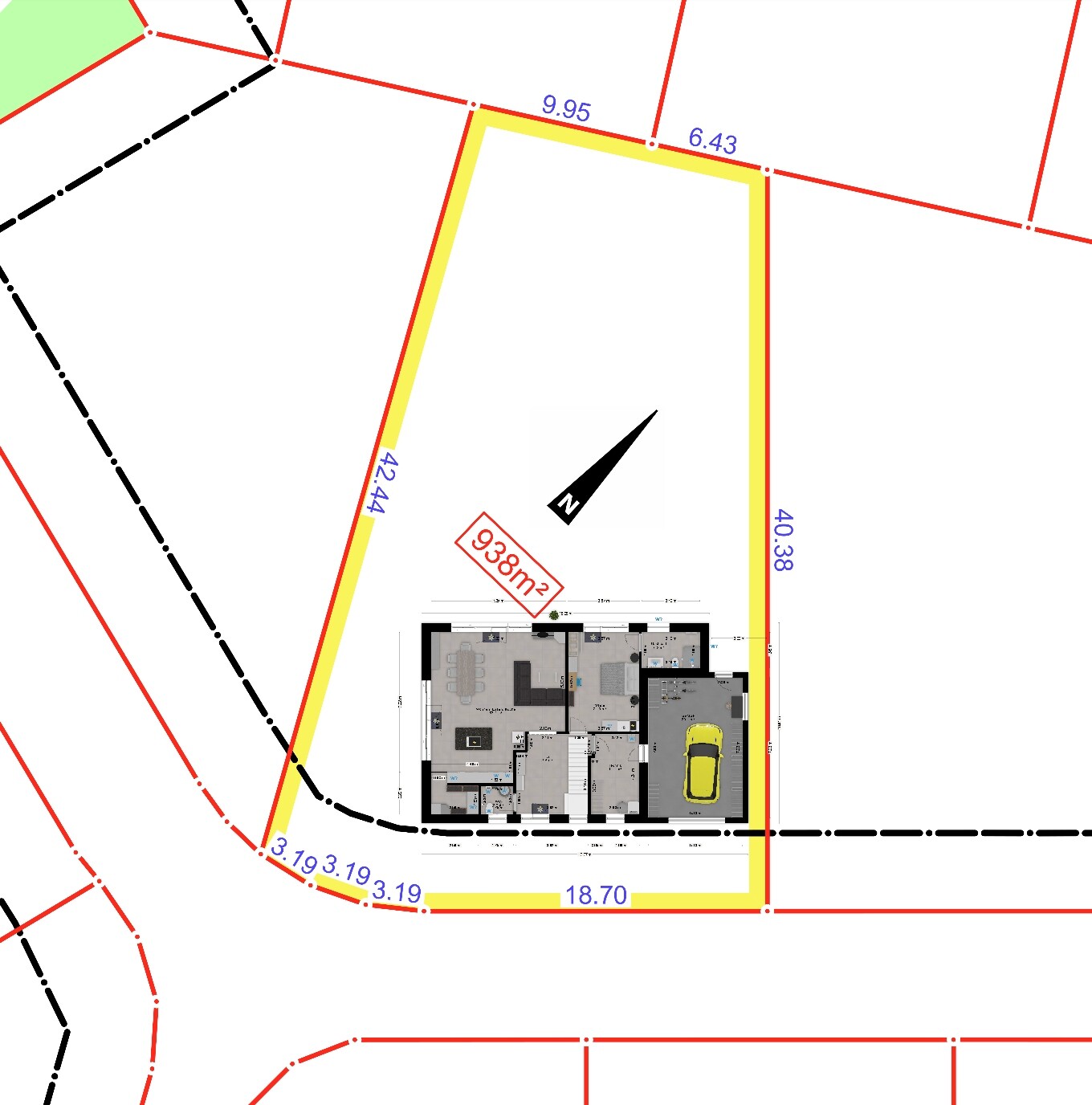
- Conditions: Small-town new development area in Mecklenburg-Vorpommern, site coverage ratio 0.35, maximum one full story, eaves height max. 5m (16 ft 5 in), gable or half-hipped roof with 20°–50° pitch, minimum distance to street 5m (16 ft 5 in), to neighbors 3m (10 ft).
- Plot: 938 m² (10,094 sq ft), essentially flat, with utility garden and play lawn.
- Neighboring plots: Northeast (“right”) already developed (close to road and at distance from us, since their garage is on the side facing away from us), southwest (“left”) not yet sold.
Design:
- Footprint: approx. 15.5m×11m (51 ft × 36 ft) + garage overhang 2m×8m (6 ft 7 in × 26 ft), garage-boundary distance 1m (3 ft 3 in)
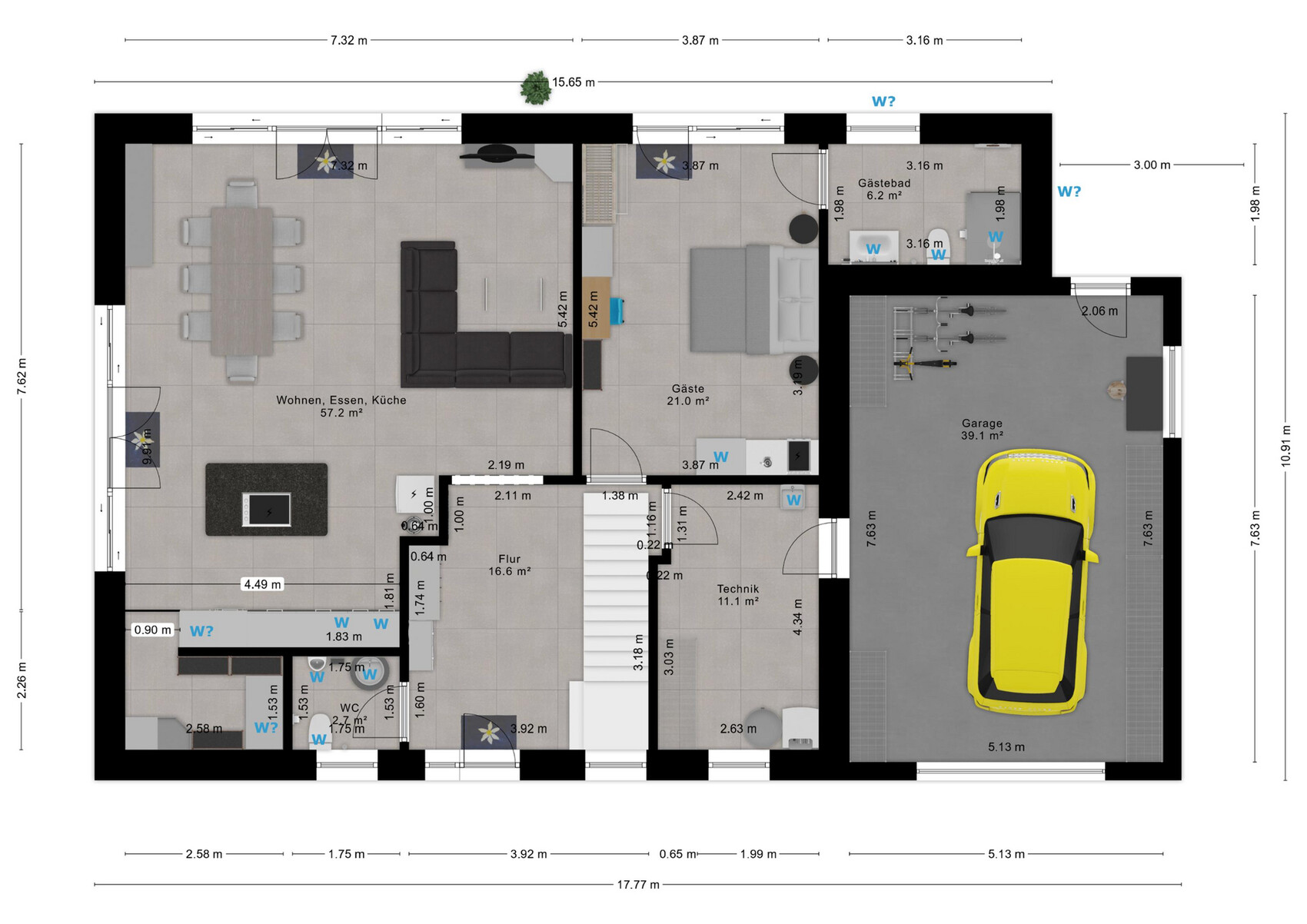
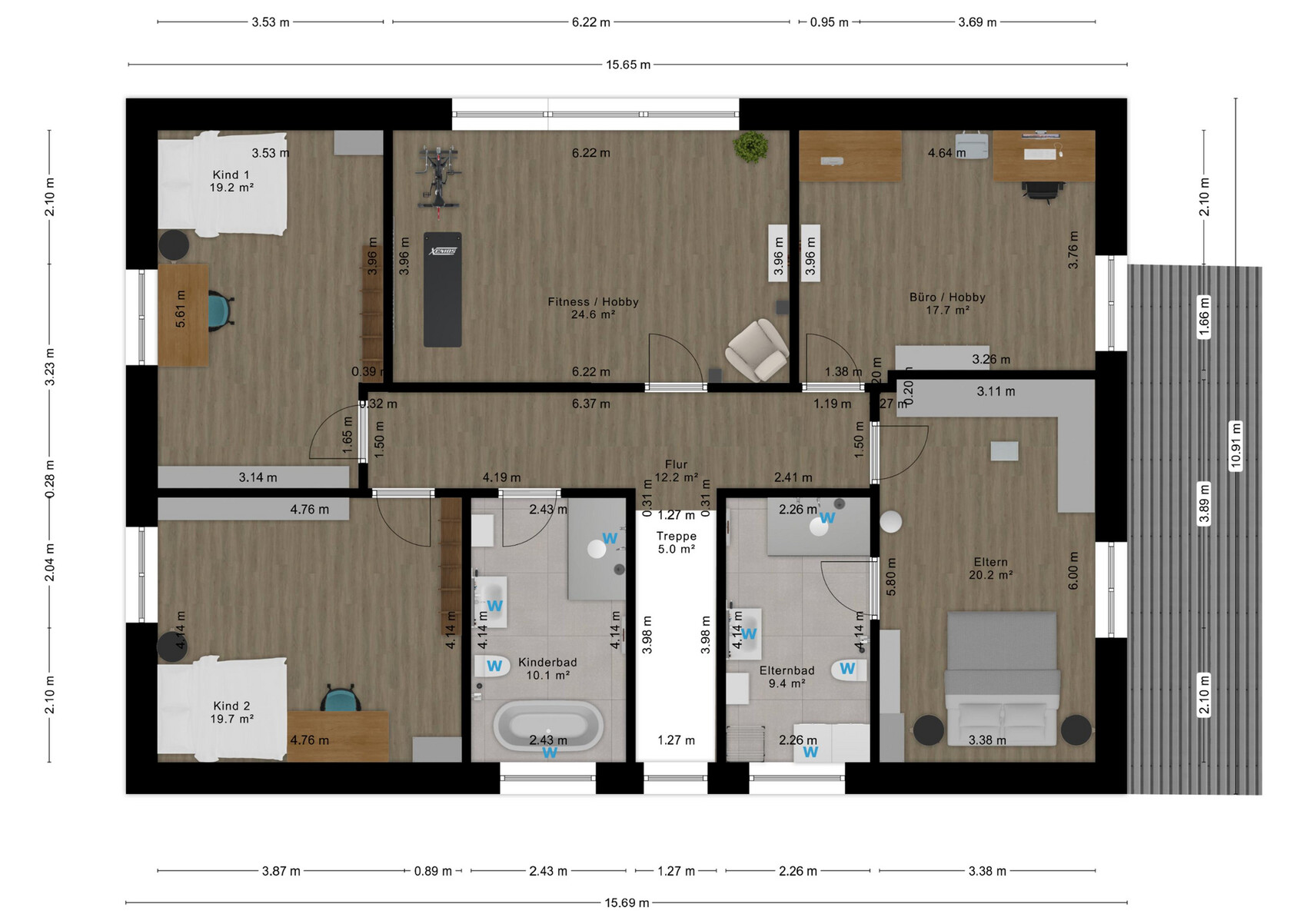
- Living and utility space: ground floor approx. 115 m² (1,238 sq ft), upper floor approx. 125 m² (1,345 sq ft), garage approx. 40 m² (430 sq ft)
- Ceiling height: ground floor approx. 2.60m (8 ft 6 in), upper floor approx. 2.50m (8 ft 2 in)
- Building services: ventilation system, photovoltaic panels on southeast roof, underfloor heating powered by air-source heat pump everywhere except garage/attic.
- Location: the house should be as close to the street as possible (see plan) with the main entrance facing it (southeast), to maximize garden space.
- Gable roof: rather flat (25°) to allow for a high knee wall (>1.20m (3 ft 11 in)), attic therefore only used for storage.
- We are foregoing a basement in favor of a larger footprint, which also enables a barrier-free guest area.
- Ground floor: the living area should get both sunlight and garden views, so it must be on the west side.
- Upper floor: usability of space is the priority, so we accept the narrow corridor (approx. 1.5m×8m (4 ft 11 in × 26 ft)). Still, generous dormers, including in the stairwell, should provide enough daylight.
- Exterior walls are brick-clad, interior rather modern: white walls/kitchen fronts, tiled floors on the ground floor, PVC on the upper floor.
Notes on the floor plans:
- Area measurements do not account for sloping ceilings on the upper floor.
- ⚡ means high-voltage electricity, W (waste) water
Development:
We had several designs, including with a basement, without construction over the garage (which was recently confirmed as possible), with open space, guest rooms on different sides, a 180° half-landing staircase, etc. – the current approach now seems quite logical to us and despite the naturally high costs, not extravagant. I grew up in a house with a full basement and converted attic, and the plan tries to provide similar spaces over two floors.
- What we like: the bright living room, purely functional generous sizing everywhere, especially for guests and thanks to the large room upstairs, the access from the garage.
- What we don’t like: see also the “Concerns” listed at the bottom. Otherwise, the “very generous” house (architect’s comment) might have few ‘eye-catchers’ for its price, e.g., no gallery or two bathrooms upstairs instead of one large. Therefore, general suggestions are welcome on how to enhance the design beyond the floor plan, for instance through lighting, mirrors, windows, external design.
Ground floor details:
- Living room with window fronts each with a door leading to terraces in the southwest (for sunlight) and northwest (toward the garden).
- Kitchen open to the living area; appliances located in a central niche—therefore, to minimize noise, the oven/microwave are there instead of the refrigerator.
- Room behind kitchen (separated by a slightly hidden door) serves as storage and a place for some kitchen appliances and an additional worktop.
- From the hallway, a doorless passage to the living room, doors to guest room, guest toilet, and utility room, also from there access to the garage.
- Large guest room with barrier-free bathroom and external access, potentially a one-room separate apartment.
- Garage for one car, e-scooter/bicycles and as a workshop/storage room, for example for garden tools.
Upper floor details:
- Children’s rooms on the sunnier gable side.
- Children’s bathroom with bathtub, master bathroom with washing machine/dryer (but space in utility room to allow for changes).
- Long dormers above bathrooms/stairwell and fitness/hobby room; no other roof windows.
- Access to attic via fitness/hobby room.
Concerns / Questions
- The (currently half-landing) staircase may need to be spiral to allow doors to fit under its end. Is preserving the half-landing for climbing safety worth a bay window?
- Prefabricated houses often have bay windows, although they might be energetically disadvantageous. Are they mainly for aesthetics, or have we missed practical opportunities by not including any?
- Is the staircase too close to the entrance, e.g., regarding dirt distribution?
- We would like remote/central control for roller shutters on all burglary-relevant windows. Would narrow windows be acceptable in the utility room, guest bathroom, and ground floor toilet, to prevent break-ins? Does anyone have experience with this?
- With a 25° pitch and 1.20m (3 ft 11 in) knee wall, is an overhanging roof suitable as a cover for the entrance and/or terrace without causing too much shading? What other canopy options would make sense, especially since the terrace is on the exposure-prone side?
- To prevent bicycles from scratching the car in the garage, should it be widened? This would reduce the remaining strip on the southwest side, where the tightest boundary distance (at the west corner, “top left”) is currently about 5m (16 ft 5 in).
- Is a TV placed directly next to the window front a problem due to the northwest orientation?
- Should the pantry behind the kitchen have a second sink?
- Would it be better to fill the garden-facing dormer entirely with windows rather than leaving corners open as planned?
- Which windows should be included in the bathroom dormer considering there are houses on the opposite side of the street?
We look forward to your comments!
H
HeimatBauer6 Dec 2023 08:55We’re going around in circles.
The original poster (OP) presented their plan here, which has been developed over many iterations, and yet they are quite surprised by the feedback. It wasn’t the kind of confirmation along the lines of “just move the light fixture by 10cm (4 inches), otherwise perfect,” but rather a “redo it – but do it right this time.”
I’d say this: Everyone is the architect of their own fortune, and there have to be houses that earn the label “highly individual.” The OP has now been thoroughly informed about the practical issues that can arise with a build like this. If they don’t see those problems for themselves – that’s their choice.
My advice to the OP: Build the house exactly as you want it. You want it, you get it. No one inside the house needs to be happy except you.
To the other responders, who in my opinion have been extremely restrained and have kept their tone respectful: Thank you for your input. Even as an uninvolved observer, I’ve learned a lot again—not just about home design but also about how to approach a project like this—and how not to.
The original poster (OP) presented their plan here, which has been developed over many iterations, and yet they are quite surprised by the feedback. It wasn’t the kind of confirmation along the lines of “just move the light fixture by 10cm (4 inches), otherwise perfect,” but rather a “redo it – but do it right this time.”
I’d say this: Everyone is the architect of their own fortune, and there have to be houses that earn the label “highly individual.” The OP has now been thoroughly informed about the practical issues that can arise with a build like this. If they don’t see those problems for themselves – that’s their choice.
My advice to the OP: Build the house exactly as you want it. You want it, you get it. No one inside the house needs to be happy except you.
To the other responders, who in my opinion have been extremely restrained and have kept their tone respectful: Thank you for your input. Even as an uninvolved observer, I’ve learned a lot again—not just about home design but also about how to approach a project like this—and how not to.
Haus 42 schrieb:
Those were far from complete designs. We already know one design, don’t we? It has been discussed here before. Unfortunately, you have disabled the ability to follow your posts, so it’s not possible to review the discussion. That’s why I assumed you had logged out.
The question is, why do you do that? It’s not *us* who benefit from this discussion, only you do.
Also, it should be in your interest to influence the quality of answers by staying attentive. It helps to be present. We are. It doesn’t have to be constantly, but it should be occasionally.
Haus 42 schrieb:
I’ve checked again what I still haven’t answered. That’s how users want it—at least speaking for myself and knowing some floor plan experts here—people don’t want to gather all information from various posts. A clear yes or no in a questionnaire is easier to recognize than embedding the answer in a sentence.
It’s not as if we get paid to collect your data, create a “Haus42” file, and suggest solutions. I’m not sitting bored on the sofa happily piecing together sparse information.
I just like to help. Floor plans and house building are my passion.
Haus 42 schrieb:
but it can also be implemented without a revolution. Well, not really.
Build your house the way you think. You’ve received input about the major flaws.
Haus 42 schrieb:
I would prefer a landing to change direction shortly before. A landing is additional to the stair incline; it can’t be incorporated within the rise itself.
Haus 42 schrieb:
That’s true. I’m counting on the planner’s expertise. Then it will be a completely different design. The question you can ask yourself is: why do you draw something in advance if it clearly needs changes that invalidate the design? Why not use a proven concept and go to the planner with a room program?
H
hanghaus20236 Dec 2023 12:16I would start with the positioning of the buildings. In my opinion, integrating the garage into the house is not necessary. The orientation should also be reconsidered.
Is the orientation specified in the zoning plan / building permit?
Is there no fixed building envelope?
Is the driveway required to be in this location?
The marked line is not at 5 m (16 feet)????
Is that a railway line in the aerial photo below?
The southeast street side is surely going to be built on as well, right??
Is the orientation specified in the zoning plan / building permit?
Is there no fixed building envelope?
Is the driveway required to be in this location?
The marked line is not at 5 m (16 feet)????
Is that a railway line in the aerial photo below?
The southeast street side is surely going to be built on as well, right??

Haus 42 schrieb:
I found an early version with zero-thickness walls and a later one with a huge upper-floor hallway: That already gives you something to work with—“almost” because this incomplete insight into the design process history sheds limited light on how the contributors can follow the reasoning. Useful information would be: how many design drafts were there in total, and how many development stages were there between the “middle-aged” version and the initial draft in the first post?
At least the “middle-aged” version already includes the more practical and cost-effective fixed-door terrace doors instead of lift-and-slide ones. From my building-toolkit*LOL*, I can share a cheap trick: I also create sketches with zero-thickness walls “when time is tight,” but I keep in mind (like in third-grade math class) to reallocate about 1.20 meters (4 feet) each from the building’s width and depth budgets to the special “walls” account. Applied to the “middle-aged” plan with approximately 162 sqm (1745 sq ft) of floor area (about 130 sqm (1400 sq ft) of usable area after walls), this results in a zero-thickness wall plan with about 9.70 m (32 feet) depth and 13.60 m (45 feet) width (resulting in roughly 132 sqm (1420 sq ft)—the decimals here are due to rounding, so the quick calculation checks out). Naturally, as an old hand, I never switch to the graphical phase this early.
Haus 42 schrieb:
Of course, pursuing wishes is risky because they might not correspond to what one later actually appreciates. But even the “room program” would then be such a kind of “mortgage.” The room program is not a “mortgage” but a “specification document”—of course, considering graduated categories such as “need,” “comfort,” and “luxury.” You apparently misunderstood the term “dead square meters”: these are not just unused or open-through spaces but “empty calories” in the sense of construction costs that don’t translate into improved residential quality (which can also legitimately include generous room sizes). I never perform life cycle simulations of room usage. The wife of a retired associate of mine demonstrates on average about three and a half times per year that furnishing is a fluid process.
A “bay window” to relax the dimensions for accommodating a stair landing would bring along a chain reaction of follow-up changes. We can discuss that individually in coaching sessions if it is important for you to be deeply involved in your house’s design. But architects earn their living from this—similar to caterers who rent out rooms for celebrations so that nobody needs to keep a festive table setup in their year-round living room for a golden wedding anniversary. As a client, you don’t need to be able to demonstrate to the architect how the house should be planned yourself.
Haus 42 schrieb:
Quantifying “space requirements” would be difficult for me—especially since, from comments, I imagine a lot of space being allocated for little function. [...] I lived for 17 years in less than 20 sqm (about 215 sq ft)—calculated proportionally when I wasn’t living alone—and managed fine. Of course, when one has more means, the desire grows to at least come close to one’s childhood, so that it’s less about necessity and more an “if you’re going to do it, do it properly” attitude. Allocating space would already go beyond “quantifying” the room program and step into qualifying it. In quantifying, every room initially just gets a name according to its purposes—for example, “living-dining room” and “kitchen,” “living room” and “dining kitchen,” or “open-plan kitchen living area.” Qualifying then groups all three on the garden level, after which you assign sizes adjusted to the incomes of a nurse, ward physician, or chief physician respectively.
Haus 42 schrieb:
Fundamental harsh rejection of the approach as something to be discarded, etc.—I wonder if this is just about tastes or stylistic school beliefs being offended [...] But a lot remains unsaid, since it’s “not worth it” anyway or so I shouldn’t be further encouraged to keep tweaking the existing design. The trash can as the most important tool of star architects from the drafting-board era is already underestimated by average architects of the mouse-click age and fundamentally misunderstood by amateur planners. If I draw something failed or unusable (which for me happens extremely rarely because such things never even reach the graphical phase), I don’t take it as a hit on my professional self-esteem—I dispose of it professionally. From my experience with IT and communications “geek stuff,” I know the connection between clean code and stable system performance and therefore start each new design attempt in a fresh petri dish. A lab coat is not a garment of penance. Slowing down in a dead end is no shame but the gateway to new possibilities. You can wisely keep a five out of a throw but better throw the other dice—including the fours—back into the cup. Even professionals usually had to learn this.
Haus 42 schrieb:
That’s true. I rely on the competence of the planner, who has indeed opposed ideas before (e.g., painting the upper-floor ceiling instead of insulating the roof). What do you mean by that: insulation of the roof instead of the upper-floor ceiling on one hand and open roof undersides on the other—aren’t these two different things?
Haus 42 schrieb:
I only meant that for a stylistically ‘failed’ room, a clever choice of interior design can still make a difference. An interior design—applied to both styling and function—should not rely on a fixed configuration to be convincing. This is precisely the essential difference between furniture and built-in fittings.
Haus 42 schrieb:
Winning awards for the exterior shape isn’t really important to me—maybe there are even two fewer break-in attempts if burglars find everything as shabby as you do. There are actually millionaires who successfully use this form of passive burglary prevention. Some even intentionally park a dented old Golf III near their house for at least this secondary purpose.
Haus 42 schrieb:
No, that’s not the intention. Here’s your critical ("Gretchen" or Shakespeare) question: is your personal authorship of the house design important to you, or are you (which I consider wiser) willing to entrust serious house design to professionals? The latter would free your own design to remain just a playful experiment.
Haus 42 schrieb:
Fortunately, my “blindness to logical connections” has apparently only been fatal in architecture. But I don’t understand how the wish to place rooms usually located in the basement—like guest or hobby rooms—above ground could fundamentally contradict single-story living. I didn’t claim that. The contradiction related to “similar floor areas on two levels” and “single-story living.” If the ground floor and upper floor are to be roughly equal size, it results in a full upper floor, but here only an attic floor will be possible. A basement or underground level was not mentioned in this context.
Haus 42 schrieb:
Of course, the building authority might reject the design arguing that the garage can’t be split: either it’s a garage, so it doesn’t count in the ground floor calculation for the full-height parts of the (then too large) upper floor, or it’s not, thus losing its distance privilege. I’ll gladly pass this question on to an expert at the well-known forbidden place.
K a t j a schrieb:
Apart from the “floating” wall above the garage, an ignorant general contractor will just botch it for you. They’ll build any rubbish without batting an eye or making recommendations. As long as you pay. The question is, do you want that? If I want a new haircut, I go to a hairdresser. I could do it myself, but it would look like it. With a house, you don’t get a second try. Once it’s built, it’s done. In this sense, an ignorant general contractor is like a shoe and locksmith service that also offers haircuts (except the latter also runs a drop-shipping wig shop, just in case you don’t like the result, *ROTFL*). The “floating” wall can work; it just requires a big budget for steel construction.
kbt09 schrieb:
And rotating the house, if the ridge orientation allows it, might even be advantageous for photovoltaic use—this should be checked. It would also allow for a southeast terrace in spring and west or west-north terraces mainly for summer. A professional designer would just have different priorities than placing the house at the street side to isolate children from critical onlookers of their soccer skills ;-)
HeimatBauer schrieb:
To the other respondents who, in my opinion, have been extremely restrained and polite: thank you for your input. Even as an uninvolved person, I’ve learned a lot again—not just about house design but also about how to approach such a house build—and how not to. Why don’t you name your learning outcomes from this specific example? At least, from my perspective, I haven’t said anything for the first time here.
https://www.instagram.com/11antgmxde/
https://www.linkedin.com/company/bauen-jetzt/
H
HeimatBauer7 Dec 2023 08:21Of course, what I am reading here for the first time has probably already been discussed in the forum – I just either haven’t read it before or have already forgotten about it 🙂
What I found very interesting just now was the positioning of the stairs and their dimensions. The staircase is an aspect I considered first in my own initial thoughts; in my own build, I simply took the staircase proposed by the general contractor’s architect (on https://www.hausbau-forum.de/threads/grundriss-einfamilienhaus-240-m-mit-teilueberbauter-garage.46476/page-3 the upper right option, probably slightly larger in dimensions than here but still too small, for example, for the office desk surface that had to be transported over the balconies) and given the size of my house, this is the only area I sometimes (!) wonder if perhaps (!) a different staircase might have created a different spatial character. Whether better or not – no idea. And this mental exercise was sparked exactly by the stair design and its dimensions.
It is surely not the first time stairs have been discussed here – but it is the first time a) I read it like this and b) it triggers this kind of reflection in me.
What I found very interesting just now was the positioning of the stairs and their dimensions. The staircase is an aspect I considered first in my own initial thoughts; in my own build, I simply took the staircase proposed by the general contractor’s architect (on https://www.hausbau-forum.de/threads/grundriss-einfamilienhaus-240-m-mit-teilueberbauter-garage.46476/page-3 the upper right option, probably slightly larger in dimensions than here but still too small, for example, for the office desk surface that had to be transported over the balconies) and given the size of my house, this is the only area I sometimes (!) wonder if perhaps (!) a different staircase might have created a different spatial character. Whether better or not – no idea. And this mental exercise was sparked exactly by the stair design and its dimensions.
It is surely not the first time stairs have been discussed here – but it is the first time a) I read it like this and b) it triggers this kind of reflection in me.
H
HeimatBauer7 Dec 2023 08:32And besides the conceptual learning effect, my repeatedly stated resolution was once again reinforced: to take my ideas and wishes to a professional and have a house designed by them. Exactly as outlined in the phased planning model. This is not new either, but was confirmed again through the example.
Similar topics