
ᐅ Floor Plan for a Single-Family Home, 240 m², with Partially Built-Over Garage
Created on: 3 Dec 2023 13:51
H
Haus 42
Hello everyone,
My wife and I are currently favoring the attached design for our house project. It is our own concept, inspired by forum discussions, catalogs, and model homes, but also discussed with architects and now unrecognizable compared to the first drafts.
A first detailed drawing is in progress (which may include structural and building services adjustments), so general criticism is welcome, but especially suggestions on potential problem areas or ways to achieve essential improvements through small changes: After all, we don’t want to build an expensive house only to regret it later, but rather invest in meaningful improvements (e.g., bay windows). At the bottom, I have listed some specific concerns.
Framework conditions:
Design:
Notes on the floor plans:
Development:
We had several designs, including with a basement, without construction over the garage (which was recently confirmed as possible), with open space, guest rooms on different sides, a 180° half-landing staircase, etc. – the current approach now seems quite logical to us and despite the naturally high costs, not extravagant. I grew up in a house with a full basement and converted attic, and the plan tries to provide similar spaces over two floors.
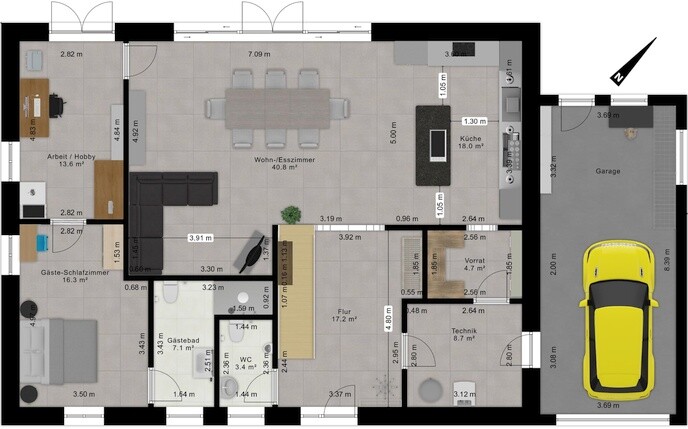
Ground floor details:
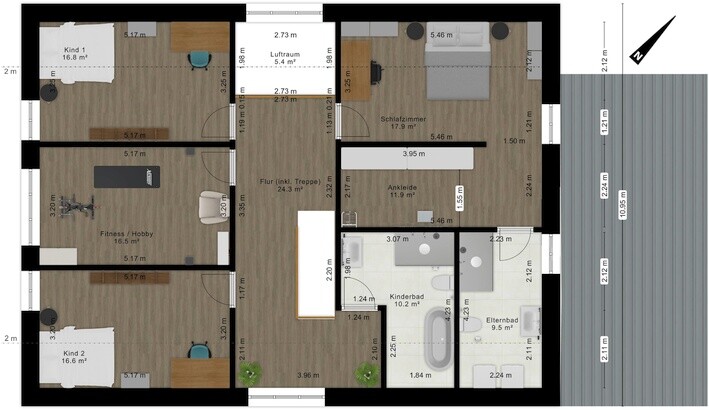
Upper floor details:
Concerns / Questions
We look forward to your comments!
My wife and I are currently favoring the attached design for our house project. It is our own concept, inspired by forum discussions, catalogs, and model homes, but also discussed with architects and now unrecognizable compared to the first drafts.
A first detailed drawing is in progress (which may include structural and building services adjustments), so general criticism is welcome, but especially suggestions on potential problem areas or ways to achieve essential improvements through small changes: After all, we don’t want to build an expensive house only to regret it later, but rather invest in meaningful improvements (e.g., bay windows). At the bottom, I have listed some specific concerns.
Framework conditions:
- Planned residents: two adults (working days home/office: 2/3 and 3/2), two (initially small) children, two cats, guests staying several weeks per year.
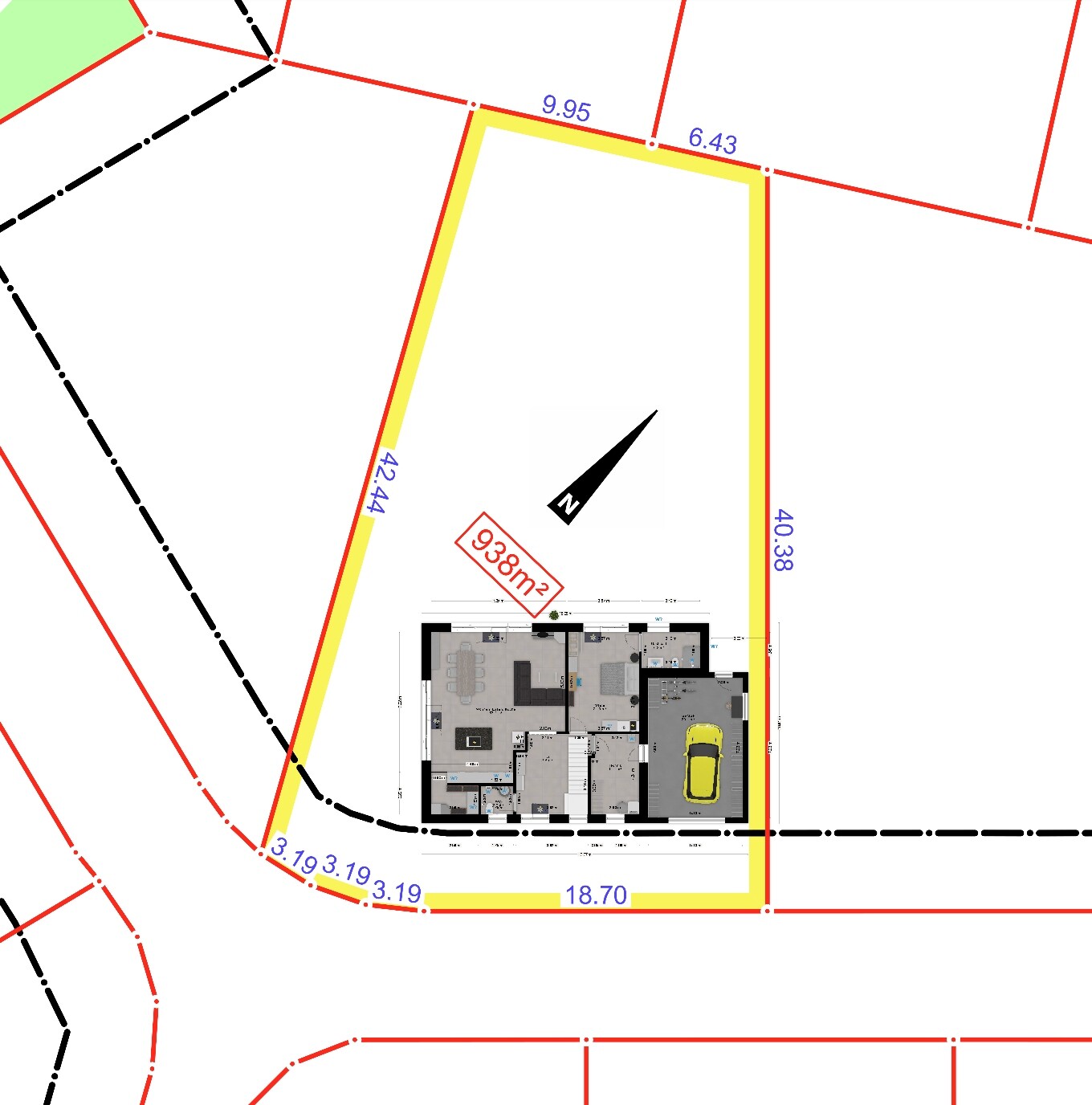
- Conditions: Small-town new development area in Mecklenburg-Vorpommern, site coverage ratio 0.35, maximum one full story, eaves height max. 5m (16 ft 5 in), gable or half-hipped roof with 20°–50° pitch, minimum distance to street 5m (16 ft 5 in), to neighbors 3m (10 ft).
- Plot: 938 m² (10,094 sq ft), essentially flat, with utility garden and play lawn.
- Neighboring plots: Northeast (“right”) already developed (close to road and at distance from us, since their garage is on the side facing away from us), southwest (“left”) not yet sold.
Design:
- Footprint: approx. 15.5m×11m (51 ft × 36 ft) + garage overhang 2m×8m (6 ft 7 in × 26 ft), garage-boundary distance 1m (3 ft 3 in)
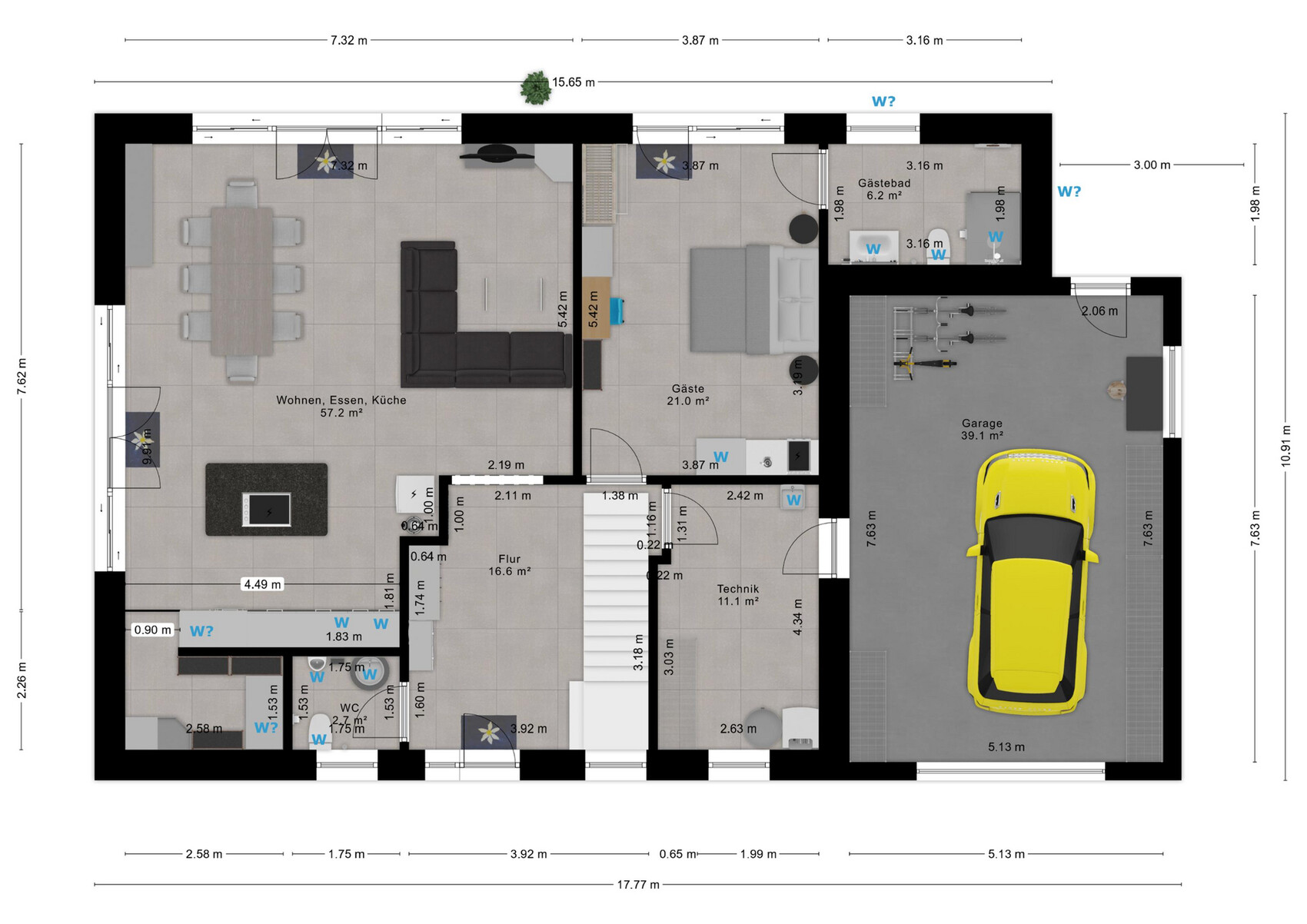
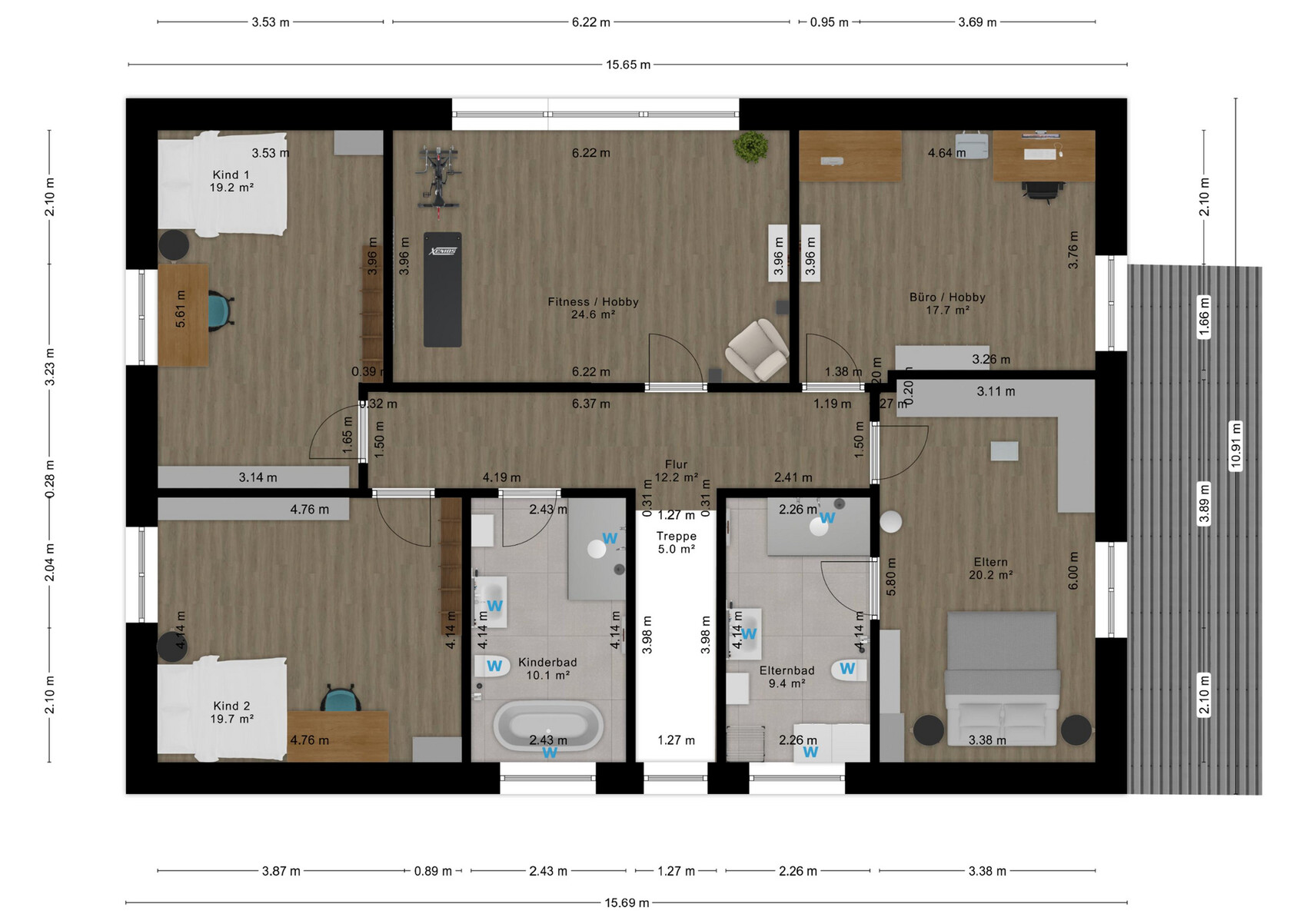
- Living and utility space: ground floor approx. 115 m² (1,238 sq ft), upper floor approx. 125 m² (1,345 sq ft), garage approx. 40 m² (430 sq ft)
- Ceiling height: ground floor approx. 2.60m (8 ft 6 in), upper floor approx. 2.50m (8 ft 2 in)
- Building services: ventilation system, photovoltaic panels on southeast roof, underfloor heating powered by air-source heat pump everywhere except garage/attic.
- Location: the house should be as close to the street as possible (see plan) with the main entrance facing it (southeast), to maximize garden space.
- Gable roof: rather flat (25°) to allow for a high knee wall (>1.20m (3 ft 11 in)), attic therefore only used for storage.
- We are foregoing a basement in favor of a larger footprint, which also enables a barrier-free guest area.
- Ground floor: the living area should get both sunlight and garden views, so it must be on the west side.
- Upper floor: usability of space is the priority, so we accept the narrow corridor (approx. 1.5m×8m (4 ft 11 in × 26 ft)). Still, generous dormers, including in the stairwell, should provide enough daylight.
- Exterior walls are brick-clad, interior rather modern: white walls/kitchen fronts, tiled floors on the ground floor, PVC on the upper floor.
Notes on the floor plans:
- Area measurements do not account for sloping ceilings on the upper floor.
- ⚡ means high-voltage electricity, W (waste) water
Development:
We had several designs, including with a basement, without construction over the garage (which was recently confirmed as possible), with open space, guest rooms on different sides, a 180° half-landing staircase, etc. – the current approach now seems quite logical to us and despite the naturally high costs, not extravagant. I grew up in a house with a full basement and converted attic, and the plan tries to provide similar spaces over two floors.
- What we like: the bright living room, purely functional generous sizing everywhere, especially for guests and thanks to the large room upstairs, the access from the garage.
- What we don’t like: see also the “Concerns” listed at the bottom. Otherwise, the “very generous” house (architect’s comment) might have few ‘eye-catchers’ for its price, e.g., no gallery or two bathrooms upstairs instead of one large. Therefore, general suggestions are welcome on how to enhance the design beyond the floor plan, for instance through lighting, mirrors, windows, external design.
Ground floor details:
- Living room with window fronts each with a door leading to terraces in the southwest (for sunlight) and northwest (toward the garden).
- Kitchen open to the living area; appliances located in a central niche—therefore, to minimize noise, the oven/microwave are there instead of the refrigerator.
- Room behind kitchen (separated by a slightly hidden door) serves as storage and a place for some kitchen appliances and an additional worktop.
- From the hallway, a doorless passage to the living room, doors to guest room, guest toilet, and utility room, also from there access to the garage.
- Large guest room with barrier-free bathroom and external access, potentially a one-room separate apartment.
- Garage for one car, e-scooter/bicycles and as a workshop/storage room, for example for garden tools.
Upper floor details:
- Children’s rooms on the sunnier gable side.
- Children’s bathroom with bathtub, master bathroom with washing machine/dryer (but space in utility room to allow for changes).
- Long dormers above bathrooms/stairwell and fitness/hobby room; no other roof windows.
- Access to attic via fitness/hobby room.
Concerns / Questions
- The (currently half-landing) staircase may need to be spiral to allow doors to fit under its end. Is preserving the half-landing for climbing safety worth a bay window?
- Prefabricated houses often have bay windows, although they might be energetically disadvantageous. Are they mainly for aesthetics, or have we missed practical opportunities by not including any?
- Is the staircase too close to the entrance, e.g., regarding dirt distribution?
- We would like remote/central control for roller shutters on all burglary-relevant windows. Would narrow windows be acceptable in the utility room, guest bathroom, and ground floor toilet, to prevent break-ins? Does anyone have experience with this?
- With a 25° pitch and 1.20m (3 ft 11 in) knee wall, is an overhanging roof suitable as a cover for the entrance and/or terrace without causing too much shading? What other canopy options would make sense, especially since the terrace is on the exposure-prone side?
- To prevent bicycles from scratching the car in the garage, should it be widened? This would reduce the remaining strip on the southwest side, where the tightest boundary distance (at the west corner, “top left”) is currently about 5m (16 ft 5 in).
- Is a TV placed directly next to the window front a problem due to the northwest orientation?
- Should the pantry behind the kitchen have a second sink?
- Would it be better to fill the garden-facing dormer entirely with windows rather than leaving corners open as planned?
- Which windows should be included in the bathroom dormer considering there are houses on the opposite side of the street?
We look forward to your comments!
I would do the same based on your and 11ant’s last comments. I wouldn’t tolerate that tone, especially since his plan, as others have pointed out, is good. You don’t have to criticize everything just because the house doesn’t meet YOUR standards. Sometimes you act as if you were the building gods of Germany. For example, Karsten’s comments are very helpful but not offensive at the same time.
evelinoz schrieb:
especially since his plan, as noted by others, is good. It is not good, and no one said that it is good.
evelinoz schrieb:
I wouldn’t accept that tone, Which one? The patience to repeatedly explain the same things constructively even though none of the questions get answered?
evelinoz schrieb:
You don’t have to speak badly about everything just because the house doesn’t meet YOUR standard. My standard, to stay on the example, is no longer child-friendly due to age. Still, I focus on feasibility without planned construction defects and functionality for everyday family life. I don’t have to impose _my_ standard here (whatever that means) on anyone.
evelinoz schrieb:
Karsten’s comments are, for example, very helpful but not insulting at the same time. Karsten covers a completely different area. His advice is certainly on point and helpful, but there are no discussions there either. Question / answer.
Here, however, constructive opinions are expected. If the original poster does not participate in the discussion, that is their choice and not rude on our part.
Again: Criticism is always perceived as unfriendly but is expected by the original poster.
When someone asks an expert how something can be implemented, they are requesting help, and that is always received positively.
I also don’t understand why you generalize and put everyone under the same label with YOUR here.

evelinoz schrieb:
There’s no need to criticize everything just because the house doesn’t meet YOUR standards. Sometimes you act as if you were the building gods of Germany.I’m a bit confused about what you might have misunderstood. I don’t share any kind of matching “standard” (?) with Yvonne or other regular posters; and furthermore, I never expect that a design submitted by questioners for discussion should focus on me as a tenant or future owner. I have approved many houses here that have nothing in common with my own building preferences. I wouldn’t consider myself part of a gods’ council; I see myself more as a kind of “swimming instructor for prospective builders and hobby designers” (and as a fixer-upper exorcist *LOL* and guardian of overlap dimensions).https://www.instagram.com/11antgmxde/
https://www.linkedin.com/company/bauen-jetzt/
First of all: I usually don’t respond quickly because I prefer to answer thoughtfully. Sorry if this is below the forum’s usual response standard, especially on weekdays.
Thanks for the clarification!
I had mentally already checked it off and therefore initially forgot to mention it—sorry.
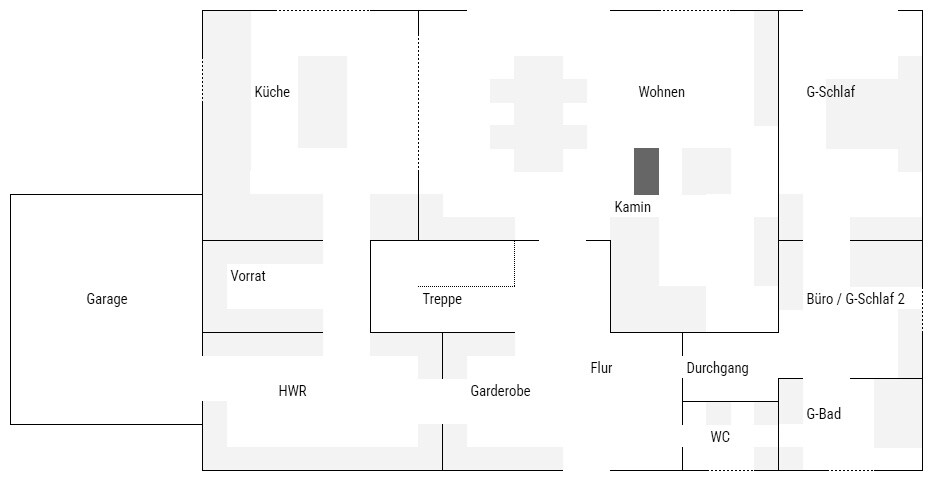
Not all of these were complete drafts or are still available. For example, there were versions with a basement, with a corridor along one wall between entrance and garage, with a right-angled house extension to the north, and with a study in the ground floor’s south corner. I found an early version with zero-thickness walls and a later one with a huge upper-floor hallway: (And no, these are not the only drawbacks I see now.)
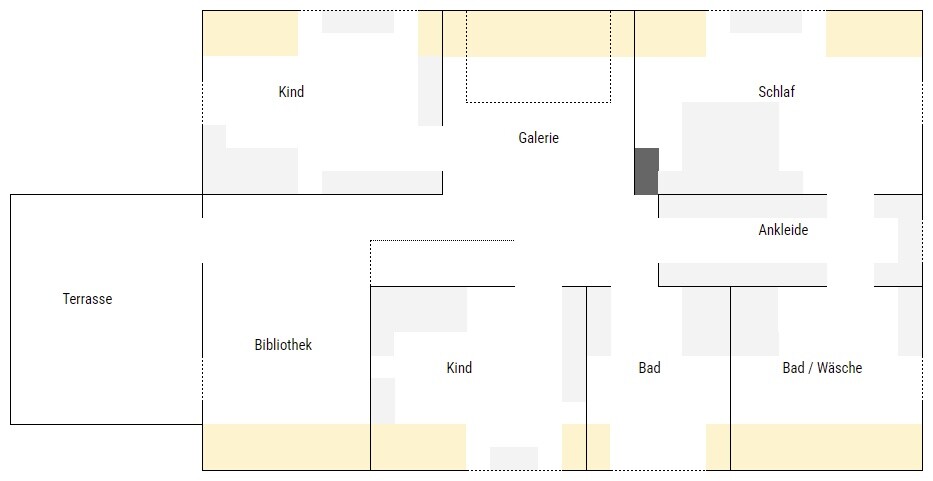
Of course, pursuing personal wishes is risky because they may not align with what you later truly appreciate. But even the “room program” would be such a “burden.” Clearly, you’d forgo a bedroom less readily than the garden, but I can accept that drawback in my design. It’s not “cleverly optimized,” and it may well be that even without compromises on my articulated wishes, some areas could be reduced without me missing the otherwise unused square meters in the center of the house, and perhaps even welcoming shorter distances. On the other hand, certain inefficiencies don’t overly bother me because I can’t predict the future: Who knows how a room will be used in 20 years?
The straight staircase would then end right at the exterior wall—I’d prefer a landing to change direction shortly beforehand. But probably a spiral or helical staircase would be better suited in this design anyway, especially to allow headroom under the HVAC room door.
I looked again at what I still haven’t answered. Age (around 30/40/0/0) and number of dining seats (usually 4, up to 8 in special cases) are obviously easy; others less so:
Well, I see at least four kinds of criticism here:
I expected a mixture like this, though perhaps not in this exact proportion.
That’s true. I’m hoping for the competence of the designer, who has already opposed some ideas—for example, rejecting finishing the upper-floor ceiling in favor of insulation in the roof.
I never said it was arbitrary; I only meant that in a stylistically unfortunate room, a clever choice of interior design can make a big difference. Maybe my design standards are lower, and who knows—my wasted space might later become an opportunity for great cat furniture or a virtual reality arena? Winning architectural awards for the exterior is actually not very important to me—maybe it even reduces the chance of break-ins if burglars think everything looks shabby.
Also true. Since I use a height-adjustable desk, the exact position will have to be different anyway. Given that the study is oversized (the room I am most willing to downsize), there should be space for that. But a more concrete consideration would be necessary for window planning at the latest.
Thanks to your input, that’s now more feasible, although the revised draft will probably be rejected again as “too fiddled together” because of a slanted toilet wall.
Actually, I always favored a small recessed area, as was popular in the 1970s. But that was never going to fly with my wife, so the other downsides weren’t even discussed. 😉
No, it’s not meant that way.
Fortunately, my “blindness to logical correlations” has only proven fatal in architecture so far. But I don’t see how the wish to locate rooms usually placed in the basement, like guest or hobby rooms, above ground fundamentally contradicts having a one-story design.
Of course, the building authority could reject the design arguing that you cannot count the garage in two parts: Either it is a garage and thus not counted toward the ground floor area of the full-height sections of the (too large) upper floor, or it is not a garage and then doesn’t qualify for setback exceptions. Or they might accept it as a permissible deviation because the house would look the same from the outside with a tiny garage for a motorcycle.
11ant schrieb:
Hopefully and most likely, it’s just a building boundary.
ypg schrieb:
This is not a building line, it’s a building boundary. You don’t have to build up to it, it only marks a limit. With building lines, you have to build up to them.
Thanks for the clarification!
11ant schrieb:
The railway line is a major reason for requests for a wide-ranging and also thoroughly qualitative representation of the surroundings, and the way it was mentioned here really deserves a reprimand.
I had mentally already checked it off and therefore initially forgot to mention it—sorry.
11ant schrieb:
Show a small selection of drafts 1 to 41.
Not all of these were complete drafts or are still available. For example, there were versions with a basement, with a corridor along one wall between entrance and garage, with a right-angled house extension to the north, and with a study in the ground floor’s south corner. I found an early version with zero-thickness walls and a later one with a huge upper-floor hallway: (And no, these are not the only drawbacks I see now.)
11ant schrieb:
[The wish for a large garden separated from the street] is also a kind of Achilles’ heel, and a popular basis for spectacular Pyrrhic victories.
Of course, pursuing personal wishes is risky because they may not align with what you later truly appreciate. But even the “room program” would be such a “burden.” Clearly, you’d forgo a bedroom less readily than the garden, but I can accept that drawback in my design. It’s not “cleverly optimized,” and it may well be that even without compromises on my articulated wishes, some areas could be reduced without me missing the otherwise unused square meters in the center of the house, and perhaps even welcoming shorter distances. On the other hand, certain inefficiencies don’t overly bother me because I can’t predict the future: Who knows how a room will be used in 20 years?
kbt09 schrieb:
If the staircase should have a landing, what does your dimension of 420 cm (165 inches) then mean? 419 cm (165 inches) is already the length of a straight, comfortably climbable staircase.
The straight staircase would then end right at the exterior wall—I’d prefer a landing to change direction shortly beforehand. But probably a spiral or helical staircase would be better suited in this design anyway, especially to allow headroom under the HVAC room door.
ypg schrieb:
I’m waiting for the completed questionnaire 😉
I looked again at what I still haven’t answered. Age (around 30/40/0/0) and number of dining seats (usually 4, up to 8 in special cases) are obviously easy; others less so:
- Quantifying “space requirements” would be difficult—especially since I apparently plan a lot of space mentally for little function, based on comments.
- The number of guests should be quite high, but a concrete number is hard to say, especially since the visits from in-laws will likely be longer stays.
- I don’t have a dedicated music wall and don’t need a soundproof music room like a colleague set up in a townhouse end unit.
- We would like a fireplace but can’t have one because of grant conditions. Well, maybe the funding will fall through anyway due to the budget situation.
- A greenhouse might be added later but has no priority.
- There is no cost estimate yet for this design. For reference on the scale of our budget: We nearly bought an existing house for €810k (around $[amount omitted for rules]), albeit in a location with much higher land value.
- If we had to save money, the first things we could do without would probably be parts of the garden/guest area/study/hobby room/bedroom, a toilet, a shower, and the (now canceled) storage room. But this is all a matter of trade-offs: I lived for 17 years in less than 20m² (around 215 ft²) per person in shared housing and managed just fine. Having the option to afford more naturally raises the desire to at least approach the comfort of my own childhood, so this is less about absolute necessity and more a “if we do this, let’s do it properly” approach.
ypg schrieb:
I notice you hardly accept any criticism. Only the suggestion to swap kitchen and living room… but even that advice wasn’t meant to be applied to your drawn floor plan, rather to be considered from the start in a new design.
Well, I see at least four kinds of criticism here:
- Points about functionally disadvantageous situations in the house’s use, like discomfort on the sofa or darkness in the morning. These two specific points made sense to me and can also be solved without a complete redesign.
- Comments about general inefficiency, which is probably true, but I can reassure myself by thinking “who knows what that square meter will be good for later.” (With the limitation mentioned above, since more space can also mean downsides.)
- Comments about supposedly wrong priorities, which cannot really be objective even if 90% of architects agree. For example, the hobby room can also serve as a playroom, so I don’t see a harmful undersizing of the children’s rooms. Also, the children get their sunlight mostly in the garden, which has room for a small soccer field, as the house is positioned like a barrier.
- Fundamental rejection of the whole approach as something to discard, etc.—here I wonder whether it’s just a matter of taste or stylistic dogma (“If you spend €800k, don’t build a gym upstairs but something more eye-catching”), or whether drawbacks from the first two categories are really present. (See your vague comment that the house “does not work.”) Much remains unsaid here, as it is apparently “not worth it” or I’m not to be encouraged to keep tweaking the existing design.
I expected a mixture like this, though perhaps not in this exact proportion.
ypg schrieb:
If you stubbornly insist on amateur ideas and won’t be dissuaded, you pay for external walls standing on garages, complex engineering that good planning can avoid, extra masonry allowances for corners that could be cleaner, multiple toilet vents distributed over the roof, more wastewater connections than usual, a garage inside the thermal envelope, dormers that are expensive and must be used sparingly, and so on.
But the biggest and costly problem is the potential defects that good planning is meant to minimize.
That’s true. I’m hoping for the competence of the designer, who has already opposed some ideas—for example, rejecting finishing the upper-floor ceiling in favor of insulation in the roof.
ypg schrieb:
… because furnishing is more than arbitrarily placing furniture?!
I never said it was arbitrary; I only meant that in a stylistically unfortunate room, a clever choice of interior design can make a big difference. Maybe my design standards are lower, and who knows—my wasted space might later become an opportunity for great cat furniture or a virtual reality arena? Winning architectural awards for the exterior is actually not very important to me—maybe it even reduces the chance of break-ins if burglars think everything looks shabby.
ypg schrieb:
Under a sloping roof with 120 mm (5 inch) sand-lime brick walls, for example, you won’t be able to place a screen properly. And walking through a door toward a wardrobe in the direction of travel effectively makes the room feel 1-2 m² (10-20 ft²) smaller.
Also true. Since I use a height-adjustable desk, the exact position will have to be different anyway. Given that the study is oversized (the room I am most willing to downsize), there should be space for that. But a more concrete consideration would be necessary for window planning at the latest.
ypg schrieb:
Just sketch your “spatial design options” for your open-plan living area… a nice, comfortable TV corner to relax in is simply not possible.
Thanks to your input, that’s now more feasible, although the revised draft will probably be rejected again as “too fiddled together” because of a slanted toilet wall.
Actually, I always favored a small recessed area, as was popular in the 1970s. But that was never going to fly with my wife, so the other downsides weren’t even discussed. 😉
11ant schrieb:
If the design was really just an exercise
No, it’s not meant that way.
11ant schrieb:
… that would be a sign of blindness to logical connections / conceptual principles, since this obviously contradicts a full upper floor (no attic) that is not possible here.
Fortunately, my “blindness to logical correlations” has only proven fatal in architecture so far. But I don’t see how the wish to locate rooms usually placed in the basement, like guest or hobby rooms, above ground fundamentally contradicts having a one-story design.
Of course, the building authority could reject the design arguing that you cannot count the garage in two parts: Either it is a garage and thus not counted toward the ground floor area of the full-height sections of the (too large) upper floor, or it is not a garage and then doesn’t qualify for setback exceptions. Or they might accept it as a permissible deviation because the house would look the same from the outside with a tiny garage for a motorcycle.

First of all, I want to congratulate you for not sulking in the corner feeling offended. Unfortunately, that is often the reaction when laypeople are told their masterpiece is inadequate. But there is a reason why architecture requires several years of study and also has licensing restrictions with aptitude tests.
This has nothing to do with us considering houses over 200 square meters (2,150 square feet) too large. (We have already had bigger houses here.) However, the higher the budget, the more absurd it becomes to attempt to cobble something together yourself that is likely to fail technically, aesthetically, and in daily use.
Apart from the "floating" wall above the garage, an uninformed general contractor will probably piece this together for you regardless. They will build any junk for you without batting an eye or offering any recommendations. As long as you pay, that’s what matters. The question is, is this what you want? If I want a new hairstyle, I go to a hairdresser. I could do it myself, but it would look accordingly. With a house, there is no second chance. Once it is built, that’s it.
This has nothing to do with us considering houses over 200 square meters (2,150 square feet) too large. (We have already had bigger houses here.) However, the higher the budget, the more absurd it becomes to attempt to cobble something together yourself that is likely to fail technically, aesthetically, and in daily use.
Apart from the "floating" wall above the garage, an uninformed general contractor will probably piece this together for you regardless. They will build any junk for you without batting an eye or offering any recommendations. As long as you pay, that’s what matters. The question is, is this what you want? If I want a new hairstyle, I go to a hairdresser. I could do it myself, but it would look accordingly. With a house, there is no second chance. Once it is built, that’s it.
Haus 42 schrieb:
The straight staircase would end directly in front of the exterior wall – so I would prefer a landing to allow for a change of direction shortly before. However, a spiral staircase might be better in this design anyway, considering the head clearance under the utility room door. My comment about the staircase was not meant to persuade you to choose a straight staircase, but rather to encourage you to consider the dimensions of the planned stairs.
Acknowledging the redesign of the living/kitchen area and the staircase issue will probably lead you to reconsider the current design more like this:
Haus 42 schrieb:
Fundamental rejection of the approach as something to discard, etc. Otherwise, it will just become a patchwork solution.
On the ground floor, it might also make sense to combine the guest bathroom and guest toilet since neither is used continuously. You could possibly create a good division so that the toilet is somewhat separated, maybe with a sliding door to the rest of the bathroom… possibly even with two entrances.
Additionally, rotating the house—if allowed by the roof ridge orientation—could be beneficial for photovoltaic system efficiency; this should be checked. It would also allow for a southeast-facing terrace in spring and a west to northwest-facing terrace more suitable for summer.
Similar topics