
Hello everyone,
We have a geotechnical report for a potential building plot. Since I am not a geologist, I find it somewhat difficult to interpret the information. Are there experienced people here who can draw conclusions for construction from such a report? As a layperson, who would you usually discuss such a report with before purchasing a plot?
In particular, the report contains information about foundations and infiltration that reads quite negative to me as a non-expert.
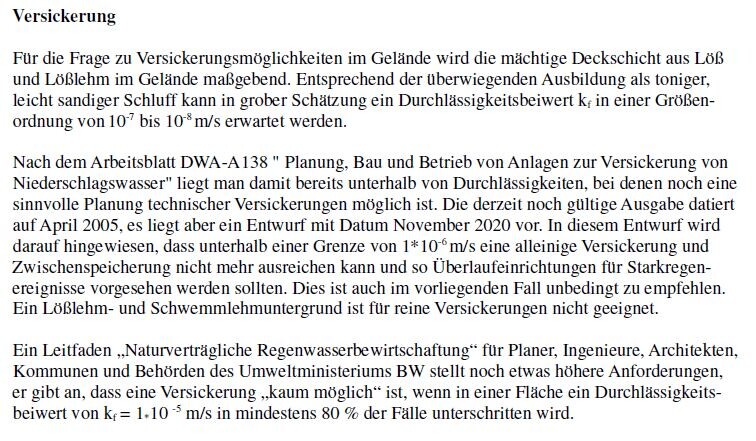
a) Infiltration: Due to poor soil permeability, it is recommended to provide overflow installations for heavy rain events.
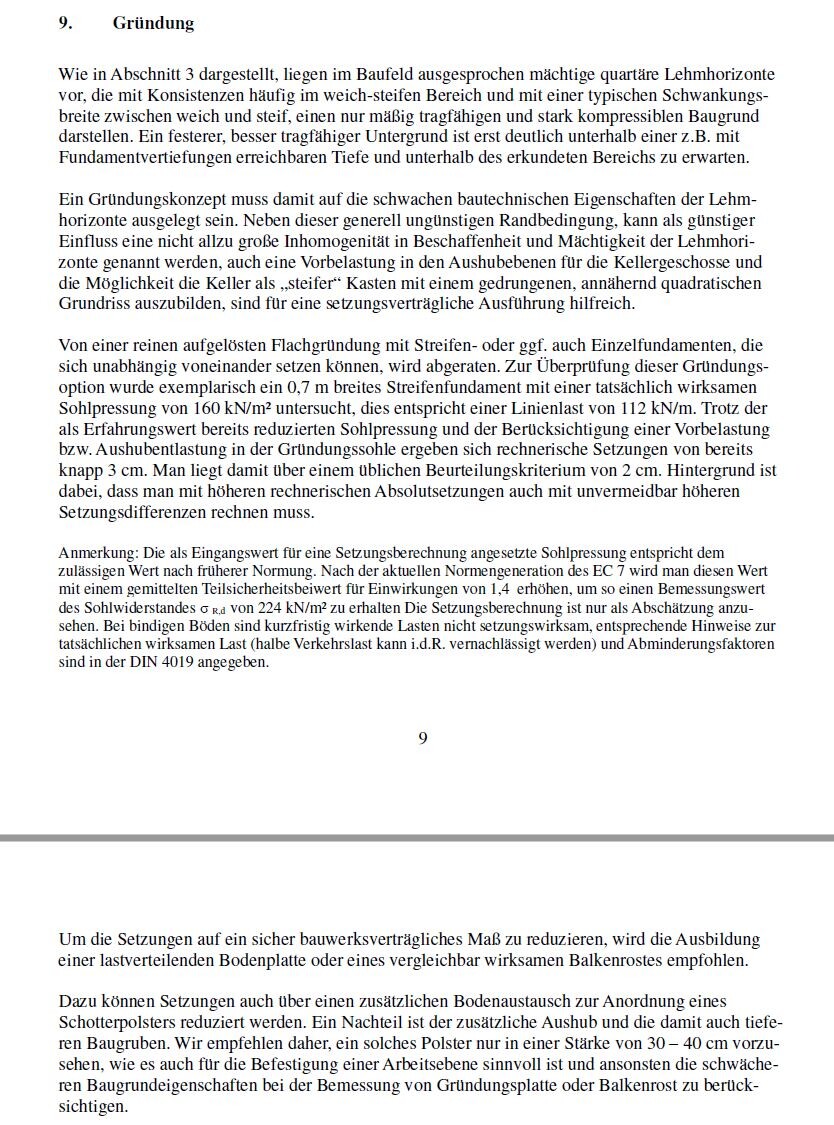
b) Foundations: Clay layers with weak geotechnical properties:

Thanks and regards
We have a geotechnical report for a potential building plot. Since I am not a geologist, I find it somewhat difficult to interpret the information. Are there experienced people here who can draw conclusions for construction from such a report? As a layperson, who would you usually discuss such a report with before purchasing a plot?
In particular, the report contains information about foundations and infiltration that reads quite negative to me as a non-expert.
a) Infiltration: Due to poor soil permeability, it is recommended to provide overflow installations for heavy rain events.
b) Foundations: Clay layers with weak geotechnical properties:
Thanks and regards
So, the ground slab... let's keep it simple. The backfill up to 1 meter (3.3 feet) should be removed. Install geogrid and refill with frost protection material 00/32 or 00/45. At least 50 cm (20 inches) overlap, then taper off at a 45-degree angle. This should be sufficient for frost protection according to the NHN elevation. However, this should also be specified in the report.
Seal the ground slab against moisture according to DIN 18533 W1.1-E (ground moisture).
Drain the roof surfaces into the sewer system; you won’t be able to avoid that.
You can assume a bedding modulus of about 15 MN/m³.
Now I have to put the kids to bed, so I will think about what else is important. But this would be my recommendation.
Seal the ground slab against moisture according to DIN 18533 W1.1-E (ground moisture).
Drain the roof surfaces into the sewer system; you won’t be able to avoid that.
You can assume a bedding modulus of about 15 MN/m³.
Now I have to put the kids to bed, so I will think about what else is important. But this would be my recommendation.
moccanna schrieb:
Hello WilderSueden,
the soil survey was carried out by a geotechnical engineering firm. But maybe I misunderstood your question? Are you interested in which firm actually did it?I had the same question. It was clear that it wasn’t about a specific plot. Therefore, it was assumed that it is a general soil survey for a new development area, where usually quite a few houses are planned. In that case, the survey wouldn’t be very useful because it’s too general. One is then advised to get an individual survey. However, this survey has the quality of an individual one.moccanna schrieb:
The plot itself is being sold by a developer who planned to build two detached houses on the site.Then he would be your contact person. Is the house being offered by the developer at a fixed price including earthworks?
W
WilderSueden1 Dec 2023 22:51moccanna schrieb:
The soil survey was carried out by a geotechnical engineering firm. But perhaps I’m misunderstanding your question? Are you interested in which firm actually conducted it? It’s more about the fact that, if you know, you can usually obtain a soil report from the local authority, which they prepared for the site development or infrastructure work. After all, a road isn’t built without proper groundwork. The samples are typically taken somewhere in the general area but most likely not exactly where your house will be. Or you might have received the report from a neighboring property owner.
Here, we’re talking about a developer; you’re not building yourself but buying a house. Therefore, any additional costs related to the ground conditions are not your concern. The developer includes these in their offer. By the way, you don’t have any influence on the foundation type here – that’s decided by the developer. You just need to make sure, or have an expert check, that the construction is done properly and not shoddy.

Based on the original poster’s description, this is most likely not a genuine property developer as defined by building laws, but rather a disguised developer—that is, a general contractor (GC) who somehow acquired a plot of land that must be sold under developer obligations. However, there will be a separate contract for constructing the house.
So it’s the worst of both worlds: paying property transfer tax on the house, but still being the client with all the responsibilities during the construction phase (construction-side).
Unfortunately, this model is very common, and these GCs often incorrectly call themselves developers.
I have no idea how this practice hasn’t yet been recognized as a circumvention of existing law. If I run a red light through a parking lot, I can still get a ticket.
So it’s the worst of both worlds: paying property transfer tax on the house, but still being the client with all the responsibilities during the construction phase (construction-side).
Unfortunately, this model is very common, and these GCs often incorrectly call themselves developers.
I have no idea how this practice hasn’t yet been recognized as a circumvention of existing law. If I run a red light through a parking lot, I can still get a ticket.

WilderSueden schrieb:
Here we are talking about a property developer—you don’t build yourself, you buy a completed house. Any additional costs caused by the building site are not your concern; the developer includes these in their offer. By the way, you also have no influence on the type of foundation—they decide that. Your only task is to ensure, possibly through an expert, that no poor workmanship occurs. Tolentino schrieb:
As the original poster writes, this very likely isn’t a real property developer in the legal sense, but more of a disguised developer or general contractor who somehow acquired a plot of land that must be sold under developer restrictions. However, there will be a separate contract for building the house. I don’t share your interpretation, but rather read
moccanna schrieb:
The plot itself is being sold by a property developer who planned to build two single-family houses on it. as a plot available for free construction by the original poster, managing the build independently; the seller or previous owner acts as the developer here but is not party to the deal with the original poster. The current owner has abandoned plans to sell the plot with a building on it and is now selling it undeveloped instead. At the moment, many plots are returning to the market because a commercial buyer has given up their development project. In such small units as here, the buyer is often not a large investment holding company for depreciation purposes, but a private “end consumer.”
https://www.instagram.com/11antgmxde/
https://www.linkedin.com/company/bauen-jetzt/
Similar topics