
On the right side of this terrace, about 80cm (31 inches) down to the lawn, a small staircase with 4 steps is needed.
It will be built from granite slabs and will be quite a solid block, likely only movable as a whole.
A gravel layer will be used as the base.
Based on my long experience observing construction sites, this layer should be compacted.
For that, a vibratory plate compactor is usually the best choice.
However, since this house is on a slope, and this is an ongoing issue, there is no simple way to get a 50-kilogram (110-pound) machine behind the house. Carrying it down the concrete steps and back up again would be quite a challenge.
The alternative would be a hand tamper — a rod with a flat plate at the bottom — which I would have to borrow somehow, but such a tool does not provide nearly the level of compaction that would be ideal.
I assume there is no solution to this problem and I simply can’t think of one, but maybe I am overlooking something?
W
WilderSueden28 Nov 2023 08:30These are palisades, which I think is what you mean by posts. However, as far as I know, posts are actually freestanding.
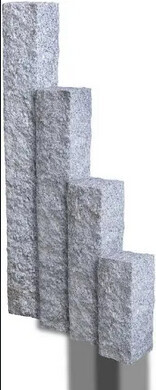
From your description, I still can’t quite understand exactly what you are planning.
You need to anchor these at least one-third of their height in the ground anyway. If set in concrete, it might be a bit less, but I wouldn’t really try to save on that.
From your description, I still can’t quite understand exactly what you are planning.
You need to anchor these at least one-third of their height in the ground anyway. If set in concrete, it might be a bit less, but I wouldn’t really try to save on that.
 ateliersiegel28 Nov 2023 13:11
In "my" hardware store, granite stones measuring 10 x 25 x 100 centimeters (4 x 10 x 40 inches) are called "steles."
I plan to lay them flat as the tread surfaces of the steps and, to achieve a reasonable step height, support them underneath.
The "interior" of the staircase will be filled with concrete paving stones.
This staircase will be located in front of the approximately 80 cm (31 inches) high terrace. So far, there are a few Ytong blocks there... that works too, but it’s not as attractive.
If I understand correctly, the method using gravel as a base is meant to prevent rainwater from collecting between the solid stone and the dense ground—water that could freeze and cause the structure to shift.
If you want to do it "properly," there is a continuous foundation beneath such a structure, buried about 80 centimeters (31 inches) deep where it won’t freeze and cause movement.
That’s too much work for me—for now, at least.
I think the risk of frost causing "real damage" is low, because the staircase, as described, will be a single connected block that might only move as a whole (at least that’s what I believe).
While writing this, I’m weighing whether the effort involved in:
a. Ordering gravel, moving it to the base of the house, digging a pit for it, filling it, leveling, and somehow compacting it
is significantly different from the second option:
b. Digging three 1-meter (3 feet) deep holes, filling them with some gravel, setting foundation blocks in them, and building the staircase on top.
Well, it’s good we’re discussing this 🙂
I plan to lay them flat as the tread surfaces of the steps and, to achieve a reasonable step height, support them underneath.
The "interior" of the staircase will be filled with concrete paving stones.
This staircase will be located in front of the approximately 80 cm (31 inches) high terrace. So far, there are a few Ytong blocks there... that works too, but it’s not as attractive.
If I understand correctly, the method using gravel as a base is meant to prevent rainwater from collecting between the solid stone and the dense ground—water that could freeze and cause the structure to shift.
If you want to do it "properly," there is a continuous foundation beneath such a structure, buried about 80 centimeters (31 inches) deep where it won’t freeze and cause movement.
That’s too much work for me—for now, at least.
I think the risk of frost causing "real damage" is low, because the staircase, as described, will be a single connected block that might only move as a whole (at least that’s what I believe).
While writing this, I’m weighing whether the effort involved in:
a. Ordering gravel, moving it to the base of the house, digging a pit for it, filling it, leveling, and somehow compacting it
is significantly different from the second option:
b. Digging three 1-meter (3 feet) deep holes, filling them with some gravel, setting foundation blocks in them, and building the staircase on top.
Well, it’s good we’re discussing this 🙂
W
WilderSueden28 Nov 2023 13:53ateliersiegel schrieb:
Granite stones measuring 10 x 25 x 100 centimeters (4 x 10 x 40 inches)Have you ever lifted one of these? Each stone weighs about 60-70 kilograms (130-155 pounds). If you manage to get the stones there, you can carry a plate compactor or rammer as well.ateliersiegel schrieb:
I consider the risk of frost causing "real damage" to be low because the staircase, as described, will be a single, solid block and should only move as a whole (I believe).Don’t underestimate frost. The danger is precisely that one part of a wall or structure moves differently from another, causing stress. These stresses are then released at the weakest points, for example, mortar joints. Ten centimeters (4 inches) of gravel is definitely far too little if you’re placing a rigid structure on it and you don’t have sandy soil.K
KarstenausNRW28 Nov 2023 14:06ateliersiegel schrieb:
In "my" hardware store, granite stones sized 10 x 25 x 100 centimeters (4 x 10 x 39 inches) are called "steles."
I plan to lay them flat as the treads of the steps and, to achieve a reasonable step height, support them from underneath.
The "interior" of the staircase will be filled with concrete paving stones.
This staircase will be placed in front of the terrace, which is about 80 centimeters (31 inches) high. So far, there are just a few aerated concrete blocks there... that works too, but it’s not as nice.
If I understand correctly, the method with gravel as a base is intended to prevent rainwater from collecting between the solid stone and the dense soil beneath, which could cause the structure to shift when freezing occurs.
If you want to do it "properly," a continuous foundation would be installed under such a structure, buried deep enough—around 80 centimeters (31 inches)—to avoid frost heaving and movement.
For me, at least for now, that’s too much work.
I consider the risk that frost will cause "real damage" to be low because the staircase, as described, will be a cohesive block and would only move as a whole (I believe).
While writing this, I’m weighing whether the effort involved in:
a. ordering gravel, moving it down beside the house, digging a pit for it, filling, leveling, and compacting it
is significantly different from the second option:
b. digging three 1-meter (3 feet) deep holes, adding some buckets of gravel, setting foundation stones in place, and building the staircase on them.
Well, good thing we’re discussing it 🙂 LOL – glad you still haven’t answered how you plan to set the steps (yes, that’s what they’re actually called in hardware stores).
The "steles" weigh 67 kilograms (148 pounds) each. Usually, they are installed either with equipment or an excavator to do it properly:
And the correct assembly to ensure it functions properly looks like this:
The most important thing is that you build a proper foundation under the lowest step. Otherwise, the entire staircase can shift very quickly.
P.S. The structure design is from EHL for their own block steps, so it is very suitable for your project.
ateliersiegel28 Nov 2023 16:45Dear Karsten,
stair construction is indeed a topic as well, but here I was mainly focused on the options for compacting a gravel subbase. That’s why I didn’t put much emphasis on describing the stairs.
The longest granite block I have moved and built into this terrace is 2.50 meters long (8 feet 2 inches).
That was quite challenging, but it also worked without lifting devices—just with levers and similar tools. (Unfortunately, I can’t find the photos right now.)
What I want to say is:
I will manage to get the stairs done “somehow.”
🙂
stair construction is indeed a topic as well, but here I was mainly focused on the options for compacting a gravel subbase. That’s why I didn’t put much emphasis on describing the stairs.
The longest granite block I have moved and built into this terrace is 2.50 meters long (8 feet 2 inches).
That was quite challenging, but it also worked without lifting devices—just with levers and similar tools. (Unfortunately, I can’t find the photos right now.)
What I want to say is:
I will manage to get the stairs done “somehow.”
🙂
X
xMisterDx28 Nov 2023 18:52Where exactly is the problem with 67kg (148 lbs)? Lift it once with two people, then you can lever the rest into place. You’re not carrying that stuff 500m (550 yards) down the street to the neighbor.
Similar topics