
ᐅ Single-family house floor plan, 240 m², two full stories without basement, solid construction
Created on: 12 Nov 2023 13:40
H
Haus LuniH
Haus Luni12 Nov 2023 13:40Hello everyone,
We are a young couple planning to build a single-family home for ourselves and our future children. We have summarized our building project in the following table. We are looking forward to your feedback and opinions on our floor plan. We are very curious to hear your suggestions for improvements! 🙂
Attached are the:
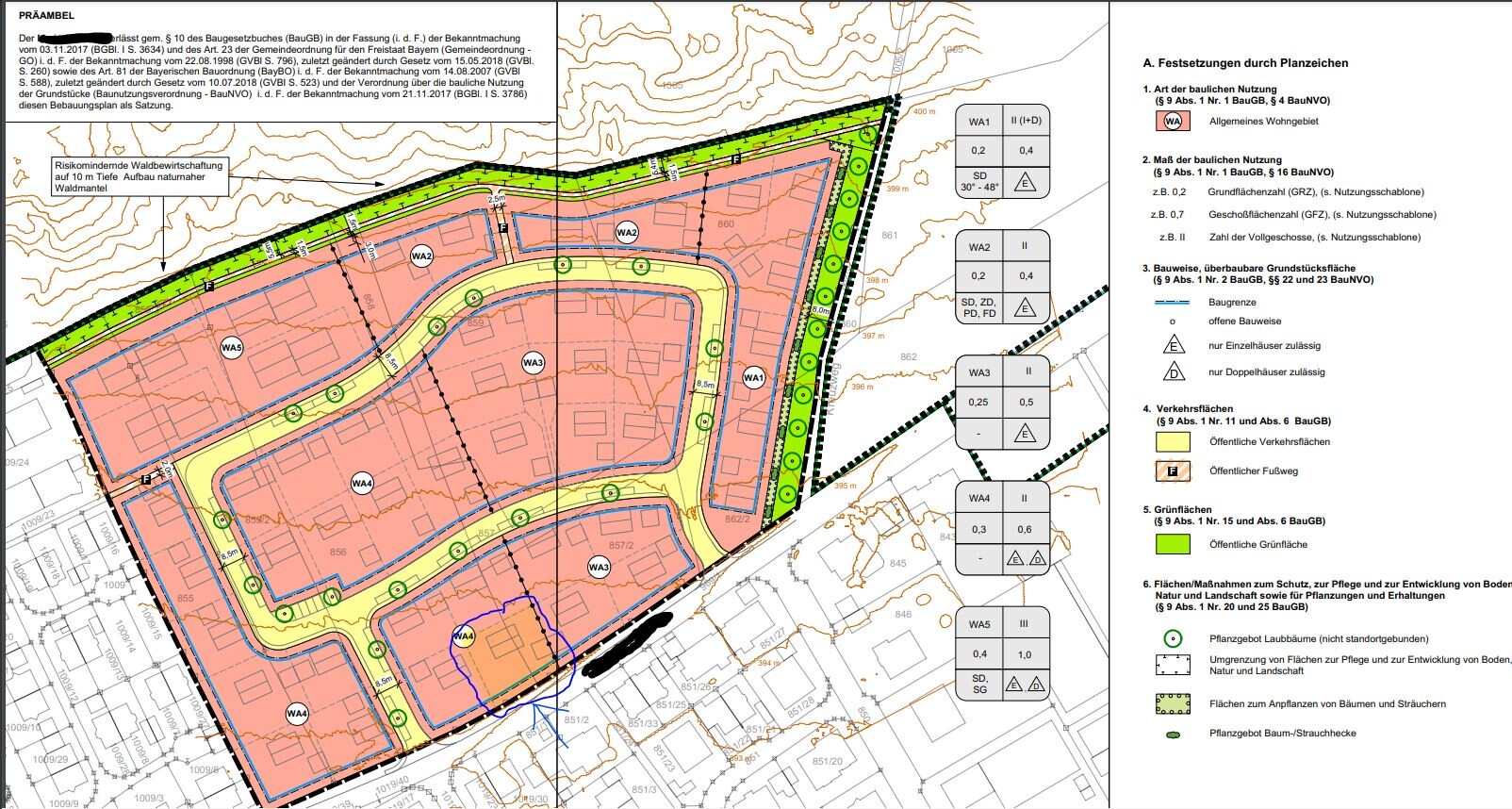
- Development plan
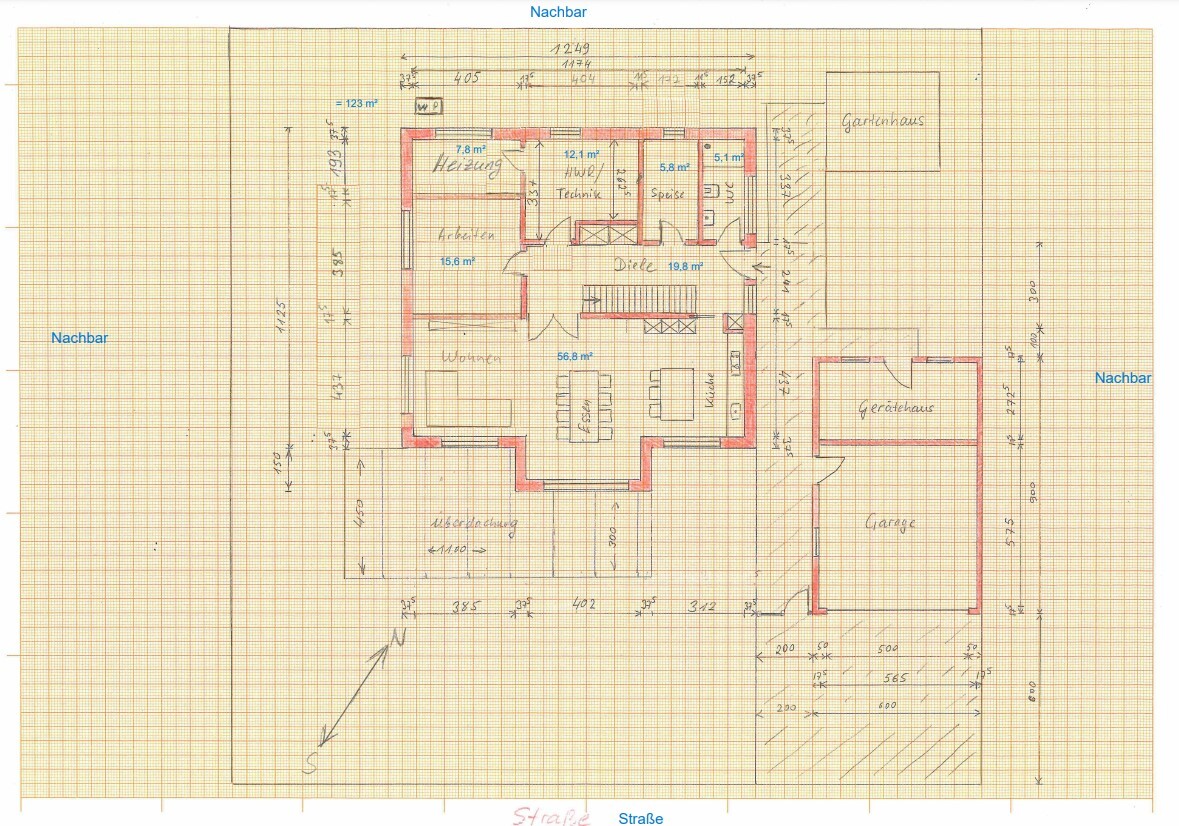
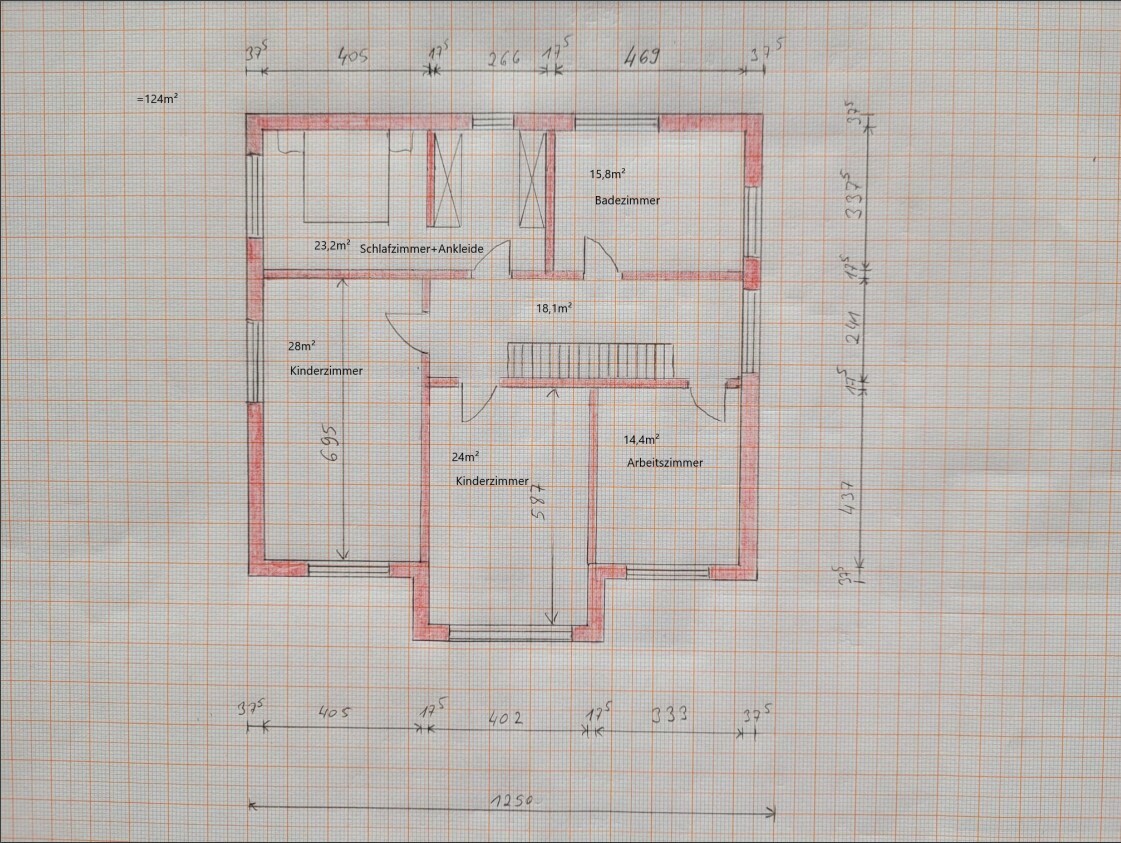
- Floor plan
We are a young couple planning to build a single-family home for ourselves and our future children. We have summarized our building project in the following table. We are looking forward to your feedback and opinions on our floor plan. We are very curious to hear your suggestions for improvements! 🙂
| Development Plan/Restrictions | |
| Plot size | 708m² (7619 ft²) |
| Slope | Flat plot |
| Site coverage ratio | 0.3 |
| Floor area ratio | 0.6 |
| Building envelope, building line and boundary | Open construction style |
| Edge building | Allowed for garages (9 meters (30 ft)) |
| Number of parking spaces | 2 in the garage (double garage); 2 in front of the garage |
| Number of storeys | 2 full storeys |
| Roof type | SD; WD |
| Architectural style | |
| Orientation | See floor plan |
| Maximum height/limits | 8m (26 ft) |
| Additional requirements | |
| Client Requirements | |
| Style, roof shape, building type | Urban villa |
| Basement, storeys | 2 full storeys; no basement |
| Number of people, ages | Family of 2 persons (young couple planning to have 2 children) |
| Room requirements on ground and upper floors | Ground floor: kitchen; dining room; living room; pantry; technical room with utility area; hobby room/guest room Upper floor: master bedroom with walk-in closet; child 1; child 2; office (home office); bathroom |
| Office: family use or home office? | Home office |
| Number of overnight guests per year | 1 |
| Open or closed architecture | Closed |
| Conservative or modern construction | Modern |
| Open kitchen, cooking island | Yes; yes |
| Number of dining seats | 8 fixed seats; should be extendable up to 16 people as we often host many guests (almost every month) |
| Fireplace | No |
| Music/stereo wall | No |
| Balcony, roof terrace | No |
| Garage, carport | Double garage |
| Utility garden, greenhouse | No |
| Additional wishes/special features/daily routine | - Living room: acoustically decouple it from the dining area and kitchen, but without installing a full interior wall. - Double doors between living/dining area: unsure whether it should be double double-doors, a door with fixed panel, or a sliding door; the doors are mainly for sound insulation to the upper floor in the evening when we are on the ground floor and the children are already asleep. The doors will remain open during the day; they should be clear glass (style: loft door). - Sliding door to the kitchen: planned to reduce walking distance to the pantry/restroom and from the entrance to the kitchen for groceries. - Bathroom on the upper floor: still undecided about the exact positions of doors and windows; as there will be no separate children’s bathroom, it should include a bathtub, shower, washbasin, toilet, and bidet. |
| House Design | |
| Who designed the plan: | Do-it-yourself: self-designed; floor plan resembles the parents’ house with some changes. |
| What do you particularly like? Why? | Rooms are large enough to potentially accommodate a third child; the ground floor can be fully used at an advanced age (age-appropriate); large floor-to-ceiling windows provide excellent natural light; island as workspace and storage. |
| What do you dislike? Why? | The living room is very open; this might be disturbing when someone is cooking in the kitchen. |
| Price estimate according to architect/planner: | Not available yet |
| Personal price limit for the house, including fittings: | 550,000 |
| Preferred heating technology: | Preferred: ground source heat pump (brine-water) + photovoltaics + central ventilation system; for cost reasons probably air-source heat pump + photovoltaics + central ventilation system |
| If you have to give up something, which features/extensions | |
| - can you live without: | Bathtub (planned mainly for the children) |
| - cannot do without: | |
| Why is the design as it is now? For example | We did extensive online research regarding the floor plan; the parents’ house was built 3 years ago and the floor plan was adapted to our wishes. The layout is similar and I (the husband) have lived in the parents’ house for one year. |
| What do you think makes it particularly good or bad? | The house should be practical in general (short walking distances, not too extravagant in design, smartly planned, etc.) and suitable for various changing life situations (currently we are just two, plan 2-3 children, and want to live in the house into old age). The house should be simple, low-maintenance (not many shelves that collect dust, not lots of decoration), and visually appealing. Our typical daily routine: on weekdays we both usually come home in the evening due to work, then we shower, cook and eat together. Afterwards, we usually watch TV. On weekends we often meet with friends and family, with 12-14 people or more gathering. So far, we are two and plan for two children. My wife often works from home (2-3 days a week), while I usually commute. We both have a university education and want to stay connected to our professional lives. That is why the house should be practical and low-maintenance, so we can focus on activities we enjoy during our free time. |
Attached are the:
- Development plan
- Floor plan
First of all, I want to commend you for using simple yet effective tools like digital programs combined with pencil and millimeter paper to design your house. This approach gives you a much better sense of the house and the plot because you develop a stronger feel for the measurements.
The question is: what exactly should the €55,000 (about $60,000) cover? You mention “smart,” and the double garage is already drawn in and seems to be a fixed idea. Should the existing €550,000 (about $600,000) cover everything, including the garage, possibly exterior landscaping, and additional construction costs, or is it meant for the house only?
@Harakiri already suggests that for €550,000 only for the house, you won’t get 240 sqm (about 2,583 sq ft). You would have to aim for about 180 sqm (about 1,938 sq ft) if you estimate roughly €3,000 (about $3,300) per sqm of living space.
Looking at the upper floor, you designed the ground floor so that your wishes are quite generous and without bottlenecks, and the upper floor followed from that. The bedrooms (including the children’s rooms) are oversized. One bedroom is nearly 7 meters (about 23 feet) long, which is larger than a living room in an average family home. This is excessive and not budget-friendly.
You will need to set priorities and reduce the size.
You mention that a similar house was built about three years ago. I assume it was significantly smaller?
You can see from the upper floor that “simply enlarging” is not straightforward because the ground and upper floors are highly interdependent.
One option is to drastically reduce the size of the upper floor. However, this may result in flat roofs or additional roofs on the ground floor, which also come at a cost.
The question is: what exactly should the €55,000 (about $60,000) cover? You mention “smart,” and the double garage is already drawn in and seems to be a fixed idea. Should the existing €550,000 (about $600,000) cover everything, including the garage, possibly exterior landscaping, and additional construction costs, or is it meant for the house only?
@Harakiri already suggests that for €550,000 only for the house, you won’t get 240 sqm (about 2,583 sq ft). You would have to aim for about 180 sqm (about 1,938 sq ft) if you estimate roughly €3,000 (about $3,300) per sqm of living space.
Looking at the upper floor, you designed the ground floor so that your wishes are quite generous and without bottlenecks, and the upper floor followed from that. The bedrooms (including the children’s rooms) are oversized. One bedroom is nearly 7 meters (about 23 feet) long, which is larger than a living room in an average family home. This is excessive and not budget-friendly.
You will need to set priorities and reduce the size.
You mention that a similar house was built about three years ago. I assume it was significantly smaller?
You can see from the upper floor that “simply enlarging” is not straightforward because the ground and upper floors are highly interdependent.
One option is to drastically reduce the size of the upper floor. However, this may result in flat roofs or additional roofs on the ground floor, which also come at a cost.
Haus Luni schrieb:
The house should basically be practical (short walking distances, not too extravagantly designed, smartly planned, etc.) and adaptable to many different life situations (currently we are just two, but we plan to have 2–3 children and want to live in the house even in old age). The house should be simple, low-maintenance (not many surfaces that collect dust, not much decoration) and visually appealing. Haus Luni schrieb:
For this reason, the house should be practical and easy to maintain, so we can focus on the things we enjoy in our free time. Because the house is quite large and spacious, the walking distances naturally become long.
A study of over 15sqm (160 sq ft) is, of course, well suited as a bedroom in old age – an empty floor with huge rooms is not. Also, a daily or nightly walk of 8 linear meters (26 ft) to the toilet and a shower bathroom of 5sqm (54 sq ft) is not age-appropriate.
Generally, it is recommended to plan for the next 20 years to cover the main focus of your life.
For further planning, I recommend moving the office upstairs and adjusting the room sizes. A small utility room could also fit upstairs, which would allow the technical room on the ground floor to be reduced.
And an 8-meter (26 ft) long hallway is basically not very practical for everyday life, simply because it is too long.

X
xMisterDx12 Nov 2023 16:23Uh, yeah. You don’t really need a pantry.
A utility room and a technical room totaling 20m² (215 sq ft) is completely over the top. Just there on the ground floor, you could easily save 12–15m² (130–160 sq ft).
Two home offices? Are those really necessary? Guests can sleep on the couch. Keeping an extra room free for just two or three times a year is a waste of money.
In contrast, the open living area with 56m² (600 sq ft) seems almost small. We have 57m² (613 sq ft) for living room and kitchen in our 152m² (1636 sq ft) home, but we don’t have a huge hallway like that or 20m² (215 sq ft) dedicated to heating and “technical” space.
And when you’re older, you can forget about it anyway. If one or both of you have walking difficulties, maintaining a 240m² (2583 sq ft) house and a 700m² (7535 sq ft) plot will no longer be feasible, and you’ll have to move. That’s just how it is.
A utility room and a technical room totaling 20m² (215 sq ft) is completely over the top. Just there on the ground floor, you could easily save 12–15m² (130–160 sq ft).
Two home offices? Are those really necessary? Guests can sleep on the couch. Keeping an extra room free for just two or three times a year is a waste of money.
In contrast, the open living area with 56m² (600 sq ft) seems almost small. We have 57m² (613 sq ft) for living room and kitchen in our 152m² (1636 sq ft) home, but we don’t have a huge hallway like that or 20m² (215 sq ft) dedicated to heating and “technical” space.
And when you’re older, you can forget about it anyway. If one or both of you have walking difficulties, maintaining a 240m² (2583 sq ft) house and a 700m² (7535 sq ft) plot will no longer be feasible, and you’ll have to move. That’s just how it is.
Similar topics