
Hello everyone,
We bought a two-family house from 1936 in June. More about the financing can be found in this thread. We are still very happy that we bought it. Our baby is due in December, and once our second child needs their own bedroom, the apartment will become too small. We have also visited the property quite often since then and are very pleased with the location. Everything from daycare to high school is within walking distance, along with plenty of sports clubs, and more.
Since the purchase, quite a bit has happened. Our financing was based on equity and a bank loan for the purchase alone. For the renovation, we planned to use capital from the sale of another property. The sale has now been completed and brought in slightly more than our optimistic estimate (365,000€ vs. 350,000€ optimistic expectation vs. 300,000€ minimum expectation). I have to say that selling caused me more headaches than buying the new house—even though it involved significantly less money. Especially the news about falling prices everywhere unsettled us and made us worry that the buyer might pull out. We did have multiple offers, including two in the same range, but the second highest bidder reacted quite badly to being rejected. That would have meant relisting, which, due to the increased costs of living since the agreement and the age of the house, probably would have led to a lower sale price. Once the notarized contract was signed, we were able to breathe a sigh of relief.
Now the work begins. We already have an architect who we have been consulting with over the past two years while looking at houses. She has so far done all the appointments and planning free of charge and invested a lot of time. We have already met on-site with a heating engineer, electrician, and flooring specialist. All have praised the structural condition and potential of the house so far, which is very reassuring.
Here is a picture of the current exterior from the garden side:
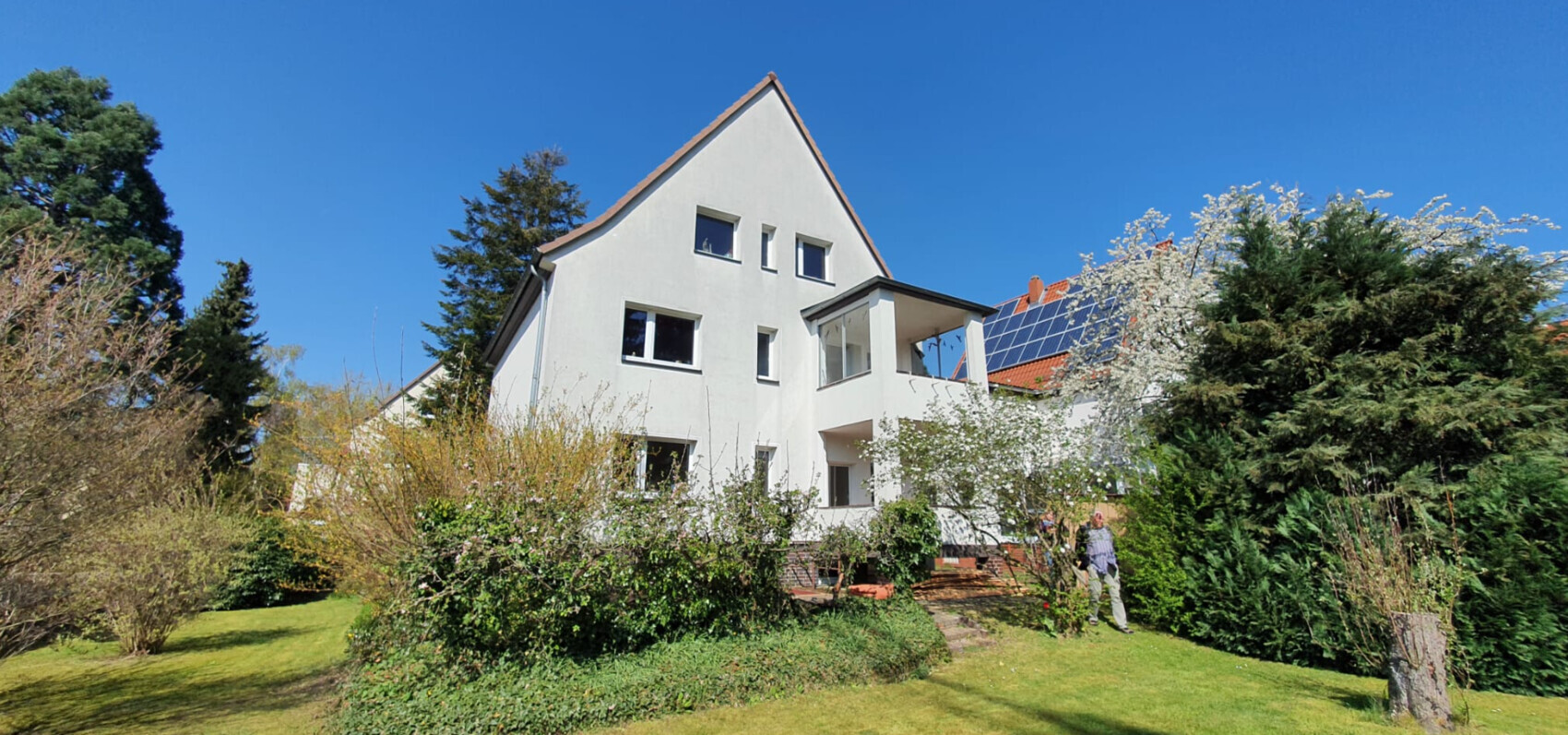
The house was insulated on the outside with 8cm (3 inches) of external thermal insulation composite system (ETICS) in 1996—but unfortunately, no major energy upgrades have been made since then. According to the energy certificate, the current demand is about 220 kWh/m²/a, which for 187 m² (2,013 sq ft) of living space would mean around 41,000 kWh per year. According to gas bills, however, the consumption in 2020 (the last year it was occupied) was only around 22,000 kWh for two households living there separately. That is still a lot, and of course, we want to modernize it. During the recent heatwave, it was actually cooler in the two full floors than in our already quite cool old apartment, which I see as a good sign. The house itself has cavity solid walls.
This means the following for us:
- Insulation of the top-floor ceiling: The attic has a huge footprint and covers roughly 80% of the developed attic space. Therefore, we decided to insulate the attic floor at first, which is more cost-effective than insulating the entire roof, since we won’t need that space anytime soon.
- Insulation of the basement ceiling
- Elimination of some thermal bridges
- Completely new windows and exterior doors throughout the house
Before buying, the architect said that should reduce the demand to around 150 kWh/m²/a or less, and further optimizations might no longer be cost-effective. Since then, energy costs have changed quite a bit… so we’ll see if we address anything else (would you, for example, recommend adding cavity insulation between the two masonry layers as well? Or would that not work well with the ETICS?). What’s your realistic assessment? I would obviously like to reduce it further, but I would prefer to avoid completely rebuilding the roof.
In addition:
- Replace pipes and wiring throughout the whole house
- New radiators
- Heat pump, if it makes sense / if the house can be heated properly with one
- If heat pump: photovoltaic system (the left side of the roof in the picture faces directly south)
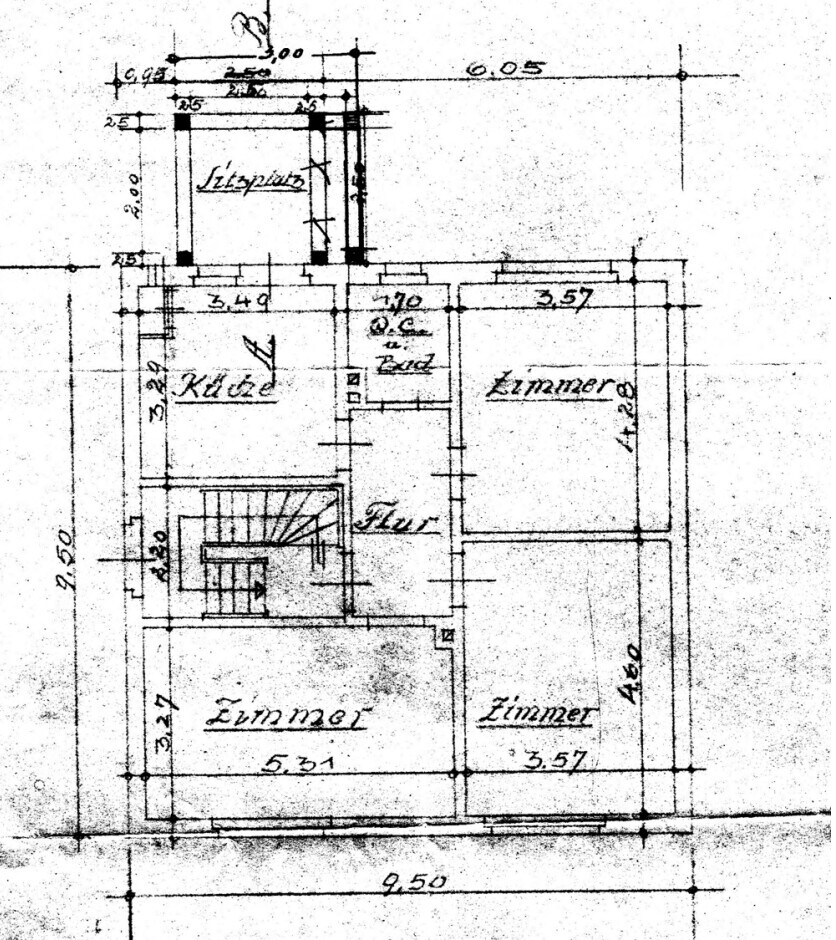
That’s the energy-related part. Several other works are planned as well. This is the current floor plan—the ground floor and first floor are almost identical, but both floors have a nice passage between the two right-side rooms with a sliding door that needs to be preserved:
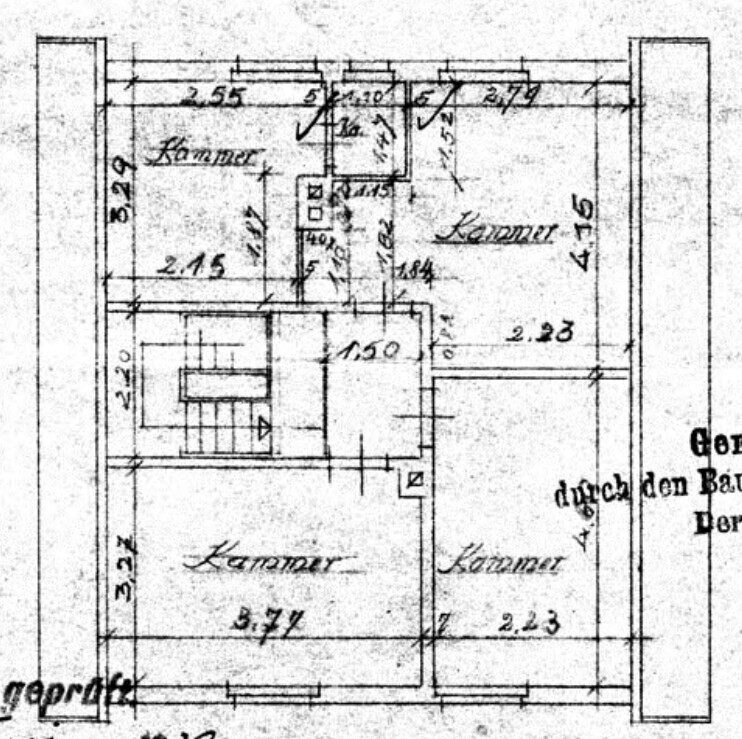
And the attic floor plan:
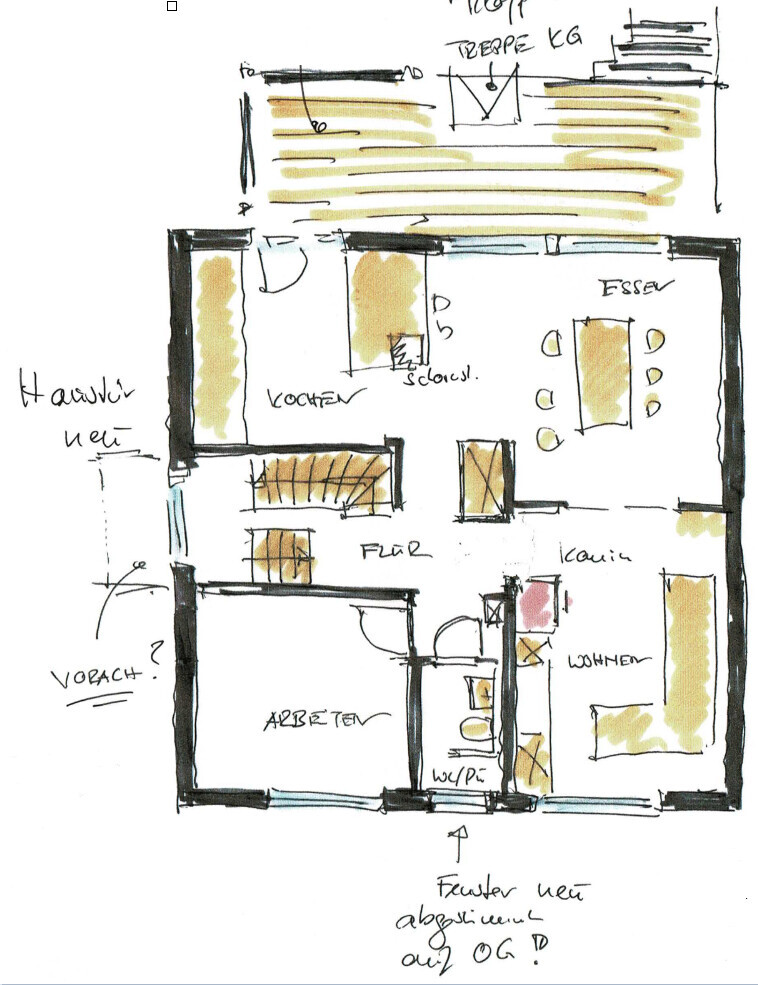
The rough plan is as follows:
Ground Floor:
First Floor:
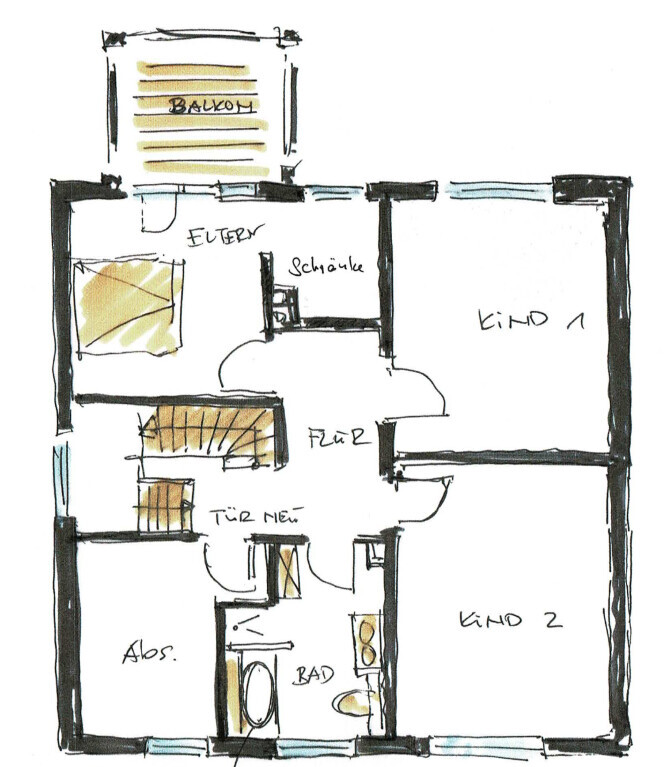
Since both bathrooms need renewing anyway (photos from inside will follow later), we are moving them to the front, facing the street. This will free up space downstairs to open up the kitchen/dining area and allow a slightly larger bathroom upstairs than currently exists. Right now, we live with a 3 m² (32 sq ft) bathroom—it works for three people but is definitely not very comfortable 😀
I work almost 100% from home, so the office is on the ground floor. The attic layout will remain as is. It will include my partner’s craft/workroom, a guest room, and we have one extra room that is still undecided 🙂. The nice thing is that due to the steep roof, we even have higher ceilings on the attic floor (>2.60 m / 8.5 ft) than on the ground and first floors (2.55 m / 8.4 ft), with very little sloping (photos to follow).
Throughout the house, there are old wooden floorboards hidden under several layers of flooring. Fortunately, none are glued down but simply laid loose, so we already looked underneath with the flooring specialist and found the condition to be good. These floors will be restored rather than replaced! This is also a reason why we don’t want to install underfloor heating—the floorboards are too thick, probably fragile for removal, and underfloor heating would cause a chain reaction: the doors (which we also just want to restore/paint), the frames, and so on, would no longer fit. However, underfloor heating will probably be installed in the bathroom upstairs. The indoor staircase is another beautiful old wooden staircase that was hidden under carpet and will also only be restored as needed.
The architect’s first cost estimate is around 270,000€ for all measures (excluding photovoltaics). The three tradespeople who have been on site have more or less confirmed her rough calculation. Statics engineer and window fitter will visit next week—we’re excited 🙂
Current concerns:
- Can we achieve an energy level that makes a heat pump reasonably economical (we do have a lot of roof space for photovoltaics)?
- Is the rest of the cost estimate realistic?
- What surprises might still be waiting for us?
- When will it be completed? Target is early summer next year...
We look forward to your feedback!
We bought a two-family house from 1936 in June. More about the financing can be found in this thread. We are still very happy that we bought it. Our baby is due in December, and once our second child needs their own bedroom, the apartment will become too small. We have also visited the property quite often since then and are very pleased with the location. Everything from daycare to high school is within walking distance, along with plenty of sports clubs, and more.
Since the purchase, quite a bit has happened. Our financing was based on equity and a bank loan for the purchase alone. For the renovation, we planned to use capital from the sale of another property. The sale has now been completed and brought in slightly more than our optimistic estimate (365,000€ vs. 350,000€ optimistic expectation vs. 300,000€ minimum expectation). I have to say that selling caused me more headaches than buying the new house—even though it involved significantly less money. Especially the news about falling prices everywhere unsettled us and made us worry that the buyer might pull out. We did have multiple offers, including two in the same range, but the second highest bidder reacted quite badly to being rejected. That would have meant relisting, which, due to the increased costs of living since the agreement and the age of the house, probably would have led to a lower sale price. Once the notarized contract was signed, we were able to breathe a sigh of relief.
Now the work begins. We already have an architect who we have been consulting with over the past two years while looking at houses. She has so far done all the appointments and planning free of charge and invested a lot of time. We have already met on-site with a heating engineer, electrician, and flooring specialist. All have praised the structural condition and potential of the house so far, which is very reassuring.
Here is a picture of the current exterior from the garden side:
The house was insulated on the outside with 8cm (3 inches) of external thermal insulation composite system (ETICS) in 1996—but unfortunately, no major energy upgrades have been made since then. According to the energy certificate, the current demand is about 220 kWh/m²/a, which for 187 m² (2,013 sq ft) of living space would mean around 41,000 kWh per year. According to gas bills, however, the consumption in 2020 (the last year it was occupied) was only around 22,000 kWh for two households living there separately. That is still a lot, and of course, we want to modernize it. During the recent heatwave, it was actually cooler in the two full floors than in our already quite cool old apartment, which I see as a good sign. The house itself has cavity solid walls.
This means the following for us:
- Insulation of the top-floor ceiling: The attic has a huge footprint and covers roughly 80% of the developed attic space. Therefore, we decided to insulate the attic floor at first, which is more cost-effective than insulating the entire roof, since we won’t need that space anytime soon.
- Insulation of the basement ceiling
- Elimination of some thermal bridges
- Completely new windows and exterior doors throughout the house
Before buying, the architect said that should reduce the demand to around 150 kWh/m²/a or less, and further optimizations might no longer be cost-effective. Since then, energy costs have changed quite a bit… so we’ll see if we address anything else (would you, for example, recommend adding cavity insulation between the two masonry layers as well? Or would that not work well with the ETICS?). What’s your realistic assessment? I would obviously like to reduce it further, but I would prefer to avoid completely rebuilding the roof.
In addition:
- Replace pipes and wiring throughout the whole house
- New radiators
- Heat pump, if it makes sense / if the house can be heated properly with one
- If heat pump: photovoltaic system (the left side of the roof in the picture faces directly south)
That’s the energy-related part. Several other works are planned as well. This is the current floor plan—the ground floor and first floor are almost identical, but both floors have a nice passage between the two right-side rooms with a sliding door that needs to be preserved:
And the attic floor plan:
The rough plan is as follows:
Ground Floor:
First Floor:
Since both bathrooms need renewing anyway (photos from inside will follow later), we are moving them to the front, facing the street. This will free up space downstairs to open up the kitchen/dining area and allow a slightly larger bathroom upstairs than currently exists. Right now, we live with a 3 m² (32 sq ft) bathroom—it works for three people but is definitely not very comfortable 😀
I work almost 100% from home, so the office is on the ground floor. The attic layout will remain as is. It will include my partner’s craft/workroom, a guest room, and we have one extra room that is still undecided 🙂. The nice thing is that due to the steep roof, we even have higher ceilings on the attic floor (>2.60 m / 8.5 ft) than on the ground and first floors (2.55 m / 8.4 ft), with very little sloping (photos to follow).
Throughout the house, there are old wooden floorboards hidden under several layers of flooring. Fortunately, none are glued down but simply laid loose, so we already looked underneath with the flooring specialist and found the condition to be good. These floors will be restored rather than replaced! This is also a reason why we don’t want to install underfloor heating—the floorboards are too thick, probably fragile for removal, and underfloor heating would cause a chain reaction: the doors (which we also just want to restore/paint), the frames, and so on, would no longer fit. However, underfloor heating will probably be installed in the bathroom upstairs. The indoor staircase is another beautiful old wooden staircase that was hidden under carpet and will also only be restored as needed.
The architect’s first cost estimate is around 270,000€ for all measures (excluding photovoltaics). The three tradespeople who have been on site have more or less confirmed her rough calculation. Statics engineer and window fitter will visit next week—we’re excited 🙂
Current concerns:
- Can we achieve an energy level that makes a heat pump reasonably economical (we do have a lot of roof space for photovoltaics)?
- Is the rest of the cost estimate realistic?
- What surprises might still be waiting for us?
- When will it be completed? Target is early summer next year...
We look forward to your feedback!
Here is an update.
First, as planned, the drywall contractor was here and built our new bathrooms, or rather their walls.
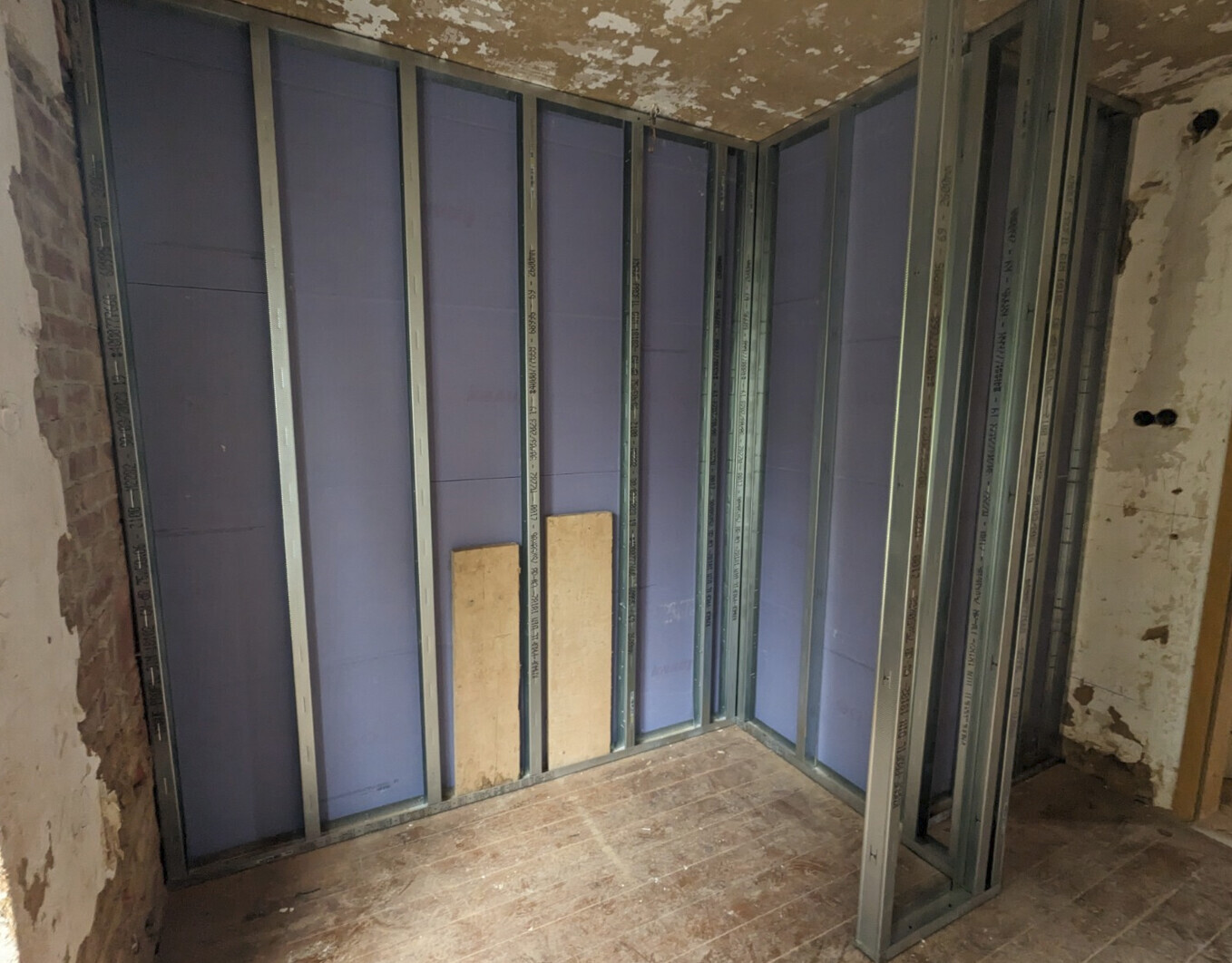
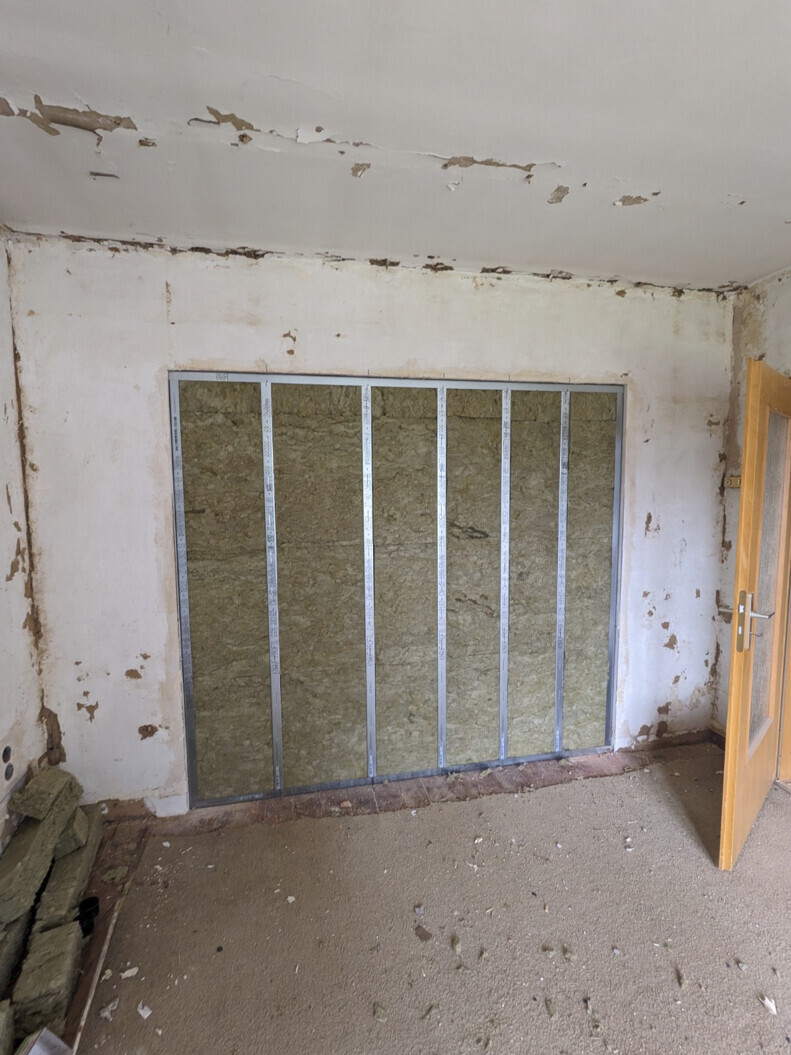
The wall between the children’s rooms is now also in place:
The basement is mostly insulated now – sorry for the poor picture quality. There’s a cozy ceiling height of about 183–185 cm (72–73 inches). But it’s only intended for storage. In one room, we still have 2 m (79 inches) clearance.
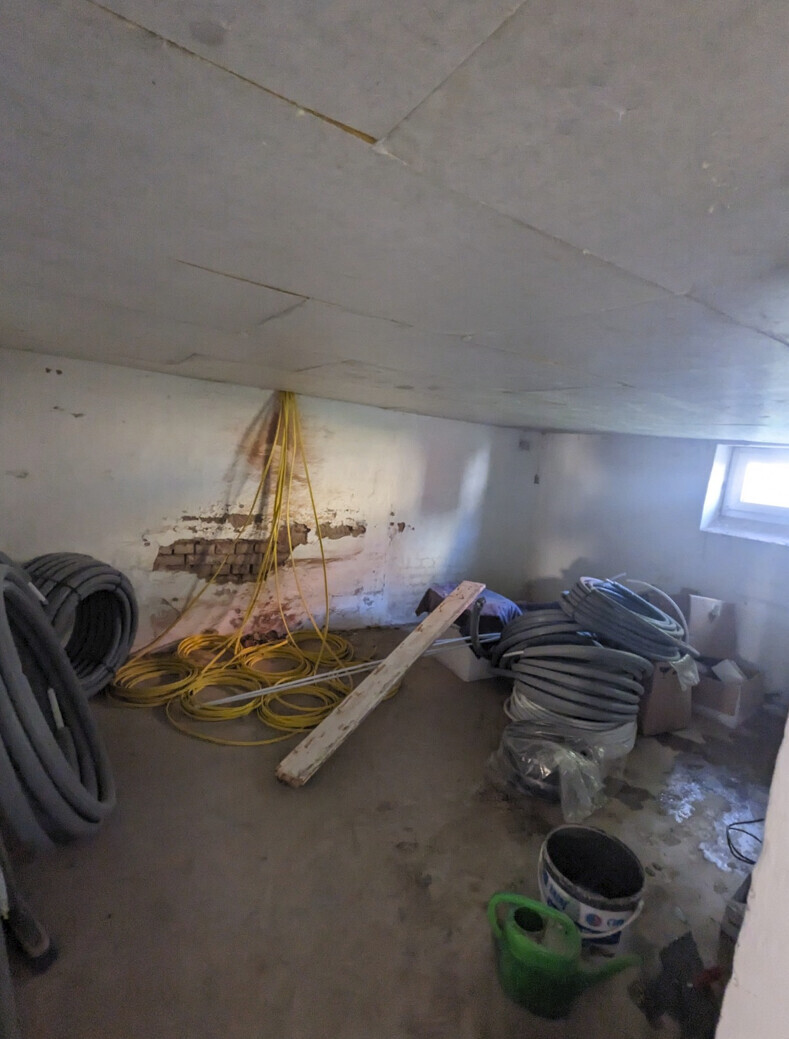
Then the heating engineer came and installed almost all the pipes (only one pipe was placed incorrectly. The architect had him remove the wastewater pipe again through my study; I’m not sure if we would have requested that) as well as the connections for the radiators.
The latter are now about 50% more expensive than in the initial quote due to larger dimensions and additional radiators – good thing we set the subsidy amount higher than the original offer.
The electrician has reached the ground floor and is waiting for our decision regarding the kitchen. We have two options:
First, a U-shape:
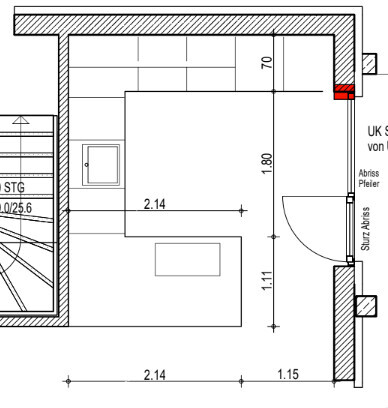
This allows for very efficient work paths but feels less like our style (we can still reverse the door swing, although it opens 180 degrees) and has two dead corners.
Alternatively, this layout with longer walking distances (which we currently have even longer in our rental apartment – the distance between cooktop and sink is greater – and it doesn’t bother us much, plus it creates more space if the kids are in the kitchen). We would move the property line here to the sink side; currently, it’s only next to the tall cabinet on the left side because we once considered raising it and putting the oven above. The passage at the bottom of the plan is 75 cm (30 inches).

What do you think? The kitchen will be custom-built by the carpenter.
Also: The window installer has fitted the patio door. I don’t have a photo of that yet but will add one later. It looks great!
First, as planned, the drywall contractor was here and built our new bathrooms, or rather their walls.
The wall between the children’s rooms is now also in place:
The basement is mostly insulated now – sorry for the poor picture quality. There’s a cozy ceiling height of about 183–185 cm (72–73 inches). But it’s only intended for storage. In one room, we still have 2 m (79 inches) clearance.
Then the heating engineer came and installed almost all the pipes (only one pipe was placed incorrectly. The architect had him remove the wastewater pipe again through my study; I’m not sure if we would have requested that) as well as the connections for the radiators.
The latter are now about 50% more expensive than in the initial quote due to larger dimensions and additional radiators – good thing we set the subsidy amount higher than the original offer.
The electrician has reached the ground floor and is waiting for our decision regarding the kitchen. We have two options:
First, a U-shape:
This allows for very efficient work paths but feels less like our style (we can still reverse the door swing, although it opens 180 degrees) and has two dead corners.
Alternatively, this layout with longer walking distances (which we currently have even longer in our rental apartment – the distance between cooktop and sink is greater – and it doesn’t bother us much, plus it creates more space if the kids are in the kitchen). We would move the property line here to the sink side; currently, it’s only next to the tall cabinet on the left side because we once considered raising it and putting the oven above. The passage at the bottom of the plan is 75 cm (30 inches).
What do you think? The kitchen will be custom-built by the carpenter.
Also: The window installer has fitted the patio door. I don’t have a photo of that yet but will add one later. It looks great!
Although the response has been rather limited, it’s time for another update 🙂
A lot has happened since May.
- We have a stylish new roof with photovoltaic panels. It was originally planned for July but ended up being done in October.
- The heat pump has arrived – the outdoor unit is still in the neighbor’s garage because the scaffolding is still up. That should be removed next week, as
- The painter has been working for some time now. He is basically doing everything: completely new interior plaster, painting, repairing around the new windows, painting the exterior facade, and working on the floor including baseboards.
Overall, it already looks really good, but progress is just slow… many small details are missing that you tend to underestimate as a layperson. Moving in is planned for January…
Unfortunately, we are now about 30% over budget… but we are largely responsible for that ourselves. For example, the budget originally didn’t include photovoltaic panels (12 kWp, about 20k before subsidies), a completely new roof (additional costs around 25k), and a larger terrace (extra cost 5k). Then there was a surprise with the structural engineering (15,000€ additional costs during shell construction), which no one can be blamed for since the floor plans were simply wrong regarding the exterior walls and the cavity wall construction was only discovered when opening up the walls.
The architect estimated many trades well, but for the painter she was completely off… we are over 200% above budget here (around 30k), and this is something I hold against her. With her experience, she should have known that the estimated budget was insufficient to fix the mess left by the electrician and plumber. Only 2,000€ were allocated for interior plaster repairs and 12,000€ for painting. Similarly, for drywall work for cladding new pipes, steel beams, etc., we are at four times the estimated 3,000€.
She had clearly said that we should plan for 15% cost overruns, but we had assumed this would cover surprises like the structural issue. Luckily, there have been no others…
Overall, this doesn’t put us in financial trouble since we fortunately have enough reserves, but it does affect the mood.
Otherwise, the architect continues to do a good job. She is on site several times a week, manages the construction well, and is reachable and active even at difficult times. Compared to what we have heard from friends and acquaintances about their architects, we think we made a good choice.
Photos will follow once the scaffolding is removed next week 🙂
A lot has happened since May.
- We have a stylish new roof with photovoltaic panels. It was originally planned for July but ended up being done in October.
- The heat pump has arrived – the outdoor unit is still in the neighbor’s garage because the scaffolding is still up. That should be removed next week, as
- The painter has been working for some time now. He is basically doing everything: completely new interior plaster, painting, repairing around the new windows, painting the exterior facade, and working on the floor including baseboards.
Overall, it already looks really good, but progress is just slow… many small details are missing that you tend to underestimate as a layperson. Moving in is planned for January…
Unfortunately, we are now about 30% over budget… but we are largely responsible for that ourselves. For example, the budget originally didn’t include photovoltaic panels (12 kWp, about 20k before subsidies), a completely new roof (additional costs around 25k), and a larger terrace (extra cost 5k). Then there was a surprise with the structural engineering (15,000€ additional costs during shell construction), which no one can be blamed for since the floor plans were simply wrong regarding the exterior walls and the cavity wall construction was only discovered when opening up the walls.
The architect estimated many trades well, but for the painter she was completely off… we are over 200% above budget here (around 30k), and this is something I hold against her. With her experience, she should have known that the estimated budget was insufficient to fix the mess left by the electrician and plumber. Only 2,000€ were allocated for interior plaster repairs and 12,000€ for painting. Similarly, for drywall work for cladding new pipes, steel beams, etc., we are at four times the estimated 3,000€.
She had clearly said that we should plan for 15% cost overruns, but we had assumed this would cover surprises like the structural issue. Luckily, there have been no others…
Overall, this doesn’t put us in financial trouble since we fortunately have enough reserves, but it does affect the mood.
Otherwise, the architect continues to do a good job. She is on site several times a week, manages the construction well, and is reachable and active even at difficult times. Compared to what we have heard from friends and acquaintances about their architects, we think we made a good choice.
Photos will follow once the scaffolding is removed next week 🙂
K
Kiefernadel4 Nov 2023 11:50Hello Leschaf,
Thank you for your updates. I always enjoy reading them and find your progress very interesting.
Thank you for your updates. I always enjoy reading them and find your progress very interesting.

leschaf schrieb:
There was a surprise regarding the structural engineering (additional costs of 15,000€ (about $16,000) during the shell construction) that no one can be blamed for, since the floor plans were simply wrong regarding the exterior walls and only when opening the walls was the double-layered masonry discovered. This is somewhat complicated, but can definitely be clarified in advance.
leschaf schrieb:
The architect estimated many trades quite well, but completely missed the painter... here we are simply over 200% above the estimate (or about 30,000€ (about $32,000)) and that is something I hold against her. With her experience, she really should have known that the budget was not sufficient to fix the damage caused by the electrician and plumber. Only 2,000€ (about $2,100) was allocated for interior plaster repairs and 12,000€ (about $13,000) for painting. The same goes for drywall work for cladding new pipes, steel beams, etc.—we ended up at four times the estimated 3,000€ (about $3,200). This smells like the typical underestimation by architects who are not specialized in working with existing buildings. What exactly does "damage caused by the electrician and plumber" mean: were they unskilled laborers working by piecework and/or was the planning insufficiently detailed here? I would have deducted costs of fixing that damage from their invoices. These are called overruns or extra work charges.
https://www.instagram.com/11antgmxde/
https://www.linkedin.com/company/bauen-jetzt/
11ant schrieb:
This is a bit complex, but definitely something that can be clarified in advance.
This sounds like the typical underestimation from architects who are not specialized in historic buildings. What exactly does "mess from the electrician and plumber" mean: were these piecework laborers, and/or was the planning poorly detailed here? — I would have deducted the cost of cleaning up from their invoices. This is called site supervision work. You are probably right about the first point.
Regarding the mess: so far we are quite satisfied with the electrician. The heating engineer was so-so; he did some thoughtless work in one or two places. But my main issue was that due to the vibrations when chiseling out the walls, a lot of the clay-based undercoat simply fell off or became loose and had to be removed. We paid over 100 hours on an hourly basis for repairs and preparation of the topcoat. The architect is actually very experienced with older buildings, which is why we hired her. We were also able to visit several of her renovation projects beforehand, and both she and the respective clients were very open. But I just don’t understand how you can so badly underestimate the painting work. To meet the budget, we basically would have had to just fill the grooves and then paint 😀
leschaf schrieb:
But my point was more that a lot of the clay base plaster simply fell off or became loose and had to be removed due to the vibrations caused by chiseling the walls. We paid over 100 hours of labor for repairs and preparation before applying the topcoat plaster. The architect actually has a lot of experience with old buildings, which is why we hired her. We were also able to visit several of her renovation projects beforehand, and both she and the respective clients were very open. But I just don’t understand how the painting work could be so underestimated. Unfortunately, I interpret the outcome as casting doubts on her experience with older buildings. That’s what I meant when I said I wouldn’t recommend hiring architects who specialize only in new construction for renovations: they tend to wrongly assume that planning stage 1 is no longer necessary for existing buildings – but that’s not true, it just looks different in this context. Also, planning stages 5 through 7 are extremely important in terms of budget control even here.
https://www.instagram.com/11antgmxde/
https://www.linkedin.com/company/bauen-jetzt/
Similar topics